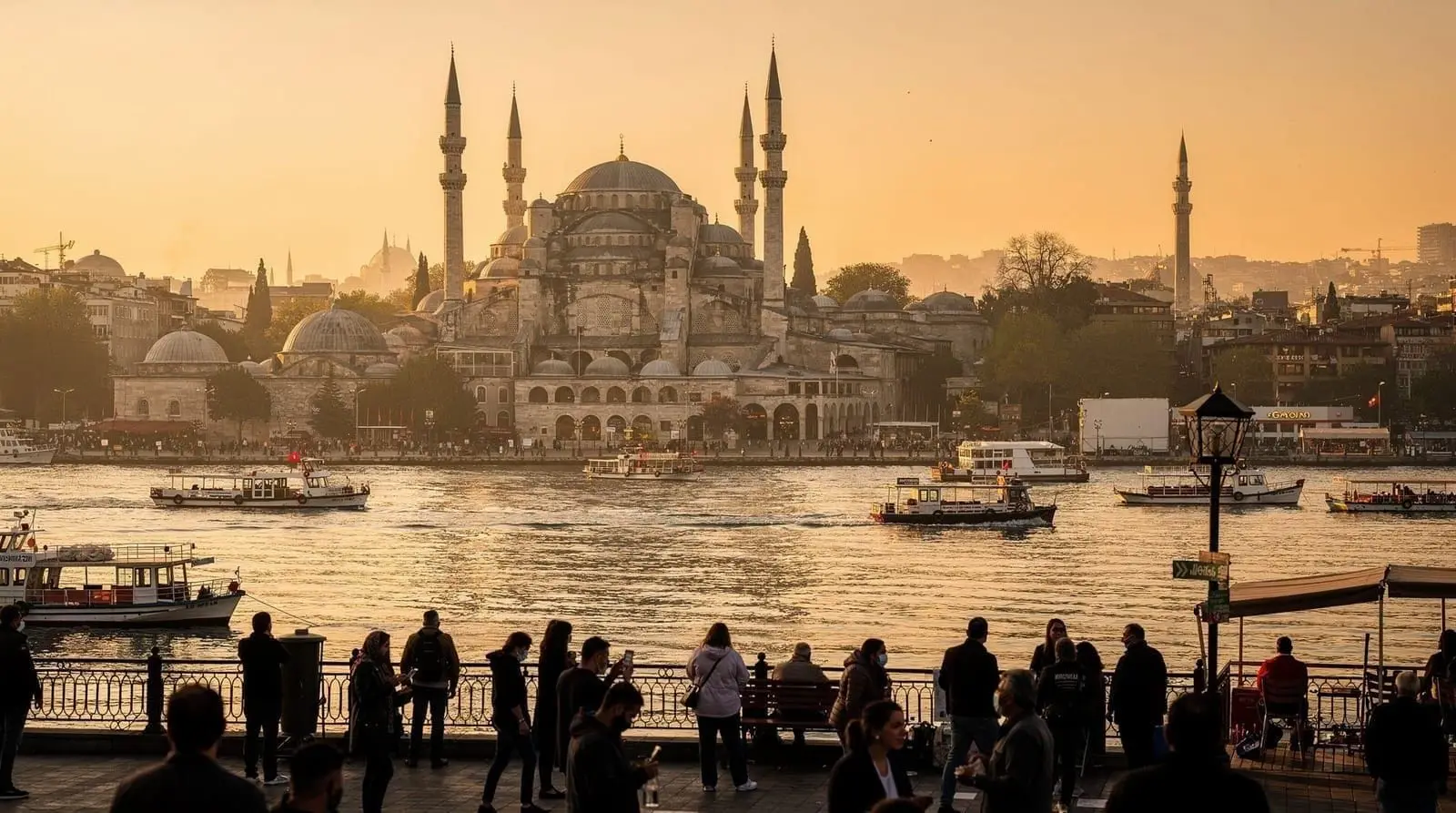
Istanbul travel guide
Plan your Istanbul trip with honest logistics, ticket tips, and curated tours — from Sultanahmet to the Bosphorus and beyond.
Full-Day Walking Tour of Istanbul's Old City
Duration: 5 hours
Quick facts
- Best for
- History, food, culture, Bosphorus views
- Time needed
- 4–7 days minimum
- Currency
- Turkish Lira (TRY) — check current rates
- Airport
- IST (main) or SAW (low-cost, Asian side)
- Best time
- April–May and September–October
What kind of city Istanbul actually is
Istanbul sits on two continents, spans 15 million people, and has been a capital three times over — Byzantine, then Roman/Byzantine again under the name Constantinople, then Ottoman. That layering shows everywhere: a Roman cistern beneath a tram stop, an Ottoman mosque whose foundation stones are Byzantine, a neighborhood where Greek Orthodox churches and Ottoman hans stand fifty meters apart.
Tourists often arrive expecting a city that can be done in two days. It can’t. The Sultanahmet district alone — Hagia Sophia, the Blue Mosque, Topkapı Palace, the Basilica Cistern, the Grand Bazaar — absorbs three full days if you’re doing it properly. Add the Bosphorus, Beyoğlu, and an afternoon on the Asian side, and you’re at a week without trying.
This guide covers the city end-to-end: how to move around, what things actually cost (in TRY with USD/EUR equivalents, priced as of mid-2026), which attractions are worth paying for, and where the tourist traps are.
| Where | Straddling Europe and Asia across the Bosphorus |
| Time needed | 4–7 days minimum; 7–10 days with day trips |
| Airport | IST (European side) or SAW (Asian side, low-cost) |
| Currency | Turkish Lira (TRY) |
| Best time | April–May and September–October |
Getting to Istanbul and between airports
Istanbul has two international airports, and the difference matters.
Istanbul Airport (IST) — on the European side, northwest of the city center. This is the main hub used by Turkish Airlines and most flag carriers. From IST to Sultanahmet:
- Metro M11 to Gayrettepe, then M2 to Vezneciler/Kapalıçarşı (roughly 60–80 minutes depending on connections, standard metro fare with Istanbulkart)
- HAVAIST bus H-1 to Taksim (90–120 minutes in traffic, ~120 TRY)
- Taxi — 45–70 minutes without traffic, 500–800 TRY; insist the meter runs, or use BiTaksi or Uber instead
Sabiha Gökçen Airport (SAW) — on the Asian side. Used mainly by low-cost carriers (Pegasus, etc.). It is 50+ km from Sultanahmet. Getting across:
- HAVABUS to Kadıköy, then ferry to Eminönü (2 hours total, 150–200 TRY)
- Metro M4 to Ayrılık Çeşmesi, then Marmaray to Sirkeci (~2.5 hours)
- Taxi or private transfer — 700–1,200 TRY; traffic on the bridge adds 30–60 minutes at peak hours
If you have a connecting domestic flight (e.g., to Cappadocia), check which airport your departure is from — IST and SAW are on opposite sides of the Bosphorus and switching between them takes 90–120 minutes minimum.
Getting around the city
Istanbulkart is the rechargeable smart card that covers every form of public transit: tram, metro, bus, ferry, funiculaire, and the Marmaray tunnel. Buy it at any major transport hub (airport, Eminönü, Taksim) for 100 TRY, load credit, and use it everywhere. Each ride is capped at roughly 25–30 TRY per segment. Transferring within 90 minutes costs less.
Key lines for tourists:
- Tram T1 (Kabataş ↔ Bağcılar): the tourist backbone — stops at Sultanahmet, Grand Bazaar (Kapalıçarşı), Eminönü, Kabataş
- Metro M2 (Yenikapı ↔ Hacıosman): connects to Taksim, useful for Beyoğlu
- Marmaray: the Bosphorus tunnel connecting European and Asian sides — fast and cheap
- Ferries from Eminönü and Karaköy to Kadıköy, Üsküdar, and the Princes’ Islands
Taxis exist but driver behavior varies. Always check the meter is running. BiTaksi and Uber (which summons official taxis) are safer options. Agree on a price before getting in if hailing.
The Sultanahmet district: where to start
Sultanahmet is the old city core, sitting on the First Hill — the site of ancient Byzantium and the heart of the Ottoman capital. Every major historical monument is within walking distance of Sultanahmet Square:
- Hagia Sophia — 1,500-year-old basilica, re-opened as a mosque in 2020; UNESCO World Heritage Site
- Blue Mosque — Sultan Ahmed I’s 17th-century mosque, the one with six minarets; free entry but closed during prayer times
- Topkapı Palace — the Ottoman imperial court for 400 years; the Harem section requires a separate ticket
- Basilica Cistern — underground 6th-century Roman reservoir; atmospheric, worth the ticket
- Grand Bazaar — 4,000-shop covered market; entertaining even if you don’t buy anything
- Hippodrome — the Byzantine racing track, now a park; the Obelisk of Theodosius and Serpent Column are free to view
- Süleymaniye Mosque — Sinan’s 1557 masterpiece on the Third Hill; excellent view, fewer crowds than the Blue Mosque
A realistic day in Sultanahmet: arrive before 9am to beat the Hagia Sophia queue, visit the Basilica Cistern mid-morning, eat a simit from a street cart, walk to the Blue Mosque after prayer time, then end at the Grand Bazaar before closing at 7pm.
What things cost in Istanbul
Prices below are estimates. Turkey has experienced significant inflation; always check current TRY/USD or TRY/EUR rates before travel. The rates here assume approximately 33–35 TRY per USD.
Entry tickets: prices and rules are set by each venue and the Ministry of Culture and Tourism and change, so check the current price on the official site before going.
- Hagia Sophia: check the current entry rules and price on the official site of the Ministry of Culture and Tourism
- Topkapı Palace: check the current price on the official site; the Harem is a separate timed ticket
- Basilica Cistern: check the current price on the official site
- Galata Tower: check the current price on the official site
- Dolmabahçe Palace: check the current price on the official site
Food:
- Simit (sesame bread ring): 10–15 TRY (~0.30–0.45 USD)
- Balık ekmek (fish sandwich at Eminönü): 80–120 TRY (~2.50–3.50 USD)
- Sit-down meal at a lokanta: 250–450 TRY per person (~7–13 USD)
- Mid-range restaurant dinner: 500–900 TRY per person (~15–26 USD)
- çay (tea): 30–60 TRY in a café (~1–2 USD)
Transport:
- Istanbulkart metro/tram ride: about 46 TRY (full fare, October 2026)
- Ferry to Kadıköy: fare shown on the Istanbulkart reader (current tariff on sehirhatlari.istanbul)
- Airport bus (HAVAIST): ~120 TRY
The Istanbul Museum Pass covers 12 attractions and pays off if you plan to visit at least 4–5 paid sites. A Tourist Pass covers 120+ attractions including some skip-the-line access; useful for a week-long visit.
The Bosphorus and the Asian side
The Bosphorus is what makes Istanbul unique: a 31-km strait dividing Europe from Asia, lined with Ottoman mansions, yalıs (waterside wooden villas), military fortresses, and two suspension bridges. Taking a boat on the strait is one of the cheapest panoramic experiences in any major city — the public ferry from Eminönü up the Bosphorus to Anadolu Kavağı takes roughly 90 minutes and costs about 60–80 TRY each way with Istanbulkart.
If you prefer a shorter cruise, 2-hour sightseeing boats depart from Eminönü and Karaköy multiple times daily.
The Asian side is accessible in 20 minutes by ferry from Eminönü to Kadıköy or Üsküdar. Kadıköy has good food markets, the Çiya Sofrası restaurant (widely regarded as one of Istanbul’s best traditional kitchens), and a lively nightlife strip. Üsküdar is quieter, with Ottoman mosques and a view of the Maiden’s Tower.
Beyoğlu, Galata, and Karaköy
Cross the Galata Bridge from Eminönü and you’re in Karaköy, the entry point to the modern city north of the Golden Horn. Walk uphill or take the 19th-century funiculaire to Galata Tower, then continue north along İstiklal Caddesi through Beyoğlu toward Taksim Square.
İstiklal Caddesi is a 1.4-km pedestrian street lined with 19th-century European-style buildings, bookshops, cafés, music venues, and tourist shops. The street is permanently crowded; if you want to understand the neighborhood’s character, duck into the side streets (Asmalımescit, Çukurcuma, Cihangir) where local restaurants and wine bars cluster.
Galata Tower offers the best 360-degree view of the old city, the Golden Horn, and the Bosphorus — but the viewing platform gets crowded; arrive early morning for the best experience.
Balat, Fener, and the Golden Horn
Balat and Fener are among Istanbul’s oldest neighborhoods, on the European bank of the Golden Horn. They were historically the Jewish and Greek Orthodox quarters; today they’re a mixture of original residents, artists, and tourists. The streets of pastel-painted houses are photogenic and largely intact. The Patriarchate of Constantinople (Fener) and the Church of Pammakaristos (Fethiye Mosque) are key historical stops.
These neighborhoods are best visited on foot, a 30–40 minute tram-and-walk journey from Sultanahmet. Chora / Kariye — the Byzantine church with the finest surviving Byzantine mosaics — is a 15-minute walk from Balat.
Day trips and extensions: what’s honest
Operators market several destinations as “day trips from Istanbul.” Some of them are genuinely feasible; others require overnight stays to be worthwhile.
Genuine day trips (return in the same day):
- Princes’ Islands — 1–2 hours by ferry from Eminönü; car-free, scenic
- Bursa — 2.5 hours by fast ferry and bus; first Ottoman capital, green spaces, silk bazaar
- Edirne — 2.5 hours by bus; the Selimiye Mosque by Sinan, Ottoman wrestling
- Gallipoli and Troy — long but doable as a 1-day guided tour from Istanbul (5 hours each way)
Extensions that require a flight and overnight:
- Cappadocia — 1.5-hour flight to Nevşehir (NAV) or Kayseri (ASR); the hot-air balloon over Göreme starts at dawn; impossible to do meaningfully in one day
- Ephesus — 1-hour flight to İzmir (ADB) then 1 hour to Selçuk; a serious site requiring 3–4 hours on the ground
- Pamukkale — 3 hours from İzmir by road; best combined with Ephesus over 2 nights
“Day trip by plane to Cappadocia” tours exist on GYG and they’re genuinely exhausting — 4am departure, 10+ hours of travel. We recommend at least two nights in Göreme if you want to see the site properly and attempt a balloon flight.
Scams and honest warnings
Taxi fraud: The main risk for new arrivals. Drivers may take the bridge route unnecessarily, or offer a “fixed price” that’s double the metered fare. Use BiTaksi or Uber when possible. If hailing, confirm the meter is running before moving.
Mosque entrance “fees”: The Blue Mosque, Süleymaniye, and most other functioning mosques are free to enter. Anyone near the entrance asking for a “ticket” or “donation” before you enter is running a scam. Tickets (where required) are only purchased inside or via official GYG-style bookings.
Carpet and tea scam: A friendly local invites you for “free tea” in a shop. You end up in a carpet showroom facing high-pressure sales. The tea isn’t free if you leave without buying. Politely decline if you’re not interested before entering.
Bar/nightclub overcharging: Around İstiklal Caddesi, strangers may invite you to bars or clubs. The bill at the end is sometimes 10x what you’d expect. Stick to places you’ve found yourself or via reliable recommendations.
Fast-track tickets: Many sites now have skip-the-line options via GYG and the official ticketing portals. These are legitimate for busy periods (June–August, spring weekends). However, some third-party vendors at the gate sell “priority tickets” at inflated prices — buy digitally in advance instead.
When to go
April–May: Ideal — 15–22°C, tulip season in city parks (particularly Emirgan Park), manageable crowds, reasonable prices. This is peak season for Cappadocia balloon flights.
June–August: Hot and humid (28–35°C), peak tourists, peak prices, longest queues. Hagia Sophia can have 2-hour waits without advance tickets in July–August.
September–October: Second ideal window — still warm, post-summer price dip, crowds thinner after mid-September.
November–March: Off-season; cheaper, atmospheric (occasional snow on the domes), but short days and some rain. Cappadocia balloon flights become weather-dependent and less reliable.
Ramadan 2026 (approximately 19 February–19 March): Istanbul during Ramadan is worth experiencing — iftar street food, illuminated mosques, evening celebrations. But restaurant hours may be reduced during the day, and prayer times at the major mosques see larger crowds.
Where to base yourself: a quick comparison
| Neighborhood | Character | Best for | Downside |
|---|---|---|---|
| Sultanahmet | Historic core, walkable to major sites | First-timers, history-focused trips | Touristy, quieter nightlife |
| Beyoğlu | Nightlife, restaurants, galleries | Food and nightlife, repeat visitors | Further from Sultanahmet sites |
| Kadıköy | Local, Asian-side, food markets | Budget travelers, local feel | Ferry commute to old city sites |
| Beşiktaş | Bosphorus-front, upscale | Waterfront access, football culture | Less walkable to old city |
Our Sultanahmet vs Beyoğlu guide goes deeper on this trade-off if you’re deciding where to book.
Frequently asked questions about Istanbul travel
How many days do I need in Istanbul?
Four days covers the essentials: one day in Sultanahmet (Hagia Sophia, Blue Mosque, Topkapı, Basilica Cistern), one day for the Grand Bazaar, Beyoğlu and Galata, one day for the Bosphorus and Asian side, and one flex day for Balat/Fener or a Princes’ Islands ferry trip. Seven days allows a more relaxed pace and an overnight to Cappadocia.
Is Istanbul safe for solo travelers?
Generally yes, including for solo women, though standard city precautions apply. The tourist districts of Sultanahmet and Beyoğlu are busy and well-lit. The Taksim/İstiklal area has more pickpocket risk in evening crowds. The main hazards are the taxi and bar scams described above, not violent crime.
Do I need a visa to enter Turkey?
It depends on your passport. US and UK citizens were granted visa-free access (up to 90 days) recently, though conditions can change — verify at evisa.gov.tr before traveling. Many European nationalities also travel visa-free. Others need to apply for an e-Visa online (evisa.gov.tr) for approximately 50 USD; do not use third-party sites that charge more.
What currency does Turkey use?
The Turkish Lira (TRY). Cards are widely accepted in Istanbul’s tourist areas, but carry cash for markets, taxis, smaller restaurants, and tips. Tip roughly 10–15% in cash (in Lira) at sit-down restaurants. ATMs are common; use bank ATMs rather than standalone machines to avoid conversion-fee traps.
Is it expensive to visit Istanbul?
By Western European standards, no. Entry tickets add up if you visit multiple paid attractions in a day, but food, transport, and accommodation are significantly cheaper than comparable European cities. A mid-range day (3 attractions, 2 sit-down meals, Istanbulkart transport) costs roughly 1,500–2,500 TRY per person (~45–75 USD at mid-2026 rates).
Can I visit Istanbul during Ramadan?
Yes, and some travelers specifically prefer it for the evening atmosphere. Be prepared for daytime restaurant closures (especially outside tourist zones), longer queues at mosques on Fridays, and early prayer calls. Iftar (breaking the fast at sunset) involves large public meals and open-air markets that are worth experiencing.
What is the Istanbulkart and do I need one?
The Istanbulkart is a rechargeable smart card for all public transit: metro, tram, bus, ferry, and the Marmaray tunnel. You do need it — paying with cash on buses is not usually possible, and card prices are lower than token prices on other lines. Buy it at the airport kiosk when you arrive, load 200–300 TRY for a short stay.
Should I visit Hagia Sophia or the Blue Mosque first?
Hagia Sophia first, early in the morning before 9am if possible, to avoid the worst queues and heat. The Blue Mosque is free and closes to tourists during prayer times (check the schedule before you go), so plan around it. A single morning covers both if timed well. See our comparison guide for more detail.
Where should I stay in Istanbul?
For a first visit centred on history, Sultanahmet is the most walkable choice. For food and nightlife, Beyoğlu is better positioned. Budget travelers and those wanting a more local feel often prefer Kadıköy on the Asian side, accepting a ferry commute to the old city sites. See the comparison table above and the Sultanahmet vs Beyoğlu guide.
Top experiences
Bookable activities with verified prices and instant confirmation on GetYourGuide.


