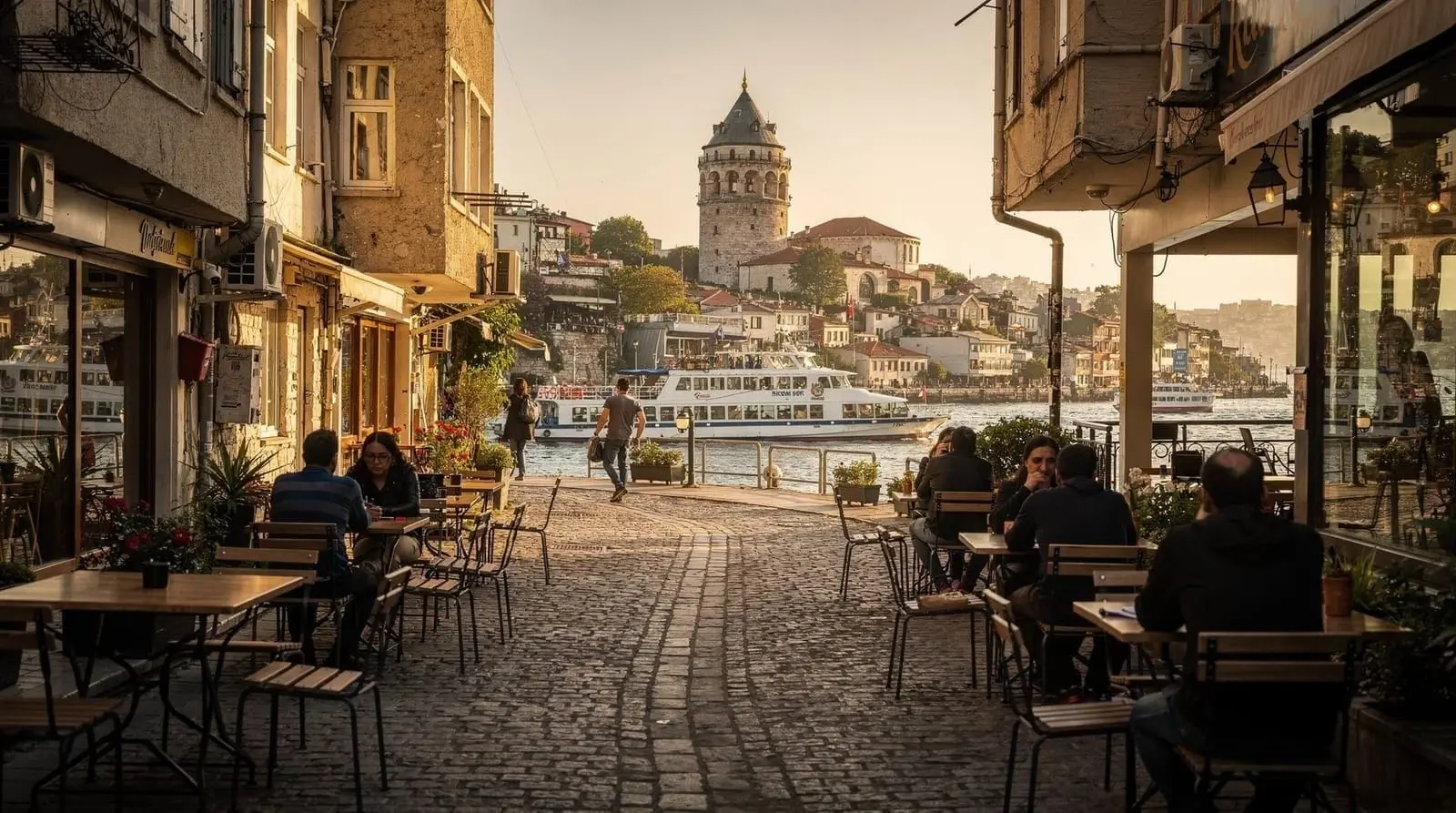
Karaköy
Istanbul's creative waterfront neighbourhood where the Bosphorus ferries dock — specialty coffee, baklava, art galleries, and the base of the Galata hill.
Istanbul: Galata Tower, Chora Church, and Balat Tour
Quick facts
- Location
- North shore of Golden Horn, European side
- Nearest tram
- Karaköy (T1) — end of line from Sultanahmet
- Ferry terminal
- Karaköy IDO terminal (Bosphorus ferries)
- Known for
- Karaköy Güllüoğlu baklava, specialty coffee, design galleries
- Walk to Galata Tower
- 8–10 min uphill
- Walk to Eminönü
- 12 min along the waterfront
Karaköy in context: the waterfront district that changed
| Where | Golden Horn waterfront, European side, base of Galata hill |
| Cost | Baklava piece ~15–20 TRY; espresso ~25–40 TRY; lunch ~300–400 TRY |
| Time needed | 2–3 hours standalone, or a full day with Galata Tower and Beyoğlu |
| Getting there | T1 tram terminus, or ferry from Kadıköy/Üsküdar |
| Best time | Weekday mornings for calm; weekend afternoons for full energy |
Karaköy was, through most of the 20th century, an unglamorous port quarter: customs warehouses, ship chandlers, a few cheap restaurants for dock workers. The T1 tram still terminates here at the old Karaköy pier, where ferries depart for Kadıköy, Üsküdar, the Princes’ Islands, and up the Bosphorus. What changed in the 2010s was a wave of gallery openings, specialty coffee shops, and small restaurants that quietly transformed the backstreets between the tram line and the base of the Galata hill into one of Istanbul’s more genuinely interesting neighbourhoods for an extended morning or afternoon. Our Karaköy neighbourhood guide has a fuller walking route if you want to plan a whole morning here.
The result is a place that manages to be both functional — it remains a working ferry port and transport hub — and unusually pleasant to be in. The mismatch between utilitarian waterfront architecture and the small-batch coffee roasters and design boutiques inside is part of the character.
What to eat and drink
Karaköy Güllüoğlu is the reference point. This baklava institution operates from a relatively modest shopfront on Rıhtım Caddesi; the queue at peak times extends down the street. The pistachio baklava (fıstıklı) costs approximately 15–20 TRY per piece (under 1 USD), is made fresh multiple times a day, and is widely regarded as among the best in the city. The café seating inside is minimal and communal. Arrive early or between mealtimes to avoid the longest waits.
Several specialty coffee shops have opened in the backstreets behind the waterfront. Unlike the international chains that dominate İstiklal Avenue in Beyoğlu, these are independent roasters with a genuine interest in single-origin Turkish-roasted coffee. Prices are reasonable by European standards: an espresso runs 25–40 TRY (under 1.50 USD).
For a proper lunch, Karaköy Lokantası on Kemankeş Caddesi is one of Istanbul’s better neighbourhood restaurants — Turkish home cooking in a restored space, fixed-price weekday lunch menus, reliable quality. A two-course lunch runs around 300–400 TRY (9–12 USD). Reservations helpful for dinner.
If you would rather have the neighbourhood’s food explained as you eat it, a walking food tour across the European and Asian sides is a relaxed way to taste your way through the waterfront without choosing every stop yourself.
The area around Kemankeş Caddesi and the side streets heading up toward the Galata hill has a concentration of small restaurants, wine bars, and meyhane-style venues. The density of genuinely local eating options here is higher than in Sultanahmet, where tourist pricing dominates.
Galleries and design spaces
Karaköy became a gallery district partly because rent was lower than in the historic city centre and partly because large warehouse spaces were available for conversion. Several remain active:
SALT Galata, housed in the old Ottoman Bank building on Bankalar Caddesi (the “Banks Street” one block back from the waterfront), is the most significant cultural institution in the neighbourhood. The building itself — an 1892 neoclassical structure by French architect Alexandre Vallaury — is worth entering regardless of the current exhibition. SALT runs research-driven contemporary art and architecture shows, and entry to the exhibitions is free. The building also houses a reading room open to the public.
Istanbul Modern relocated from Karaköy to a new waterfront building in 2023 (designed by Renzo Piano), a short walk west toward Tophane. This is Turkey’s major contemporary art museum; the permanent collection covers Turkish modern art from the late Ottoman period to the present. Entry runs approximately 150 TRY (4.50 USD).
The streets between Karaköy and the Galata hill also house a number of smaller design and craft galleries, many operating on irregular hours. Worth checking as you walk up toward Galata Tower.
Transport hub: ferries, trams, and connections
The Karaköy ferry terminal (IDO) is one of Istanbul’s main inter-continental transit points. Regular ferry routes operate to:
- Kadıköy (Asian shore): about 20 minutes, departures roughly every 15 minutes during peak hours. A standard Istanbulkart tap.
- Üsküdar (Asian shore): slightly shorter crossing, similar frequency.
- Princes’ Islands: seasonal longer ferry service, approximately 1.5–2 hours to Büyükada.
- Bosphorus ferry routes: some scenic tours and commuter ferries depart from here.
The T1 tram ends and begins at Karaköy, making this the natural interchange for travellers between Sultanahmet and the northern European districts. Tünel funicular station is a 10-minute uphill walk, connecting Karaköy to İstiklal Avenue without the cobbled climb.
The Galata Bridge and Eminönü connection
Karaköy is connected to Sultanahmet and the old city via the Galata Bridge, a double-deck crossing over the Golden Horn. The lower deck is lined with cheap fish restaurants — a well-known Istanbul experience, though the food is tourist-grade and the prices are pitched accordingly. Worth a walk across for the view; the fish restaurants are skippable unless you are specifically after the local colour rather than the local fish.
The upper deck has fishermen at all hours, which is a genuinely Istanbul scene. The 10-minute walk across the bridge to Eminönü lands you near the Spice Bazaar and the ferries to the Bosphorus and Asian shore.
Combining Karaköy with a broader itinerary
Karaköy works well as:
A morning base before heading up to Galata Tower — breakfast at a Karaköy café, baklava at Güllüoğlu, then the uphill walk to the tower for the 09:00 opening when queues are shortest.
An afternoon stop after the old city — T1 tram from Sultanahmet to Karaköy, SALT Galata for a gallery visit, waterfront walk, ferry to Kadıköy for the Asian side food scene.
A connector neighbourhood between the old city and Beyoğlu — walk from Eminönü across the Galata Bridge, spend an hour in Karaköy, then take the Tünel up to İstiklal.
The guided tour that covers Galata Tower, Chora Church, and Balat passes through the Galata neighbourhood and gives useful historical context to what you are looking at in these streets.
Frequently asked questions about Karaköy
Is Karaköy walkable from Sultanahmet?
Yes — the Galata Bridge connects the two districts; the walk takes about 15–20 minutes. Alternatively, the T1 tram does the journey in about 8 minutes.
Is Karaköy Güllüoğlu the best baklava in Istanbul?
It is one of the most consistently cited options, with a long history and a reputation for freshness. Güllüoğlu is a family business that opened this Karaköy branch in 1949. Whether it is “the best” depends on personal preference, but it is a genuine product at a fair price, not tourist packaging.
Are the galleries in Karaköy free?
SALT Galata has free admission for its exhibitions. Istanbul Modern charges an entry fee (approximately 150 TRY). Most of the smaller independent galleries are free to enter.
Can I walk from Karaköy to Galata Tower?
Yes, directly uphill on the main road or via the more atmospheric cobbled backstreets. The walk takes 8–10 minutes but involves a significant elevation gain — plan for it if you have mobility concerns.
What time do the ferries to Kadıköy run?
The IDO ferry service between Karaköy (Eminönü area) and Kadıköy runs approximately 06:00–23:30 with departures roughly every 15–20 minutes at peak times. Check the IDO or BUDO timetable for current schedules; they are reliable but vary seasonally.
Is Karaköy on the T1 tram line?
Yes — Karaköy is the terminus of the T1 tram coming from Sultanahmet, Eminönü, and the old city. The journey from Sultanahmet to Karaköy takes approximately 8–10 minutes. From Karaköy, the Tünel funicular connects uphill to İstiklal Avenue.
Can I park a car in Karaköy?
Street parking in Karaköy is extremely limited and the neighbourhood is not practically car-accessible for visitors. Public transport (T1 tram, ferries) is the appropriate approach.
What is Istanbul Modern?
Istanbul Modern (İstanbul Modern) is Turkey’s first and most prominent contemporary art museum, reopened in 2023 in a purpose-built waterfront building designed by the Renzo Piano Building Workshop. The permanent collection covers Turkish modern and contemporary art from the late Ottoman period to the present. Temporary exhibitions feature international and Turkish contemporary artists. The café has a direct Bosphorus view. Entry approximately 150 TRY; check for current programming at istanbulmodern.org.
Should I stay in Karaköy or nearby Beyoğlu?
Karaköy has very little tourist accommodation compared to Beyoğlu, which has the wider hotel selection and nightlife. Karaköy works best as a morning or afternoon stop rather than a base — see the comparison table above and the Sultanahmet vs Beyoğlu guide for where to actually book.
Karaköy vs Beyoğlu: which suits your morning?
| Karaköy | Beyoğlu | |
|---|---|---|
| Pace | Calmer, waterfront | Busier, pedestrian-street energy |
| Food | Baklava, specialty coffee, neighbourhood lokanta | Wider range, more tourist-oriented options |
| Galleries | SALT Galata, Istanbul Modern | Smaller commercial galleries along İstiklal |
| Nightlife | Minimal, quiets down early | Istanbul’s main nightlife strip |
| Best paired with | Galata Tower (short uphill walk) | Taksim, Cihangir |
Both are covered together in the Beyoğlu neighbourhood guide, and if you’re deciding where to actually stay for your trip, the Sultanahmet vs Beyoğlu guide weighs both against the old city.
Karaköy as a historical district: what the warehouses remember
The name Karaköy is probably derived from the Byzantine Greek Kara-köy or from an early Ottoman usage meaning “black village” — the etymology is disputed. What is clear is that this has been the main commercial port of the city since at least the Byzantine period. The Genoese colony at Galata, immediately north and uphill, used Karaköy as its primary loading and unloading point; the neighbourhood accumulated warehouses, chandleries, rope-walks, and the infrastructure of maritime commerce over several centuries.
The Galata Bridge connecting Karaköy to the old city across the Golden Horn has been in some form since at least the Byzantine period, though the current bridge dates from 1994 (replacing the old floating bridge, a section of which has been preserved as a pedestrian way nearby). The bridge’s lower deck — lined with fish restaurants — is a well-known Istanbul scene, though the restaurants themselves are tourist-grade and overpriced for the quality. Walk across for the view; eat on the shore rather than on the bridge.
The Perşembe Pazarı (Thursday Market) district, immediately west of the main Karaköy pier area, is an older commercial quarter that once specialised in marine hardware, tools, and industrial equipment. Several of these specialist shops survive. The Saturday and Wednesday street market that spills into this area is a mix of commercial goods aimed at local buyers — hardware, clothing, produce — without the tourist-facing packaging of the Grand Bazaar.
The Kamondo family and Karaköy’s Jewish heritage
The Kamondo family — Sephardic Jewish bankers who became one of the Ottoman Empire’s major financial dynasties in the 19th century — had their primary operations in Karaköy and the adjacent Bankalar Caddesi. The Kamondo Stairs (visible on the walk up from Karaköy toward the Galata Tower) were built by this family as a practical connection between street levels and as a gesture of civic improvement toward the neighbourhood they inhabited and served.
The Jewish community of Galata and Karaköy dated from the 1492 expulsion of Jews from Spain — they were invited to settle in the Ottoman Empire by Sultan Bayezid II. Karaköy was a Jewish quarter until the 20th century; the current resident Jewish population is very small, but several synagogues remain in the neighbourhood and are occasionally open to visitors.
Practical notes for walking the neighbourhood
The terrain of Karaköy divides into two distinct zones. The flat waterfront level (along Rıhtım Caddesi, the main road by the pier) has the ferry terminals, Istanbul Modern, the fish hall, and the main café strip. This is easy to navigate even in poor weather.
The section between the waterfront and the Galata Tower slopes upward steeply. The main road (Bankalar Caddesi) is manageable; the cobbled side streets are atmospheric but require sturdy footwear. The Kamondo Stairs at the base of the hill are a useful shortcut for those who can manage 20–30 steps.
Both zones are safe during the day and into the evening. The waterfront becomes quieter after 22:00 as the café scene winds down; the areas further from the waterfront quiet down even earlier. This is not a nightlife neighbourhood in the sense that Beyoğlu or Taksim are.
What to buy in Karaköy
The neighbourhood is not primarily a shopping destination, but a few categories of purchase make sense here:
Baklava and sweets: Karaköy Güllüoğlu is the primary option; smaller sweet shops in the side streets also sell lokum (Turkish delight), helva, and candied fruits at prices aimed at locals rather than tourists.
Books: the SALT Galata building has a bookshop specialising in art, architecture, and urban history publications — interesting for material on Istanbul specifically.
Design objects: several of the independent design boutiques that opened in the gentrification wave sell Istanbul-made ceramics, textiles, and accessories. Quality varies; the better shops have a clear provenance story for their products.
Coffee beans: the specialty roasters in the neighbourhood sell their beans at shop prices — a good souvenir that also has genuine utility.
Seasonal considerations
Karaköy functions well year-round, but the character shifts with season. Summer (June–August) brings the maximum tourist density and the highest temperatures; the waterfront is crowded from mid-morning. The ferry piers in particular are congested. If visiting in summer, the early-morning window (07:00–09:00) is when the neighbourhood operates at its actual pace — fishermen, market traders, commuters — before the tourist day begins.
Winter (November–March) is when the neighbourhood feels most like itself: quieter, with fewer visitors, the gallery programming at full intensity, and the pleasure of a hot çay at a waterfront café with mist on the Bosphorus behind you. Rain is common but rarely sustained for more than a few hours. The Galata Tower visit in winter light — particularly on a clear cold morning — is genuinely beautiful.
The food scene in more detail
The specialty coffee scene in Karaköy deserves some elaboration, because it represents a genuine departure from Istanbul’s traditional coffee culture. Turkey’s relationship with coffee is long and serious — the Ottoman coffeehouse (kahvehane) was a social institution from the 16th century, and Turkish coffee (preparation: finely ground, simmered in a small copper pot with sugar if requested, poured unfiltered into a small cup) remains a distinct preparation with its own ritual. The fortune-telling from the coffee grounds (tasseography, or fincan tası baksı in Turkish) is a genuine folk practice still common in social settings.
What happened in Karaköy in the 2010s was the arrival of the third-wave specialty coffee movement — single-origin beans, precision preparation methods, trained baristas — alongside the neighbourhood’s art and design scene. The two communities overlap. The result is a small but dense cluster of serious coffee operations within a few blocks of the Karaköy ferry pier, making this one of the better short areas in Istanbul for a coffee drinker who wants to explore Turkish coffee culture and its contemporary counterpart in the same hour.
Specific recommendation: visit one of the specialty roasters in the morning for a well-made espresso (25–40 TRY), then have a traditional Turkish coffee at one of the waterfront çay houses in the afternoon (10–20 TRY) — the contrast in preparation, intensity, and social context is instructive about how the same ingredient operates in different cultural registers.
Architecture walk: 15 minutes in Karaköy
A structured 15-minute walk that hits the neighbourhood’s architectural highlights:
- Start at the IDO ferry terminal on the waterfront: the terminal building itself is a mid-20th-century modernist structure, functional and well-maintained.
- Walk east along Rıhtım Caddesi (the waterfront road) toward the Galata Bridge: the Istanbul Modern is on your right (a 2023 building by Renzo Piano workshop, opened after the original location near this pier).
- Cross to Bankalar Caddesi (one block inland): the SALT Galata building (1892, Alexandre Vallaury) dominates the right side. The former Ottoman Bank interior is accessible through the gallery entrance.
- The Kamondo Stairs (Kamondo Merdivenleri): slightly uphill from Bankalar Caddesi, look for the curved double staircase on your left. This is a Cartier-Bresson photograph location and worth 5 minutes for its own sake.
- Continue uphill on any of the cobbled lanes toward the Galata Tower: the streets between Bankalar Caddesi and the tower are where the concentration of independent design studios, galleries, and specialty coffee shops is highest.
This walk takes 15–20 minutes at a slow pace, or can be extended into a 2-hour exploration with stops in galleries and coffee shops.
Top experiences
Bookable activities with verified prices and instant confirmation on GetYourGuide.
