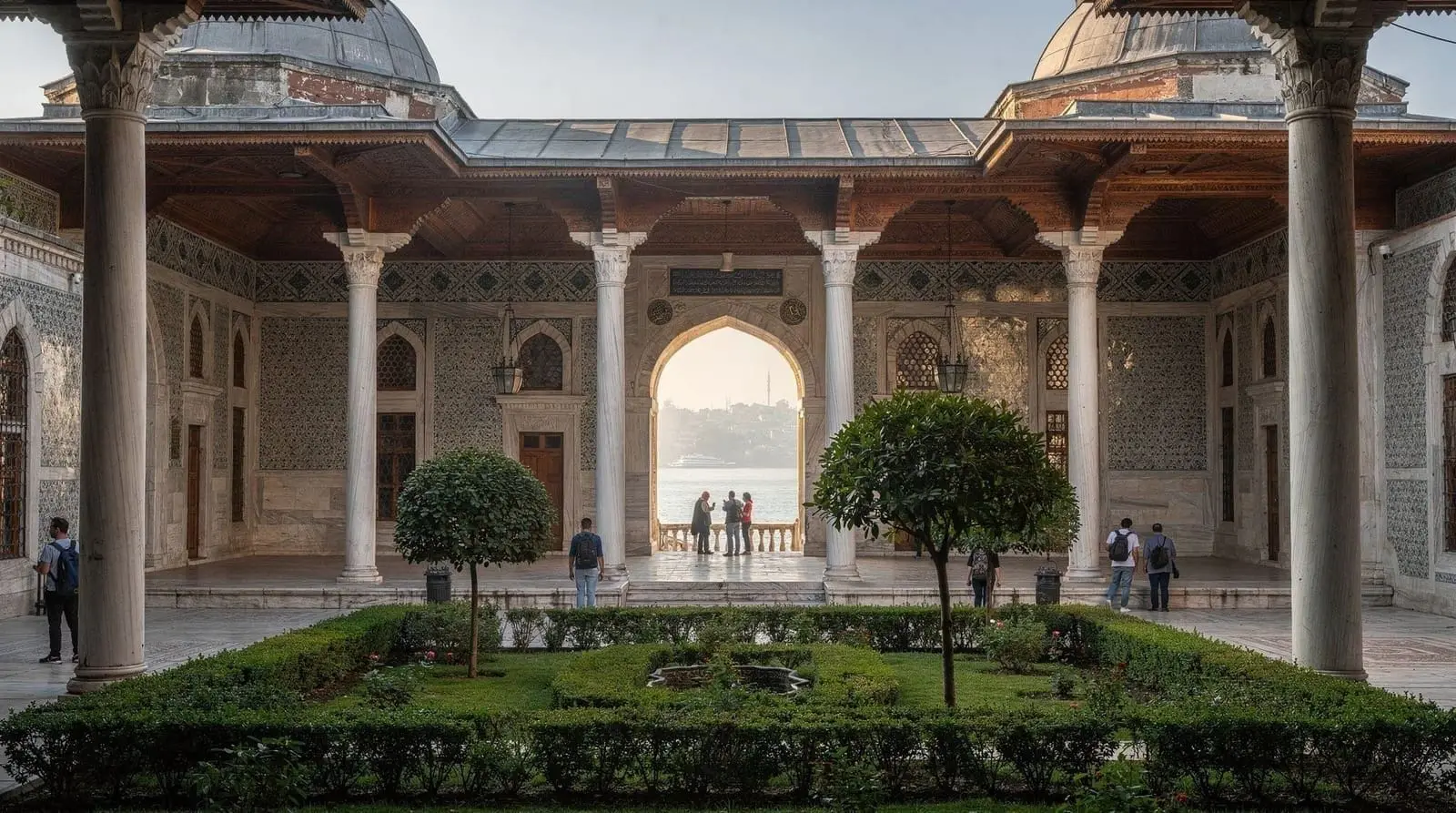
Topkapı Palace — visitor guide with Harem tips
Complete guide to Topkapı Palace in Istanbul — tickets, Harem access, what to see, how long it takes, and how to avoid the worst queues.
Istanbul: Topkapi Palace & Harem Skip-the-Line Access & Audio Guide
Quick facts
- Built
- 1460s–1850s (various sultans)
- Entry
- Check current prices on the official site; Harem is a separate timed ticket
- Time needed
- 3–4 hours (add 1 hour for Harem)
- Getting here
- Tram T1 to Gülhane stop or walk from Hagia Sophia
- Best time
- Weekday mornings before 10am
Four centuries of Ottoman rule in one complex
Topkapı Palace is not a single building. It’s a walled complex of courtyards, pavilions, audience halls, treasury rooms, gardens, mosques, and kitchens built across four centuries of Ottoman rule, from the 1460s to the mid-19th century. At its peak it housed up to 4,000 people — servants, administrators, the Sultan’s household, the Harem residents, and the Janissary guards.
| Where | Tip of the Sultanahmet peninsula, 300m from Hagia Sophia |
| Cost | Check current prices on the official site; Harem is a separate timed ticket |
| Time needed | 3–4 hours; add 1 hour for the Harem |
| Getting there | Tram T1 to Gülhane, 10-min walk uphill |
| Best time | Weekday mornings before 10am, booked in advance |
Sultan Mehmed II chose the promontory at the tip of the Sultanahmet peninsula for a reason: Topkapı sits at the confluence of the Golden Horn, the Bosphorus, and the Sea of Marmara, with views in every direction. For a sultan who had just conquered Constantinople in 1453, this was the most strategically and symbolically loaded site in the known world.
The palace served as the administrative heart of an empire that, at its height under Süleyman the Magnificent, stretched from Hungary to the Persian Gulf and from Algeria to the Caucasus. Today it’s one of the most visited museums in the world — and one that genuinely requires planning to see properly.
Layout and what to see
Topkapı is organized around four successive courtyards, each more restricted in access than the last during the Ottoman period.
First Courtyard (Court of the Janissaries): The entrance through Bâb-ı Hümâyûn (the Imperial Gate). The Hagia Eirene church (one of the oldest Byzantine churches in Constantinople, used as an armory by the Ottomans) is here — usually accessible only for special concerts. Free to enter this courtyard.
Second Courtyard (Court of the Divan): The Divan (imperial council chamber) is on the left — a relatively small room where the Grand Vizier and council met to govern the empire. The Sultan would observe through a latticed window without being seen. The Council Tower rises above it. The kitchens on the right house the Ottoman ceramic and porcelain collection. The Imperial Stables are at the far end.
Third Courtyard (Court of the Throne Room): The Throne Room at the entrance — small, intimate, not the grand hall that European palace visitors might expect. Audiences were brief and formal; the Sultan was almost never seen directly. The Library of Ahmed III (1719) is the best-preserved interior in this courtyard. Most importantly: the Treasury and the Pavilion of the Holy Mantle are here.
Fourth Courtyard: Gardens with Ottoman pavilions, including the Revan Kiosk and the Baghdad Kiosk (both 17th century), the Circumcision Room, and a terrace with exceptional views over the Bosphorus toward Asia.
The Treasury — what’s actually worth seeing
The Treasury occupies four rooms in the Third Courtyard. The queues can be long (15–30 minutes in peak season) but the room is genuinely exceptional.
Topkapı Dagger: Made in 1747 as a gift for the Persian Shah Nadir (the mission turned back when the Shah was assassinated before delivery). The handle has three enormous emeralds; the hilt conceals a small watch under a hinged emerald. The blade is inlaid with gold and enamel. It’s the most recognizable object in the collection and worth the queue.
Spoonmaker’s Diamond (Kaşıkçı Elması): An 86-carat pear-shaped diamond surrounded by two rows of smaller diamonds. Fifth largest in the world. The name comes from a legend about a poor man who found it and traded it to a spoonmaker for three wooden spoons — almost certainly apocryphal, but the name stuck.
Topkapı Throne: A jewel-encrusted throne used on special occasions; the gold and enamel work is extraordinary.
Holy Relics Pavilion (Pavilion of the Sacred Mantle): In the Third Courtyard, this holds items with direct religious significance in Islam: the cloak and sword of the Prophet Muhammad, the staff of Moses, the arm bone of John the Baptist, and the footprint of the Prophet. This section is sacred to Muslim visitors; non-Muslim visitors can also enter, but a respectful manner is expected. Recitations from the Quran play continuously.
The Harem
The Harem is the most misunderstood part of Topkapı. It wasn’t simply a seraglio for the Sultan’s pleasure — it was the private residential and administrative quarters of the entire imperial household, including the Valide Sultan (the Sultan’s mother, who wielded enormous political power), the Sultan’s wives and favorites, the princes, and the hundreds of servants and eunuchs who managed it all.
Access requires a separate timed ticket and is on a timed schedule. In peak season, book in advance or arrive at opening — slots fill quickly.
The Harem complex has more than 300 rooms, but only a portion are open to visitors. Key spaces include:
- The Courtyard of the Carriage Gate (entry)
- The Apartments of the Black Eunuchs, who managed Harem access
- The Apartments of the Valide Sultan — the largest and most elaborately decorated rooms
- The Imperial Hall — where the Sultan received Harem residents on formal occasions
- The Privy Chambers of Murad III (1578) and Ahmed III — extraordinarily detailed interiors with tile work, painted ceilings, and fountains
- The Twin Pavilions (Çifte Kasırlar) — residential rooms used by favorite concubines
A guided Harem visit or audio guide is strongly recommended — without context, the succession of rooms can blur together. The political and social dynamics of the Harem are as interesting as the architecture.
Tickets and booking
Main palace ticket: Prices are set by the museum and the Ministry of Culture and Tourism and change, so check the current price on the official site before going. Purchased at the Bâb-ı Hümâyûn gate or online.
Harem ticket: Priced separately; check the current price on the official site. Separate queue and timed entry.
Hagia Eirene: When accessible (usually for special exhibitions), priced separately.
In peak season (June–August), book both tickets online before arrival. The main palace and Harem together can generate a 60–90 minute combined wait if you’re buying at the gate on a July or August morning.
The Istanbul Museum Pass covers main palace entry but not the Harem — you’ll need to buy the Harem ticket separately even with a pass.
How long to allow
- Main palace only (no Harem): 2.5–3 hours for most visitors who stop properly at the Treasury, the Third and Fourth Courtyards, and the kitchens.
- With Harem: Add 60–90 minutes.
- Guided tour: Tours typically run 3–4 hours and include both sections.
The Topkapı Restaurant in the Fourth Courtyard has a genuinely good view from its terrace over the Golden Horn and Bosphorus — worth a break here if you’re doing a full visit.
Getting there and logistics
By tram: Tram T1 to the Gülhane stop puts you at the lower gate of Gülhane Park, a 10-minute walk uphill to the main entrance. Alternatively, alight at Sultanahmet and walk 10 minutes from Hagia Sophia along the back of the Hagia Sophia complex.
Crowds: The palace is large enough that even on busy days, the Fourth Courtyard terraces and kitchens are relatively uncrowded while the Treasury queue is long. Go to the Treasury either first thing in the morning or in the last hour before closing (typically 6pm in summer; hours vary by season).
Combining with nearby sites: Hagia Sophia is 300 meters from the main entrance. The Basilica Cistern is a 5-minute walk south. The Archaeological Museums are immediately adjacent (separate ticket).
Honestly: what you can skip
If your time is limited and you’ve prioritized other sites:
- The kitchens’ porcelain collection is enormous and exhausting if you’re not specifically interested in Chinese and Ottoman ceramics.
- The First Courtyard has little to see beyond Hagia Eirene (when closed, skip it).
- The armoury collection in the second courtyard has antique weapons that are of limited interest unless you’re specifically interested.
Focus your time on: the Treasury, the Privy Chambers in the Third Courtyard, the Harem (if adding it), and the Fourth Courtyard for the views.
The palace gardens and views
Topkapı’s gardens were as much a part of the imperial complex as the pavilions. The Gülhane Park (Rose House Garden) below the first courtyard was the outer imperial garden, now a public park accessible for free from the Gülhane tram stop. It offers a shaded walk and occasional flower displays.
The Fourth Courtyard terraces are the view points within the palace — the Marble Terrace (Mermer Sofa) has the most dramatic panorama, with the Bosphorus visible to the east and the Sea of Marmara to the south. On clear days, the Asian shore of Istanbul is clearly defined. This is where the Ottoman sultans came to relax and where some of the most intimate pavilions were built.
The Mecidiye Kiosk (now the restaurant) is at the south end of the Fourth Courtyard, with a terrace that captures both the Bosphorus view and the view back toward the Hagia Sophia dome. Worth a coffee break mid-visit.
The Kitchen complex and ceramics
The Topkapı kitchens occupy the entire right (eastern) side of the Second Courtyard — a long series of domed rooms that once served the palace’s thousands of residents. Today they house the Ottoman ceramic and porcelain collection.
The collection is staggering in size — thousands of pieces of Chinese celadon, blue-and-white, and later Chinese export porcelain (the Ottomans were major collectors), plus European and Ottoman domestic ceramics. If you’re interested in decorative arts history, this is genuinely exceptional.
If you’re not specifically interested in ceramics, the kitchen rooms themselves are worth a 15-minute walk-through for the scale of the domed cooking chambers alone. At its peak, the kitchens fed thousands daily — the sheer number of ovens and preparation rooms in a row gives a better sense of the palace’s scale as a working institution than the more decorative courtyards do. Look for the enormous copper cauldrons displayed in several of the rooms; some are large enough to have cooked for hundreds of people at once.
Getting the most from a Topkapı visit
Order of visits: Many guides recommend going to the Treasury first (before the queue builds), then the Holy Relics Pavilion, then the Harem (if pre-booked), then the Fourth Courtyard pavilions. Leave the Second Courtyard (kitchens, Divan) for the end when energy is lower, since it’s interesting but less compelling than the Treasury.
What to read in advance: The Ottoman Harem in particular benefits from background reading. The political dynamics — the Valide Sultan’s power, the kıslar ağası (chief black eunuch), the system of promotion for concubines — are as interesting as the architecture. Even a Wikipedia article read the night before transforms the visit.
Combination tickets: The Topkapı and Dolmabahçe combo ticket is worth considering if you plan to visit Dolmabahçe Palace on the same or subsequent day. The Topkapı-Hagia Sophia-Basilica Cistern combo is also commonly available through GYG and official ticketing sites.
Day-trip context: the palace in Istanbul’s broader history
Topkapı was abandoned as the primary royal residence in the 1850s when Sultan Abdülmecid I moved to Dolmabahçe Palace on the Bosphorus — a European-style palace that reflected the 19th-century Ottoman embrace of French architectural fashion. The contrast between the two palaces — one a complex of modest pavilions organized around defensibility and privacy, the other a French baroque palace designed to impress European visitors — tells the story of the Ottoman Empire’s last century in architectural form.
If you visit both, Topkapı first (earlier in your Istanbul stay) and Dolmabahçe second gives a more logical chronological sequence. Both are accessible via Tram T1 and ferry.
The honest planner’s assessment
What can you skip if short on time?
If you’re prioritizing the essential Topkapı experience:
- Treasury: Non-negotiable — it’s the highlight of the entire palace
- Harem (if you’ve pre-booked): Worth every minute
- Fourth Courtyard pavilions and terrace views: 30–45 minutes well spent
- Third Courtyard Throne Room and Holy Relics: Important, 30 minutes
Lower priority if time is tight:
- Second Courtyard kitchens/ceramics — extensive, interesting mainly to specialists
- First Courtyard (unless Hagia Eirene is open for a special exhibition)
- The secondary galleries in the Treasury rooms
What most visitors underestimate:
The palace grounds are large and the walking between courtyard sections adds up. In summer heat, pace yourself — the distances between the main sights (entrance → Third Courtyard → Treasury → Fourth Courtyard → Harem) involve a lot of sun-exposed walking through stone courtyards. There’s shade in the garden areas and the covered walkways; use them.
Stroller/accessibility note:
The palace has significant cobbled and uneven surfaces. Strollers are manageable on the main courtyard paths but challenging on some side routes. Wheelchairs can access the main sections but not all areas. There are some steps within the Harem section.
Food and water on site: Beyond the Mecidiye Kiosk restaurant, there are smaller snack kiosks near the entrance and in the Fourth Courtyard selling bottled water, tea, and simple pastries. Prices are museum-premium but reasonable by Istanbul standards. Bringing your own water bottle is sensible in summer, since the walk between courtyards is longer than first-time visitors expect.
Topkapı and the Istanbul Museum Pass
The Istanbul Museum Pass is issued by the Ministry of Culture and covers the main palace entry at Topkapı but not the Harem (which requires a separate ticket regardless). The pass also covers:
- Hagia Sophia (current entry fee period)
- Basilica Cistern
- Galata Tower
- Dolmabahçe Palace
- Archaeological Museums
- Turkish and Islamic Arts Museum
- Several other state museums
If you’re planning 4+ paid sites over a 3–5 day stay, the Museum Pass usually pays off. See the city passes guide for current pricing and calculation.
Which ticket option suits your time budget
| Time available | Recommended option | What you’ll see |
|---|---|---|
| 2 hours | Main palace, fast route | Treasury, Third Courtyard Throne Room, Fourth Courtyard terrace |
| 3–4 hours | Main palace, unhurried | All four courtyards, kitchens/ceramics, gardens |
| 4–5 hours | Main palace + Harem | Everything above plus the Harem’s Privy Chambers and Valide Sultan apartments |
| Full day | Topkapı + Hagia Sophia or Basilica Cistern | The Sultanahmet “greatest hits” in one sitting — tiring but doable |
For most first-time visitors with only a few hours, adding the Harem is worth trading against the kitchens/ceramics section rather than against the Treasury or Fourth Courtyard views.
Frequently asked questions about Topkapı Palace
Do I need to book Topkapı Palace in advance?
In summer (June–August) and on weekends, advance booking is strongly recommended, especially for the Harem (which has timed entry and fills quickly). In spring and autumn on weekdays, walk-in is usually possible with modest queuing.
Is the Harem worth the extra ticket?
For most visitors, yes. The interiors — particularly the Valide Sultan’s apartments and the Privy Chambers of Murad III — are architecturally remarkable. The social history is also genuinely interesting. Skip it only if you’re very short on time.
Can I visit Topkapı Palace and Hagia Sophia in the same day?
Yes, but it’s tiring. Both require several hours each. A comfortable day would allocate the morning to Hagia Sophia (arriving before 9am) and the afternoon to Topkapı. The Harem would need to be done on a second day or combined with a lighter morning.
What is the Istanbul Museum Pass, and does it cover Topkapı?
The Istanbul Museum Pass covers the main palace entry at Topkapı but not the Harem. It also covers other major sites including the Basilica Cistern and Galata Tower. If you’re planning to visit 4+ paid sites in a few days, it usually offers a saving. See the city passes comparison.
Is there a dress code at Topkapı Palace?
No formal dress code for the palace itself (it’s a museum). Modest dress is expected in the Holy Relics Pavilion. Women are not required to cover their hair in the palace as a whole.
Is Topkapı Palace or Dolmabahçe Palace better to visit?
They’re different enough that visiting both rewards the extra time. Topkapı reflects four centuries of Ottoman court life through modest, defensible pavilions; Dolmabahçe is a single 19th-century European-style palace built to impress. If you can only choose one, Topkapı has the deeper history and the Treasury; Dolmabahçe has more uniform grandeur and fewer crowds.
What’s the best order to see Topkapı Palace in?
Go to the Treasury first, before the mid-morning queue builds, then the Holy Relics Pavilion, then the Harem if you’ve pre-booked a slot, and finish at the Fourth Courtyard terraces for the views. Leave the Second Courtyard kitchens and ceramics collection for last, since it’s interesting but the least essential section if your energy is fading.
Top experiences
Bookable activities with verified prices and instant confirmation on GetYourGuide.

