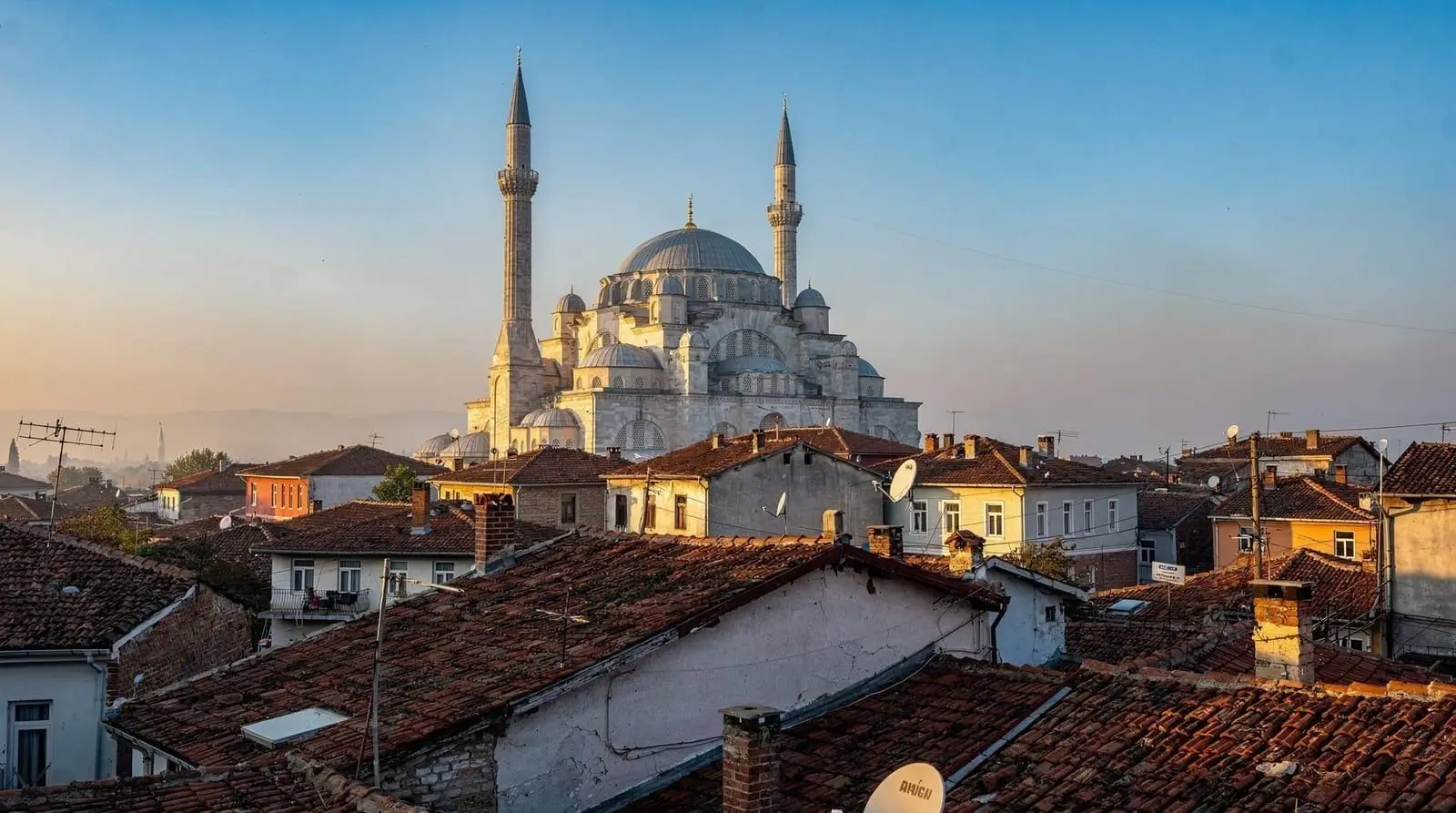
Edirne
Turkey's European city near Greece and Bulgaria — the UNESCO Selimiye Mosque, Kırkpınar oil wrestling, and Ottoman history, 2.5 hours by bus from Istanbul.
Istanbul: Day Trip to Edirne
Quick facts
- Distance from Istanbul
- ~240 km northwest
- Transfer time
- 2.5–3h by bus from Esenler otogar
- UNESCO monument
- Selimiye Mosque (1575) — listed 2011
- Location
- European Turkey, near Greek and Bulgarian borders
- Entry
- Selimiye Mosque: free
Edirne is the westernmost city in Turkey — geographically in Europe, separated from Greece by the Meriç River and from Bulgaria by the Tunca.
| Where | ~240 km northwest of Istanbul, near the Greek and Bulgarian borders |
| Cost | Selimiye Mosque free; ciğer kebap lunch ~200–350 TRY |
| Time needed | 1 day (comfortable day trip) |
| Getting there | Bus from Esenler otogar, 2.5–3 hours |
| Best time | April–June and September–October; Kırkpınar festival late June–July |
Selimiye Mosque: Sinan’s masterpiece
Mimar Sinan was the architect responsible for both the Süleymaniye Mosque in Istanbul and the Selimiye in Edirne. He built the Selimiye when he was around 80 years old, completed in 1575 for Sultan Selim II. In his autobiographical writings, Sinan wrote that the Selimiye surpassed Hagia Sophia’s dome — a direct architectural challenge after centuries of comparison. The dome of the Selimiye is slightly larger in span (31.28 metres) than Hagia Sophia’s (31.24 metres) and rests on an eight-pier system that distributes the weight more elegantly, allowing the walls to be opened up with hundreds of windows.
The experience inside is different from Istanbul’s great mosques. The proportions feel tighter and more focused; the light from the windows pours in from multiple directions simultaneously. The calligraphy panels and İznik tiles are original and in excellent condition.
The mosque is surrounded by a large courtyard with four slender minarets, each 71 metres tall. It was inscribed as a UNESCO World Heritage Site in 2011.
Entry is free. Dress modestly (shoulders and knees covered; women cover hair). Open outside prayer times.
Getting from Istanbul to Edirne
Edirne is one of the easiest day trips from Istanbul: 240 km on the D100 motorway, with buses running throughout the day.
By bus: From Istanbul’s Esenler otogar (accessible by metro from the European side), regular buses to Edirne depart every 30–60 minutes. Companies include Metro Turizm, Nilüfer, and others. Journey time: 2.5–3 hours depending on traffic. Fare: 350–600 TRY one-way (≈ 9–15 USD). Return buses run until evening.
By car: About 2.5 hours on the E80/TEM motorway. Parking near the historic centre is available; the city centre is compact enough to walk once parked.
By organised tour: A small number of operators offer guided day trips from Istanbul to Edirne. These handle transport and include a guide for the Ottoman monuments.
The Ottoman city centre
Edirne’s historic core concentrates within comfortable walking distance of the Selimiye.
Eski Cami (Old Mosque, 1414): An earlier, more austere mosque built by Süleyman I (not the Magnificent — his predecessor). The interior is covered in enormous calligraphic inscriptions painted directly on the walls — bold black Arabic text on white. A striking contrast to the tiled elegance of the Selimiye.
Üç Şerefeli Cami (Three Balconied Mosque, 1447): Named for one of its four minarets, which has three balconies — an architectural experiment at the time. The courtyard is tranquil; the mosque itself is used daily for prayer and is less visited than the Selimiye.
Bedesten (covered market): Edirne’s old marketplace dates to the 15th century. Today it trades silverware, textiles, and crafts. Less touristic than Istanbul’s Grand Bazaar, prices are accordingly more reasonable.
Makedonya Kulesi (Macedonia Tower): A remnant of the old Byzantine walls, visible near the river. The area around the rivers (Tunca and Meriç) is pleasant for walking, especially in spring.
Kırkpınar oil wrestling festival
Edirne is the permanent home of Kırkpınar, the world’s oldest continuously held sporting event: 660+ years of oil-wrestling competition. Men coated in olive oil wrestle in a field outside the city every summer (typically late June to early July). The contest takes its name from the village of Kırkpınar, now in Greece, where the tradition began.
If you visit during the festival, the atmosphere in Edirne is festive — brass bands, food stalls, and thousands of spectators. The wrestling itself is technical and disciplined, nothing like the theatrical version; bouts can last hours. Tickets: 200–500 TRY (≈ 5–13 USD) for general admission.
Outside the festival period, a bronze wrestler statue stands in the main square as a permanent acknowledgment of the tradition.
Eating in Edirne
Edirne has its own food identity, with two distinctives worth seeking out.
Ciğer (liver kebap): Edirne-style liver is a city signature. Thin-sliced calf’s liver, quickly fried in clarified butter with red pepper flakes, served with flatbread and raw onion. Restaurants around the Eski Cami area specialise in it; a portion runs 200–350 TRY (≈ 5–9 USD).
Badem ezmesi (marzipan): Edirne’s traditional confectionery is almond paste shaped into various forms and sold in sweet shops throughout the city. Better than the generic lokum (Turkish delight) sold to tourists everywhere.
The central market area near the Bedesten has small lokanta-style restaurants with set lunches (öğle yemeği) for 200–350 TRY including soup, main, and bread.
Practical notes
The Selimiye and the main mosques are within 10 minutes’ walk of each other. A comfortable day trip allows 4–5 hours in the city if you leave Istanbul by 08:00 and take a late afternoon bus back.
The city sees relatively few Western tourists compared to Istanbul’s main attractions — you are unlikely to encounter the scams and aggressive touting that appear near Sultanahmet. Café and restaurant staff are accustomed to visitors but less likely to speak English; a translation app helps for menus.
Edirne’s market streets near the Bedesten sell herbs, olives, and local produce at competitive prices — worth browsing if you have time.
Edirne’s three great mosques compared
Edirne’s mosque-hopping route is one of its main draws, and the three main mosques are different enough in character to be worth distinguishing before you set out:
| Selimiye Mosque | Eski Cami | Üç Şerefeli Cami | |
|---|---|---|---|
| Built | 1575 | 1414 | 1447 |
| Signature feature | Sinan’s largest dome, İznik tiles | Monumental black-on-white calligraphy | Experimental three-balcony minaret |
| Crowd level | Busiest, but still uncrowded by Istanbul standards | Quiet | Quietest |
| Time needed | 45 min | 15 min | 15 min |
Doing all three in sequence — as outlined in the walking route above — takes under 90 minutes and gives a compressed tour of early to peak Ottoman mosque design in one city.
Edirne vs. Bursa: choosing a single day trip
Both are historic Ottoman cities within a comfortable day trip of Istanbul, and visitors often have to choose one. Edirne has the easier logistics (2.5–3 hours each way by direct bus, no ferry connection required) and the single standout monument in the Selimiye Mosque. Bursa has more to see overall — the Green Mosque, Grand Bazaar, silk market and the Uludağ cable car — but requires a longer, multi-leg journey. If mosque architecture and an easy logistics day are the priority, choose Edirne. If a fuller day with food, shopping and a mountain excursion matters more, choose Bursa.
Connecting to Istanbul
Edirne connects logically into a broader Thrace and Balkans itinerary. From Edirne, the border crossings to Greece (Kapıkule/Kastanies) and Bulgaria (Kapıkule to Kapitan Andreevo) are 10–20 km away. For Istanbul-based visitors, Edirne is simply the most accessible introduction to Ottoman Europe.
Within the Istanbul context, Edirne pairs well with the broader Ottoman architecture coverage — compare the Selimiye to the Süleymaniye Mosque and Hagia Sophia in Istanbul to understand Sinan’s development across different commissions.
Edirne as the first Ottoman capital of Europe
To understand why Edirne has so much Ottoman architecture for a relatively small city, you need to know its history. After the Ottomans crossed from Anatolia into Thrace in the 1350s, they captured Edirne (then called Adrianople) in 1369 and immediately made it their European capital. For 84 years — until the conquest of Istanbul/Constantinople in 1453 — Edirne was the centre of Ottoman administrative, cultural, and military operations in Europe.
This explains the concentration of 14th and 15th-century mosques, hans, and bazaars. Edirne was the place from which Istanbul was conquered, and the Ottomans built accordingly. After 1453, Istanbul became the capital, but Edirne remained the second city of the empire and a major ceremonial and military centre through the 17th century.
The city has changed hands multiple times in war — it was occupied by Russia in 1829 and 1878, by Bulgaria in 1913 during the First Balkan War (a period the Turks call the “martyrdom of Edirne”), and by Greece in 1920–1922 before being returned to Turkey in the population exchanges that followed the Greco-Turkish War. These historical overlays are visible in the city’s architecture: several of the mosques were used as stables or barracks during occupations and show the scars.
Saraçhane and the market area
Between the Eski Cami and the Bedesten, the Saraçhane (Saddlers’ Market) is Edirne’s most atmospheric commercial street. The name comes from the traditional craft of leather saddle-making that occupied the hans along this route. Today it mostly trades spices, dried goods, and household items — a practical local market rather than a tourist bazaar.
The Ali Paşa Çarşısı is a covered market arcade built by Mimar Sinan in the 1560s, adjacent to the Bedesten. It is smaller than Istanbul’s covered markets but genuinely historical and still functional — rows of small shops selling textiles, tools, and provisions. Walking through it gives a reasonable impression of what a working Ottoman market looked like at its operational height.
The Jewish heritage of Edirne
Edirne had one of the most significant Sephardic Jewish communities in the Ottoman world. After the expulsion from Spain in 1492, large numbers of Jews settled in Ottoman cities, and Edirne received a substantial community that maintained synagogues, schools, and cultural institutions for four centuries.
The Great Synagogue of Edirne (Büyük Sinagog), built in 1907, is the third-largest synagogue in Europe by capacity. It fell into disrepair after the community emigrated (mainly to Israel and the United States) in the 20th century, but was restored and reopened in 2015. It is open to visitors — entry is usually through an arrangement with the local administration. The interior is striking and largely intact.
The restoration project has been cited as an example of Turkish government investment in multicultural heritage.
Architecture walk: connecting the monuments
The historical core of Edirne is compact enough that all the major monuments are within a 30-minute walk of each other. A suggested walking route:
Start at Selimiye Mosque on its slight hill above the city. Spend 45 minutes in the mosque and the Selimiye Foundation Bazaar (arasta) around its base, which still houses craft workshops. Descend northwest along Saraçlar Caddesi, the main pedestrian commercial street, toward the centre.
Turn right at the Clock Tower into the Kale içi area and find the Üç Şerefeli Cami. The courtyard of this mosque is particularly satisfying — its columns come from a dozen different earlier Roman and Byzantine buildings, a common Ottoman practice of repurposing spoliated material. The mixing of capitals (Corinthian, Ionic, and later Ottoman styles) in a single colonnade is visible if you look carefully.
Continue east along the main bazaar area to the Eski Cami, which faces a small square. The scale of the calligraphy on the interior walls becomes clear as soon as you enter — letters over a metre high, painted in black on white. The effect is overwhelming and entirely different from the tiled grandeur of the Selimiye.
From the Eski Cami, the Koza Han (a 15th-century han, smaller than Bursa’s Koza Hanı but still atmospheric) and the Bedesten are immediately adjacent. End with a walk to the riverfront if the weather is good.
The rivers and the landscape
Edirne sits at the confluence of two rivers — the Tunca and the Meriç (the ancient Hebros, which forms the border with Greece just 7 km west of the city). The flood plains around the city are flat and open, giving Edirne a spacious feel unusual in Turkish cities.
The Tunca River islands host several Ottoman structures that are worth visiting if you have a second half-day: the Sarayiçi area (the island complex that housed the second Ottoman palace, now partly excavated) and the Kırkpınar wrestling ground. In spring, the islands’ poplar and willow trees are beautiful, and local families use the river park for picnics.
The Meriç River promenade offers views toward Greece. The Karaağaç neighbourhood on the far bank (reached by the Karaağaç Bridge) is an unusual district — its stately early 20th-century buildings are a legacy of the period when Edirne was briefly administered by Greece (1920–1922), and the university buildings here were originally Greek-era structures. The neighbourhood has a slightly melancholy quality: beautiful buildings, an unresolved historical identity.
Getting the most from a solo visit
Edirne is particularly rewarding for independent travellers who move at their own pace. The major sites have minimal English-language interpretation beyond the Selimiye Foundation Museum, so a Turkish-language app or a detailed guidebook adds value. The Turkish Ministry of Culture publishes Selimiye information in English at the entrance; the mosque staff are usually helpful to curious visitors.
Local café culture in Edirne is less cafe-bar and more traditional çayhane (tea house) — older men playing cards or backgammon, glasses of strong çay. Sitting in one near the Eski Cami for half an hour costs 15–25 TRY and gives a genuine sense of the city’s pace.
Practical visit checklist
For a focused day trip from Istanbul, the following sites make for a rich day:
- Selimiye Mosque + Selimiye Complex Museum (45 min each)
- Eski Cami interior (15 min)
- Üç Şerefeli Cami courtyard (15 min)
- Ali Paşa Çarşısı and Bedesten walk-through (30 min)
- Kırkpınar museum (if the festival is not on): small exhibit of wrestling photographs and artefacts, free
- Lunch: ciğer kebap near Eski Cami (30–45 min)
- Great Synagogue (if accessible, 30 min)
- Return bus from Edirne otogar
The otogar is about 2 km from the historic centre — catch a taxi or the local bus (very cheap). Return buses to Istanbul run from early morning until around 22:00.
Fitting Edirne into a wider Istanbul plan
Edirne works best as one chapter in a longer stay rather than a stand-alone outing. If you are still shaping your trip, the Edirne day trip guide walks through the practical side in more detail, and the broader best day trips from Istanbul guide shows how it compares with the other options. For an honest look at which excursions are realistic in a single day, read the day trip reality check.
Edirne makes the most sense once you have already seen the headline mosques in the capital. Spend your first days in Sultanahmet and around the Blue Mosque, then come to Edirne to see how Ottoman architecture looked before and during Sinan’s career. The comparison is far more rewarding with Istanbul’s domes fresh in your mind. Our guide on Ottoman Istanbul gives useful background for that. If you want that context before you leave the capital, a guided morning walk through the Old City is an easy way to get it.
If you would rather stay close to the city, the Princes’ Islands offer a very different, slower kind of day out. For planning how many days to give the whole region, see how many days in Istanbul, and for a bigger picture of the country, the Turkey highlights itinerary shows where a Thrace stop could fit.
Frequently asked questions about Edirne
Is Edirne worth visiting from Istanbul?
Yes, particularly if you care about Ottoman architecture or want to see what Turkey’s European territory looks and feels like. The Selimiye Mosque alone justifies the trip; the city around it is modest but pleasant. It is the most comfortable day trip from Istanbul in terms of travel distance — 2.5 hours each way leaves a full day in the city.
How do I get from Istanbul to Edirne by bus?
From Esenler otogar on the European side (accessible by metro M1), buses to Edirne depart every 30–60 minutes with companies like Metro Turizm and Nilüfer. Journey time 2.5–3 hours. Fare around 350–600 TRY one-way. Return buses run until at least 20:00 most days.
Is the Selimiye Mosque free to enter?
Yes. Like most working mosques in Turkey, the Selimiye is free to enter outside prayer times. Dress modestly (shoulders and knees covered; women cover hair). Shoes must be removed at the entrance; bags are provided. The mosque is actively used for the five daily prayers.
What is Kırkpınar oil wrestling?
The world’s oldest continuously held sporting event — over 660 years old. Men wrestling in olive oil compete in a stadium outside Edirne every summer (typically late June to early July). It is a legitimate athletic tradition, not performance wrestling. The festival around the competition fills the city. Tickets are inexpensive.
What is the food to eat in Edirne?
Edirne-style liver kebap (ciğer) is the signature dish — thin slices of calf’s liver fried in butter with pepper, served with flatbread and raw onion. Several specialist restaurants around the Eski Cami area serve it. Also worth trying: badem ezmesi (almond marzipan), Edirne’s traditional sweet.
Can I combine Edirne with Gallipoli on a day trip?
In theory, but the distances make it very long. Edirne is northwest of Istanbul; Gallipoli is southwest. Combining both would require 10+ hours of travel. The more sensible approach is separate day trips, or combining Gallipoli with Troy and keeping Edirne as its own day trip.