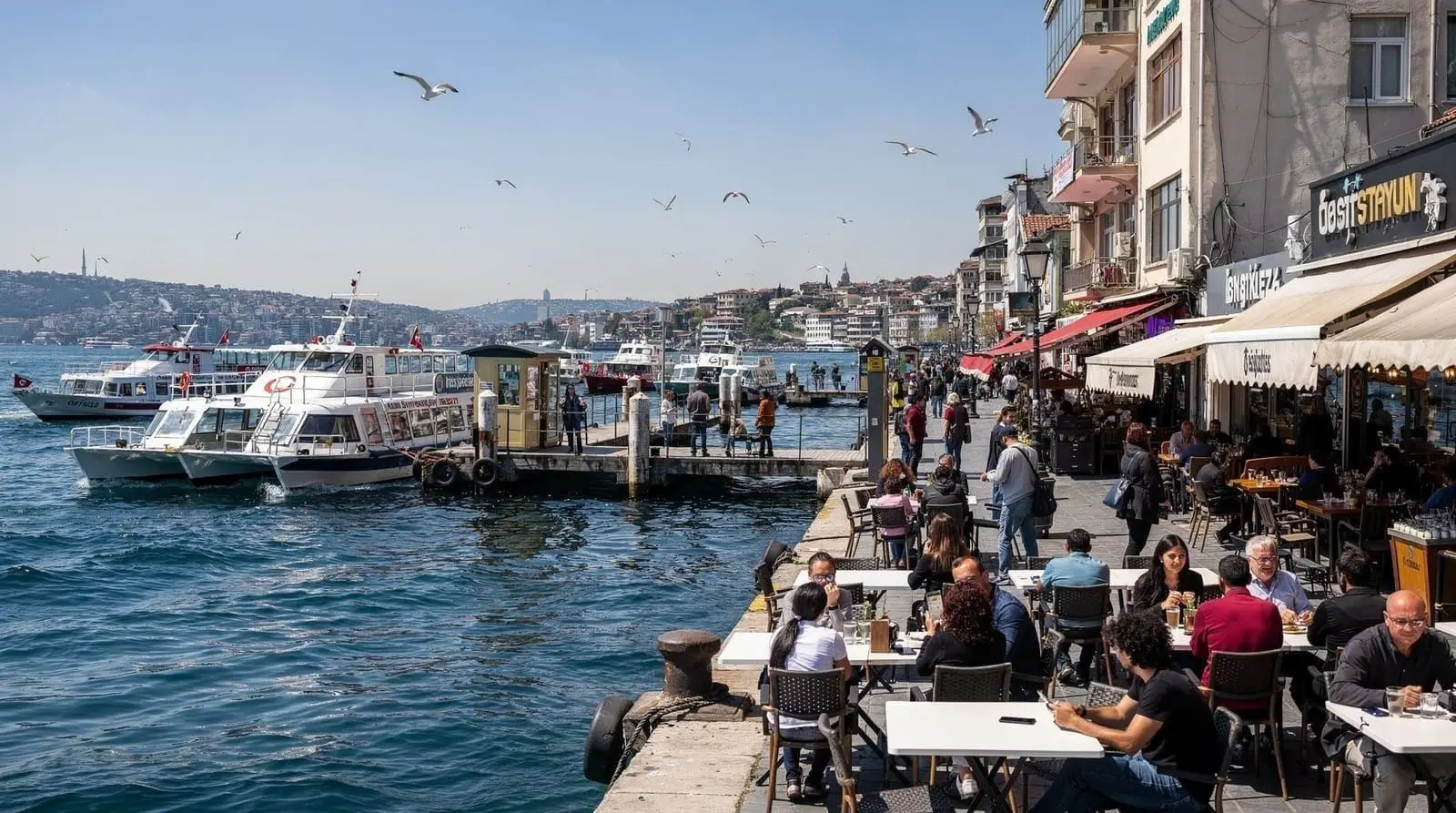
Beşiktaş
Working Istanbul neighbourhood between Dolmabahçe and Bosphorus — fish market, street food, honest prices, ferry to Asian side.
Istanbul: Dolmabahce Palace and Harem Skip-the-Line Ticket
Quick facts
- Location
- European Bosphorus shore, 7 km north of Sultanahmet
- Nearest transport
- Kabataş tram T1 (10-min walk south); bus from Taksim
- Ferry pier
- Beşiktaş pier — routes to Kadıköy and Üsküdar
- Market day
- Wednesday and Saturday street market
- Known for
- Fish market, Çarşı (main square), Beşiktaş football club
- Character
- Working-class Istanbul, less tourist infrastructure
Beşiktaş without the tourist layer
| Where | European Bosphorus shore, 7 km north of Sultanahmet |
| Cost | Free to walk; a market lunch runs 150–250 TRY |
| Time needed | 1–2 hours as a stop; half a day with Dolmabahçe and Ortaköy |
| Getting there | Kabataş tram T1 (10-min walk) or bus from Taksim |
| Best time | Weekday mornings for the fish market (before 10:00) |
Beşiktaş (pronounced roughly “BESH-eek-tash”) is one of Istanbul’s most functional and least tourist-processed neighbourhoods. It sits on the European Bosphorus shore between the Dolmabahçe Palace to the south and Ortaköy to the north, and it is primarily a residential and commercial district for the local population: shopkeepers, students from the nearby Bosphorus University, ferry commuters, football supporters of Beşiktaş JK (one of Turkey’s three major football clubs, whose stadium Vodafone Park is here), and a working fish market that operates most mornings.
For the visitor, Beşiktaş is useful as a transit point — it has a ferry pier connecting to the Asian shore, bus connections to Taksim and Ortaköy, and is the natural neighbourhood to be in before or after a Dolmabahçe Palace visit. But it is also a place where Istanbul operates without tourists being the primary consideration, which gives it a different texture from the old city or the polished areas of Beyoğlu.
The market and fish hall
The covered Beşiktaş Fish Market (Balık Hali) operates in a market hall near the main square (Çarşı). It is smaller than the fish stalls in Karaköy or Eminönü but is a genuine working fish market with daily fresh catches from the Marmara and Black Sea. Prices here are what local residents pay — significantly cheaper than fish restaurants in tourist areas.
The Wednesday and Saturday outdoor street market expands the coverage to vegetables, fruits, dairy, and cheap household goods. It occupies several streets and is a good place to observe daily Istanbul life. Prices are local; you are unlikely to be overcharged for a bag of tomatoes.
For eating around the market: several lokanta restaurants in the streets behind Çarşı offer set-menu lunches (soup, main, dessert) for approximately 150–250 TRY (4.5–7.5 USD). These are the working-lunch spots for the neighbourhood; quality is consistent, atmosphere is zero-pretension.
The Eagle Statue (Barbaros Monument)
The dominant feature of the main Çarşı square is the large bronze statue of Barbaros Hayreddin Pasha, the 16th-century Ottoman admiral who essentially built the Ottoman naval empire in the Mediterranean. The statue dates from 1946 and is a gathering point for the neighbourhood. The area around it is where the street food vendors concentrate — simit, roasted corn, mussel sellers, and various other mobile snacks.
Ferry connections
The Beşiktaş ferry pier is an important transit point for cross-strait travel:
- To Kadıköy: regular service, approximately 20 minutes. Istanbulkart fare.
- To Üsküdar: shorter crossing, approximately 10–15 minutes.
These are working commuter ferries rather than tourist boats, which means they run frequently and reliably and are considerably less crowded than the Eminönü piers. For travellers wanting a quick Bosphorus crossing to the Asian side from the northern European shore, Beşiktaş is often the most practical pier.
Connecting Beşiktaş to the larger itinerary
The neighbourhood makes most sense as part of a Bosphorus shore day rather than as a standalone destination:
- Dolmabahçe Palace is a 10-minute walk south. After the palace visit, walk to Beşiktaş for a local lunch.
- Ortaköy is 20 minutes north on foot or 10 minutes by bus. This is one of the most pleasant Bosphorus waterfront walks in the city.
- Bosphorus cruise departures from Kabataş (T1 tram end) or from the waterfront are accessible.
- Ferry to Kadıköy from the Beşiktaş pier connects the European and Asian sides efficiently.
Frequently asked questions about Beşiktaş
Is Beşiktaş worth visiting as a destination?
As a standalone tourism destination: no — there is no single attraction that justifies a special trip. As a neighbourhood component of a Bosphorus shore day, or as a practical ferry hub combined with the Dolmabahçe Palace visit: definitely yes. The market and local eating options make it a more honest Istanbul experience than many tourist-adjacent areas.
Is the Beşiktaş neighbourhood safe?
Yes — it is a normal Istanbul residential and commercial neighbourhood with no particular safety concerns. The crowds around match days for Beşiktaş JK football can be very dense (stadium capacity 41,000), but this is not a safety issue.
How do I get to Beşiktaş from Sultanahmet?
Two main options: (1) T1 tram to Kabataş (end of line), then 10-minute walk north; (2) Bus 22, 22RE, or 25E from near the Grand Bazaar area, approximately 20–30 minutes depending on traffic.
What are the best hours for the fish market?
The fish hall (Balık Hali) operates from early morning (around 06:00) through the late morning. By midday the selection is reduced and some stalls have closed. For the best variety and freshest fish, go before 10:00.
Beşiktaş football culture and Vodafone Park
Beşiktaş JK is one of Turkey’s three major football clubs (alongside Fenerbahçe and Galatasaray), based in this neighbourhood since the club’s founding in 1903. Vodafone Park, the current stadium opened in 2016 on the Bosphorus waterfront, has a capacity of 41,903 and is architecturally striking — a modern structure whose terraces face the strait. On match days, the neighbourhood is saturated with black-and-white scarves and the volume increases substantially. If a home match coincides with your visit, the ferry piers and transport around Kabataş can become congested.
The rivalry between Beşiktaş, Fenerbahçe, and Galatasaray is one of the more intensely felt in European football. The Derby matches (particularly Beşiktaş vs. Fenerbahçe and Beşiktaş vs. Galatasaray) are high-security events with strong police presence and are best avoided by visitors without a specific interest in attending. Regular league matches are more relaxed and can be attended by visitors; tickets are available through the club’s website (bjk.com.tr) or through authorised resellers.
Beşiktaş history: from Byzantine to Ottoman to modern
The Beşiktaş area was settled in the Byzantine period as a suburb of Constantinople; the name may derive from the Byzantine Greek “beshikos” (cradle) combined with the Ottoman Turkish “taş” (stone). A palace complex known as the Beşiktaş Sarayı stood on the waterfront site now occupied by Dolmabahçe Palace — it was demolished in the 1840s to make way for the new palace.
The neighbourhood was a mixed community through the Ottoman period, with significant Greek, Armenian, Jewish, and Turkish populations. The Greek Orthodox church of Ayios Ioannis Prodromos (St John the Baptist) is one of the few surviving minority religious buildings in the neighbourhood. The 20th century saw the progressive departure of the minority populations; the current neighbourhood is overwhelmingly Turkish Muslim.
The Ihlamur Pavilion
A 10-minute walk inland from Beşiktaş (uphill toward Nişantaşı) brings you to the Ihlamur Kasrı (Ihlamur Pavilion) — a pair of small Ottoman Baroque buildings set in a manicured garden that were used as a rest stop and informal residence by the Ottoman sultans in the mid-19th century. The site is one of Istanbul’s overlooked pleasant spots: the garden is free to enter, the pavilions are open for a small fee (approximately 100 TRY), and on a weekday it is usually very quiet. The buildings are by Nikoğos Balyan, the same architect who worked on Dolmabahçe Palace.
Eating in Beşiktaş: specific recommendations
The area around Çarşı (the main square) has the best concentration:
Siirt Şeref Büryan Kebap: a few streets from the main square, this restaurant serves büryan kebab — slow-cooked lamb served with rice and thin bread, a dish originally from the Kurdish city of Siirt. It is genuinely distinctive and not a dish found in tourist-area restaurants. A full portion runs approximately 250–350 TRY (7.5–10 USD).
Fish restaurants on the market street: the streets between the fish hall and the sea have several working fish restaurants with daily menus based on whatever is fresh. Prices are local; a fish plate with bread runs 200–300 TRY. Ask what is fresh rather than ordering from the written menu.
The waterfront tea gardens: the Bosphorus waterfront path south of Beşiktaş toward Kabataş has several çay bahçesi (tea gardens) with plastic chairs facing the water and Istanbulkart prices for çay (10–15 TRY) and ayran. These are not refined; they are genuinely pleasant.
The Bosphorus waterfront walk from Kabataş to Ortaköy
One of Istanbul’s better urban walks: from the Kabataş T1 tram terminus, follow the Bosphorus shore north for approximately 30–40 minutes to reach Ortaköy. The route passes Dolmabahçe Palace’s main gate and garden wall, the Çırağan Palace (Kempinski) gardens, several waterfront tea spots, and the Beşiktaş Vodafone Park stadium before reaching the Ortaköy waterfront and the mosque. The walk is entirely flat, partially separated from traffic on a dedicated pedestrian path, and provides continuous Bosphorus views.
Returning from Ortaköy: bus 25E to Beşiktaş (10 minutes), or bus 40 toward Taksim (25 minutes). The walk is only practical in one direction (north) because the route is better oriented with the sun behind you in the afternoon.
Maritime heritage: the Naval Museum
The Istanbul Naval Museum (Deniz Müzesi) is located in Beşiktaş, on the Bosphorus waterfront just south of the main square, and is one of Istanbul’s most substantial and undervisited museums. It covers the history of the Ottoman and Turkish navies from the 15th century through the modern period, and the collection of imperial caiques (the gilded rowing boats used by the sultans for Bosphorus travel) is remarkable — these are among the finest examples of Ottoman craft in any Turkish museum.
The caiques in the museum include the enormous 40-oar kalyonlar used for official imperial processions; they represent the most opulent end of Ottoman shipbuilding craft. The museum also has maps, weapons, navigational instruments, and documentation of the Ottoman naval campaigns that established Turkey’s maritime history.
Entry is approximately 100 TRY (3 USD). The museum is open Tuesday through Sunday, 09:00–17:00. It is a 10-minute walk south from the main Beşiktaş square. If you have an interest in naval history or in the Ottoman Empire’s maritime dimension, this is worth a significant portion of an afternoon.
Yıldız Palace park
The Yıldız Palace complex, uphill from Beşiktaş (approximately 15 minutes on foot or 5 minutes by taxi), is one of Istanbul’s most pleasant green spaces. The palace itself houses several pavilions built for Sultan Abdülhamid II in the 1870s–1890s; the porcelain factory pavilion (Yıldız Çini Fabrikası, still producing ceramics today) and the main chalet (Şale) are open for visits.
The surrounding park is large, well-maintained, and occupies a hillside with partial Bosphorus views. It is quieter than the major tourist sites and is primarily used by Istanbul residents for walks and picnics. Entry to the park is free; the individual pavilions have modest entry fees.
The neighbourhood market in detail
The Beşiktaş Wednesday and Saturday markets operate on a street layout that takes over several blocks around the Çarşı area. The character is distinct from the Grand Bazaar: this is a working provisioning market, not a souvenir-shopping destination. Vendors include:
Vegetable and fruit stalls: the variety reflects the seasonal Turkish growing calendar. Spring brings broad beans, artichokes, and strawberries; summer brings tomatoes, peppers, and figs; autumn brings persimmons, pomegranates, and quince. Prices are market rates, not tourist rates.
Cheese vendors: good coverage of Turkish regional cheeses. The beyaz peynir (white cheese, similar to feta but with distinct Turkish variations) varies by regional source; vendors will often offer small tastes.
Olive dealers: a range of Turkish olive varieties, usually sold from large containers. The black and green options cover the range from mild to strongly brined.
Textile and clothing stalls: practical clothing at low prices, aimed at locals buying workwear and household textiles. Not of interest for souvenir purposes but useful for context.
The market is busiest in the morning (08:00–12:00); arriving at 08:30 gives you the full selection without the peak-hour crush.
Connecting Beşiktaş to the wider city: transport summary
T1 tram: Kabataş is the northern end of the T1 line (10-minute walk south from Beşiktaş main square). The tram runs to Sultanahmet in approximately 25 minutes, passing through Karaköy en route.
Ferry pier: the Beşiktaş pier has regular services to Kadıköy (20 min) and Üsküdar (10–15 min) on the Asian shore. Ferries are less frequent than the Eminönü/Karaköy services but useful for the northern European shore to Asian shore crossing.
Bus connections: buses from Beşiktaş run to Taksim (15 min), Ortaköy (10 min north), and across the Bosphorus bridges to the Asian side.
Dolmuş: shared minibuses along the Bosphorus shore are faster than city buses for short distances within the northern European waterfront strip.
The Bosphorus University (Boğaziçi Üniversitesi) connection
Boğaziçi University, one of Turkey’s most competitive universities and the successor to the American-founded Robert College (1863), has its main campus on the hill above Beşiktaş. The university is visible from the upper streets of the neighbourhood and has a significant effect on the area’s character — the student population contributes to the café scene, bookshops, and general intellectual energy that distinguishes Beşiktaş from purely residential or commercial neighbourhoods.
The university campus is technically accessible to visitors (it is a public institution), though there are no specific tourist attractions within. The campus grounds have Bosphorus views and are pleasant for a walk, but you would need a reason specific to the university to make the uphill journey worthwhile.
Summary: what Beşiktaş does best
For the visitor, Beşiktaş is most useful in three roles: as the natural service neighbourhood adjacent to Dolmabahçe Palace (eating, orienting, resting before or after the palace visit), as a practical ferry hub connecting the northern European shore to the Asian side, and as an introduction to Istanbul’s working-class neighbourhood character — the market, the fish hall, and the football culture make it a different experience from either the tourist-facing old city or the gentrified Beyoğlu.
It is not a destination in the way that Galata Tower or Dolmabahçe Palace are destinations. It is a place to be in for a few hours, to eat well at local prices, and to see Istanbul operating on its own terms without a tourist layer over the top. That is a specific and valuable kind of travel experience, and Beşiktaş delivers it consistently.
Sunset cruise departures from Beşiktaş
Beşiktaş and the neighbouring Kabataş waterfront are also a practical departure point for evening Bosphorus cruises, an alternative to the more heavily marketed Eminönü departures.
Bosphorus sightseeing cruise with sunset option — departs the northern waterfront near Beşiktaş and KabataşTaking a sunset cruise from this stretch of shore rather than Eminönü means less time spent getting to the pier if you’re already based around Beşiktaş, Dolmabahçe or Ortaköy for the day, and the golden-hour light on Çırağan Palace and the first Bosphorus Bridge is close to the departure point rather than a 30-minute sail away.
Top experiences
Bookable activities with verified prices and instant confirmation on GetYourGuide.
