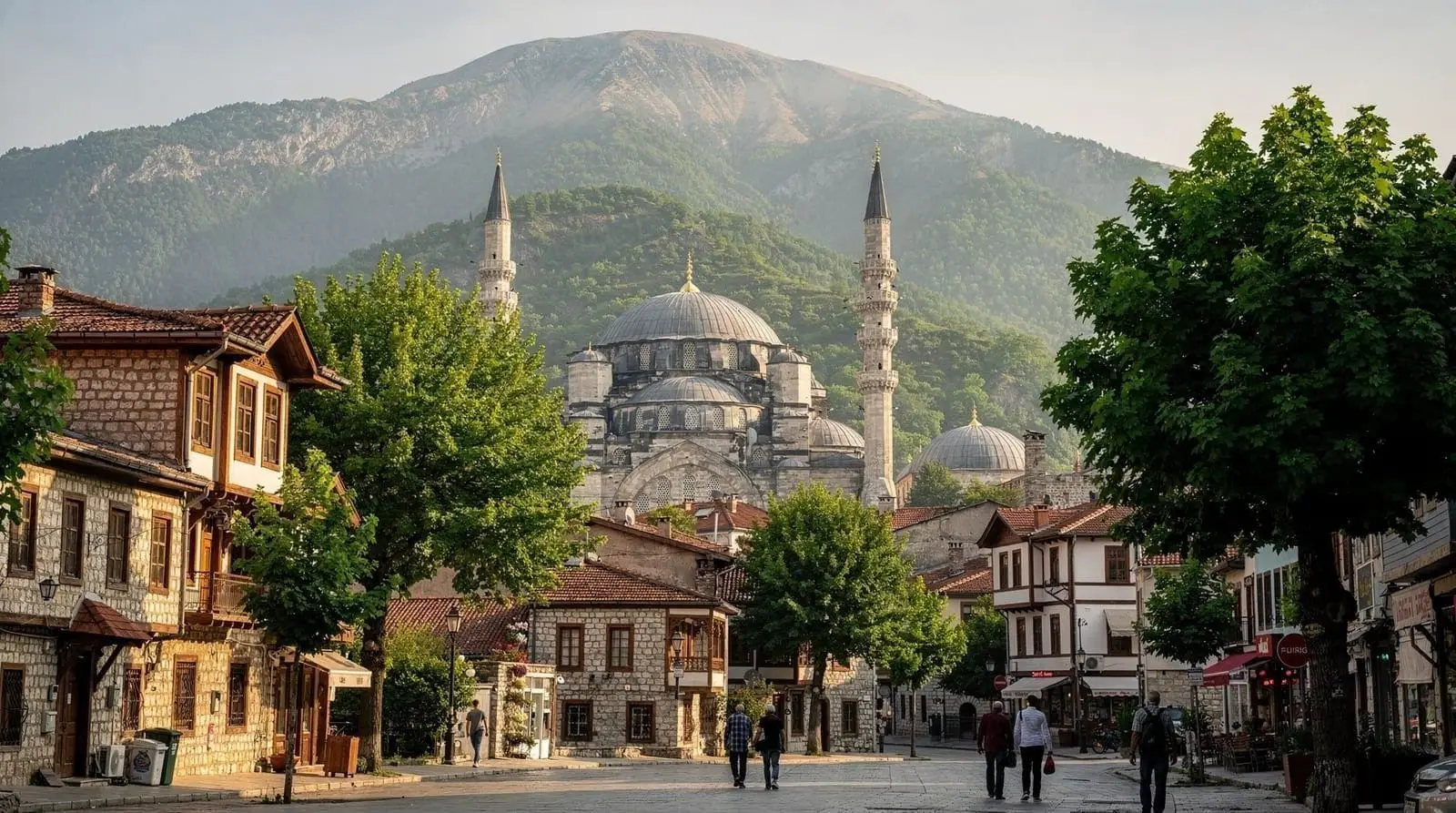
Bursa
First Ottoman capital — Ulu Cami mosque, İskender kebap, and Uludağ cable car, all reachable on a true day trip from Istanbul across the Sea of Marmara.
Bursa Full Day Sightseeing Tour from Istanbul
Quick facts
- Distance from Istanbul
- ~155 km south of Istanbul
- Transfer time
- Fast ferry Yenikapı→Mudanya ~1h10, then bus ~30min to city; or ~2.5h by bus direct
- Entry fees
- Most mosques and green tomb: free
- Must-eat
- İskender kebap (invented in Bursa)
- Uludağ cable car
- ~200–250 TRY one way (≈ 5–7 USD)
Bursa is the city that started Ottoman history. Founded as the first Ottoman capital in 1326, it has a different weight from Istanbul — older, quieter, still shaped by the traditions of silk weaving, thermal baths, and the distinctive İskender kebap that was invented here. It is a legitimate day trip from Istanbul: travel time by ferry and bus is roughly 2–2.5 hours each way, and the city’s highlights concentrate around a walkable central area.
| Where | ~155 km south of Istanbul, across the Sea of Marmara |
| Cost | Mosques free; İskender kebap 400–600 TRY; cable car ~400–500 TRY return |
| Time needed | 1 day (true day trip); 2 days to include Uludağ properly |
| Getting there | Fast ferry Yenikapı→Mudanya (~1h10) + bus (~30min), or direct bus (~2.5h) |
| Best time | April–June and September–October; Jan–March for Uludağ skiing |
Why Bursa earns its place on a Turkey itinerary
Most Istanbul visitors overlook Bursa in favour of flashier extensions like Cappadocia. That is a defensible choice, but Bursa offers something different: a working Ottoman city that has been inhabited continuously since the 14th century, where the Grand Mosque still holds five daily prayers and the Kapalı Çarşı (Covered Bazaar) still trades silk. There is no theme-park quality here — Bursa is simply what it is.
The city sits at the base of Uludağ — a 2,543-metre mountain that provides skiing in winter and cooler breezes in summer. The cable car (teleferik) from the Teferrüç district of Bursa rises through forest to the upper station at 1,635 metres. In winter, a second gondola stage continues to the ski resort at 2,088 metres.
If you are still deciding how Bursa fits into your wider plans, the Bursa from Istanbul guide walks through the practicalities step by step, and the best day trips from Istanbul roundup shows how it compares with the alternatives. For an honest look at which excursions are realistic in a single day, read the day trip reality check.
Getting to Bursa from Istanbul
There are two main routes, each with trade-offs. Whichever you choose, the journey starts in Istanbul, and the getting around Istanbul guide explains the Marmaray and metro connections you will use to reach the ferry or the bus terminal. An Istanbulkart makes those city legs painless.
Fast ferry + bus (recommended for comfort): IDO fast ferries run from Yenikapı (reachable by Marmaray from both sides of Istanbul) to Mudanya harbour, about 1 hour 10 minutes. From Mudanya, dolmuşes and city buses run the 30-minute trip to central Bursa. Total time: about 2 hours. This is the most scenic approach — you cross the Marmara with views back toward Istanbul’s minarets. Buy ferry tickets in advance online on busy weekends.
Direct bus from Istanbul: Kamil Koç, Metro Turizm, and other companies run direct buses from the Esenler otogar (long-distance bus terminal, reached by metro) to Bursa’s otogar in about 2.5–3.5 hours depending on traffic. There are also direct buses from Harem (Asian side). Fare: 350–600 TRY one-way (≈ 9–15 USD).
Organised tour: The simplest option if you want to see multiple sites without planning. A reputable tour handles transfers, a licensed guide, and often lunch — including a straightforward full-day tour to Bursa across the Sea of Marmara for travellers who just want the city sights covered.
The Green Mosque and the Green Mausoleum
The Yeşil Cami (Green Mosque) and adjacent Yeşil Türbe (Green Mausoleum) are Bursa’s most photographed monuments and among the finest surviving examples of early Ottoman architecture in the world. Both date to the early 15th century, built for Sultan Mehmed I.
The Green Mosque gets its name from the İznik tiles used in the interior — although most of the truly green-tiled surfaces are actually in the mausoleum across the street. The mosque’s main hall is open to non-Muslim visitors outside prayer times; entry is free. The craftsmanship of the tilework, particularly the mihrab (prayer niche), is more intricate than anything comparable in Istanbul.
The mausoleum contains the sarcophagi of Mehmed I and his family. It is small, always cool, and completely free. The octagonal exterior covered in turquoise tiles stands directly opposite the mosque entrance.
Ulu Cami — the Grand Mosque
The Ulu Cami (Grand Mosque) predates the Green Mosque by about 30 years, built 1396–1399 under Bayezid I. It is a different architectural vision: 20 domes arranged in rows, supported by 12 massive pillars, a two-storey interior that can hold thousands of worshippers, and a fountain (şadırvan) inside the prayer hall — an unusual feature.
Unlike Istanbul’s great imperial mosques, the Ulu Cami sees almost no tourist crowds. Visit early in the morning or between prayer times. Dress modestly (shoulders and knees covered, women cover hair); loaner scarves are available.
If this is one of your first mosque visits in Turkey, the mosque etiquette guide explains what to expect inside, and the Ottoman Istanbul guide gives the dynastic background that makes Bursa’s early monuments easier to place.
The Grand Bazaar and Koza Hanı
Bursa’s bedesten (covered market) and the connected Koza Hanı (Silk Cocoon Han) form a UNESCO World Heritage site complex alongside the city’s other Ottoman monuments. The Koza Hanı was built in 1491 and originally served as the trading post for silk cocoons. Today it trades mostly silk scarves and textiles, but the architecture — two-storey arched courtyard with a şadırvan fountain in the centre — is largely intact.
Silk goods here are generally better quality and more fairly priced than at Istanbul’s Grand Bazaar. Expect 200–800 TRY for a silk scarf (≈ 5–20 USD) depending on quality. The salesmanship is lower-key than Istanbul. If you want to compare, the Grand Bazaar and Spice Bazaar in Istanbul are the obvious benchmarks, and the bargaining in the bazaar guide is useful for any market you visit.
İskender kebap: the definitive Bursa meal
İskender kebap was invented in Bursa in 1867 by İskender Efendi, and his descendants still operate the original restaurant: Kebapçı İskender on Atatürk Caddesi (multiple branches, but the original location carries history). The dish is döner meat sliced over pide flatbread, covered in tomato sauce, poured with molten butter, served with yogurt and grilled green peppers.
A portion runs about 400–600 TRY (≈ 10–15 USD). The butter is the key — it arrives sizzling hot at the table and is poured on in front of you. Avoid ordering it at restaurants outside Bursa; the versions elsewhere are inferior.
For the wider picture of what to eat across the country, the Turkish food guide and the Istanbul street food guide are good companions, and the baklava and Turkish desserts guide covers the sweet side.
For a more casual lunch, the Kapalı Çarşı area has small lokanta-style restaurants serving lamb dishes and soups for 200–350 TRY per person.
Uludağ and the cable car
The Bursa Teleferik (cable car) station in the Teferrüç neighbourhood is accessible by city bus or taxi from central Bursa (about 15 minutes). The round-trip costs roughly 400–500 TRY (≈ 10–13 USD) for the lower stage to the forest plateau. A second gondola stage reaches the ski resort.
In summer (May–September), the upper station offers cool air, pine forests, and picnic spots. In winter, it’s a working ski destination with multiple runs; accommodation fills quickly on weekends.
Allow 1.5–2 hours for the cable car + time at the top on a day trip — combining this with the city centre sites is possible if you depart Istanbul early (by 08:00 ferry).
Other sites worth including
Bursa Muradiye Complex: A group of 12 royal tombs from the 15th and 16th centuries, set in a garden. The tombs are uniquely varied in decoration — several have original İznik tiles in remarkable preservation. Free entry. A quiet, unhurried site.
Hisar (castle district): The old Byzantine-Ottoman fortress hill offers elevated views over the city and houses the tombs of the founders of the Ottoman dynasty, Osman Gazi and Orhan Gazi. The site is modest but historically significant.
Cumalıkızık village: A UNESCO-listed Ottoman village of 270 stone and timber houses, 8 km east of central Bursa. The main street feels genuinely preserved, not reconstructed. Several houses serve breakfast (kahvaltı) for 150–300 TRY per person. Worth including if you have time.
How much time do you need?
A focused day trip covers the Ulu Cami, Koza Hanı, Yeşil Cami, and the Muradiye Complex with lunch at Kebapçı İskender and leaves you back in Istanbul by evening. Two full days would let you add Uludağ properly and explore Cumalıkızık.
Leave Istanbul by 08:00 ferry to arrive in Bursa by 10:30–11:00. This gives you roughly six hours before you need to catch the return ferry or bus.
Ottoman history you can actually feel
Bursa is not a museum city — it is a living city of 3.2 million people that has kept its Ottoman-era structures in daily use. The Ulu Cami receives worshippers five times a day. The Koza Hanı still functions as a commercial han. The Muradiye Complex is visited by local families as well as tourists. This lived-in quality distinguishes Bursa from sites like Ephesus, which are entirely archaeological. You see Ottoman architecture being inhabited, not just preserved.
The Ottoman character of Bursa is also evident in the food culture. The Kapalı Çarşı area has several traditional lokanta restaurants serving dishes like İnegöl köfte (a local meatball variety from the nearby İnegöl district), lamb stew (kuzu güveç), and the regional pide variant made with extra butter. Bursa’s traditional pide (İskender’s bread base aside) is slightly different from Istanbul’s — worth comparing if you are a bread enthusiast.
The Muradiye Complex: gardens and royal tombs
The Muradiye Complex is one of the quieter highlights of Bursa and often bypassed by tour groups that focus on the more famous Yeşil Cami and Ulu Cami. Built in the 1420s for Sultan Murad II, the complex includes a mosque, a medrese (theological school, now housing a period furnishings exhibit), and 12 royal tombs in a walled garden.
The tombs span the 15th and early 16th centuries and each has a distinct character. Several have been studied for their original decoration — fragments of painted plaster, carved stone, and in some cases remarkable tile work predating the peak İznik tile era. The garden setting is planted with roses and cypresses, and in spring is genuinely beautiful.
Entry is free. The site is in a residential neighbourhood of Bursa, about a 15-minute walk from the Ulu Cami, and is usually quiet enough that you can move through at your own pace without encountering tour groups.
Thermal baths (Çekirge)
Bursa has been famous for its thermal baths since ancient times. The Romans built bath complexes here; the Byzantines maintained them; the Ottomans expanded them. The thermal springs produce water at around 40–57°C, and the Çekirge district (about 5 km west of central Bursa) has a concentration of hotels and standalone hammams fed directly by the springs.
The Eski Kaplıca (Old Bath), near the Murad I Mosque in Çekirge, uses a Byzantine foundation and has been in continuous operation for over 600 years. A basic hammam experience here runs around 600–1,000 TRY (≈ 15–25 USD) including towel and kese (body scrub). Less theatrical than the famous Istanbul hammams, more genuinely local.
Compared to the Istanbul experience at places like Çemberlitaş or Süleymaniye Hammam, the Bursa thermal baths are hotter (the spring water is warmer) and less tourist-oriented. For visitors who are not interested in the performative tourist hammam experience, Çekirge is better.
First time in a hammam? The hammam first-timer guide and the hammam etiquette guide explain the routine, and the historic hammams of Istanbul are the natural point of comparison.
Silk and textiles: what to buy
Bursa’s status as the end point of the historic Silk Road (the overland trade route from Central Asia to the Mediterranean) gave the city its textile heritage. The çarşı area around the Koza Hanı still trades in silk and cotton goods, though production is now largely factory-based.
What is worth buying in Bursa’s bazaar:
Silk scarves: 200–800 TRY (≈ 5–20 USD) for smaller pieces, more for large silk shawls. Examine the weave density; pure silk feels cool and smooth, not slippery or plasticky. The best silk products have hand-finished edges.
Bursa-style bath towels (peştemal): The traditional Turkish bath towel — flat-woven, fast-drying, striped. Bursa versions are well-made; expect 400–900 TRY for a full-size peştemal.
Lokum and confectionery: The Kapalı Çarşı area has several long-standing confectionery shops selling walnut-stuffed lokum and almond pastes at better prices than Istanbul’s tourist shops.
The Koza Hanı courtyard, where silk merchants have traded since 1491, has a mulberry tree at the centre — an intentional planting, since mulberry leaves are the food source for silkworms. The symbolism is deliberate.
Day-trip logistics and timing advice
For a comfortable day trip from Istanbul, the following schedule works well:
- 07:45: Take the Marmaray train from Istanbul’s Asian or European side to Yenikapı station (combined Europe-Asia underground line).
- 08:30–09:00: Fast ferry from Yenikapı to Mudanya (1h10). Book online in advance at weekends.
- 10:00–10:30: Arrive Mudanya, catch a bus or dolmuş to central Bursa (30 minutes).
- 11:00–13:30: Ulu Cami, Koza Hanı, Bedesten, İskender kebap lunch.
- 13:30–15:00: Yeşil Cami + Yeşil Türbe + Muradiye Complex.
- 15:30–17:00: (Optional) Cable car to Uludağ or Çekirge hammam.
- 18:00–19:00: Return bus or dolmuş to Mudanya.
- 19:15–20:30: Return fast ferry to Yenikapı.
- 21:30–22:00: Back in Istanbul.
The schedule above leaves the Uludağ cable car as optional. If you want to do Uludağ properly, either drop the Muradiye Complex or plan an overnight in Bursa.
Bursa’s natural context: the Uludağ massif
The city sits at the foot of Uludağ (Mount Olympus of Bithynia in ancient sources — one of several mountains in the Greek and Roman world with this name). At 2,543 metres, it is one of the highest peaks in western Anatolia and one of the few mountains near a major Turkish city that has significant snow cover every winter. The cable car (teleferik) that connects the Teferrüç district of Bursa to the ski resort has operated since the 1960s and is an intrinsic part of the Bursa experience for Turkish families.
In summer, the mountain is a hiking and picnic destination for city residents — the pine forests up to 2,000 metres provide coolness in July–August heat that Bursa’s streets cannot match. The upper plateau vegetation transitions from forest to alpine grassland; the summit in good conditions offers views to the Sea of Marmara.
The Uludağ ski resort itself is significant by Turkish standards — multiple runs at different difficulty levels, accommodation at the resort level from budget to upscale, and a winter sports culture that draws visitors from Istanbul every weekend. For non-skiers, the upper cable car stage simply offers winter mountain scenery that is spectacular when the trees are snow-loaded.
Getting to Bursa: comparing the options
| Fast ferry + bus | Direct bus | Organised tour | |
|---|---|---|---|
| Total time | ~2 hours | 2.5–3.5 hours | Varies, transfers handled |
| Cost | Ferry fare + bus | 350–600 TRY one-way | Higher, all-inclusive |
| Scenery | Marmara crossing, Istanbul skyline view | None | Depends on route |
| Best for | Independent travellers who value the crossing | Budget travellers, simplicity | First-time visitors wanting a guide |
Bursa vs. other Istanbul day trips
Bursa competes with Edirne and the Princes’ Islands for a single day-trip slot. The Edirne day trip guide and the Princes’ Islands day trip guide go deeper on each, and Gallipoli is another option if history is your priority. The honest distinction: Bursa gives the deepest Ottoman architectural material outside Istanbul and the best food (İskender kebap), Edirne gives Sinan’s self-declared masterpiece (the Selimiye Mosque) with a shorter, easier journey, and the Princes’ Islands give a beach-and-bicycle escape with almost no history to absorb. If you can only do one, choose Bursa for architecture and food depth, Edirne for the easiest logistics, or the Islands if you want a genuine rest day rather than more sightseeing.
Fitting Bursa into a longer trip
Bursa works best as a break from Istanbul’s busier sights. If you are building a longer itinerary, the 3-day Istanbul itinerary and the 5-day Istanbul itinerary leave room for an excursion, and the how many days in Istanbul guide helps you decide whether you can spare one. For bigger loops, see Turkey highlights in 10 days.
Practical dining guide for Bursa
Budget visitors to Bursa should know that eating well here does not require tourist restaurant prices. The market area around the Eski Aynalı Çarşı (near the Ulu Cami) has:
Lokanta-style restaurants (piyaz salonu): Bursa-style piyaz (white bean salad with tahini, egg, olives, and parsley) is a regional signature and essentially a free starter wherever you sit down for lunch. Piyaz salonu serve set-price lunches (öğle yemeği) for 200–350 TRY including soup, main course, piyaz, and bread.
Kebap shops around Setbaşı: The Setbaşı bridge area over the Gökdere stream (about 15 minutes walk from the Ulu Cami) has a cluster of small kebap and köfte restaurants popular with local workers. Prices are 25–40% lower than in the tourist-facing restaurants.
Breakfast: Bursa’s standard Turkish kahvaltı (breakfast) spreads are available from mid-range hotels and at dedicated breakfast restaurants. Local specialities include Bursa cream (kaymak) and the regional clotted cream served with honey, best on fresh bread from a local bakery.
Frequently asked questions about Bursa
Is Bursa worth a day trip from Istanbul?
Yes, for most visitors who care about Ottoman history, architecture, and food. It is a functioning, lived-in Ottoman city that has changed less than Istanbul’s historical core. The combination of the Grand Mosque, Green Mosque, silk bazaar, and İskender kebap is coherent and rewarding. If you are primarily interested in nightlife or coastal scenery, choose the Princes’ Islands instead.
What is the fastest way to get from Istanbul to Bursa?
The IDO fast ferry from Yenikapı to Mudanya (≈ 1 hour 10 minutes) combined with a local bus or taxi to central Bursa (30 minutes) gives a total of about 1 hour 45 minutes. Buy tickets online to avoid queues. Alternatively, direct buses from Esenler take about 2.5–3 hours but avoid the ferry portion.
What is İskender kebap and where should I eat it?
İskender kebap is döner meat on pide flatbread, drenched in tomato sauce and hot butter, served with yogurt. The original and most respected restaurant is Kebapçı İskender on Atatürk Caddesi in central Bursa. Expect to pay 400–600 TRY per portion (mid-2026 prices). The dish was literally invented in Bursa in 1867 — eat it here.
Can I visit Uludağ on a day trip from Istanbul?
Yes, but it is tight. Leave Istanbul on the 08:00 ferry, arrive in Bursa by 10:30, take a taxi to the cable car (15 min), ride up and spend 1–1.5 hours at the top, then return and see one or two city sites before catching a late afternoon ferry or bus. This requires efficient timing and is not recommended if you also want to visit the Green Mosque, Grand Mosque, and Koza Hanı thoroughly. An overnight in Bursa makes the Uludağ portion far more comfortable.
Are the mosques free to enter?
Yes. The Ulu Cami (Grand Mosque), Yeşil Cami (Green Mosque), and the mosques in the Muradiye Complex are all free to enter. The Yeşil Türbe (Green Mausoleum) is also free. Dress modestly: shoulders and knees covered, shoes removed at the entrance.
What is the silk market in Bursa?
The Koza Hanı is a 15th-century caravanserai (trading han) in the heart of Bursa’s bazaar that has historically traded silk cocoons and textiles. Today it sells silk scarves, fabrics, and garments at generally fairer prices than Istanbul’s Grand Bazaar. Quality silk products start at around 200 TRY for small items and rise to 2,000 TRY+ for long scarves or garments.
Top experiences
Bookable activities with verified prices and instant confirmation on GetYourGuide.


