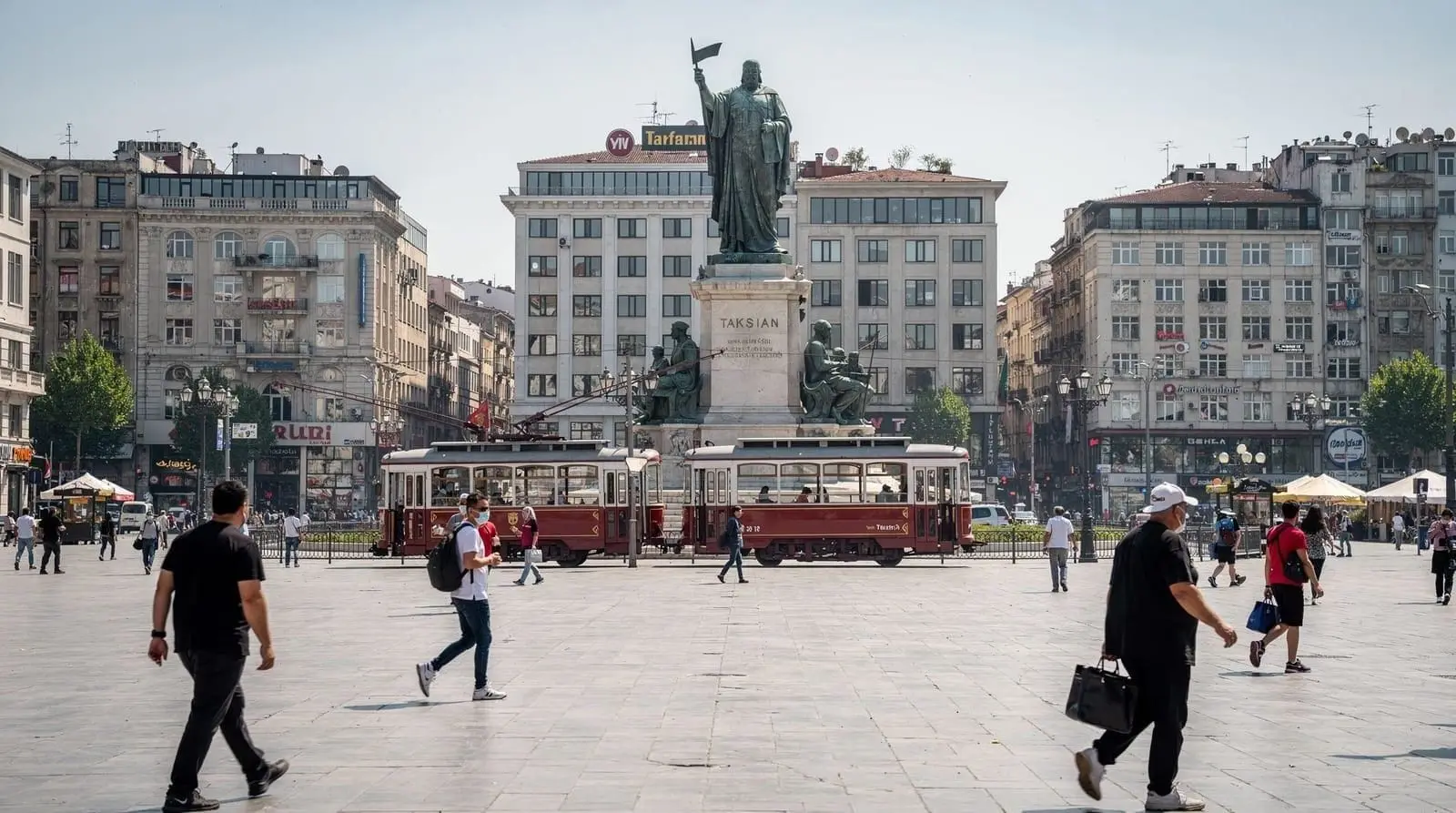
Taksim Square and surroundings
Istanbul's symbolic modern square at the top of İstiklal Avenue — transport hub, Republic Monument, and gateway to Nişantaşı and the city's nightlife.
Explore Istanbul Night Life: Pub Crawl
Quick facts
- Location
- Northern Beyoğlu, European side
- Metro
- Taksim (M2) — direct from Şişli, Osmanbey, Levent
- Symbol
- Republic Monument (Cumhuriyet Anıtı), 1928
- Walk to İstiklal
- Starts here — 3 km south to Tünel
- Nightlife hub
- Bars and clubs concentrated around Taksim Square
- Airport access
- M2 metro connects to Gayrettepe for IST airport M11
Taksim: transport node, symbolic square, and night hub
Taksim Square (Taksim Meydanı) is Istanbul’s most prominent modern public space — familiar from news coverage, political demonstrations, New Year celebrations, and practically every contemporary photograph of the city that is not a mosque or a castle. In person, the square is large, traffic-adjacent, and dominated by the Republic Monument (Cumhuriyet Anıtı, 1928), which depicts Atatürk and other founders of the Turkish Republic in bronze relief. Surrounded by hotels, a cultural centre, and bus and metro infrastructure, the square is more functional than beautiful.
| Where | Northern Beyoğlu, top of İstiklal Avenue |
| Cost | Free — a public square, not a ticketed site |
| Time needed | 1–2 hours as a standalone stop; more if combined with İstiklal or nightlife |
| Getting there | Metro M2 (Taksim station), or the F1 funicular up from Kabataş |
| Best time | Weekday morning as a transit point; evenings from 20:00 for nightlife |
What makes Taksim worth understanding is its role as a node: everything in northern European Istanbul radiates from here. İstiklal Avenue begins here and runs 3 km south to Tünel. The M2 metro line connects Taksim to Levent, Nişantaşı, the new financial district, and — critically for airport connections — Gayrettepe, where you transfer to the M11 line toward Istanbul Airport (IST). Bus services fan out to virtually every district of the city.
As a destination in itself, Taksim rewards the visitor who is oriented toward nightlife, modern urban life, or upscale shopping. As a sightseeing destination, it is secondary to the old city and the Bosphorus.
The AKM: Atatürk Cultural Centre
The large building on the east side of Taksim Square is the Atatürk Kültür Merkezi (AKM), Istanbul’s main opera house and performing arts venue. After decades of closure and renovation (the original 1969 structure was demolished and rebuilt), the new AKM reopened in 2021. It houses the Istanbul State Opera and Ballet and the Istanbul Philharmonic Orchestra, as well as exhibition spaces. Performance tickets vary widely (100–500 TRY) and can be purchased through the venue’s own website. The lobby is open to visitors during operational hours.
Nişantaşı: the genuinely upscale alternative
A 15-minute walk or two metro stops north of Taksim is Nişantaşı, the district where Istanbul’s expensive shopping and eating is actually concentrated. Abdi İpekçi Caddesi has the Turkish outposts of European luxury brands; the side streets have independent boutiques, art galleries, and several of the city’s better mid-to-high range restaurants. If you are interested in contemporary Turkish design, this is more productive than İstiklal Avenue.
Hüsrev Gerede Caddesi and the surrounding streets have a good density of cafés and restaurants aimed at the local professional class rather than tourists. Prices are higher than the old city but the quality generally matches.
Gezi Park: what it is now
Gezi Park, adjacent to Taksim Square on the northwest, was the site of the 2013 Gezi Park protests that began as an environmental demonstration against the park’s redevelopment and broadened into a wider civic movement. The park itself remains; it is a modest green space used by locals. There is no museum or formal commemoration on site. The AKM renovation and the park’s continued existence were outcomes of that period.
Nightlife around Taksim
The streets within walking distance of Taksim — particularly Sıraselviler Caddesi heading south toward Cihangir, and the cluster of bars along the Beyoğlu backstreets — are Istanbul’s primary nightlife concentration. Bars range from small meyhane-style venues with live fasıl music to large clubs with international DJs. The area is genuinely active from approximately 22:00 until 04:00 on Fridays and Saturdays.
Practical notes: entry to most bars is free; drinks run 100–250 TRY (3–7 USD) depending on the venue. Clubs on the fancier end charge entry (200–500 TRY) and enforce dress codes. The specific bar scam detailed on the Beyoğlu page applies equally here — some venues near the square are specifically set up to exploit tourists; always confirm prices before ordering.
The organised pub crawl from Taksim area covers a curated route of vetted venues with included drinks and local guide support — a reasonable option for first-time visitors who want to explore the nightlife scene with less navigational uncertainty. For a livelier group format with transport between venues included, the party bus pub crawl covers a wider circuit in one night.
Choosing where to base yourself: Taksim vs Sultanahmet vs Beyoğlu
| Taksim/Beyoğlu | Sultanahmet | |
|---|---|---|
| Best for | Nightlife, metro access, contemporary Istanbul | Historical sites, walkability |
| Distance to old city sites | 30–45 min (walk + tram) or 20–25 min taxi | Walking distance |
| Evening atmosphere | Genuinely active past midnight | Quiet by 22:00 |
| Airport (IST) access | Direct M2→M11 metro, ~50–60 min | Requires a transfer via tram + metro |
| Hotel prices | Mid-range, wide choice | Higher near the main sites |
If historical sightseeing is the trip’s main purpose, Sultanahmet wins on convenience. If nightlife, restaurants, or a longer stay matter more, Taksim/Beyoğlu is the stronger base — see the staying in Sultanahmet vs Beyoğlu guide for a fuller breakdown.
Transport from Taksim to the rest of the city
To Istanbul Airport (IST): M2 metro from Taksim to Gayrettepe, then M11 metro to Istanbul Airport. Total journey approximately 50–60 minutes. Cost: two Istanbulkart taps (Istanbul Airport has a separate access gate). This is the cheapest reliable option (under 100 TRY total vs 400–700 TRY for a taxi). Check the M11 timetable — the line operates until late but not 24 hours.
To Sultanahmet and old city: No direct metro link. Options: (a) M2 to Vezneciler, then short walk; (b) Taksim to Tünel by walking İstiklal (20 min), then Tünel funicular to Karaköy, then T1 tram to Sultanahmet (15 min); (c) Taxi (15–25 min, 150–250 TRY depending on traffic). The walking + tram option is often faster than a taxi during peak traffic.
To Kadıköy (Asian side): Metro to Vezneciler or walk to Karaköy, then ferry. Total approximately 40–50 minutes.
To Sabiha Gökçen Airport (SAW): Bus service (Havabus) from Taksim, approximately 90 minutes depending on traffic. No direct metro.
Frequently asked questions about Taksim
Is Taksim Square safe?
Generally yes, as it is heavily policed and monitored. The usual Istanbul precautions apply: keep valuables secure in crowds, be alert for bar invitation scams in the evening. The square and surrounding streets are active until late, which provides the safety of numbers.
What is the Republic Monument?
The Cumhuriyet Anıtı was unveiled in 1928 to mark five years of the Republic of Turkey. The sculptor was Pietro Canonica, an Italian. The central figure on the primary face is Atatürk in military uniform; other faces depict İsmet İnönü and Fevzi Çakmak, key figures of the independence war. The monument is a significant national symbol and is the focal point of Republic Day (29 October) ceremonies.
How do I get from Taksim to Sultanahmet?
The most reliable route: walk İstiklal to Tünel (20–25 minutes), take the Tünel funicular down to Karaköy (2 minutes), then board the T1 tram toward Kabataş and exit at Sultanahmet (about 10 minutes). Alternatively, take a taxi, which runs 150–250 TRY and 15–25 minutes depending on traffic.
Is there a tourist trap restaurant in Taksim?
Several. The immediate vicinity of Taksim Square, particularly on Cumhuriyet Caddesi heading north, has a concentration of restaurants with English-language menus, laminated photograph boards, and aggressively welcoming hosts. These tend toward poor value. For better food, walk 10 minutes in any direction from the square itself.
Can I walk from Taksim to the Bosphorus?
Yes — walk south on İstiklal to Tünel (20 min), then continue downhill through Karaköy to the waterfront (another 10 min). Total walk about 30–35 minutes. From the Karaköy waterfront, you are directly at the ferry piers and can see the Bosphorus and the Asian shore clearly.
Is Taksim a good area to stay for a first Istanbul visit?
It depends on priorities. For historical sightseeing, Sultanahmet is more convenient — everything is walkable. For nightlife, restaurants, and easier metro access to the airport and business districts, Taksim/Beyoğlu is the better base. Many longer-stay visitors split their trip between the two.
How do I get from Taksim to Istanbul Airport?
Take the M2 metro from Taksim to Gayrettepe, then transfer to the M11 line directly to Istanbul Airport (IST). Total journey is roughly 50–60 minutes and costs under 100 TRY with an Istanbulkart — considerably cheaper than a taxi, which runs 400–700 TRY depending on traffic.
Taksim’s political and social history
The square’s name derives from the Ottoman water distribution system: taksim means “distribution” in Arabic-derived Turkish, and the 18th-century Ottoman water distribution reservoir (taksim) that stood here fed the aqueducts serving Galata and Beyoğlu. The reservoir was demolished; the square developed in the late Ottoman period as Beyoğlu expanded northward.
Through the 20th century Taksim became Istanbul’s symbolic civic space — the site of Republic Day parades, political rallies, and major celebrations. It was also the site of significant violence: the 1977 Taksim Square massacre on May Day, when gunfire from buildings around the square killed at least 34 people amid a crowd of hundreds of thousands, remains a defining moment in Turkish political memory. The square was subsequently closed to left-wing and labour demonstrations for years.
The 2013 Gezi Park protests began in the adjacent park and spread nationally — the event fundamentally altered Turkish political dynamics and the relationship between civil society, the government, and urban public space. The square has been the site of multiple terrorist attacks in recent decades; its security presence reflects this history.
For most visitors, this political history is visible primarily in the security infrastructure and the monument itself, not in anything that disrupts a normal visit. But understanding the square as a politically charged space — rather than a simple tourist plaza — is part of understanding Istanbul.
The neighbourhoods reachable on foot from Taksim
Cihangir: 15 minutes south and west of Taksim, Cihangir is a hillside residential neighbourhood favoured by Istanbul’s creative class, academics, and foreign journalists. The streets are narrow, sloped, and cat-filled; the weekend flea market at Cihangir Park sells a mix of antiques, books, and household goods. The café scene is independent and non-tourist-facing. Cihangir Kebap at the bottom of the hill is a well-regarded dürüm spot.
Nişantaşı: 10–15 minutes north of Taksim via Cumhuriyet Caddesi, this is Istanbul’s upscale shopping and dining district. Abdi İpekçi Caddesi has Turkish luxury brands and international fashion. The Vakko department store is the main reference point for quality Turkish textiles. The Maçka area at the northern end has several good mid-to-high range restaurants.
Fındıklı and Kabataş: heading south from Taksim toward the Bosphorus, the streets descend through Kabataş (end of the T1 tram line) to the Bosphorus waterfront. From here, the Dolmabahçe Palace is a 10-minute walk south.
Harbiye: north of Taksim, Harbiye houses the Istanbul Military Museum (Askeri Müze), which holds significant Ottoman and Turkish military artefacts and occasionally performs Ottoman Mehter (Janissary band) concerts in the courtyard. Hours and concert schedules vary; check on arrival.
Şişli: a further metro stop or two north along the M2 line, Şişli is a dense commercial and residential district that most visitors pass through rather than visit deliberately — but it has practical value as a base for longer stays thanks to lower hotel prices than Taksim itself and direct metro access to both the old city and the airport line.
Accommodation context: Taksim vs. Sultanahmet
A common visitor decision is whether to base in Taksim/Beyoğlu or in Sultanahmet. The honest comparison:
Sultanahmet puts you within walking distance of the major historical sites (Hagia Sophia, Blue Mosque, Topkapı, Grand Bazaar) and is compact and walkable. Hotel prices in the central Sultanahmet area tend to be higher, and the immediately surrounding restaurants are tourist-priced. The T1 tram connects to Karaköy and onward to Kabataş.
Taksim provides better metro connectivity to the rest of the city (M2 line), proximity to the nightlife and restaurant scene of Beyoğlu, and a more mixed residential/tourist atmosphere. It is further from the old city (30–45 minutes by foot + tram, or 20–25 minutes by taxi depending on traffic).
For a first Istanbul visit focused on historical sites: Sultanahmet is more practical. For a longer stay or a visit more focused on contemporary Istanbul, restaurants, and nightlife: Taksim/Beyoğlu makes sense. The two areas are different enough in character that the choice shapes the quality of the experience.
Practical details: what’s near Taksim Square
Within a 5-minute walk of the main square:
- Multiple ATMs (all major Turkish banks represented)
- 24-hour pharmacies on Cumhuriyet Caddesi
- Several grocery stores open until midnight or later
- The main tourist information point (İstanbul Büyükşehir Belediyesi tourism office at the AKM)
- Taxis available at the dedicated stand on Taksim Square
- The metro M2 station (underground, clearly signed)
Getting the most from the Taksim area on a limited time budget
If you have only an evening in the Taksim/Beyoğlu area, a practical sequence:
18:00: Arrive at Taksim Square. Observe the square briefly; consider the Republic Monument and the AKM facade.
18:15–19:00: Walk south along İstiklal Avenue to approximately the midpoint (Galatasaray Square). Turn left into one of the side streets toward Asmalımescit. This is where Istanbul’s best evening eating and drinking is concentrated in a walkable area.
19:00–21:00: Dinner at one of the Asmalımescit meyhane venues — try Cumhuriyet Meyhanesi or Yakup 2 for traditional raki and meze. Budget 500–800 TRY per person including drinks. These are the venues where Istanbul’s cultural intelligentsia eats; the food and atmosphere are both genuine.
21:00 onwards: Either continue south to Karaköy for the waterfront café scene, or return north to the bar area around Taksim Square for the nightlife if that is the intention.
This routing avoids the worst tourist-trap concentrations while covering the best of what the district offers in sequence.
Honest assessment of Taksim as a visitor base
Several Istanbul hotels market themselves as “Taksim location” — this is accurate geography but worth unpacking. Taksim Square is not especially pleasant to be in; it is large, surrounded by traffic, and without the architectural character of the Sultanahmet streets. The appeal of a Taksim-area hotel is not the square itself but the metro access (M2 line for airport and business district), the walking distance to İstiklal Avenue, and the proximity to Beyoğlu’s restaurants and nightlife.
For visitors whose primary focus is the historical old city, the T1 tram journey from a Sultanahmet hotel is actually shorter than the reverse journey from Taksim, and the immediate neighbourhood is more historically interesting. For visitors whose priority is contemporary Istanbul — restaurants, gallery openings, nightlife, Bosphorus ferry access from Kabataş — a Taksim or Beyoğlu base makes more sense. The two neighbourhoods are both valid; the choice depends on what you are in Istanbul to experience.
Taksim and the broader urban context
Taksim Square sits at the junction between İstiklal Avenue’s pedestrian zone, the commercial districts of Nişantaşı and Şişli to the north, and the descent to Kabataş and the Bosphorus to the south. This geography makes it a circulation node more than a destination. The major developments adjacent to the square — the AKM cultural centre, Gezi Park, the traffic interchange — are all functional rather than decorative. The square works best understood as a transit space that you pass through on the way to more specific destinations rather than a destination in itself.
This is in contrast to European equivalents like Trafalgar Square or Piazza Navona, which are destinations in themselves. Taksim’s role in Istanbul is more akin to a major railway junction — important for getting to the right train, not for lingering. Adjust your expectations accordingly and you will find the district around it rewarding; arrive expecting a showpiece and you may be disappointed.
Transport connections from Taksim in detail
M2 metro line: Taksim is the central hub of the M2 line, which connects:
- Northward to Şişli, Mecidiyeköy, Levent (business and financial district), and Sarıyer
- Southward to Şişhane (near Galata Tower), Haliç (near Balat/Fener), and further into the old city
Metro M7 and M9 connections: transfers at various points along the M2 provide connections to additional lines serving the expanding city.
Airport connections: the M2 connects at Gayrettepe to the M11 direct line to Istanbul Airport (IST). Total journey from Taksim to IST approximately 50–60 minutes; combined fare under 100 TRY. This is the most practical cheap option for IST.
Buses from Taksim: The bus network fanning out from Taksim Square covers routes the metro doesn’t reach directly — useful for Ortaköy along the Bosphorus shore, or for connecting to Beşiktaş without doubling back through Kabataş. Istanbulkart works on all bus lines; check the destination board on the front of the bus, as route numbers alone can be confusing for first-time visitors.
Late-night options: The M2 metro runs until around midnight on weeknights and slightly later on weekends, after which taxis or ride-hailing apps are the only option back to Sultanahmet or the airport. Confirm the meter is running in a taxi, or use the BiTaksi app, which shows an estimated fare upfront and reduces the risk of the “broken meter” scam that occasionally targets visitors leaving nightlife venues late.
The Füniküler: the Taksim-Kabataş funicular (F1 line) is a short two-stop underground funicular running from Taksim Square down to Kabataş on the Bosphorus shore. The journey takes about 4 minutes. At Kabataş, the T1 tram continues to Sultanahmet (15 minutes) or you can board Bosphorus ferries. This is the fastest route from Taksim to the old city without a taxi.
Asmalımescit and the meyhane culture
The Asmalımescit neighbourhood, a short walk southwest of Taksim Square toward the Bosphorus, is Istanbul’s reference area for traditional meyhane dining. A meyhane is a Turkish tavern-restaurant where the format is: raki (the anise-flavoured spirit, diluted with water), a sequence of cold and hot meze dishes, fish, and extended conversation. The ritual is social rather than rapid; a meyhane dinner is expected to last 2–3 hours.
The meyhane tradition is rooted in Istanbul’s cosmopolitan minority communities — Greek, Armenian, and Jewish tavern culture in Beyoğlu going back to the 19th century. Contemporary meyhanes are mostly Turkish-owned but maintain the format. Cumhuriyet Meyhanesi and Yakup 2 are long-standing institutions; newer venues have opened as the neighbourhood gentrified.
A meyhane dinner for two, with raki and several rounds of meze, runs approximately 800–1,500 TRY (24–45 USD). The quality-to-price ratio is among the best in Istanbul’s restaurant scene for the overall experience.
Beyoğlu’s street cats and their significance
One of the most remarked-upon features of Istanbul is its street cat population — the city has hundreds of thousands of semi-wild cats that live in the streets, are fed by residents, and operate as informal neighbourhood inhabitants. Beyoğlu and the streets around Taksim have a high concentration.
This is not simply a curiosity. Istanbul’s relationship with its cats is documented in Kedi (2016), a well-regarded documentary film that uses the city’s cats as a lens on urban community. The cats are genuinely embedded in neighbourhood social life; residents know individual cats, feed them, and mourn their passing. For visitors, the cats are both a pleasant constant in the streetscape and an insight into the informal networks of care that operate alongside the city’s official infrastructure.
Top experiences
Bookable activities with verified prices and instant confirmation on GetYourGuide.
