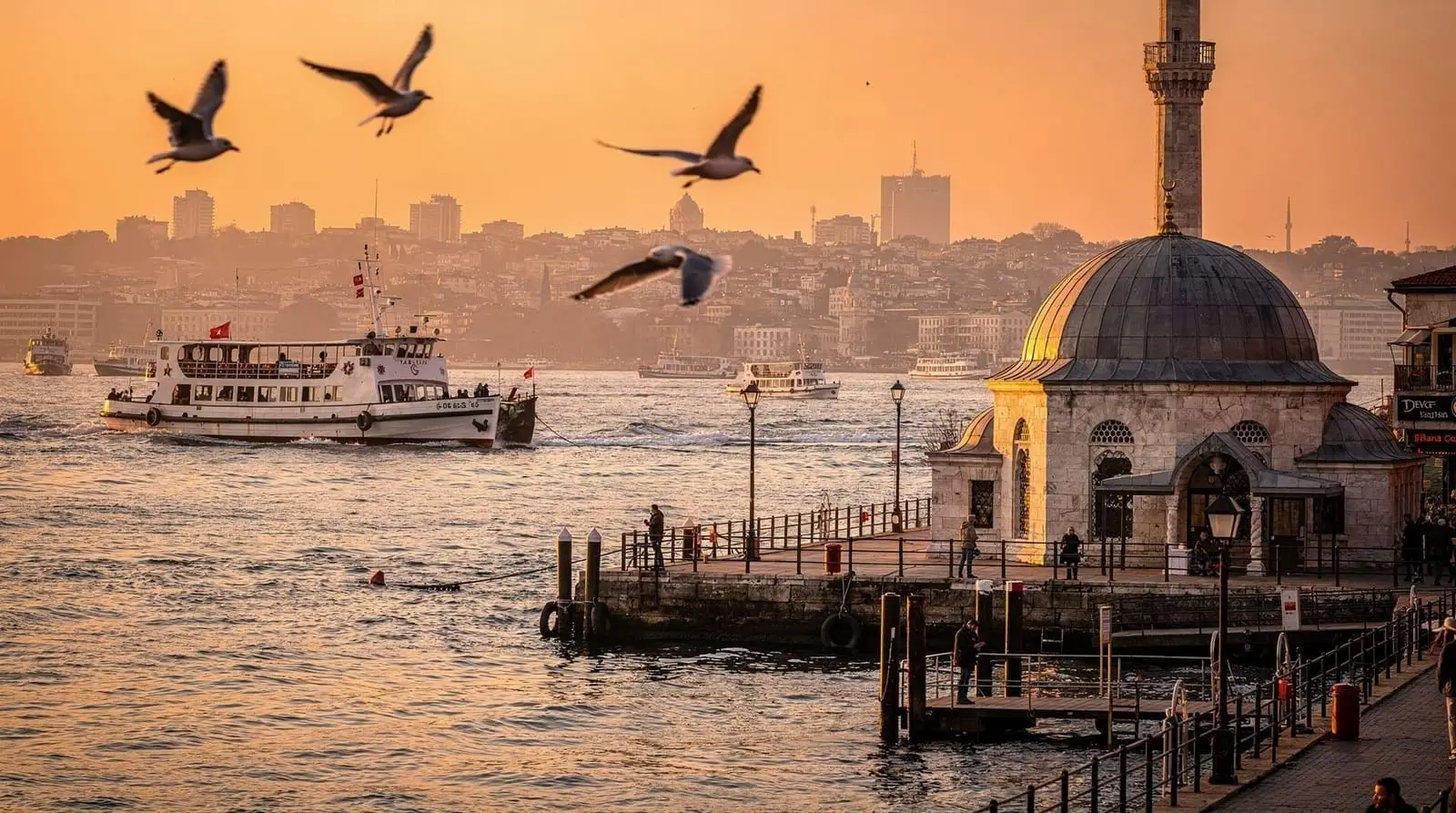
Üsküdar
Istanbul's most traditional Asian-shore district — Sinan mosques, ferry views of the European skyline, Maiden's Tower offshore, and a genuinely local
Istanbul: Asian Side Uskudar & Kadikoy Tour with Lunch
Quick facts
- Location
- Asian shore, directly opposite Seraglio Point
- Ferry from Eminönü
- ≈ 20 minutes, Istanbulkart
- Famous for
- Maiden's Tower offshore, historic mosques, seafront promenade
- Character
- Conservative, traditional, local — very different from Beyoğlu
- Market
- Doğancılar Park area; Pazartesi pazarı (Monday market)
- Nightingale Hill
- Çamlıca Hill, 15 min by taxi — panoramic Istanbul view
Üsküdar: the Asian shore’s oldest neighbourhood
Üsküdar (historically Chrysopolis — “Golden City” in Greek) has been settled since the 7th century BCE, making it older than Byzantium on the European shore. For much of Ottoman history it was the starting point of the overland pilgrimage route to Mecca (the Hac Yolu) and had a character defined by religious institutions, merchant caravanserais, and military camps. Today it remains Istanbul’s most traditionally oriented Asian-shore district — quieter than Kadıköy, more residential, with a visible religious observance that makes it feel materially different from the European city across the water.
| Where | Asian shore, directly opposite Seraglio Point |
| Cost | Free to walk; Maiden’s Tower entry ~150 TRY |
| Time needed | Half a day; a full day combined with Kadıköy |
| Getting there | Ferry from Eminönü or Karaköy (~20 min), or Marmaray rail (~5 min) |
| Best time | Morning, for the European skyline in good light on the crossing over |
For visitors, Üsküdar offers a different Istanbul experience: the ferry crossing itself gives you a 20-minute view of the old city skyline from the water that is among the best in the city; the Maiden’s Tower sits just offshore; and the neighbourhood has several genuinely significant smaller mosques that see few foreign visitors.
The ferry crossing
The Eminönü or Karaköy to Üsküdar ferry is one of Istanbul’s most pleasurable 20-minute journeys. The European skyline — Topkapı Palace’s domes, Hagia Sophia’s minarets, the Süleymaniye complex — fills the western horizon as you cross. In early morning the light comes from the east and illuminates the European shore directly. The fare is a standard Istanbulkart tap.
The return journey from Üsküdar has the Asian shore’s hills and the Maiden’s Tower in the foreground. Morning is best for the European view heading over; afternoon and sunset are better on the return.
The mosques worth entering
Mihrimah Sultan Mosque (Mihrimah Sultan Camii): built in 1547–1548 for Süleyman the Magnificent’s daughter Mihrimah, designed by the great Ottoman architect Sinan. This is one of Sinan’s earlier major works, and the interior demonstrates his developing approach to light management — a single large dome with a ring of windows in the drum letting in diffuse light throughout the day. Entry is free; dress appropriately (shoulders and knees covered, women cover hair). The mosque is active and sees relatively few tourists compared to the imperial mosques of Sultanahmet.
Şemsi Ahmed Pasha Mosque (Şemsi Ahmet Paşa Camii): a tiny and exquisite mosque by Sinan, built 1580, directly on the Bosphorus waterfront at the Üsküdar pier. It is one of the smallest mosques Sinan designed — a single dome, minimal decoration — and its position on the water’s edge is remarkable. The view from the mosque’s courtyard back across to the European shore is one of the best in Üsküdar.
Yeni Valide Mosque (Yeni Valide Camii): a larger 18th-century imperial mosque near the main square, built 1710. Significant but less architecturally distinctive than the Sinan-designed buildings.
The Maiden’s Tower
The Maiden’s Tower (Kız Kulesi) — a small tower on a rocky islet 200 metres offshore — is Üsküdar’s most visited specific attraction. Ferry service to the tower departs from the Üsküdar waterfront. The tower has an entry ticket (approximately 150 TRY in 2025), audio guide, and a café inside. Entry tickets with audio guide are available to pre-book; the boat service is included. The tower is covered in detail on its own page: Maiden’s Tower.
Çamlıca Hill
Büyük Çamlıca (Great Nightingale Hill), about 3 km inland from the Üsküdar ferry pier, is the highest point on the Asian shore and offers a panoramic view of Istanbul, the Bosphorus, and the Sea of Marmara that is genuinely comprehensive. The hill has been landscaped as a public park with cafés, a new mosque (the Çamlıca Mosque, completed 2019 — one of Turkey’s largest, capacity 37,500), and several observation terraces. A taxi from the Üsküdar pier takes approximately 15 minutes; rideshare also works well. The view is best in clear morning or late afternoon light.
The Çamlıca Mosque is visually imposing (the main dome’s diameter matches that of Hagia Sophia) and is free to visit, though its 2019 vintage means it lacks the historical weight of the city’s older mosques.
Eating in Üsküdar
The neighbourhood has a working commercial centre around the main square (Hakimiyeti Milliye Square), with lokanta restaurants, a fish market, and street food vendors. Prices are local — a lunch at a neighbourhood lokanta runs 150–250 TRY (4.5–7.5 USD).
The waterfront promenade (İskele Meydanı to Şemsi Ahmed Pasha mosque area) has several çay houses and simple cafés with Bosphorus views. These are significantly cheaper than comparable spots on the European shore.
Combining Üsküdar with an Asian shore day
Üsküdar and Kadıköy are the two main Asian-shore destinations and work well together in a single day:
- Ferry from Eminönü to Üsküdar (morning).
- Walk to Şemsi Ahmed Pasha mosque (5 minutes from pier).
- Visit Mihrimah Sultan mosque and the main neighbourhood square (30–45 minutes).
- Optional: taxi to Çamlıca Hill for the panorama (45 minutes–1 hour).
- Bus or taxi to Kadıköy (15–20 minutes) for lunch and market.
- Ferry back from Kadıköy to Eminönü or Karaköy (afternoon).
The guided Asian side tour covering Üsküdar and Kadıköy includes lunch and a local guide who navigates the market area and explains the historical context.
Frequently asked questions about Üsküdar
Is Üsküdar touristy?
Very little, compared to the old city or Beyoğlu. Foreign visitors are uncommon in the main residential streets. This is part of the appeal — the neighbourhood operates on its own terms, and tourists are a minority. Some menus may not have English translations; pointing and smiling works reasonably well.
Is Üsküdar conservative?
More visibly so than most Istanbul neighbourhoods. Headscarves are more common, alcohol is less visible (fewer bars, though not absent), and the general atmosphere is closer to a Turkish provincial city than to the cosmopolitan European districts. This is worth knowing for setting expectations, not as a warning.
How do I get from Üsküdar to Kadıköy?
Bus or taxi, approximately 15–20 minutes. There is also a water taxi (deniz taksi) from the Üsküdar pier to Kadıköy, which is more expensive but scenic.
Should I stay in Üsküdar or on the European side?
Most first-time visitors are better off staying in Sultanahmet or Beyoğlu, since the majority of sights and restaurants are concentrated there. Üsküdar makes a more interesting base for a longer stay or a return visit, when the quieter, more residential atmosphere and easy ferry access to both the old city and the Bosphorus become an advantage rather than an inconvenience.
Is one visit to Üsküdar enough, or does it deserve more time?
A half day covers the ferry crossing, the two main Sinan mosques, and either the market square or Çamlıca Hill comfortably. A full day, combined with Kadıköy, is the better use of time if the Asian shore interests you generally rather than Üsküdar specifically.
Üsküdar’s literary and cultural associations
Üsküdar has an unusually prominent place in Turkish cultural memory. The Ottoman song “Üsküdar’a Gider İken” (When Going to Üsküdar), one of the most recognisable pieces of Turkish folk music, dates its current form to the 18th century. The lyrics describe the journey across the Bosphorus to Üsküdar from a female narrator’s perspective — a domestic account of the ferry crossing from the European city to the Asian shore that resonates because the crossing itself has been a daily experience for Istanbulites for centuries.
The neighbourhood also features significantly in Orhan Pamuk’s writing — the Nobel laureate grew up in Nişantaşı on the European side but has extensively described the Asian shore’s character, and Üsküdar’s mosques, cemeteries, and waterfront appear in various works. If you are a Pamuk reader, the crossing to Üsküdar will have specific resonances.
Florence Nightingale’s Crimean War hospital operated at the Selimiye Barracks in Üsküdar from 1854 — the barracks building (still used by the Turkish military) contains a small museum dedicated to her work. The museum is open on limited days to visitors with advance arrangement; contact the Selimiye Barracks for current access information.
The Büyük Selimiye Cami and other mosques
Beyond the Mihrimah Sultan and Şemsi Ahmed Pasha mosques described above, Üsküdar has several other significant mosque buildings:
Yeni Valide Camii (1710): a large 18th-century imperial mosque directly at the ferry pier. The donor was Gülnuş Sultan, the Valide Sultan (sultan’s mother) of Mustafa II and Ahmed III. The building is handsome and well-maintained; the interior is proportionally generous. Being at the pier, it is the first mosque you encounter stepping off the ferry.
Rum Mehmet Pasha Camii (1471): one of the oldest surviving buildings in Üsküdar, built just after the conquest of Constantinople and designed by Christodoulos, a Greek architect working for Ottoman patrons — an early example of the cultural mixing that characterised early Ottoman construction. The mosque is small and rarely visited by tourists; it is architecturally important as a transitional structure between Byzantine and early Ottoman styles.
Beylerbeyi Camii (1778): slightly north along the shore, this Baroque mosque is by a different architectural sensibility than the Sinan buildings — lighter, more decorative, with a grace that reflects 18th-century Ottoman absorption of European aesthetic influences.
Üsküdar cemeteries: reading Ottoman history in stone
Istanbul’s cemeteries are densely informative about Ottoman and Turkish history, and Üsküdar has some of the most significant. The large cemetery complex at Bülbülderesi Mezarlığı (just inland from the main mosque area) contains Ottoman graves dating from the 17th century to the present. The tombstones include the tall cylindrical Ottoman turban markers for men and the distinctive female markers with floral carvings; later Ottoman stones have Arabic-script inscriptions; Republican-era stones have Latin-script Turkish.
For anyone interested in how Ottoman society organised rank, gender, and religious identity, walking through a large Istanbul cemetery is instructive. The turban style on a man’s tombstone indicated his rank and guild affiliation; a scholar’s stone would have a different turban from a janissary’s or a court official’s. The translation from Arabic to Latin script on the markers is a visible record of the 1928 alphabet reform.
Getting around Üsküdar and connecting to other Asian-side destinations
To Kadıköy: Bus lines 12T, 12KD, and others from the Üsküdar bus terminal, approximately 15–20 minutes. Minibus (dolmuş) is faster but less frequent.
To Çamlıca Hill: Taxi approximately 15 minutes, 80–120 TRY. Rideshare options (BiTaksi/Uber) are more predictable in pricing.
To Anadolu Hisarı (Ottoman castle on the Bosphorus shore, further north): taxi or bus approximately 30–40 minutes. The castle is worth the journey for serious history visitors; the surroundings are quiet and the structure is intact.
To Sabiha Gökçen Airport (SAW): direct bus service from Üsküdar, approximately 45–60 minutes depending on traffic. The M4 metro from Ayrılık Çeşmesi (reached by metro from Kadıköy) also connects to the airport direction but involves a transfer.
To Beşiktaş: a passenger ferry crosses directly from Üsküdar to Beşiktaş in about 15 minutes, useful if Dolmabahçe Palace or the Bosphorus waterfront is next on your route rather than doubling back through Eminönü.
Üsküdar compared with Kadıköy
Both are Asian-shore districts, but they suit different travellers. The table below is a quick gut-check for which to prioritise if time only allows one.
| Üsküdar | Kadıköy | |
|---|---|---|
| Atmosphere | Traditional, conservative, quieter | Bohemian, younger, nightlife-oriented |
| Main draws | Sinan mosques, Maiden’s Tower, Çamlıca Hill | Food market, bars, independent shops |
| Best for | History and mosque architecture | Food, café culture, evening atmosphere |
| Alcohol/nightlife | Limited | Widely available |
| Combine well with | Çamlıca Hill, Beylerbeyi | Moda seafront, Bosphorus ferry |
For a single Asian-shore afternoon, most first-time visitors get more variety from Kadıköy; for a quieter, more traditional slice of Istanbul life, Üsküdar wins. Doing both in one day, as outlined above, is entirely feasible and gives the fullest picture. For a broader framing of how the Asian side fits into an Istanbul trip, see the Asian side Istanbul guide.
Üsküdar market culture
The main commercial market area around Üsküdar Square (Hakimiyeti Milliye Meydanı) operates daily. The covered market hall (Üsküdar Çarşısı) focuses on food, textiles, and household goods at local prices. Wednesday and Saturday bring a larger outdoor street market that extends through several adjacent streets — vegetables, fruit, dairy, clothing, and practical household items aimed at residents.
This is genuinely useful for provisioning if you are staying nearby, and it gives a clear picture of what day-to-day shopping looks like for Istanbul residents on the Asian side: considerably different from the Grand Bazaar or Spice Bazaar tourist economy on the European shore.
The Hakimiyet-i Milliye Square and the Selimiye Barracks
Üsküdar’s central square (officially Hakimiyet-i Milliye Meydanı, though locals often just call it Üsküdar Meydanı) is the gathering point for the neighbourhood — the ferry pier, the mosque, the market streets, and the bus terminal all converge here. It is a functional space rather than a decorative one, but watching it for 20 minutes reveals the rhythm of Asian Istanbul: the ferries arriving and departing, commuters in business dress, headscarved women with shopping bags, schoolchildren, street vendors.
The Selimiye Barracks, a large Ottoman military complex on the hill above Üsküdar, is the building where Florence Nightingale and her nurses worked during the Crimean War (1854–56). The barracks building is still used by the Turkish military and is not generally open to the public; the Florence Nightingale Museum within the complex is accessible to visitors with advance arrangement. Contact the Turkish military liaison or the museum’s official contact to arrange a visit.
Practical visitor information for Üsküdar
Getting there: Eminönü or Karaköy ferry to Üsküdar is the recommended approach — 20–25 minutes, Istanbulkart fare, Bosphorus views included. The Marmaray rail tunnel also connects the European side to the Asian side with a stop near Üsküdar (Üsküdar Marmaray station), offering a 5-minute underground crossing if you prefer the train. Marmaray uses the Istanbulkart.
Opening hours for the mosques: Mihrimah Sultan and the other historical mosques are generally open for visits between the five daily prayer times. The approximate prayer times vary seasonally; the most convenient visiting hours for tourists are 09:00–11:30 and 14:00–15:30, which fall between the morning and midday prayers and between the midday and afternoon prayers. The mosque will be closed and access restricted during the 15–20 minutes of each prayer.
Dress code: entering any mosque in Turkey requires covering shoulders and knees (both male and female visitors), removing shoes at the entrance (bags are typically provided), and women covering their hair with a scarf (scarves are usually available at the entrance). These requirements are strictly observed in Üsküdar’s mosques, which serve a conservative local community, more so than in some tourist-oriented mosques in Sultanahmet.
Eating on a budget: the market area lokanta restaurants serve a fixed-menu lunch (çorba, a main, a small dessert, bread) for approximately 120–200 TRY (3.5–6 USD). These are not restaurants — they are cafeteria-style halls with the day’s dishes displayed in heated trays, and you point to what you want. Quality is home-cooking level; this is how many neighbourhood workers eat lunch.
The Bosphorus from the Asian shore: a different perspective
The view from the Üsküdar waterfront toward the European city is one of Istanbul’s most consistently rewarding. In the foreground: the Maiden’s Tower on its small islet. In the middle distance: the Bosphorus with its continuous traffic of ferries, tankers, and small boats. On the western horizon: the old city peninsula of Sultanahmet, with the dome of Hagia Sophia, the minarets of the Blue Mosque, and the Topkapı Palace walls visible.
This view is best from the ferry itself while crossing (roughly at the midpoint of the crossing). From the Üsküdar waterfront on land, the view is also good — particularly from the Şemsi Ahmed Pasha mosque’s small jetty area, where sitting and looking west across the water is the entire programme. The quality of light varies: morning gives the European shore in direct east-facing light; afternoon and evening give the most atmospheric versions as the sun drops behind the old city.
The European skyline from the Asian shore is the panoramic view that makes visitors understand Istanbul’s geography in a way that no map or photograph from the land can convey. If you make only one Bosphorus crossing, make it in the direction of Üsküdar from Eminönü on a clear morning.
Top experiences
Bookable activities with verified prices and instant confirmation on GetYourGuide.
