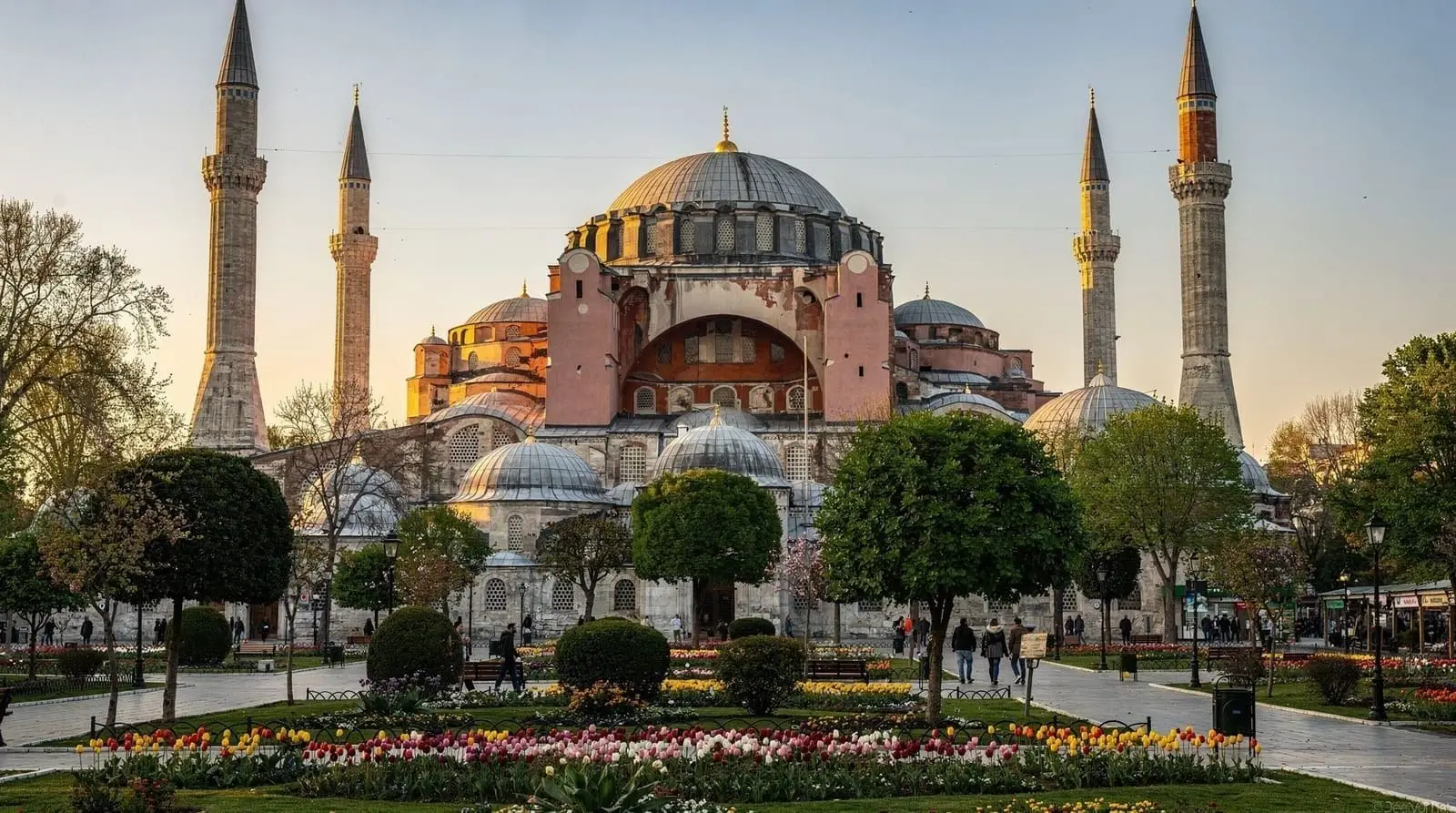
Hagia Sophia — visitor guide and honest tips
Everything you need to visit Hagia Sophia in Istanbul — tickets, dress code, what to see inside, and when to go to avoid the queues.
Istanbul: Hagia Sophia Skip-the-Line Ticket & Museum Option
Quick facts
- Built
- 537 CE (Justinian I)
- Entry
- Rules and price set by the Ministry of Culture and Tourism — check its official site
- Time needed
- 90 minutes to 2 hours
- Getting here
- Tram T1 to Sultanahmet stop
- Dress code
- Shoulders and knees covered; women cover hair
Fifteen centuries in a single building
Hagia Sophia (Ayasofya in Turkish) has been three things in its history: the greatest cathedral in Christendom, the chief imperial mosque of the Ottoman Empire, and a secular museum. Since 2020 it has been a functioning mosque again, with a tourist section open during non-prayer hours.
| Where | Sultanahmet, old city — Tram T1 to Sultanahmet stop |
| Cost | Check current rules and price on the Ministry of Culture and Tourism site |
| Time needed | 90 minutes to 2 hours |
| Dress code | Shoulders and knees covered; women cover hair |
| Best time | Weekday mornings before 9am; avoid summer afternoons |
Full step-by-step visiting tips are in our Hagia Sophia visiting guide.
That sequence of uses — each adding layers over the last rather than erasing them — is what makes Hagia Sophia unlike any other building in the world. The 6th-century Byzantine mosaics remain on the walls and ceiling. The Ottoman calligraphic roundels hang above the nave. The minbar for Friday prayers sits near the same spot where the Christian altar once stood. The Mihrab points toward Mecca while facing, approximately, east — toward Jerusalem.
Building and history
Emperor Justinian I commissioned the current structure in 532 CE, after a previous church on the site burned in the Nika Revolt. The architects Isidore of Miletus and Anthemius of Tralles were mathematicians, not traditional builders — they designed the dome using geometric principles that the construction industry at the time had never tried at this scale.
The dome is 55.6 meters high at its apex and 31.8 meters in diameter. When it was completed, the interior was the largest enclosed space in the world. The dome appears to float because its base is pierced by 40 windows, filling it with light and visually separating it from the walls below.
Justinian reportedly said at the dedication: “Solomon, I have outdone thee.” The building was the centerpiece of Constantinople for 916 years.
In 1453, Mehmed II entered Constantinople and immediately visited Hagia Sophia. He prayed in the direction of Mecca, and the building was converted to a mosque within days. The Byzantine mosaics were plastered over (preserving them, in retrospect), a minaret was added (eventually four), and the church furnishings were replaced with Islamic ones.
In 1934, Atatürk’s government converted it to a museum — a deliberate symbol of secular Turkish nationalism, removing it from active religious use. In July 2020, a Turkish court ruled that the 1934 conversion was invalid, and it was reconverted to a mosque by Presidential decree.
What you see inside
The main nave and dome: The immediate visual impact of the interior is the sheer scale and the quality of light through the dome windows. The original gold mosaic background of the dome interior, depicting Christ Pantocrator, was whitewashed by the Ottomans; what you see overhead today is mostly 9th-century and later Byzantine work in the arches and tympanum walls.
The Deësis mosaic: In the upper south gallery (accessible via a ramp), this 13th-century mosaic panel showing Christ flanked by the Virgin Mary and John the Baptist is the finest surviving example of late Byzantine mosaic work. The modeling of the faces — especially Christ’s — is considered the high point of Byzantine figural art.
The Imperial door mosaic: Above the vestibule entrance, a 9th-century mosaic shows Emperor Leo VI prostrate before Christ, with medallion portraits of the Virgin and the Archangel Michael. This doorway was reserved for the Emperor.
The Weeping Column: In the northwest of the nave, a column with a bronze cladding has a small hole worn smooth. Legend says St. Gregory the Miracle-Worker appeared here; pilgrims insert a finger and make a wish. The hole is real; the story is medieval.
Ottoman additions: The four massive wooden calligraphic roundels (diameter ~7.5 meters each) were installed in the 19th century. They show the names of God, the Prophet Muhammad, and the first four Caliphs. They were lowered in the museum period; since 2020 they hang again at full height.
The upper gallery: Access via a long sloping ramp. The gallery offers close-up views of the main dome mosaics and contains the Deësis panel plus several other mosaic fragments. There’s a red stone circle marking where the Byzantine Empress sat.
Dress code and practical entry
Hagia Sophia operates as a functioning mosque. Tourist access is structured around prayer times, which occur five times daily (timing varies by season; the noon and Friday prayers are longest). During prayer times, the tourist section closes to non-Muslim visitors.
Dress requirements: Shoulders covered, knees covered (both men and women). Women must cover their hair — free headscarves are distributed at the entrance, but bringing your own is cleaner and faster. Shoes are removed at the entrance and placed in provided bags.
Dress code enforcement: It’s real and consistent. Guards turn people away; there is no exception for “just a quick look.”
Entry fee: Entry rules and ticket prices are set by the Ministry of Culture and Tourism and change, so check the current rules and price on its official site before going.
Getting tickets: The official Turkish government ticketing site (muze.gov.tr) and GetYourGuide both sell skip-the-line options. In summer, these are worth buying — walk-in queues can reach 60–90 minutes from mid-morning onward.
Timing and crowd management
Best arrival: Weekdays between 8:30am (opening) and 10am. In peak season (July–August), this makes the difference between a 10-minute entry and a 90-minute queue.
Worst times: Saturday and Sunday from 11am to 3pm in summer. Major Turkish and religious holidays.
Afternoon prayer (Asr): Typically mid-afternoon. Plan to be inside and finished by early afternoon to avoid the closure window.
Photography: Permitted throughout the tourist section. Flash may be restricted in the upper gallery near the mosaics. Tripods are generally not allowed inside.
Combining Hagia Sophia with nearby sites
Hagia Sophia sits within a 10-minute walk of the Blue Mosque, the Basilica Cistern, and the Hippodrome (part of Sultanahmet). A practical morning sequence: arrive at Hagia Sophia by 8:30am, spend 90–120 minutes inside, walk to the Hippodrome monuments (free, 20 minutes), then visit the Blue Mosque (check prayer schedule first).
The Topkapı Palace entrance is 300 meters from the Hagia Sophia exit, through the Gülhane Park area. Combining both in a single day is possible but tiring — Topkapı alone takes 3–4 hours.
For context on Byzantine history beyond Hagia Sophia, the Chora / Kariye church in the Edirnekapı neighborhood has comparable mosaics in a smaller, less crowded space. It requires a taxi or longer tram ride (~30 minutes from Sultanahmet).
The Grand Bazaar is a 15-minute walk from the exit, via Çemberlitaş. The Spice Bazaar is reachable by Tram T1 to Eminönü (two stops).
The surrounding Sultanahmet complex
Hagia Sophia sits within a cluster of major Sultanahmet sites. Understanding the proximity helps you plan efficiently:
- The Blue Mosque is 200 meters south, across the Hippodrome square. The two buildings intentionally face each other — Hagia Sophia the Byzantine cathedral, the Blue Mosque the Ottoman response.
- Topkapı Palace entrance is 300 meters northeast, through the Gülhane Park gate area. The palace was built after 1453 by Mehmed II, who was consciously placing his court adjacent to the greatest building he had just conquered.
- The Basilica Cistern is 150 meters west — underground, cool, a useful contrast to the heat of Hagia Sophia’s exterior queues in summer.
- The Hippodrome (now Sultanahmet Square) is directly in front of the Blue Mosque, 5 minutes’ walk from the Hagia Sophia exit. Its ancient monuments are free.
- The Archaeological Museums complex is immediately east of Topkapı’s first gate — a separate ticket but worth knowing about for serious visitors.
The concentrated density of this cluster is one of the practical realities of Istanbul: the most significant attractions in the city are within a 15-minute walk of each other. If you have a single full day in Istanbul, this core is the right place to spend most of it.
Practical orientation: inside Hagia Sophia
First-time visitors often enter and immediately become disoriented by the scale. A few navigational anchors:
The main nave runs east-west. The entrance is from the west (through the inner narthex). The mihrab (prayer niche) and altar area are at the east end. The massive Ottoman calligraphic medallions hang in the nave itself.
The upper gallery access is via a long sloping ramp in the northwest corner — follow signs or ask a guard. The gallery runs along the south and east sides. The Deësis mosaic is in the south gallery, on your left as you come up the ramp and turn south. Walk to the end of the south gallery for the Deësis; double back for the imperial mosaics and gallery views of the dome.
The narthex (the vestibule before the main nave) contains important mosaics above the doors, including the imperial door mosaic (Leo VI prostrating). These are often missed by visitors who walk straight through toward the main space.
Spend time in the nave looking up: The dome windows, the semi-domes, the way the light shifts through the day — this is the architectural experience the building was built to deliver. Find a spot to stand still for five minutes and look.
Guided tours versus self-guided visits
The Hagia Sophia interior repays explanation. The layering of Byzantine and Ottoman use is visually dense — without context, the calligraphic roundels, the mihrab, the gallery mosaics, and the structural engineering can blur into “a big decorated space.”
A licensed guide or audio guide makes the building considerably more intelligible. Good guides explain:
- Why the dome appears to float (window ring at the base, 40 windows eliminating visual support)
- Which mosaics survived and where (most were plastered in 1453, the surviving ones are in specific locations)
- What the various Ottoman additions are and when they were installed
- The 2020 reconversion and what has changed versus the museum period
Audio guides are available at the entrance. Licensed guided tours via GYG include skip-the-line access and run approximately 90 minutes.
A note on the mosque conversion
Some visitors feel disappointed that Hagia Sophia is now a functioning mosque rather than a museum. A few practical points: the tourist access is still full (the same mosaics and galleries are accessible outside prayer times), the building is better maintained than it was as a museum (floor heating installed, mosaics cleaned), and the atmosphere during prayer — when allowed to observe — is a different kind of historical experience. The building has always been a complex object; the 2020 change is the latest layer rather than the final one.
Visitor experience: what to expect logistically
The entrance queue: The main tourist entrance is on the west side of the building, through the outer narthex. In summer, this queue starts forming before the 8:30am opening time. By 10am on a July or August morning, the walk-in queue can be 60–90 minutes. Skip-the-line tickets from GYG or the official portal allow a separate, much faster entry lane.
Shoe removal: Shoes must be removed at the inner door. Bags are provided; you carry your shoes in the bag. This slows the entry slightly. Wear shoes that are easy to slip on and off.
Prayer time closures: Announced by loudspeaker about 10 minutes before the prayer. The tourist areas close; guards politely direct people toward the exits. If you’re inside and near the end of your visit, you can generally finish and exit normally. If you’ve just arrived and the prayer starts, you wait outside — typically 30–60 minutes.
Inside temperature: Hagia Sophia is not air-conditioned in the conventional sense. The stone interior stays cooler than the outdoor temperature, but on hot days (35°C outside) it can feel stuffy, especially in the middle of the day with large tourist numbers. Visit early.
Accessibility: The main nave is accessible at ground level. The upper gallery requires navigating a long sloping ramp (not a staircase) — manageable for most visitors but steep. The ramp is not accessible for wheelchairs in its current configuration.
Audio guides and guided tours: Available at the entrance. Audio guides provide a fixed narrative track; guided tours offer the ability to ask questions. For a building this historically layered, some form of interpretation adds significant value.
After Hagia Sophia: what to see next
Leaving Hagia Sophia’s main exit, you’re standing between the building and the main road — the Imperial Gate of the palace complex is on your right (northeast), the Hippodrome square is in front of you, and the Blue Mosque is 200 meters south.
Immediate area: The Sultanahmet square itself has several cafés and benches where recovering from Hagia Sophia’s intensity is straightforward. The Hippodrome monuments (free) are accessible immediately.
If continuing historically: Walk north from the Hagia Sophia exit toward the Topkapı Palace first gate, passing the Fountain of Ahmed III (1728), an ornate baroque-style Ottoman public fountain at the entrance — often overlooked despite being genuinely beautiful.
If continuing with monuments: The Basilica Cistern is directly west (5 minutes) for an immediate contrast between above-ground Byzantine architecture and its underground infrastructure.
For the panoramic photograph of Hagia Sophia: The best exterior photograph is taken from the Hippodrome side (looking northeast from the Blue Mosque forecourt), in the late afternoon when the light falls on the main façade. The building’s silhouette — the main dome flanked by the four minarets — is most coherent from this angle.
Hagia Sophia vs the Blue Mosque: which first?
| Hagia Sophia | Blue Mosque | |
|---|---|---|
| Origin | Byzantine cathedral, 537 CE | Built as a mosque, 1616 CE |
| Entry | Check the official site for current rules and price | Free |
| Interior focus | Mosaics, scale, layered history | Blue İznik tiles, six minarets |
| Queues | Longer, especially summer | Shorter but affected by prayer closures |
| Best time | Before 9am | Just after Hagia Sophia, checking prayer schedule |
Visit Hagia Sophia first, early, since it has the paid ticket and the longer queue; the Blue Mosque is free and quicker to fit in afterward. See the full Hagia Sophia vs Blue Mosque comparison and the Blue Mosque visiting guide for prayer-time planning.
Frequently asked questions about Hagia Sophia
Is Hagia Sophia free to enter?
Entry rules and ticket prices are set by the Ministry of Culture and Tourism and change, so check them on its official site before going. The prayer windows vary by season and are posted at the entrance.
Do I need to cover my head at Hagia Sophia?
Women are required to cover their hair. Free headscarves are available at the entrance. Both men and women must cover shoulders and knees. Shoes must be removed at the entrance.
How long does a visit to Hagia Sophia take?
At minimum 90 minutes; allow 2 hours if you intend to visit the upper gallery (where the Deësis mosaic is). The building is large and the details reward time. Don’t rush through it.
Should I book tickets in advance?
In summer (June–August) and on weekends, yes — advance skip-the-line booking saves significant queue time. In spring and autumn on weekdays, walk-in is usually manageable if you arrive early.
Can I visit Hagia Sophia during prayer times?
The tourist section is closed to non-Muslim visitors during prayers. If you’re a Muslim visitor, you can enter to pray. Otherwise, plan around the prayer schedule — typically five closures per day of 30–90 minutes each.
What is the difference between Hagia Sophia and the Blue Mosque?
They’re distinct buildings 200 meters apart. Hagia Sophia (537 CE) is Byzantine and Christian in origin, converted to a mosque in 1453. The Blue Mosque (1616 CE) was built as a mosque from the start, in conscious dialogue with Hagia Sophia. Entry to Hagia Sophia is paid; the Blue Mosque is free. See our tips on visiting both in Istanbul and the dedicated Hagia Sophia vs Blue Mosque guide.
Should I combine Hagia Sophia with Topkapı Palace and the Basilica Cistern in one day?
It’s possible but tiring. Hagia Sophia (90–120 minutes), the Basilica Cistern (45–60 minutes), and Topkapı Palace (3–4 hours including the Harem) together are a full day on their feet. If you only have one day in Sultanahmet, our Topkapı Palace visiting guide and Basilica Cistern visiting guide help you sequence it realistically — most visitors are happier splitting these across two mornings.
Top experiences
Bookable activities with verified prices and instant confirmation on GetYourGuide.

