Pamukkale
Turkey's white travertine terraces and Roman Hierapolis ruins — fly from Istanbul to Izmir or Denizli, best combined with an Ephesus overnight.
Pamukkale and Hierapolis Full-Day Guided Tour
Quick facts
- Distance from Istanbul
- ~650 km southwest
- Getting there
- Fly IST → Izmir or Denizli (DNZ); or drive ~3h from Selçuk/Ephesus
- Combined UNESCO listing
- Hierapolis-Pamukkale, listed 1988
- Travertine entry
- ~700–900 TRY (≈ 18–23 USD) combined with Hierapolis
- Sacred Pool
- ~600–800 TRY entry (≈ 15–20 USD) — separate, inside hotel grounds
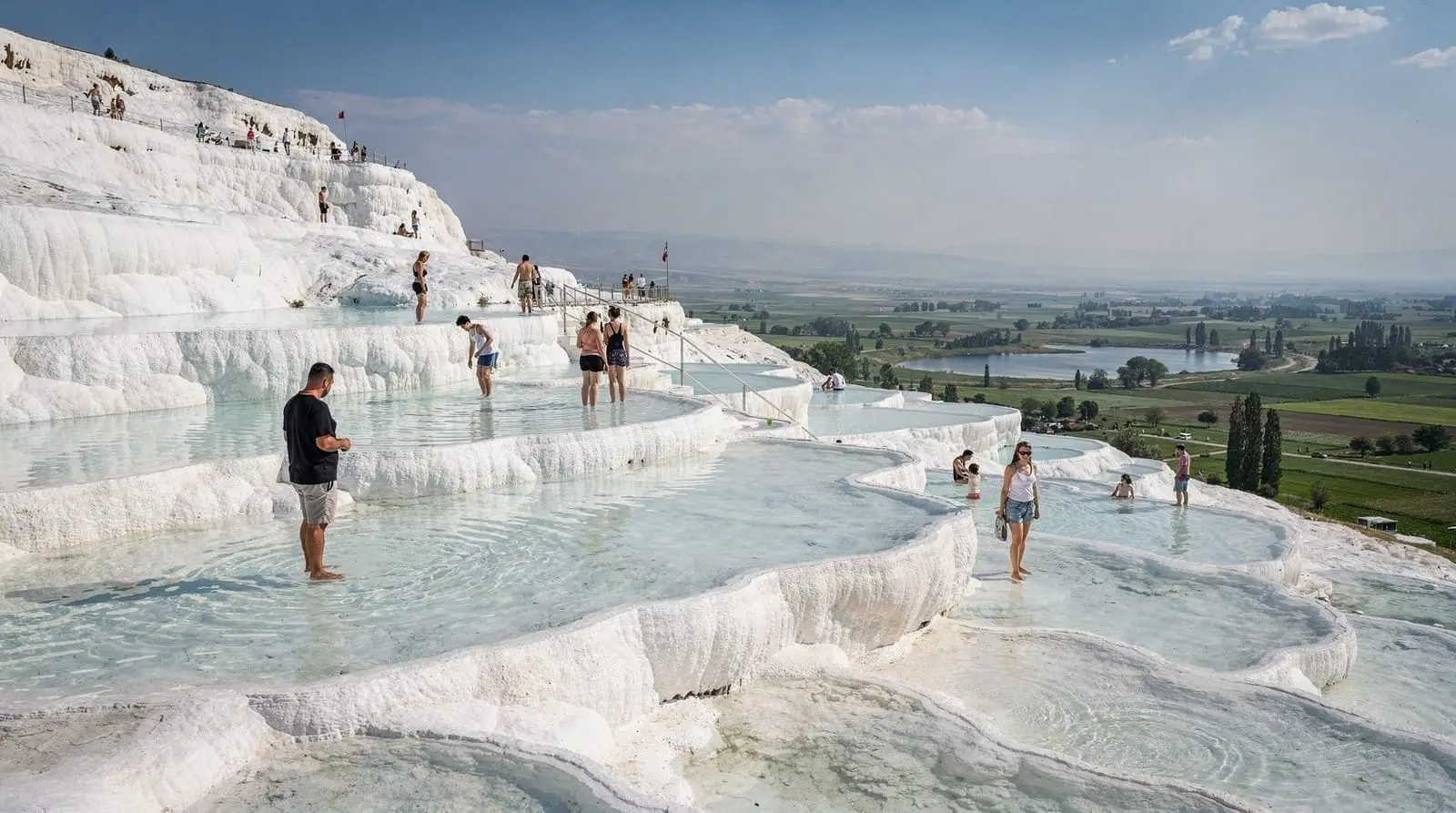
Pamukkale — “cotton castle” in Turkish — is one of Turkey’s most recognisable natural sites: white travertine terraces cascading down a hillside, formed over millennia by calcium-rich thermal spring water that deposits calcite as it cools and flows. The terraces are photographically striking and physically unusual. The site is doubly significant because the Roman city of Hierapolis was built directly on top of them in the 2nd century BCE, making the UNESCO listing a rare combination of natural and archaeological heritage.
| Where | Aegean region, ~650 km southwest of Istanbul |
| Cost | ~700–900 TRY combined travertine + Hierapolis entry |
| Time needed | A full day; overnight recommended for sunset without crowds |
| Getting there | Fly IST→Izmir (~1h) + drive (~3h), or IST→Denizli (~1h drive to site) |
| Best time | April–May or September–October |
Logistics from Istanbul: Pamukkale is 650 km from Istanbul by road and requires a flight to either Izmir (ADB, then 3-hour drive) or Denizli Çardak Airport (DNZ, a 1-hour drive to Pamukkale). The most sensible approach from Istanbul is to combine it with Ephesus in a 3-night itinerary: fly to Izmir, visit Ephesus (Day 1–2), drive to Pamukkale (Day 2 afternoon or Day 3), then fly home from Izmir or Antalya (also accessible from Pamukkale in about 3.5 hours). “Day trips from Istanbul” by flight exist but are long and tiring — see the Pamukkale from Istanbul guide for the full routing breakdown.
The travertines: what they are and how to visit
The travertines are formed by 17 thermal springs at 35°C that emerge near the top of the cliff. As the water flows over the edge and cools, calcium carbonate precipitates and builds up the layered terraces. The formations are genuinely white in well-maintained sections — a calcium surface that looks like snow or cotton from a distance.
What the management reality looks like: The site has been managed intensively since the 1990s, when overcrowding and unregulated access damaged significant sections. Today, visitors walk barefoot on designated paths (shoes must be removed), and water flow is rotated between sections to allow the terraces to rebuild. The result is that some areas look pristine and others look dried-out and grey at any given time. High season (July–August) with 10,000+ daily visitors makes the terraces feel less like a natural wonder and more like a managed attraction. Visiting in shoulder season or arriving early is the honest recommendation.
Walking the terraces takes about 30–45 minutes barefoot. The path ends at the top of the cliff where Hierapolis begins. Entry tickets cover both the travertines and Hierapolis.
Hierapolis: the Roman city above the terraces
Hierapolis was founded as a Greek city in the 2nd century BCE and developed into a significant Roman spa city — the hot springs were attributed healing properties, and the city became a pilgrimage destination. Its peak population was around 100,000 in the Imperial period. The city was largely abandoned after a major earthquake in 1354.
The ruins are extensive and spread across the hilltop above the travertines. Key highlights:
Antique Pool (Cleopatra’s Pool): A heated pool fed by the same thermal springs, containing fragments of Roman columns that fell into it during an earthquake. Swimming here — surrounded by ancient marble in 36°C water — is a genuinely surreal experience. The pool is within the grounds of the Pamukkale Thermal Hotel and charges a separate entry (around 600–800 TRY / ≈ 15–20 USD). Worth it as an experience. Book a time slot in advance in high season.
The Necropolis: One of the largest ancient cemeteries in the world — thousands of sarcophagi, tomb houses, and tumuli stretching for 2 km along the ancient road north of the city. The scale is striking: the wealth of the Roman city is visible in the elaborate carved stone tombs. Free to walk through once inside the site.
The Theatre: A 2nd-century CE Roman theatre with a well-preserved stage building (scaenae frons) still showing decorative reliefs. Seating capacity around 12,000. Access to the seating is permitted; climbing on the stage structure is restricted.
The Martyrium of St Philip: An octagonal structure on the hill above the city, believed to be the martyrdom site of the Apostle Philip. Well-preserved floor plan; interpretive panels in Turkish and English.
Hierapolis Archaeological Museum: Housed in a former Roman bath building near the site entrance. Sarcophagi, statuary, and artefacts from the excavations. Entry included in the main site ticket.
Pamukkale balloon flight
Hot air balloon flights over the travertines and Hierapolis are available, typically at sunrise, and several operators run sunrise balloon tours over the travertines with hotel pickup included. The view from above the cliff — white terraces, ruins, the plain stretching toward the mountains — is striking. The balloon operator market in Pamukkale is smaller than in Cappadocia; fewer flights per morning, smaller balloons. Costs around 100–180 EUR per person.
The town of Pamukkale
The village below the cliff is entirely organised around the site. Hotels, hostels, and pensions range from budget (600–1,200 TRY per night / ≈ 15–30 USD) to mid-range (1,200–3,000 TRY). Most have rooftop pools fed by the thermal water — this is a significant advantage and surprisingly common even in budget accommodation.
Eating options are basic but adequate. Restaurants serve standard Turkish menus — meze, grilled meat, pide — at tourist prices (350–600 TRY per person). The better food options are in Denizli, the nearby city (~20 km), if you have a car.
Key logistics for overnight stays: Walking up the terraces at sunset, after the tour groups have departed, is significantly better than a midday visit. Staying overnight in Pamukkale village enables an 18:00–20:00 visit to the travertines in near-solitude (the site closes at 22:00 in summer).
How to combine Pamukkale with Ephesus from Istanbul
The most efficient 3-night itinerary from Istanbul:
Day 1: Fly IST → Izmir (ADB). Afternoon in Selçuk: check in, Ephesus Museum, Basilica of St John. Day 2: Full day at Ephesus site (08:00–13:00, Terrace Houses included) + afternoon House of the Virgin Mary. Drive to Pamukkale (3 hours) arriving early evening. Day 3: Pamukkale — morning Hierapolis ruins and Antique Pool, afternoon travertines, sunset on the terraces. Day 4 or same evening: Fly home from Izmir (backtrack 3 hours) or fly from Denizli (DNZ, 1 hour drive) or Antalya (3.5 hours drive).
The drive between Selçuk and Pamukkale on the D585 is through rolling Aegean and Anatolian hills — unremarkable but fast.
Practical notes
Foot care: The barefoot requirement on the terraces is real. Carry a bag for your shoes. The wet calcite surface is uneven and sometimes sharp at the edges — take care.
Photography: Morning light (before 10:00) and late afternoon (after 16:00) light the white terraces best. Midday sun creates overexposed flat white in photographs. The blue pools in the terraces photograph best when water is actively flowing through them — ask at the entrance which sections are currently active.
Crowds: July–August visitor numbers of 8,000–12,000 per day are common. The terraces feel genuinely crowded then. April–May and September–October have 2,000–4,000 visitors per day — much more comfortable.
The geology of the travertines
The travertines form through a specific process that has been running at Pamukkale for approximately 400,000 years. The Büyük Menderes River basin (the ancient Maeander River) is geologically active, with fault lines producing thermal springs at the surface. The springs at Pamukkale emerge at 35°C carrying dissolved calcium carbonate — limestone in solution.
As the water flows over the edge of the cliff and is exposed to air, two things happen simultaneously: it cools, and carbon dioxide evaporates from it. Both processes reduce the water’s ability to hold calcium in solution, so the calcium precipitates as calcite — building up in thin, paper-like layers. Over millennia these layers accumulate into the terraced formations. Active sections look like white wedding cake layers; the water in the pools is a milky pale blue.
The cliff at Pamukkale is about 200 metres high and 2.7 km wide at its maximum. The total accumulated travertine deposit is estimated at tens of millions of cubic metres. The process is geologically slow but continuous: under current managed conditions, the terraces build by a few millimetres per year in active sections.
The colour depends on algae content, water depth, and mineral mix. The characteristic blue-white comes from the calcium carbonate without additives. Some sections show pink, grey, or yellow tints from mineral variation or algae.
Hierapolis: city of the dead and the dying
Hierapolis was famous in antiquity for two things: its thermal waters (believed to heal arthritis, rheumatism, and skin conditions) and its death cave — the Ploutonion.
The Ploutonion: A cave shrine to Pluto (god of the underworld) from which carbon dioxide gas emerged at lethal concentrations. Castrated priests (the Galli of the Cybele cult) could enter and emerge alive because their lower body mass and physiology provided tolerance; ordinary animals and men died within minutes. This was interpreted as divine power. The Ploutonion was rediscovered by a German-Italian archaeological team in 2013 and is now accessible to visitors within the site — a grated entrance to the cave is visible, with signs about the CO2 danger. The gas is still present.
The Necropolis: Hierapolis’s ancient cemetery is unusually large because people came here from across the Mediterranean to take the waters, and many died during treatment. The necropolis stretching 2 km north of the city contains thousands of tomb structures in varying preservation — from elaborate multi-storey tomb houses to simple stone sarcophagi. Walking through it is an arresting experience; the scale communicates the city’s population and the desperation of the ill who made the journey.
The Nymphaeum (monumental fountain): Near the Antique Pool, the city’s main public fountain was an elaborate architectural facade fed by the thermal springs. Substantial sections of the architrave survive, with carving quality comparable to major city monuments.
Day-visit pacing for maximum value
The standard tour-group experience at Pamukkale gets the sequencing wrong: it stops at the travertines first (midday, when they are worst — bleached flat white in harsh sunlight, most crowded) and rushes through Hierapolis. Here is a better sequence for independent visitors with a full day:
09:00: Arrive via Denizli or private transfer. Enter through the north gate (Hierapolis side, not the travertine lower entrance). Visit the Hierapolis Theatre (best light on the stage before 10:00).
09:30–11:30: Explore Hierapolis — Necropolis, Theatre, Martyrium of St Philip, Museum. The tour groups are at the travertines; you have Hierapolis largely to yourself.
11:30–12:30: Antique Pool swim. Book a timed entry in advance in high season. Have the pool experience before lunch rather than after.
12:30–13:30: Lunch at one of the hotels adjacent to the site (not spectacular cuisine, but functional — 400–700 TRY per person).
13:30–15:00: Rest or more Hierapolis exploration. Avoid the travertines in the 13:00–16:00 window.
16:00–18:00: Walk the travertines. The tour buses have departed. The afternoon light is warmer. The water flows in the active sections are better documented in the late afternoon. You are largely alone.
18:00–19:00: Return to accommodation or transfer to Denizli for bus/train.
The evening option (staying overnight and walking the travertines at 19:00–21:00 in summer, when the site stays open until 22:00) is the best of all approaches for those with flexibility.
The Denizli connection and getting around
Denizli is the nearest city to Pamukkale — about 20 km east. It is a working industrial city with a population of around 700,000, not particularly interesting to visit in itself, but useful for:
- Flights: Denizli Çardak Airport (DNZ) is 65 km from the city but only 85 km from Pamukkale. Domestic flights from Istanbul and Ankara serve DNZ.
- Train: Denizli has a main-line train station on the Izmir-Afyon route. The TCDD train from Izmir (via Selçuk) takes about 2.5 hours to Denizli. From Denizli otogar (bus station), dolmuşes run to Pamukkale village every 30–60 minutes (approximately 15 TRY, 35-minute journey).
- Long-distance buses: Denizli is a major bus hub with services from Istanbul (9–10 hours overnight), Izmir (3.5 hours), Antalya (3.5 hours), and other cities.
From Pamukkale village itself, most services run through Denizli otogar. If your connection requires changing in Denizli, allow an hour — the otogar is at the edge of the city and dolmuşes from Pamukkale drop you at the city bus terminal.
Driving: The road from Selçuk (Ephesus) to Pamukkale takes about 2.5–3 hours on the D585 and D585-04 roads, through Aydin and Sarayköy. Straightforward, well-signposted. The road winds through olive orchards and melon fields with occasional views of the Büyük Menderes valley — not dramatic but pleasant.
Wine and food culture around Pamukkale
The area around Pamukkale sits in the upper Büyük Menderes (Maeander) valley, part of a wine-producing region. Small wineries operate near Denizli, primarily producing red wines from Öküzgözü and Boğazkere grape varieties common in Anatolia. Less distinguished than Cappadocia’s volcanic-soil wines or the Aegean region’s Çalkarası and Muscat whites, but the local wines in Pamukkale’s restaurants are generally drinkable and cheap (a glass around 100–200 TRY / ≈ 2.5–5 USD).
Pamukkale village food is entirely oriented toward tourists and ranges from functional to mediocre. The better-value approach is to pick a restaurant with visible Turkish families eating there (a reasonable proxy for acceptable local cuisine) rather than one with English-menu placards at the roadside. Main dishes cost 300–500 TRY per person.
The local agricultural specialities of the broader Denizli area — dried figs, sun-dried tomatoes, olives, cotton seed oil — are sold at the small market off the main village street and are better quality and much cheaper than tourist shop prices.
Visiting with children
Pamukkale is one of Turkey’s most child-friendly archaeological sites. The barefoot walk on the warm white terraces is inherently engaging; the Antique Pool swim in tepid thermal water is a genuine highlight. Children do not need to engage with the Roman archaeology to enjoy the day.
The main practical consideration is the barefoot requirement: carry socks and shoes in a bag (provided at the site entrance). The travertine surface has sharp edges in places; move carefully.
The Antique Pool swim is safe for children who can swim (shallow areas exist). The thermal water temperature (36°C) is warmer than a standard pool; younger children may tire quickly. Life jackets are not provided; parental supervision is expected.
Season comparison for a Pamukkale visit
| Season | Crowds | Temperature | Terraces | Verdict |
|---|---|---|---|---|
| April–May | Low–moderate | Mild, wildflowers | Best water flow, fewest tourists | Best overall |
| June–August | Very high (8,000–12,000/day) | 35–40°C | Feels managed, hot barefoot walk | Avoid if possible |
| September–October | Low | Warm, good light | Excellent for photography | Second-best choice |
| November–March | Very low | Cool, occasional rain | Quiet but greyer light | Fine for budget/quiet trips |
For the day-by-day version of a Pamukkale-Ephesus trip in any season, see the Ephesus and Pamukkale together guide or the 7-day Istanbul–Cappadocia–Ephesus–Pamukkale itinerary. The Hierapolis guide goes deeper on the ruins above the terraces, and the Pamukkale visiting guide covers logistics once you’re on site.
Frequently asked questions about Pamukkale
How do I get from Istanbul to Pamukkale?
The most efficient route is to fly Istanbul to Izmir (ADB, ~1 hour), then drive to Pamukkale (~3 hours, 190 km). Alternatively, fly to Denizli Çardak Airport (DNZ) if available from your Istanbul airport — it is only 1 hour from Pamukkale. Direct buses from Istanbul take 10–12 hours overnight. Most visitors combine Pamukkale with Ephesus in a 3-night trip from Istanbul.
Can you still walk on the Pamukkale travertines?
Yes, on designated paths. Barefoot only — shoes must be removed and carried. Water flows through specific sections at any time, so some areas will be dry and grey while others are white and wet. The management rotation means the experience varies by season and by which sections are currently “active.”
What is the Antique Pool (Cleopatra’s Pool)?
A thermal swimming pool at 36°C inside the Pamukkale Thermal Hotel grounds, fed by the same springs that create the travertines. Ancient Roman columns and marble fragments lie on the pool floor — knocked there by earthquakes. Swimming here requires a separate entry ticket (600–800 TRY / ≈ 15–20 USD). The “Cleopatra” name is local marketing — there is no historical connection to Cleopatra.
Is Pamukkale better in summer or spring/autumn?
Spring and autumn are clearly better. July–August brings intense heat (35–40°C), large crowds (8,000–12,000 visitors per day), and a managed-feeling experience on the terraces. April–May has wildflowers in the surrounding valleys, comfortable temperatures, and far fewer visitors. September–October is warm, quiet, and the light is excellent for photography.
How much time do you need at Pamukkale?
A full day covers the travertines, Hierapolis (including theatre, necropolis, and museum), and the Antique Pool swim. With an overnight stay, you can do the ruins in the morning (before the tour groups) and the travertines at sunset (after them). A rushed half-day from a tour bus is genuinely inadequate for the site’s scale.
Is Hierapolis worth visiting separately from the travertines?
Yes — they are accessed together on the same ticket, and Hierapolis has substantial content: a 12,000-seat theatre, one of the world’s largest ancient necropolises, the Martyrium of St Philip, and the archaeological museum. The standard tour spends disproportionate time on the travertines and rushes through Hierapolis; if you have an extra hour, the necropolis is particularly unusual and rarely crowded. The Hierapolis guide has a full site walkthrough.
Should I visit Pamukkale in summer or wait for shoulder season?
Wait for shoulder season if your dates are flexible. Summer brings intense heat and the largest crowds of the year, which makes the barefoot travertine walk considerably less pleasant and the site feel more managed than natural. See the season comparison table above for the trade-offs by month.
Top experiences
Bookable activities with verified prices and instant confirmation on GetYourGuide.

