Troy and Çanakkale
Homer's Troy — nine layers of Bronze Age city, the Wooden Horse replica, and the Museum of Troy, reached from Istanbul in a long day or ideally overnight.
Full-Day Troy Tour From Istanbul
Quick facts
- Distance from Istanbul
- ~340 km to Çanakkale by road
- Transfer time
- 4–5h bus to Çanakkale; Troy 30 min south by road
- UNESCO status
- World Heritage Site since 1998
- Entry fee (Troy site)
- ~400–500 TRY (≈ 10–13 USD); Museum of Troy separate
- Museum of Troy entry
- ~350–450 TRY (≈ 9–12 USD)
Troy — Truva in Turkish — is one of archaeology’s most contested and celebrated sites. The city mentioned by Homer in the Iliad actually existed: the excavations begun by Heinrich Schliemann in 1870 and continued by scholars through the 20th century have identified nine major settlement layers spanning from roughly 3000 BCE to 500 CE. Whether the Trojan War happened here in the way Homer described is unknowable. What is certain is that this strategic hilltop at the entrance to the Dardanelles was inhabited, destroyed, rebuilt, and fought over for millennia.
| Where | Hisarlık, 30 km south of Çanakkale, Dardanelles |
| Cost | ~400–500 TRY site entry; Museum of Troy ~350–450 TRY separately |
| Time needed | 2.5–3 hours for site + museum; best as an overnight with Gallipoli |
| Getting there | 4–5h bus from Istanbul to Çanakkale, then 30 min by road to the site |
| Best time | April–May or September–October mornings; avoid midday in summer |
What you actually find at Troy today
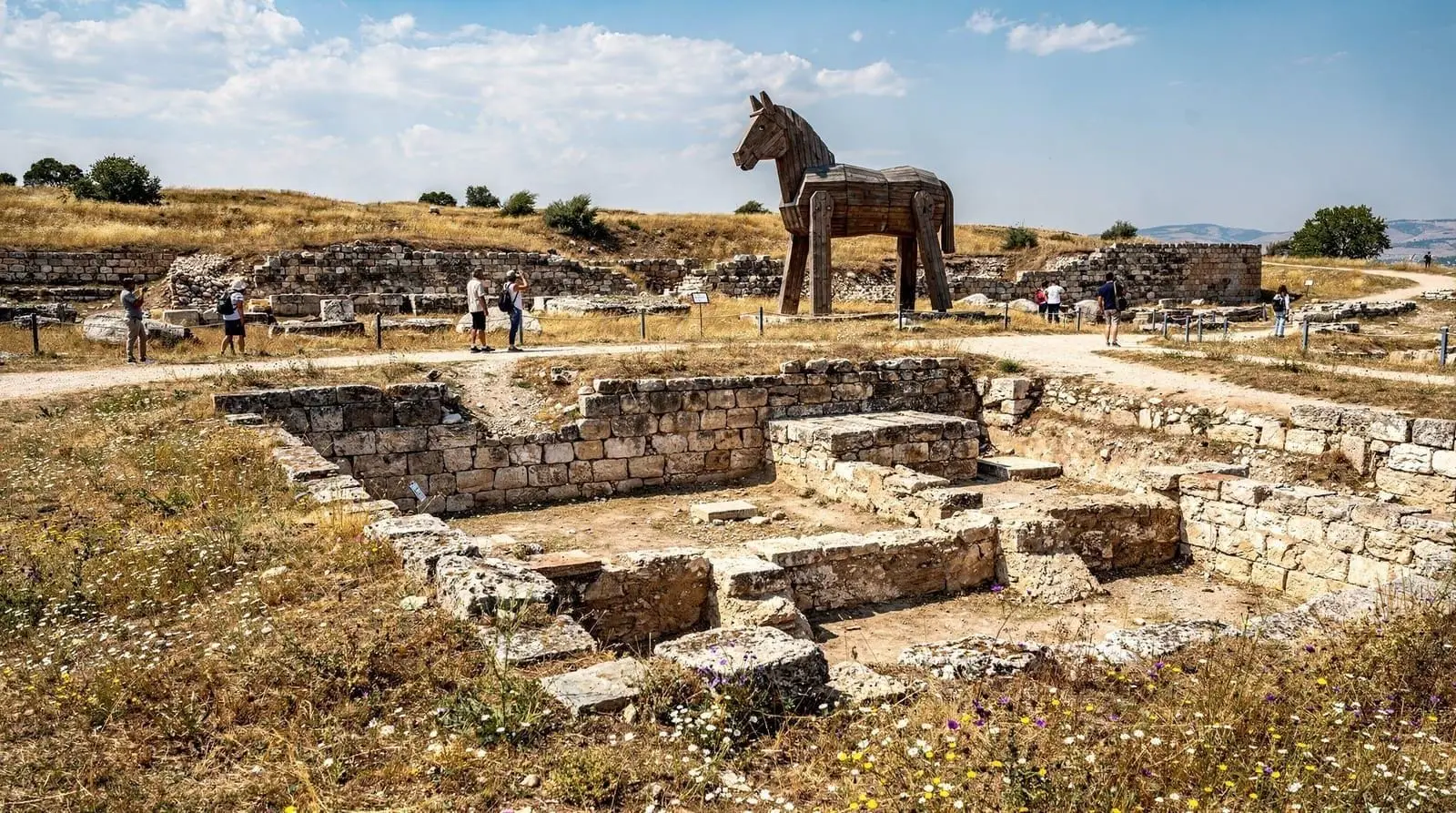
Visitors sometimes arrive expecting a dramatic ruined city and find, instead, a complex archaeological landscape that requires context to appreciate. Troy is not Ephesus — there are no grand standing columns or marble-paved streets. The excavated layers overlap confusingly; the walls you walk beside could be 1,200 BCE, 700 BCE, or Roman-era. The Wooden Horse replica near the entrance is photogenic but a tourist device with no historical basis.
That said, Troy with a good guide or a strong audio tour is genuinely fascinating. The scale of the fortification walls from Troy VI (the most likely Homeric period, around 1700–1250 BCE) is impressive. The view from the hilltop over the Dardanelles and the plain where the Scamander river once ran explains the site’s strategic value immediately.
The Museum of Troy, opened in 2018, is the real upgrade to the site experience. Purpose-built, well-designed, it houses the excavation finds across nine levels of exhibition — artefacts from every period, multimedia reconstructions, and the story of Schliemann’s contentious excavations (he destroyed significant archaeological layers in his hunt for “Priam’s Treasure”).
Getting from Istanbul to Troy
Troy sits 30 km south of Çanakkale (Çanak-kah-leh), the main city on the Dardanelles strait. The standard routes from Istanbul to Çanakkale all involve crossing the strait by ferry.
By bus: Regular coach services from Istanbul’s Esenler otogar to Çanakkale take about 4–5 hours. Several companies including Çanakkale Truva Seyahat run this route. Fare: 400–650 TRY one-way (≈ 10–17 USD). From Çanakkale, dolmuşes and taxis serve the 30-minute drive to the Troy site.
By organised tour from Istanbul: A full-day Troy tour from Istanbul handles all transport and typically includes a guide at Troy plus sometimes the Museum of Troy. Most depart Istanbul very early (05:30–06:30) and return late.
Combined with Gallipoli: The strongest approach. Day 1: Gallipoli (the peninsula is on the European side, Troy is on the Asian side, both accessed via Çanakkale). Overnight in Çanakkale. Day 2: Troy + Museum of Troy, afternoon return to Istanbul. This avoids the exhausting same-day double-site marathon.
Reading the nine layers of Troy
The UNESCO listing acknowledges the site’s complexity — nine distinct cities built on top of each other. The layers are labelled Troy I through Troy IX:
Troy I–V (3000–1750 BCE): The earliest settlement phases, represented by sections of mudbrick walls and foundations. Small in scale but old enough that the Bronze Age label is not metaphor.
Troy VI (1750–1250 BCE): The most substantial phase. Impressive limestone fortification walls — up to 4 metres thick — and towers still stand in places. This is the level associated by most archaeologists with the Homeric city; the earthquake damage visible in the walls corresponds roughly to the period attributed to the Trojan War.
Troy VIIa (1250–1180 BCE): Another candidate for “Homer’s Troy.” Destroyed by fire, with evidence of conflict. The population increased sharply before destruction — interpreted by some scholars as refugees from an attack.
Troy IX (700 BCE–500 CE): The Hellenistic and Roman city of Ilion. The Romans venerated Troy as the origin point of Rome via the Aeneas myth. A prominent odeon (small theatre) and temple foundations survive from this phase.
The site path loops through the key areas with numbered markers. Without a guide or audio guide, the sequence of eras is hard to follow. The museum provides essential context.
Çanakkale: the base city
Çanakkale is a pleasant university town of about 150,000 people on the Asian shore of the Dardanelles. It is an overnight base for most visitors doing both Gallipoli and Troy.
The waterfront (iskele and kordon) has a lively eating and café scene. The Çanakkale Archaeology Museum houses smaller finds from Troy and other sites in the region (entry around 50–100 TRY). The city’s clock tower (19th century) is a local landmark.
Eating in Çanakkale: Fish restaurants along the kordon serve fresh Aegean fish and mezes. Expect 400–700 TRY per person for a full meal. For something cheaper, the market area behind the waterfront has kebap shops and pide restaurants for 200–350 TRY.
Getting around: Çanakkale is compact and walkable in its centre. Dolmuşes to Troy leave from the otogar. Ferries to Eceabat (Gallipoli side) depart frequently from the main ferry terminal — crossing time about 25 minutes, fare around 30–50 TRY.
Where to stay: Mid-range hotels cluster along or just behind the waterfront kordon, within easy walking distance of the ferry terminal and the restaurant strip. Booking a night here rather than attempting the return trip to Istanbul the same day is what makes the Troy-and-Gallipoli combination genuinely comfortable rather than a rushed slog.
Practical site visit notes
Allow 2.5–3 hours for a thorough visit to the Troy archaeological site plus the Museum of Troy (combined). The site is approximately 500 metres in diameter; the path takes about 60–90 minutes to walk fully. The museum adds another 45–60 minutes.
The site entry ticket and museum ticket are usually sold separately. In 2026, combined rates may exist — confirm at the ticket office on arrival.
Summer heat: July and August in this region reach 35°C+ regularly. The site has limited shade. Morning visits (opening around 08:00) are strongly preferable. Bring water.
Winter: The site is open but some museum sections may have reduced hours. Less crowded. Rain is common in November–March.
The Wooden Horse — expectation versus reality
A large Wooden Horse replica stands at the site entrance and features in most visitor photos. It is a 1975 prop from a Turkish film that became a permanent fixture. There is no historical evidence that a Wooden Horse stratagem was used — Homer’s account is understood as literary myth, not military history. The replica is harmless fun but has no connection to archaeology. The actual site is more interesting than the prop.
Schliemann, archaeology, and controversy
Heinrich Schliemann was a German businessman-turned-archaeologist who became convinced in the 1860s that Homer’s Troy was real and could be found. He identified Hisarlık — a mound on the plain near the Dardanelles — as the probable site and began excavating in 1871. He found gold objects in a deep layer and immediately declared it “Priam’s Treasure.” He was wrong: the gold came from a layer (Troy II) that predated the Homeric-period city by about 1,000 years. In his excitement, Schliemann also dug through and destroyed many of the more significant upper levels in his rush to find Priam’s city.
The story illustrates the problem with early 19th-century archaeology — enthusiasm and romanticism leading to damage. Modern excavations, led by Manfred Korfmann from the University of Tübingen from 1988 onward, applied careful stratigraphic methods and revealed that Troy VI and VIIa were far more substantial cities than previously recognised — with lower town extensions that tripled the estimated population. The lower town was identified through ground-penetrating radar in the 1990s.
The “Priam’s Treasure” itself was smuggled out of Turkey by Schliemann, passed through several collections, and is now in the Pushkin State Museum of Fine Arts in Moscow (taken by Soviet forces from Berlin at the end of WWII). Turkey has been seeking its return for decades.
The Museum of Troy handles this story honestly — neither valorising Schliemann as a heroic discoverer nor simply villainising him, but presenting the full history of the excavations including their mistakes.
The Bronze Age context
Troy existed in a world that is worth briefly understanding before visiting. The period associated with the Trojan War (roughly 1250–1180 BCE) was the late Bronze Age — a connected Mediterranean world of palace economies, specialist craftsmen, long-distance trade, and complex diplomacy. The Hittite Empire covered most of Anatolia; Egypt was at its imperial height; Mycenaean Greece was the dominant Aegean civilisation.
Troy (called Wilusa in Hittite texts, which has led scholars to link it to the site) occupied a strategic position controlling access to the Dardanelles strait and the Black Sea trade route. Whoever controlled Troy controlled access to the grain, metals, and slaves from the Black Sea world. The Trojan War, in historical terms, was probably a commercial and territorial conflict dressed up in myth as a story about a stolen woman (Helen).
The Bronze Age collapse around 1200–1150 BCE destroyed most of these palace civilisations in a series of interconnected events — drought, migration, internal revolt. Troy VIIa was destroyed in fire around 1180 BCE, shortly after the collapse began. This is the likely archaeological correlate of the Trojan War.
Understanding this context makes the site visit substantially more meaningful than seeing it as simply a confirmation of Homer’s poem.
Practical archaeology: what survives and why
One question visitors frequently ask is why so little survives at Troy compared to, say, Ephesus or the Athenian Agora. The answer is geological and historical. The stone used at Troy was soft local limestone, less durable than the marble of later periods. The upper sections of walls and buildings used mudbrick, which dissolves in rain over centuries. And the site was continuously occupied and rebuilt, with each successive city using the previous one’s materials.
What does survive: sections of the Troy VI fortification walls, standing in places to 4 metres with the original limestone blocks; the ramp that led into the city; the foundations of a large building (possibly a palace) on the hilltop; the Hellenistic and Roman structures of Troy IX, including the odeon and the outline of the temple to Athena. The lower town outline, identified by ground-penetrating radar, has not been fully excavated.
The physical scale of the site is also smaller than many visitors expect — the citadel of Troy at its height was about 200 × 160 metres. The lower town may have extended to 300,000 square metres, but this is largely unexcavated. The contrast with Ephesus’s 2.5 km² of exposed ruins is real, and worth knowing before you go — set expectations around interpretation and atmosphere rather than scale.
Troy and the oral tradition
Understanding why Homer and Troy matter requires a brief consideration of how ancient cultures transmitted knowledge. The Iliad is estimated to have been composed in something close to its current form around 750–700 BCE, but it describes events set around 1250–1180 BCE — a gap of 500 years. It was composed in an oral tradition: professional bards (aoidoi) memorized and performed epic poems using fixed formulas and repeated epithets (the “wine-dark sea,” “swift-footed Achilles”) that served as mnemonic devices.
The accuracy of oral transmission across five centuries is a matter of scholarly debate. What is clear is that the Iliad contains geographic details — the Troad landscape, the rivers, the topography of the besieged city — that correspond to the actual region around Hisarlık. The cities listed in the Catalogue of Ships in Book II of the Iliad correspond in remarkable degree to Mycenaean Bronze Age settlement patterns revealed by later archaeology. The poem has a substrate of genuine historical geography, even if the Wooden Horse is a poetic device.
Whether the specific events — a 10-year siege over the abduction of Helen — happened in any form is unknowable. Large-scale military campaigns for commercial and territorial control were a feature of Late Bronze Age diplomacy. A conflict over the Dardanelles crossing — Troy’s strategic value — is plausible. A specific king named Priam and a prince named Hector may or may not have existed. The archaeology cannot resolve this.
The Museum of Troy covers this question carefully, presenting what the archaeology shows and distinguishing it from what the poetry claims. It is one of the more intellectually honest museum treatments of the myth-versus-evidence question.
Seasonal considerations and visitor experience
The Troy site is open year-round, but the visitor experience varies significantly by season.
Spring (April–May): The best season. Wildflowers grow in the excavated areas; the Troad plain behind the site shows its agricultural character with green wheat fields; crowds are present but manageable. Temperatures are comfortable (15–22°C).
Summer (June–August): Hot (30–38°C) with intense sun. The open, largely shadeless site is uncomfortable from midday onward. Arrive at opening (08:00) and aim to leave by 12:00. Çanakkale evenings are pleasant — eating along the kordon after 19:00 when the heat breaks.
Autumn (September–October): Similar to spring in quality. The harvest-season colours on the surrounding farms give the plain a golden tone. Good photography light. Fewer visitors than spring peak.
Winter (November–March): Quiet and inexpensive. The site is open but the Museum of Troy may have reduced hours. Rain is possible; the clay paths in the excavated areas can be muddy. Temperature in Çanakkale drops to 5–10°C. Some ferries run on reduced schedules.
| Season | Temperature | Crowds | Notes |
|---|---|---|---|
| Spring (Apr–May) | 15–22°C | Moderate | Wildflowers, green plain, best all-round conditions |
| Summer (Jun–Aug) | 30–38°C | High | Shadeless site — arrive at 08:00, leave by noon |
| Autumn (Sep–Oct) | Similar to spring | Lower than spring | Golden harvest light, good for photography |
| Winter (Nov–Mar) | 5–10°C | Low | Cheapest and quietest; some museum hours reduced, possible mud and rain |
What to do in Çanakkale for a half day
If you arrive in Çanakkale on a 2-day tour, or have a half day between ferry and tour departure, the town is pleasant for a few hours:
Çanakkale Archaeology Museum (Arkeoloji Müzesi): Houses artefacts from Troy and other local Troas region excavations — ceramics, bronze objects, terracottas. Smaller than the Museum of Troy but covers complementary material. Entry around 50–100 TRY.
The clock tower (Saat Kulesi): Late Ottoman landmark in the main square, built 1897. The surrounding area is the city’s main café and restaurant zone.
The replica Trojan Horse: A large wooden horse on the waterfront, donated by the film Troy (2004). Much photographed. Climable via internal ladder for a harbour view. Admission free.
Kordon (waterfront promenade): A pleasant evening walk with views across the Dardanelles to the European shore. The narrows here are the crossing point that Xerxes bridged in 480 BCE and that Lord Byron swam in 1810 (commemorated with a plaque somewhere along the promenade).
Planning it into a wider trip
Troy rarely stands alone in an itinerary — it’s usually one stop in a broader look at Turkey’s ancient world or a specific Gallipoli-focused trip. For visitors also considering Ephesus and Pamukkale further south, note that those sites require a separate multi-day trip (typically flown from Istanbul) rather than a road extension from Çanakkale — the geography doesn’t connect them efficiently. If your main interest is Gallipoli’s WWI history rather than Bronze Age archaeology, it’s entirely reasonable to visit Gallipoli alone and skip Troy; see the day trip reality check guide for an honest read on which of Istanbul’s long day trips are worth the travel time and which aren’t. For a broader menu of what’s feasible from Istanbul, the best day trips from Istanbul guide ranks the options by travel time and payoff.
Frequently asked questions about Troy and Çanakkale
Can I visit Troy on a day trip from Istanbul?
It is possible but long. The total travel time is 8–10 hours of driving and transport, leaving 3–4 hours at the site. Most people find this exhausting. A 2-day trip combining Troy with Gallipoli is significantly better — you overnight in Çanakkale, visit Gallipoli on Day 1, and Troy on Day 2.
What is the entry fee for Troy?
Around 400–500 TRY for the archaeological site (≈ 10–13 USD), plus a separate ticket for the Museum of Troy (around 350–450 TRY / ≈ 9–12 USD). Both prices are subject to change with Turkish inflation — confirm current rates at the ticket office. A combined ticket may be available.
Is Troy worth visiting without a guide?
The site is harder to interpret without guidance. Numbered markers and a site map are available, but the overlapping archaeological layers of nine cities are confusing without context. The Museum of Troy makes the self-guided experience significantly better than it was before 2018. An audio guide is available and recommended.
What is the Museum of Troy?
A purpose-built museum opened in 2018, located adjacent to the archaeological site. It houses excavation finds from all phases of occupation, multimedia reconstructions of each city layer, and a critical examination of Schliemann’s 19th-century excavations. Well-designed and genuinely informative; comparable to the quality of major European archaeological museums.
How do I get from Troy to Gallipoli?
Troy is on the Asian side of the Dardanelles; Gallipoli is on the European side. From the Troy site, return to Çanakkale by dolmuş (30 min), then take the passenger ferry across the strait to Eceabat (25 min). The ferry runs throughout the day. Organised 2-day tours handle this transition automatically.
Is there any connection to Homer’s Iliad?
Yes, archaeologically. The site at Hisarlık (Troy’s modern Turkish name) corresponds in location and period to what Homer describes. Troy VI and VIIa are the most likely candidates for the city in the Trojan War narrative. However, the Iliad is epic poetry, not history — the events, the gods, and the Wooden Horse are literary, not documentary. The real Troy is an important Bronze Age city that was strategically significant and repeatedly destroyed; the Homeric overlay makes it famous.
Should I visit Troy or Ephesus if I can only choose one?
They serve different interests. Ephesus has far more visually dramatic standing ruins — a genuinely intact Roman street and library facade — and requires flying or a multi-day trip from Istanbul. Troy is closer, historically dense but visually more modest, and pairs naturally with Gallipoli as a Dardanelles-region overnight. If dramatic ruins matter more than Homeric or WWI history, prioritise Ephesus.
Is Troy suitable for children?
It can work for children with a genuine interest in ancient history or the Trojan War story, especially with the Wooden Horse replica as a fun anchor, but the site itself requires imagination to interpret and can feel underwhelming to younger children without a guide. The Museum of Troy’s multimedia displays hold attention better than the open site.
Top experiences
Bookable activities with verified prices and instant confirmation on GetYourGuide.

