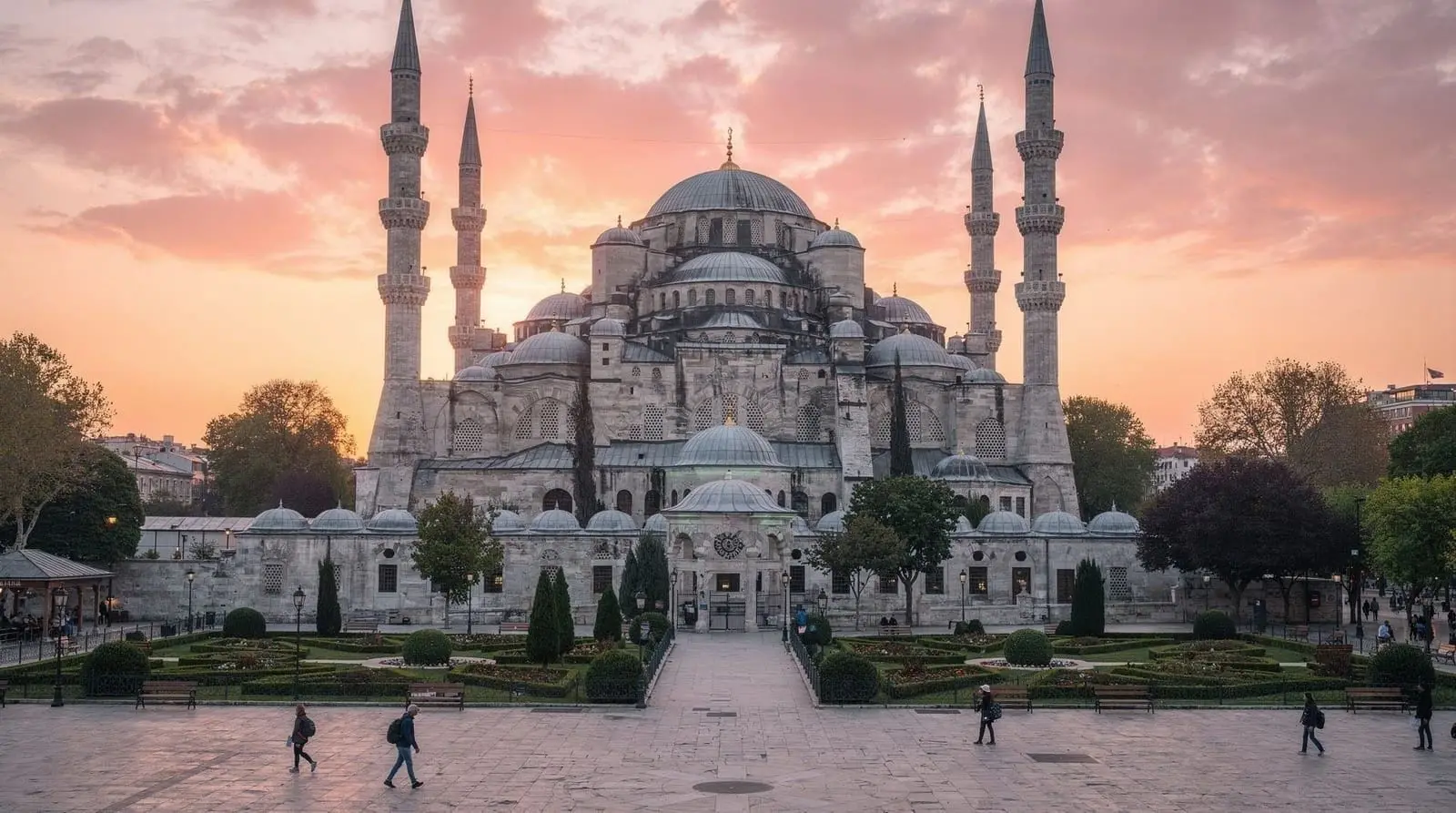
Blue Mosque (Sultan Ahmed Mosque) — visitor guide
Visit Istanbul's Blue Mosque with confidence — prayer schedule, dress code, what to see inside, and how to combine it with Hagia Sophia.
Istanbul: Blue Mosque Guided Tour
Quick facts
- Built
- 1609–1616 (Sultan Ahmed I)
- Entry
- Free (closed during prayer times)
- Time needed
- 45–60 minutes
- Getting here
- Tram T1 to Sultanahmet stop
- Dress code
- Shoulders and knees covered; women cover hair
The mosque that tried to outdo Hagia Sophia
| Where | Sultanahmet Square, facing Hagia Sophia |
| Cost | Free |
| Time needed | 45–60 minutes |
| Getting there | Tram T1 to Sultanahmet stop |
| Best time | Early morning or late afternoon, between prayer closures |
Sultan Ahmed I was 19 years old when he commissioned a mosque that would face Hagia Sophia across the Hippodrome — the first Ottoman sultan to build his imperial mosque adjacent to the 1,000-year-old Byzantine cathedral rather than replacing or co-opting it. The result, completed in 1616, is the most photographed mosque in Turkey, recognizable worldwide for its six minarets and the cascade of domes visible from the Bosphorus.
The popular name “Blue Mosque” came from Western travelers who were struck by the 20,000 Iznik tiles covering the interior walls. The tiles are predominantly white with blue, turquoise, and green floral and geometric patterns — a deliberate evocation of paradise gardens in Islamic architectural tradition.
The building is free to enter. That’s unusual for a monument of this significance, and it reflects its status as an active mosque where worship continues to have priority over tourism.
Six minarets and the story behind them
Ottoman imperial mosques typically had two or four minarets. Six was reserved for the Grand Mosque in Mecca. Sultan Ahmed’s architect Sedefkâr Mehmed Ağa built six, creating a theological controversy: was the Sultan claiming equivalence with the holy sites? The problem was resolved by adding a seventh minaret to the Grand Mosque in Mecca. The Blue Mosque kept its six.
From the outside, the silhouette follows the cascading dome logic of Sinan’s earlier mosques (especially Süleymaniye), but with more vertical emphasis from the minarets. The exterior courtyard — with its ablution fountain at the center — is serene, even crowded, and worth spending 10 minutes in before entering.
What you see inside
The interior dimensions are significant: the central dome is 23.5 meters in diameter and rises 43 meters above the floor. Unlike many large mosques, the Blue Mosque has a relatively open floor plan, supported by four massive elephant-leg columns. The effect is spacious rather than columned.
The 20,000 Iznik tiles were produced by the İznik workshops during what is considered their artistic peak, and the quality shows: the cobalt blue is vivid without being harsh, and the designs (carnations, tulips, cypresses, abstract arabesques) have genuine visual complexity. Look up at the tile bands running around the galleries above the prayer hall.
The stained glass windows — 260 of them, mostly Venetian glass, many replaced over the centuries but some original — filter light throughout the day. Mornings and late afternoons produce the best interior light.
The carpets covering the prayer floor are donated by the Turkish government and replaced periodically. The original carpets are long gone.
What you cannot see: The mihrab (prayer niche indicating the direction of Mecca) and minbar (pulpit for the Friday sermon) are at the far end of the hall. During tourist access periods, visitors enter from one side and observe without entering the active prayer area. The mosque’s imam and worshippers use a separate entrance.
Entry and dress code
Entry is free. This is consistently surprising to first-time visitors, given the monument’s scale and global fame. There is no ticket to buy.
However, the mosque is closed to tourists during prayer times — five times daily. The closures last 60–90 minutes each. The schedule shifts by approximately 1–2 minutes each day as it follows solar prayer timing. It is posted at the entrance and available on prayer time apps or the mosque’s official website.
If you arrive during a closure, wait outside or spend the time at the Hippodrome monuments (free, directly in front of the mosque) or at the Arasta Bazaar (a smaller Ottoman market behind the mosque).
Dress requirements are strictly enforced:
- Both men and women: shoulders covered, knees covered
- Women: hair covered (free scarves at the entrance; bring your own for hygiene)
- Shoes removed at the entrance (bags provided)
- No shorts, sleeveless tops, or bare shoulders regardless of gender
Guards at the entrance turn people away who don’t meet the standard. There’s no exception for a “quick look.” Bring a sarong or large scarf if you’re visiting on a hot summer day and haven’t dressed appropriately.
Photography: Permitted inside with phone and standard camera. Tripods and professional camera setups are generally not permitted without prior authorization.
Timing advice
Best windows: Early morning (8–9am before the first tourist crowd arrives) and mid-afternoon between the Asr and Maghrib prayers (roughly 3:30–6pm in summer, earlier in winter). The mosque looks spectacular in late afternoon light with the warm sun on the tiles.
Worst times: Midday in peak summer (July–August) combines high heat, maximum tourist volume, and prayer closure risk. Saturday mornings attract both tourists and local worshippers for extended Friday prayers (the Friday noon prayer is the longest, lasting 90+ minutes).
Friday noon prayer: The Friday midday prayer is the main congregational prayer in Islam and draws a larger crowd of local worshippers. The mosque may be closed to tourists for a longer window on Fridays around midday.
Combining the Blue Mosque with nearby sites
The Blue Mosque and Hagia Sophia face each other across Sultanahmet Square — a 5-minute walk. A sensible plan for a first morning in Sultanahmet: arrive at Hagia Sophia at 8:30am (when it opens), spend 90 minutes there, walk to the Hippodrome (free), check the Blue Mosque prayer schedule, and enter when the next tourist window begins.
From the back of the mosque, the Arasta Bazaar leads to the Istanbul Mosaic Museum (above the Great Palace mosaics, worth 30 minutes). Five minutes’ walk south is the Basilica Cistern.
For a thematic tour of Ottoman mosque architecture beyond Sultanahmet: Süleymaniye Mosque on the Third Hill (15-minute walk from the Grand Bazaar) is by many architectural opinions more sophisticated than the Blue Mosque, and far less crowded.
The honest assessment
The Blue Mosque is worth visiting, but the context matters:
It is a functioning mosque where tourism is accommodated, not a museum adapted for tourism. Treat it accordingly — the dress code and prayer closures are not inconveniences, they are the actual terms of access.
The interior is beautiful, but the crowd level during peak season can reduce the experience. In July–August, the tourist queue enters in a slow-moving line that doesn’t allow for the kind of quiet contemplation that makes a mosque visit meaningful. Early morning or shoulder-season visits are qualitatively different.
The exterior is at least as impressive as the interior — the cascade of domes and the six minarets against the sky are the iconic image. Budget time to sit on the Hippodrome benches and look at the whole silhouette.
The Iznik tiles are the interior’s strongest feature. Look at them with attention — the designs are varied and technically superb. Don’t rush through.
The area around the Blue Mosque
The mosque sits at the south end of the Hippodrome — the ancient Byzantine racing circuit that is now a park, running between the mosque and Hagia Sophia. The Hippodrome’s three surviving monuments (the Obelisk of Theodosius, the Serpent Column, and the Column of Constantine Porphyrogennetos) are directly in front of the mosque’s main façade, visible while you wait for prayer closures to end.
The Arasta Bazaar extends behind the mosque’s southeast corner — an Ottoman market arcade built as part of the original mosque complex to generate revenue. Less frenetic than the Grand Bazaar, it sells kilims, ceramics, jewelry, and textiles. Worth a 15-minute browse.
The Istanbul Mosaic Museum (Büyük Saray Mosaikleri Müzesi) is accessible from the Arasta Bazaar. It displays in-situ the floor mosaics of the Great Palace of Constantinople — 6th-century floors depicting hunting scenes, animals, and mythological figures. Small, easy to miss, genuinely impressive. Entry approximately 100–200 TRY.
The Basilica Cistern is a 5-minute walk north from the Blue Mosque entrance — a useful pairing on the same half-day since it provides an underground, cool alternative after the sun-exposed Hippodrome.
Topkapı Palace is a 10-minute walk northeast, through the park behind Hagia Sophia.
Practical tips for a first visit
Buy a local prayer schedule app (or check Diyanet’s official prayer times website before leaving your accommodation). Prayer times shift daily; knowing them in advance lets you plan your Sultanahmet morning without arriving during a 90-minute closure.
The exterior photograph from the Hippodrome (standing near the Obelisk of Theodosius looking south) captures the full silhouette of dome and minarets. This is usually taken before entry, not after.
Inside, the best spot for appreciating the tile work is standing under the secondary dome sections to the left and right of the main nave — the tilework on the walls here is more densely concentrated and lit by the clerestory windows above.
The courtyard (the arcaded area before the main entrance) is worth time in itself: the proportions, the ablution fountain at the center, and the framing of the mosque entrance from the courtyard arcade are excellent. This area is less crowded than the interior and photography is free.
After visiting: The Kapalı Çarşı street leading northwest from the mosque toward the Grand Bazaar is lined with tourist restaurants. Most are tourist-priced. For better-value food, walk past the bazaar toward Çemberlitaş (10 minutes) where more local restaurants exist.
The Blue Mosque in context: how it compares
Visitors often want to know whether to prioritize the Blue Mosque over other Istanbul mosques. The honest answer depends on your interests:
If you want Ottoman mosque architecture at its most refined: Süleymaniye Mosque on the Third Hill is architecturally more sophisticated — Sinan’s structural clarity is more advanced than the Blue Mosque’s architect Sedefkâr Mehmed Ağa. But the Süleymaniye lacks the tile drama.
If you want the most famous silhouette: Blue Mosque, unambiguously — six minarets, the most recognized Islamic building in Turkey.
If you want a quieter experience: Süleymaniye, with substantially fewer tourists.
If you want both: Both are free, both are walkable on the same day (Sultanahmet to Third Hill is 20 minutes on foot through the Grand Bazaar area). There’s no reason to choose.
| Blue Mosque | Süleymaniye Mosque | |
|---|---|---|
| Architect | Sedefkâr Mehmed Ağa (Sinan’s student) | Mimar Sinan |
| Minarets | Six | Four |
| Tile work | Extensive, 20,000 İznik tiles | Minimal by comparison |
| Crowds | Heavy, especially midday | Light — genuinely quiet |
| Structural reputation | Decorative richness, vertical drama | More advanced structural clarity |
Prayer schedule and closures: planning around them
The closure windows are the single biggest source of frustration for first-time visitors, and they’re avoidable with a few minutes of preparation. Diyanet (the Turkish religious authority) publishes the daily prayer schedule online and through several free apps; the times shift by 1–2 minutes daily since they follow solar timing, so a schedule from last month isn’t reliable. In practice, most tourist visits fall between the mid-morning window (after Dhuhr) and the pre-sunset window (before Maghrib) — checking the app the morning of your visit takes under a minute and saves the 60–90 minute wait that catches unprepared visitors.
History of the Blue Mosque’s construction
Building a mosque adjacent to the Hippodrome and facing Hagia Sophia was politically significant for Sultan Ahmed I. He was young (19 when construction began), had not won a major military victory (which typically funded an imperial mosque), and needed to fund the building from the treasury — an unusual and controversial choice that drew criticism from the religious establishment.
The architect Sedefkâr Mehmed Ağa was Sinan’s student and successor as chief court architect. He had access to the full vocabulary of Ottoman mosque design that Sinan had developed, but the Blue Mosque shows more emphasis on vertical drama (the six minarets, the ascending dome system visible from afar) and on decorative richness (the tile program) than on the structural innovation that characterized Sinan’s work.
Sultan Ahmed I died in 1617, just one year after the mosque’s completion. He was 27 years old. His tomb is in the türbe garden to the east of the mosque, accessible from the exterior.
The construction used 20,000 tiles from the İznik kilns at a time when the İznik workshops were already in decline. The sheer quantity of tiles ordered for this commission is thought to have contributed to a drop in quality in the later Ottoman tile tradition — the workshops were overwhelmed and cut corners. The Blue Mosque tiles are among the last examples of high-quality İznik production.
Visiting with the honest-planner perspective
Is the Blue Mosque “worth it” if you’re only in Istanbul for one day?
Yes, but it competes with Hagia Sophia and Topkapı for time. If you have one day in Istanbul and have to prioritize: Hagia Sophia first (paid, requires advance booking, architecturally and historically more significant), Blue Mosque second (free, shorter, works around prayer schedule), Topkapı third if energy permits.
Is there a “wrong time” to visit?
The Friday noon prayer is the longest and most attended. Plan to be elsewhere on Friday between approximately 12:30pm and 2pm if you want to visit without a significant wait. The Eid holidays (major Islamic festivals) bring large congregational prayers; tourist access is severely restricted.
Do I need a guided tour?
Not strictly necessary for the Blue Mosque — the visual experience speaks for itself more directly than Hagia Sophia does. An audio guide or guided tour adds useful context about the tile iconography and Ottoman patronage, but a self-guided visit with basic background reading is perfectly satisfying.
What are people doing wrong?
The most common mistake is arriving during prayer time, not having read the schedule, and standing frustrated outside for 90 minutes. The second most common mistake is dressing inappropriately and having to either borrow a headscarf at the entrance (fine, but slower) or being turned away (avoid). The third is rushing through in 15 minutes without looking at the tiles properly.
Frequently asked questions about the Blue Mosque
Is the Blue Mosque really free?
Yes, entry is free. The mosque is an active place of worship. However, it’s closed to tourists during the five daily prayer times, and you should dress according to the mosque’s requirements (covered shoulders and knees, hair covered for women).
How long do I need at the Blue Mosque?
45–60 minutes is enough for most visitors — time to appreciate the exterior, remove shoes, enter the prayer hall, study the tile work, and leave without rushing. An architectural tour can extend this to 90 minutes.
When is the Blue Mosque closed to tourists?
Five times daily for prayer. The schedule varies by time of year (it follows solar prayer timing, shifting 1–2 minutes per day). Closures typically last 60–90 minutes each. The Friday noon prayer is longest. The schedule is posted at the entrance gates.
What is the difference between the Blue Mosque and Hagia Sophia?
Hagia Sophia is Byzantine (537 CE), originally Christian, converted to a mosque in 1453. The Blue Mosque (1616 CE) was built as an Ottoman mosque from the start. Hagia Sophia has a paid entry; the Blue Mosque is free. Both are functioning mosques. They face each other across Sultanahmet Square and can be visited the same morning.
Can men visit the Blue Mosque in shorts?
No. Shorts that expose the knee are not permitted for any visitor, male or female. Sarongs or covering skirts are sometimes available at the entrance to rent or borrow, but it’s unreliable — wear appropriate clothing from the start.
Is there a tourist entrance different from the worshipper entrance?
Yes. Tourists enter from the side (north) entrance, separate from the entrance used by worshippers coming to pray. This keeps the tourist flow separate from the prayer area. Guards direct visitors at the entrance.
Top experiences
Bookable activities with verified prices and instant confirmation on GetYourGuide.

