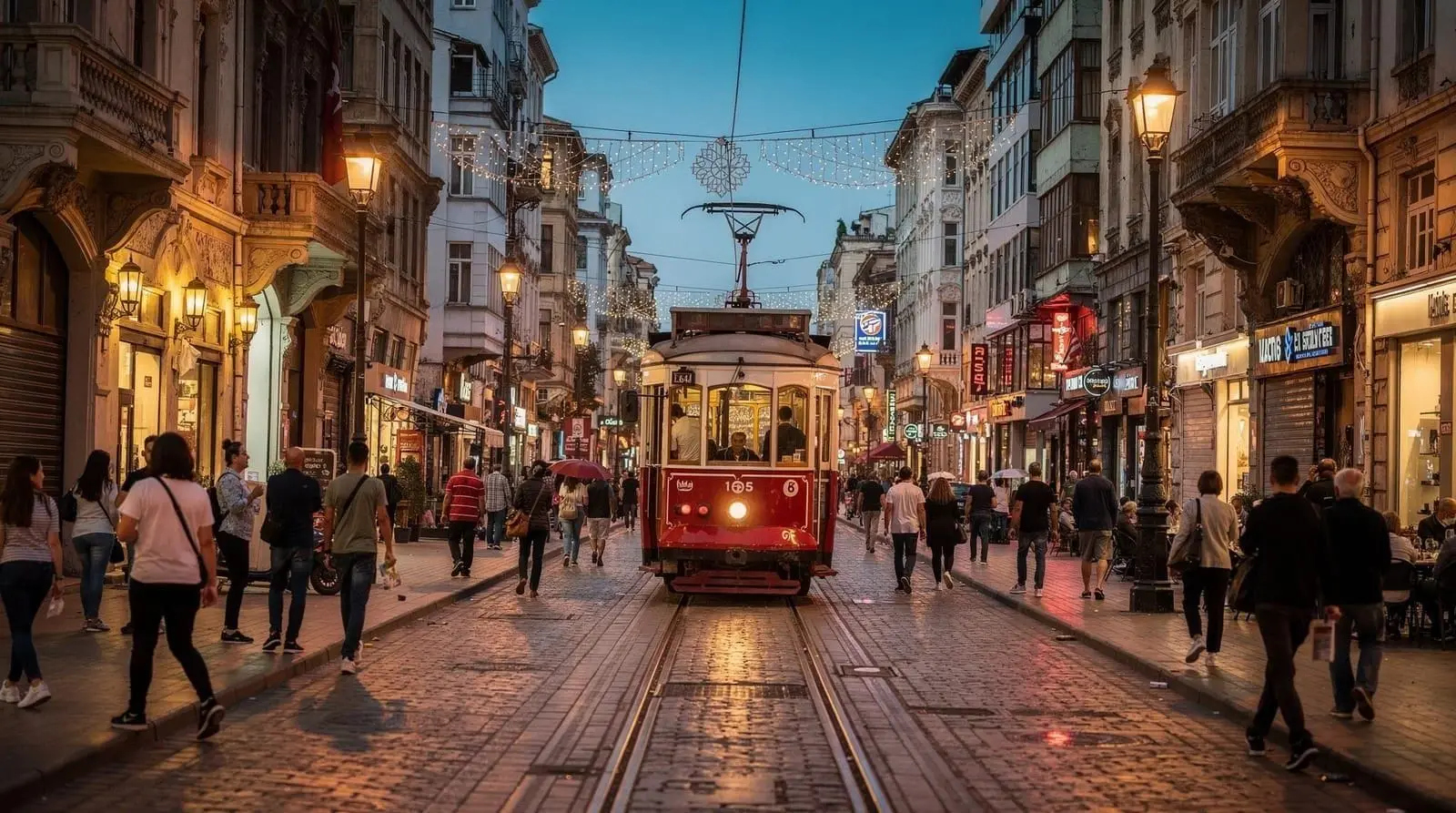
Beyoğlu and İstiklal Avenue
Istanbul's modern European district — art nouveau arcades, independent bookshops, rooftop bars, and 3 km of pedestrian street connecting Tünel to Taksim.
Istanbul: Asian Continent Highlights Walking Tour
Quick facts
- Length of İstiklal
- ≈ 3 km pedestrian
- Historic tram
- Red nostalgic tram, Taksim–Tünel
- Nearest metro
- Taksim (M2), Şişhane (M2)
- Best entry point
- Tünel Square (south) or Taksim Square (north)
- Peak hours
- Weekends 14:00–22:00 — very crowded
- Neighbourhood
- Beyoğlu, European side
The honest picture of İstiklal — useful city artery, not a hidden gem
| Where | Beyoğlu, from Tünel Square to Taksim Square |
| Cost | Free to walk; a meyhane dinner runs 400–700 TRY per person |
| Time needed | Half a day minimum, a full day with side streets |
| Getting there | M2 metro to Şişhane or Taksim; T1 tram + Tünel funicular |
| Best time | Weekday mornings for browsing; evenings for atmosphere |
İstiklal Avenue (İstiklal Caddesi) is simultaneously Istanbul’s most commercially saturated street and one of its most architecturally interesting. The 3-kilometre pedestrian boulevard running from Tünel Square to Taksim is lined with 19th-century European-style buildings housing everything from global fast-fashion chains to century-old patisseries, art-house cinemas, Greek Orthodox churches, a French consulate, and a handful of excellent second-hand bookshops. The red nostalgic tram — actually a single period car that runs the full length of the street — moves more slowly than walking, but is cheap on an Istanbulkart and makes a reasonable photo subject.
The street is genuinely best on a weekday morning. By Saturday afternoon, the crowds on İstiklal itself can reach 300,000 to 500,000 people; forward movement slows to a shuffle near Galatasaray Square in the middle. If that sounds like your idea of fun, the energy is real — street musicians, simit sellers, political demonstrations, and the full demographic cross-section of Istanbul in one continuous stream. If you want to browse properly, go on a Tuesday at 10:00.
The pasaj arcades: what to look for
The most distinctive feature of Beyoğlu’s architecture is its covered shopping arcades, or pasaj — ornate passages built mostly between 1860 and 1920, now housing a mix of cafés, antique dealers, music shops, and eccentric one-off stores. The most notable:
Çiçek Pasajı (Flower Passage), off Galatasaray Square: originally a flower market, now almost entirely given over to tourist-oriented restaurants. The arcade itself is beautiful — a glass-roofed hall from 1876 — but the menus are tourist-priced and the food is unremarkable. Worth a five-minute look; skip the lunch.
Balık Pazarı (Fish Market), directly behind Çiçek Pasajı: this narrow covered lane is more interesting, with proper fish vendors, meze shops, and a few good lokanta restaurants. The fish is genuinely fresh; a mid-range lunch here runs 250–400 TRY (7–12 USD) and is good value.
Hazzopulo Pasajı, near the Greek Orthodox church: quieter, houses several used-book dealers and a few genuine antique shops. One of the better places to find Ottoman-era prints and maps (prices vary widely; bargaining is expected).
Atlas Pasajı: smaller, mostly music-related shops including vinyl record dealers. Serious music collectors have been known to find unusual Turkish recordings here.
Eating and drinking honestly in Beyoğlu
The range of food in Beyoğlu is wide, the quality variable, and the pricing correlates loosely with distance from İstiklal Avenue itself.
On İstiklal: the street is dominated by chain cafés and global fast food. There are exceptions — Markiz, a restored 19th-century patisserie near the Galatasaray Lycée, serves good börek and coffee in a genuine art nouveau interior. Prices are above neighbourhood average but the room justifies it.
Side streets west of İstiklal (toward Cihangir): this is where the neighbourhood improves substantially. Cihangir is a residential area of sloping streets with independent cafés, decent brunch spots, and a weekend flea market at Cihangir Park. Asmalımescit, directly off İstiklal toward the Bosphorus, has several meyhane (traditional tavern-restaurants) where a proper raki and meze dinner runs 400–700 TRY (12–21 USD) per person including drinks.
Pera neighbourhood (northern section of Beyoğlu, around Pera Palace Hotel): the area around the Pera Palace — Istanbul’s grand railway hotel, built 1892 to accommodate Orient Express passengers — has several good restaurants. Mikla, on the top floor of the Marmara Pera hotel, is the reference point for modern Turkish cuisine with a view; reservations are advisable and budget around 1,000–1,500 TRY (30–45 USD) per person for dinner. It is not a casual drop-in.
Nightlife: what to expect and what to be cautious about
Beyoğlu is Istanbul’s primary nightlife hub, and İstiklal’s side streets — particularly the cluster around Balo Sokak, Büyükparmakkapı Sokak, and the Asmalımescit lanes — have bars open until 04:00. Entry is typically free or 50–100 TRY; drinks run 100–200 TRY for a beer in mid-range venues and double that in club-style spaces.
One scam worth mentioning clearly: the “friendly local” approach, where someone strikes up a conversation on İstiklal, invites you to a nearby bar “where a musician friend is playing,” and after a few drinks presents a bill that is 10 to 20 times what was implied. This is a well-documented pattern in Beyoğlu. The venues involved are not hard to identify — they tend to be ground-floor spots with aggressively welcoming door staff and no visible price list. A standard counter-measure: only enter venues where you have asked to see the menu (not just a card) first. If the bar is legitimate, this is a normal request.
The guided pub crawl is an option for those who want structure and safety in numbers on a first night out — the organised route covers vetted venues with pre-agreed pricing and a local guide managing the group.
Architecture: the buildings worth looking up at
Most of Beyoğlu’s major architecture dates from the period of Ottoman modernisation and Europeanisation in the 19th century. A few specific buildings:
The French Consulate (formerly the French Palace): a large neoclassical compound midway along İstiklal, built 1839. The gate is unmissable.
The Galata Mevlevihanesi, at the Tünel end: a Sufi lodge from the 17th century, now operating as a museum with regular evening sema (whirling dervish) ceremonies. Tickets sell out; check the schedule at the venue directly rather than relying on third-party resellers.
The Greek Orthodox Church of Hagia Triada: a red-brick neo-Gothic church near Taksim Square, built 1880. Usually open to visitors outside service hours; quiet interior.
Beyoğlu İş Hanı: an office complex built in the 1950s that now houses a range of interesting small businesses, including one of Istanbul’s better used-book dealers on the upper floors.
Getting to Beyoğlu and moving around
From Sultanahmet and the old city: the T1 tram to Karaköy (end of line), then walk uphill through Galata to Tünel (8–10 minutes), or take the Tünel funicular from Karaköy directly to the Tünel end of İstiklal. Alternatively, take the M2 metro from any central station to Şişhane (south İstiklal area) or Taksim (north end).
Within İstiklal, walking is the only realistic option — the nostalgic tram covers the full length but moves at pedestrian pace and is primarily a tourist attraction. The street itself is entirely pedestrianised.
For the side streets: most are walkable. Cihangir requires a short uphill walk from the middle of İstiklal; Asmalımescit is a gentle downhill from the same area.
Choosing a neighbourhood: İstiklal, Cihangir, or Karaköy
Visitors with limited time often ask which part of greater Beyoğlu deserves priority. The honest comparison:
| İstiklal Avenue | Cihangir | Karaköy | |
|---|---|---|---|
| Character | Commercial, high-energy, crowded | Residential, artistic, café culture | Waterfront, food and design shops |
| Best for | Shopping, arcades, nightlife | Slow mornings, independent bookshops | Brunch, galleries, Bosphorus views |
| Crowd level | Very high, especially weekends | Low to moderate | Moderate |
| Time needed | 2–3 hours | 1–2 hours | 1–2 hours |
A single day can realistically cover İstiklal’s arcades in the morning, lunch in Cihangir or the Balık Pazarı, and a Karaköy coffee stop before heading down to Galata Tower in the late afternoon.
Galata Tower entry ticket with audio guide — a natural finish to a Beyoğlu day, a short walk downhill from TünelWhat Beyoğlu is not
It is not a historical site in the Sultanahmet sense — there is no single monument to see here. It is a city neighbourhood whose value lies in being in it. If you are looking for a quick checkbox attraction, you will find the experience underwhelming. If you are prepared to spend a morning walking slowly, eating something in the market, stopping in a bookshop, and sitting in a café watching the city move, it pays off properly.
Karaköy immediately below on the waterfront is the more genuinely food-and-café-focused neighbourhood if that is your primary interest. Taksim at the northern end is covered in its own page.
Frequently asked questions about Beyoğlu and İstiklal
Is İstiklal Avenue safe?
Yes, by Istanbul standards it is heavily policed and generally safe for visitors. Pickpocketing in the crowds is the main risk — keep valuables in a front pocket or a zipped bag. The bar scam described above is the other significant hazard. Avoid isolated back streets after midnight if unfamiliar with the area.
How long does it take to walk the full length of İstiklal?
End to end (Tünel to Taksim), the walk takes about 20–25 minutes at normal pace without stopping. With stops for windows, shops, and the arcades, plan a minimum of 2 hours.
Can I take the nostalgic tram?
Yes, it uses the Istanbulkart like any other public transport. However, the tram only runs one direction at a time and operates on a single track, so it is limited and often crowded. It is more useful as an experience than as transport.
Is Beyoğlu expensive compared to the old city?
Mix of prices. International chains on İstiklal are similar to European prices. Local cafés in Cihangir and Asmalımescit are good value. Tourist-targeted restaurants near Galatasaray Square charge old-city prices. The fish market lunches and side-street lokanta meals are consistently reasonable.
What is the Pera Palace Hotel?
The Pera Palace (Pera Palas Oteli) opened in 1892 specifically to host Orient Express passengers. It hosted Agatha Christie (who reportedly wrote parts of “Murder on the Orient Express” in Room 411), Atatürk (whose personal suite is preserved as a museum), and a series of early 20th-century dignitaries. The lobby bar is open to non-guests and worth a visit for the interior alone; a cocktail runs 400–600 TRY (12–18 USD).
Are the bookshops on İstiklal genuinely good?
Several are. The Robinson Crusoe bookshop near Tünel has a well-curated English-language section focused on Istanbul and Turkey. The second-hand shops in the pasaj arcades and around Beyoğlu İş Hanı are more hit-and-miss but occasionally have unusual finds. If you read Turkish, the coverage is far wider.
Beyoğlu’s 19th-century cosmopolitan period
The neighbourhood known today as Beyoğlu developed its distinctive character in the second half of the 19th century as a result of the Ottoman Empire’s Tanzimat reforms, the growth of European commercial and diplomatic presence, and the construction of the Istanbul-to-Vienna Orient Express railway link (which terminated at Sirkeci on the European shore, directly below Galata). The Pera neighbourhood, the upper section of today’s Beyoğlu, became Istanbul’s luxury hotel and entertainment district — the Pera Palace opened in 1892 specifically for Orient Express passengers, and a series of European-style cafés, cabarets, theatres, and restaurants followed.
The social geography of this period is illuminating: the old city (Sultanahmet peninsula) was overwhelmingly Muslim Ottoman; Galata and Pera were disproportionately non-Muslim and non-Ottoman — Greek, Armenian, Jewish, Levantine, and foreign. This spatial separation between Muslim and non-Muslim, Ottoman and European, was an artifact of Ottoman social organisation that broke down gradually over the 20th century. By the mid-20th century the non-Muslim communities had largely emigrated; by the 1970s Beyoğlu had become one of Istanbul’s most neglected and dangerous districts. The rehabilitation of İstiklal Avenue as a pedestrian shopping street in the 1990s was a deliberate urban development initiative that produced the current version.
The Armenian community of Beyoğlu
Several Armenian Catholic and Protestant churches are on or immediately adjacent to İstiklal Avenue — a visible reminder that Beyoğlu was substantially Armenian through much of the 19th and early 20th centuries. The Church of St. Mary Draperis (Catholic), the Armenian Church of Surp Yerrortutyun, and others are still active and open to visitors outside service hours.
The Armenian community of Istanbul was devastated by the events of 1915 (the deportations and massacres that the Turkish government continues to dispute as genocide but most historians and many governments classify as such) and further reduced by subsequent emigration. The current Armenian community in Istanbul, based primarily in Beyoğlu and Kumkapı, numbers approximately 50,000–60,000 — a fraction of the pre-1915 population.
For visitors with an interest in this history, the churches provide a physical connection to the community’s past in the neighbourhood. Several small museums and community cultural centres document the history, though access and hours vary.
Cihangir: the neighbourhood behind İstiklal
Cihangir — the hillside residential neighbourhood west of İstiklal, between the street and the Bosphorus — deserves more time than it usually gets in tourist itineraries. It is the neighbourhood where Istanbul’s artists, journalists, academics, and foreign correspondents have historically lived, producing a density of intelligent café culture, independent bookshops, and gallery spaces that feels different from both the tourist strip of İstiklal and the upscale gloss of Nişantaşı.
The main axis is Sıraselviler Caddesi heading south from Taksim toward Cihangir Park. On weekends, the flea market in the park is modest but genuine. The streets off Sıraselviler toward the Bosphorus give a rapid view change — within five minutes of İstiklal Avenue you are in streets of apartment buildings where the primary population is local, the cats are the main common space inhabitants, and the only English on the signs is in the bookshop windows.
Transport tips for navigating the district
The Tünel: the Tünel funicular connecting Karaköy (lower Galata / Bosphorus level) to Tünel Square (southern end of İstiklal) is the world’s second-oldest underground urban railway, opened 1875 by the Société des Tramways de Constantinople — a French company. The journey takes approximately 90 seconds; it operates on the Istanbulkart. This is a practical and historically interesting two-stop journey that beats the 10-minute uphill walk from Karaköy.
Dolmuş: shared minibuses (dolmuş) run on fixed routes through Beyoğlu and are faster than city buses on some routes. They depart when full from fixed starting points; fares are paid to the driver in TRY.
Taxis in Beyoğlu: useful for getting from Taksim to Karaköy (downhill, 10 min, 80–120 TRY) or from anywhere in Beyoğlu to the ferry piers. Insist on the meter running; drivers in tourist-heavy areas occasionally try to negotiate a fixed price in advance, which is usually more expensive than the metered fare.
What Beyoğlu does well that the old city doesn’t
The honest comparative assessment: Sultanahmet and the old city have the major historical monuments. Beyoğlu has the contemporary city life — better restaurants (at the mid-range level), the independent arts scene, the genuine cosmopolitan character that the old city lost when it became primarily a tourist zone. If you have more than four days in Istanbul, the allocation of a full day to Beyoğlu and the northern districts is worthwhile. If you have only two or three days, the old city and the Bosphorus are higher priority.
The specific things Beyoğlu does better: late-night dining options (restaurants stay open until midnight and beyond in Asmalımescit and Cihangir), the arts calendar (major exhibition openings at SALT, Istanbul Modern, and the private galleries tend to be on evenings), the wine culture (Turkish wines are improving rapidly, and Beyoğlu has the best retail selection and wine bars to explore them), and the music scene (live jazz, rock, and Turkish folk at venues that do not cater specifically to tourists).
Planning the rest of your Beyoğlu time
If this page has convinced you to spend longer here, a few other pages help you shape the visit. The Beyoğlu neighbourhood guide goes deeper on the streets and the day-to-day rhythm of the area, while Staying in Sultanahmet vs Beyoğlu is the page to read if you are still deciding where to sleep. For the evening side of the district, the Istanbul nightlife guide and the rooftop bars guide cover what this page only touches on, and Istanbul scams to avoid expands on the bar approach described above.
Beyoğlu fits naturally into a longer trip as well. The Istanbul 3-day itinerary shows how a Beyoğlu day can sit alongside the old city and the Bosphorus without feeling rushed, and Istanbul public transport guide explains the metro, tram and funicular connections used throughout this page.
Top experiences
Bookable activities with verified prices and instant confirmation on GetYourGuide.

