Cappadocia
Fairy chimneys, sunrise balloon flights, and underground cities in volcanic rock — reach from Istanbul by flight and plan at least one overnight stay.
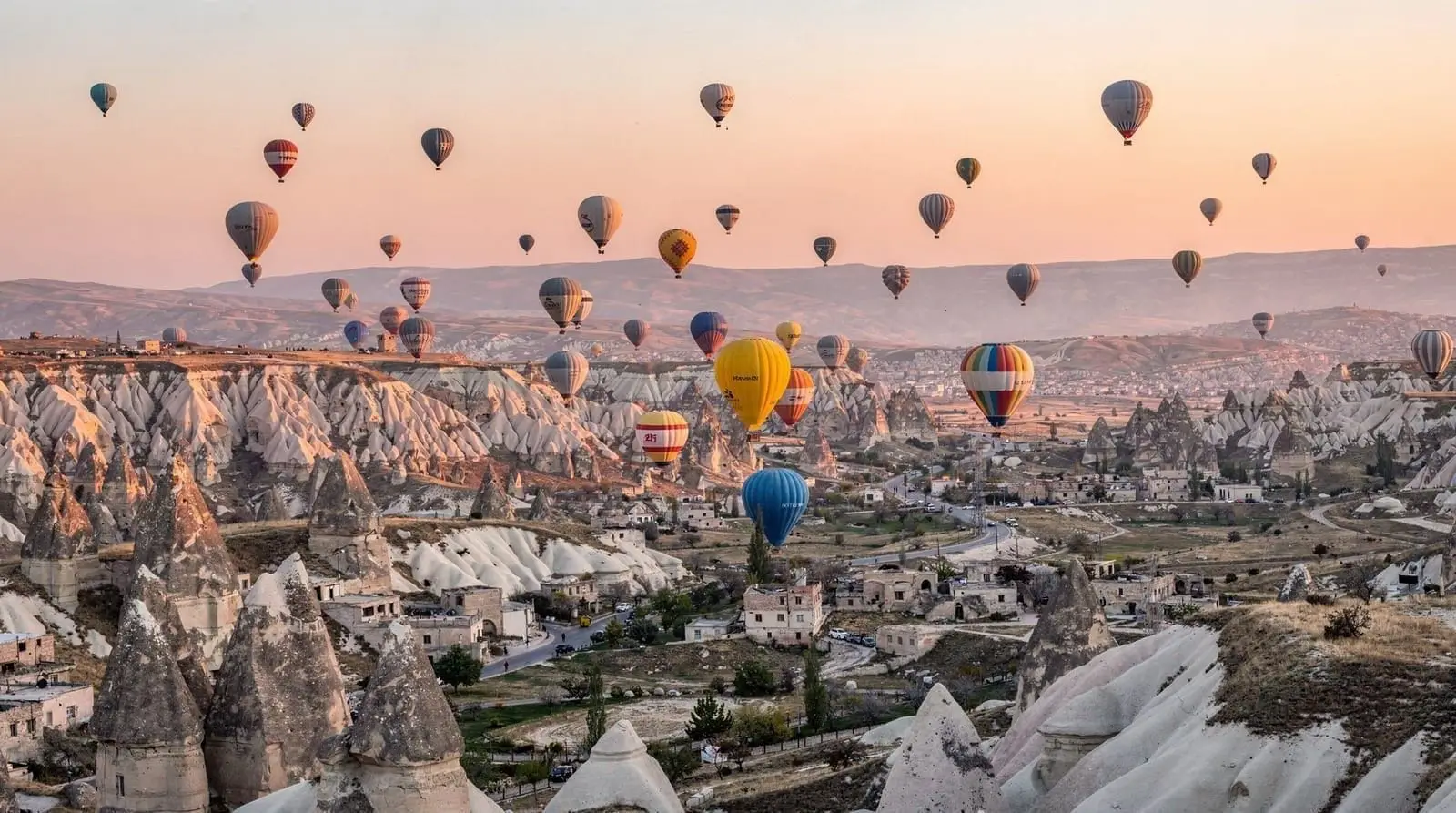
Cappadocia: Goreme Hot Air Balloon Flight at Sunrise
Quick facts
- Distance from Istanbul
- ~750 km southeast
- Getting there
- Fly from IST or SAW to Nevşehir (NAV) or Kayseri (ASR), ~1h15 flight
- Base town
- Göreme (most popular) or Ürgüp
- Balloon season
- Approximately April–October (weather-dependent)
- UNESCO status
- Göreme National Park and Rock Sites of Cappadocia, listed 1985
- Balloon flight cost
- 150–300 EUR / 170–340 USD per person (prices vary by operator)
Cappadocia is the single most popular extension from Istanbul for good reason. The landscape — formed by volcanic eruptions 60 million years ago, eroded into thousands of conical formations called fairy chimneys — is genuinely unlike anywhere else. Humans have carved into this soft volcanic tuff for millennia: early Christians cut churches decorated with Byzantine frescoes, Byzantine and Hittite communities carved out underground cities reaching eight storeys below ground, and Ottoman-era residents built villages into the cliffs. Today, hot air balloons drift over the valley at sunrise in an image that has become one of Turkey’s defining photographs.
Important logistics first: Cappadocia is not a day trip from Istanbul in any realistic sense. It is 750 km away by road. Buses take 10–12 hours. Flights from Istanbul (IST or SAW airports) to Nevşehir (NAV) or Kayseri (ASR) take about 1 hour 15 minutes. The famous sunrise balloon flight launches around 05:00 — which means, if you fly from Istanbul on the same day, you land in Cappadocia in the afternoon and cannot catch the next morning’s balloon. Plan at least two nights. Many visitors find three nights ideal.
| Where | Central Anatolia, ~750 km southeast of Istanbul |
| Cost | Balloon flight 150–300 EUR; cave hotel 40–700 EUR/night |
| Time needed | 2–3 nights minimum |
| Getting there | ~1h15 flight to Nevşehir (NAV) or Kayseri (ASR) |
| Best time | April–May and September–October for balloon season |
If you are still deciding whether the trip fits your plans, the Cappadocia from Istanbul guide walks through the practicalities in more depth, and the day trip reality check explains honestly which excursions from Istanbul are feasible in a single day. For a ready-made schedule, the Istanbul and Cappadocia in 5 days itinerary combines both places.
Getting to Cappadocia from Istanbul
By flight (recommended): Fly from Istanbul Airport (IST, European side) or Sabiha Gökçen (SAW, Asian side) to either Nevşehir Kapadokya Airport (NAV) or Kayseri Airport (ASR). Flight time approximately 1 hour 15 minutes. Turkish Airlines, Pegasus, and AnadoluJet operate these routes; fares vary from 800–4,000 TRY one-way (≈ 20–100 USD) depending on how far in advance you book. Check both airports at origin and both at destination — prices can differ significantly.
From Nevşehir airport, shuttle services run to Göreme in about 40 minutes. From Kayseri, the drive to Göreme is around 75 minutes by shuttle or taxi.
By overnight bus: Buses depart Istanbul (Esenler otogar) every evening and arrive in Göreme or Ürgüp in the morning after 10–12 hours. Companies like Metro Turizm, Kamil Koç, and Nevşehir Seyahat cover the route. Fare: 600–1,200 TRY (≈ 15–30 USD). This is physically demanding but cheap, and timing aligns with a morning arrival for an afternoon first explore — though you won’t be rested for the 04:30 wake-up call for the next day’s balloon.
One-day “day trip by plane”: These exist as organised tours and are popular with limited-time travellers. A round-trip flight + guided day tour covers the main highlights. Be honest with yourself: you will be exhausted, you will not catch a balloon flight (which launches before you arrive), and you will see Cappadocia in a rapid sweep. For many people, this is better than not going. But if you can spare two nights, the experience is incomparably richer.
The hot air balloon flight: what to know
The sunrise balloon flight over Cappadocia is one of the world’s genuinely special experiences. Around 100–150 balloons launch each morning at approximately 05:00–05:30, rising over the valleys as the light changes from pre-dawn grey to pink to full golden. The patchwork of fairy chimneys, the silence, the scale — it is difficult to describe accurately.
Balloon season runs approximately April through October, with April–May considered the best combination of weather reliability and landscape conditions. Flights are cancelled if wind speeds are too high or visibility is poor — this happens regularly, especially in winter and spring. Operators notify you the night before; most offer a rebooking rather than a refund.
Our Cappadocia balloon ride guide covers what the morning looks like from hotel pickup to landing, and the blog posts on balloon season and on whether the balloon is worth it help you decide how much of your budget to put into this one hour.
How much does it cost? Expect 150–300 EUR per person (≈ 170–340 USD) for a standard sunrise flight of approximately 60–75 minutes. “Economy” operators advertise lower prices (sometimes under 100 EUR) and use larger baskets with more passengers; “premium” operators use smaller baskets and typically have better safety records and cancellation policies. This is not the place to find the cheapest option — research your operator’s accident history and reviews.
Booking: Book your balloon flight before you book your accommodation. Flights sell out, especially in April–May peak season. Most hotels in Göreme can arrange bookings through trusted operators they work with; this is often the most reliable approach.
The Göreme Open Air Museum
The Göreme Open Air Museum is a UNESCO-listed complex of carved churches and monasteries from the 10th–13th centuries, concentrated in a valley about 1 km from the centre of Göreme town. The churches are decorated with Byzantine frescoes that survived in remarkable condition in the constant-temperature cave interiors.
The Karanlık Kilise (Dark Church) requires a separate entry fee — around 300–350 TRY (≈ 8–9 USD) in addition to the main site ticket — but has the best-preserved frescoes: vivid blues, ochres, and terracotta depicting New Testament scenes. The main site entry is around 900–1,100 TRY (≈ 23–28 USD). Arrive early (opens 08:00) to avoid tour group crowds, which peak between 10:00 and 14:00.
For more detail on Göreme and the Open Air Museum, see the Göreme destination page and the dedicated Göreme Open Air Museum guide.
The Red Tour and Green Tour: what they cover
Cappadocia’s organised tours are typically packaged as the “Red Tour” (focusing on the Göreme valley area and main formations) and the “Green Tour” (focusing on the underground cities of Derinkuyu or Kaymaklı, Ihlara Valley, and Selime Monastery). Both are full-day tours with lunch included.
Red Tour highlights: Göreme Open Air Museum, Devrent Valley (camel rock formations), Paşabağları (Monks’ Valley, classic fairy chimneys), Çavuşin village, Avanos (pottery town on the Kızılırmak River), Sunset Point at Aktepe.
Green Tour highlights: Derinkuyu Underground City (the largest, going down 8 storeys; entry fee separate), Ihlara Valley gorge hike (8 km carved canyon with rock-cut churches), Selime Monastery (giant carved complex at the valley end), Pigeon Valley viewpoint.
Both tours are worth doing on a 3-night stay; on a 2-night stay, choose one and spend the other day hiking independently or renting an ATV/scooter.
For a comparison of the organised options, read the Cappadocia tours guide; for a self-planned version, the things to do in Cappadocia guide lists what else is worth your time.
Underground cities
Cappadocia’s underground cities are one of the region’s most surprising features. Early Christian communities, facing Byzantine-Sassanid and later Arab raids, carved extensive subterranean complexes with ventilation shafts, wells, churches, storage rooms, stables, and living quarters — some extending 8 storeys underground.
Derinkuyu is the deepest (8 storeys, 85 metres) and most visited. Entry around 400–500 TRY (≈ 10–13 USD). The tunnels are narrow and low-ceilinged — claustrophobic individuals should consider this before entering. Tours include it in the Green Tour itinerary. More background on how these complexes were used and which one to pick is in the Cappadocia underground cities guide.
Kaymaklı is shallower but more extensively excavated in its upper levels, easier to navigate for those with mild claustrophobia.
Choosing between the balloon, the underground cities, and the hikes
With only 2 nights, most visitors can’t fit everything comfortably. A quick way to prioritise: the balloon flight is the single most distinctive Cappadocia experience and should be booked first regardless of anything else. The underground cities (Derinkuyu or Kaymaklı) are the second priority for most first-time visitors — nothing else in Turkey compares. Valley hikes (Rose Valley, Pigeon Valley) are free, flexible, and can be slotted into whatever time remains, including a spare afternoon or early evening before dinner. If a choice has to be made between the Green Tour’s underground city and a self-guided valley hike, the underground city wins for a first visit; hikes are the better use of a second or third day once the headline sights are covered.
Valleys for hiking
Cappadocia is an excellent hiking destination independent of organised tours. Most valleys take 1–3 hours to walk and are accessible from Göreme on foot or by taxi.
Rose Valley (Güllüdere): The classic sunset hike. Pink tuff formations, cave churches, vineyard terraces. Start from Çavuşin and walk toward Göreme, or vice versa.
Love Valley: Famous for its phallic-shaped fairy chimneys, visible from a viewpoint near Göreme. Actually called this, without embarrassment.
Pigeon Valley (Güvercinlik): The valley that connects Göreme to Üçhisar fortress. Named for the thousands of dove/pigeon caves carved by villagers to collect droppings as fertiliser. About 3 km one-way.
Ihlara Valley: Only covered on the Green Tour; it is further south and requires a car or bus to reach from Göreme.
Cave hotels: what to expect
Cave hotels are the defining accommodation choice in Cappadocia — rooms carved directly into the tuff rock, with thick walls that maintain a near-constant temperature (cool in summer, warm in winter). Quality ranges from basic to genuinely luxurious.
In Göreme: Museum Hotel and Argos in Cappadocia represent the luxury end (from 350–700 EUR per night). Mid-range cave hotels like Kelebek Special Cave Hotel or Anatolian Houses run 100–250 EUR per night. Budget options exist from 40–80 EUR.
Cave rooms in quality properties have proper plumbing, heating, wifi, and terraces — this is not camping. Book well in advance for April–May and September–October. The where to stay in Cappadocia guide compares areas and styles in more detail.
Cappadocia in winter
November through March is genuinely beautiful but operationally different. Balloon flights are less frequent (weather reliability drops significantly, especially November–February) and cancellations are common. Snow occasionally covers the fairy chimneys — one of the most photographed outcomes when it happens. Prices for accommodation drop by 40–60% off peak. Crowds are minimal. The underground cities and Göreme museum are open year-round.
If the balloon flight is your primary goal, plan for April–October. The best time to visit Cappadocia guide goes month by month, and the general Istanbul in winter guide helps if you are combining the cold months with a city stay.
How to plan a Cappadocia itinerary from Istanbul
The most common visit lengths and what they realistically allow:
1 night / 2 days: Fly to NAV or ASR the first evening. Morning 2: balloon flight (05:00 start), breakfast post-flight, Red Tour or Green Tour afternoon, evening return flight. This is the absolute minimum for a meaningful visit. You will see the key sites but will feel rushed. The overnight on the flight-in evening means you can catch Day 2’s balloon.
2 nights / 3 days: Day 1: fly in, afternoon at Göreme Open Air Museum or valley hike. Day 2: sunrise balloon, morning Red Tour. Day 3: Green Tour (underground city, Ihlara Valley) or ATV/horse riding, afternoon flight home. This is the sweet spot for most visitors — enough time to see both the surface landscape and the underground.
3 nights / 4 days: The unhurried version. Add: wine tasting in Ürgüp or Avanos, the pottery workshops in Avanos, a longer valley hike, a second balloon flight if you want to try different conditions, the northern Avanos-to-Çavuşin hike. More time also allows flexibility if a balloon flight is cancelled — you can rebook for the next morning.
Two ready-made plans are worth a look: the Cappadocia 2-day itinerary for a tight stay, and the Istanbul, Cappadocia, Ephesus and Pamukkale 7-day itinerary if you want to continue west afterwards. Longer trips also fit into the Turkey highlights 10-day itinerary. If you extend your trip, Ephesus and Pamukkale are the natural next stops, and our a week in Turkey tips cover the pacing.
Cave hotels: choosing by area and style
Göreme: Most convenient. Walking distance to the Open Air Museum, closest to balloon launch sites, most tour departure points. The hotel range is widest. Feels most like a “tourist village” — the main downside.
Üçhisar: 5 km from Göreme, perched below a distinctive castle rock. Quieter, more upscale, with some of the region’s best boutique properties (Les Maisons de Cappadoce). Views over the Rose Valley. Fewer restaurants; requires a taxi to most sites.
Ürgüp: Largest town, most “normal” (non-cave) hotel options alongside cave properties. Livelier restaurant and bar scene. More local character than Göreme. 10 km from the main sites.
Ortahisar: Very quiet, less touristic, centred around a distinctive castle rock. A cave hotel here feels genuinely remote. Suits self-driving visitors.
The ideal booking approach is to contact 3–4 hotels directly (by email) rather than purely through booking platforms. Cave hotel owners respond quickly and often have better direct rates. State your priorities: balloon access, valley views, or quiet — they can match you to their best rooms accordingly.
Cappadocia’s food and wine
The region produces wine in small quantities from old-vine grapes grown in volcanic soil. The most interesting producers are near Ürgüp and Avanos. The mineral quality of the tuff-influenced soil shows up distinctly in the whites — grape varieties including Emir (local white) and Narince. Not world-class viticulture, but genuinely local and worth trying. A tasting at a winery near Ürgüp costs around 300–500 TRY and includes 4–6 pours.
Food in Göreme and Cappadocia broadly: the regional speciality is testi kebabı (clay pot kebab) — lamb, vegetables, and spices sealed in a clay vessel, baked in a wood oven for hours, then broken at the table. The spectacle is part of it. Cost: around 600–900 TRY per person at better restaurants. Also worth eating: tarhana soup (fermented wheat and tomato), mantı (Turkish dumplings), and the fresh local bread from wood-fired ovens.
Avanos is a pottery town on the Kızılırmak River (Turkey’s longest river, red-tinged from iron-rich clay). The pottery workshops here have been producing ceramics since Hittite times; the red clay pottery is genuinely regional and a better souvenir than the mass-produced items sold at tourist shops. Workshop visits where you can try the wheel cost around 200–400 TRY.
Seasonal guide: when to go for what purpose
| Season | Weather | Balloon reliability | Crowds | Prices |
|---|---|---|---|---|
| Apr–May | Mild, spring flowers | Best of the year | Busy, book 3+ months ahead | Peak |
| Jun–Aug | Hot (35°C+), dusty | Good, but hazier skies | Highest | Highest |
| Sep–Oct | Golden light, cooler | Good | Slightly less than spring | High |
| Nov–Mar | Cold, occasional snow | Frequent cancellations | Lowest | 40–60% lower |
April–May (peak balloon season): Best balance of weather, landscape (spring flowers in the valleys, snow sometimes still on distant mountains), and balloon reliability. Busy but not overwhelming. Book 3+ months ahead.
June–August: Hot (35°C+ by midday), dusty, crowded. Balloon flights still operate well. Prices are highest. If this is your only window, come early morning and retreat indoors midday. August includes the Cappadocia Balloon Festival (approximately late July to early August — confirm current dates), which is a remarkable visual event.
September–October: Golden light, grape harvest, good temperatures. Slightly less crowded than spring peak. Excellent for photography. Balloon reliability good.
November–March: Cold (0°C nights possible, occasional snow). Balloons cancelled frequently (especially December–February). Prices drop 40–60%. The snow-covered fairy chimneys are genuinely beautiful when it occurs. Best for photographers and travellers who dislike crowds.
Frequently asked questions about Cappadocia
Can I do a day trip to Cappadocia from Istanbul?
Technically yes — one-day tours by plane exist and cover the main highlights. But you cannot catch the sunrise balloon flight (it launches before you would arrive), and the experience is compressed and tiring. The consensus among most visitors is that 2 nights (ideally 3) is the minimum for a genuine Cappadocia experience.
When is the best time to visit Cappadocia?
April and May are considered optimal: reliable balloon weather, spring flowers, moderate temperatures. September and October are also excellent. Summer (June–August) is hot (35°C+ in July), dusty, and crowded but fully operational for balloons. Winter offers dramatic snow scenery but balloon cancellations are frequent.
How much does a hot air balloon flight cost?
Standard sunrise flights cost approximately 150–300 EUR per person depending on operator and package. Budget operators with large baskets exist below this range. Premium operators with smaller, more exclusive flights charge 300 EUR+ per person. Price should not be the primary decision factor — the operator’s safety record and cancellation policy matter more.
Which airport should I fly into for Cappadocia?
Either Nevşehir Kapadokya (NAV) or Kayseri (ASR). NAV is closer to Göreme (~40 min shuttle); ASR is further (~75 min shuttle) but often has better route availability and lower prices. Check both when booking. Many hotels include or arrange airport shuttles.
What is the difference between the Red Tour and Green Tour?
The Red Tour covers the Göreme valley area: Open Air Museum, main fairy chimney formations (Paşabağları, Devrent), Avanos, and viewpoints. The Green Tour focuses on the underground cities (Derinkuyu), Ihlara Valley gorge, and Selime Monastery. Both are full-day with lunch. On a 2-night stay, choose based on priorities (formations vs. underground/gorge); on 3+ nights, do both.
Where should I stay in Cappadocia?
Göreme is the central base town — most convenient for the Open Air Museum, valley hikes, and hot air balloon departure. Ürgüp is larger and slightly more upscale, with better restaurants and less backpacker atmosphere. Uçhisar has a fortress and slightly quieter character. Most cave hotels concentrate in or near Göreme.
Is the underground city safe for claustrophobic visitors?
Derinkuyu’s tunnels are narrow and low — actively claustrophobic in places. Kaymaklı’s upper levels are more manageable. If you have moderate claustrophobia, the underground cities are challenging but doable with the right mindset and avoiding the deepest levels. With severe claustrophobia, skip them and spend the time on valley hikes instead.
What happens if my balloon flight is cancelled?
Operators contact guests the night before if weather conditions look unfavourable, and again in the early morning if the call is made on the day. Most operators offer a rebooking for a different morning during your stay or a partial/full refund under their cancellation terms. Read the specific policy before booking. Cancellation rates in April–October are lower than in winter months.
Top experiences
Bookable activities with verified prices and instant confirmation on GetYourGuide.


