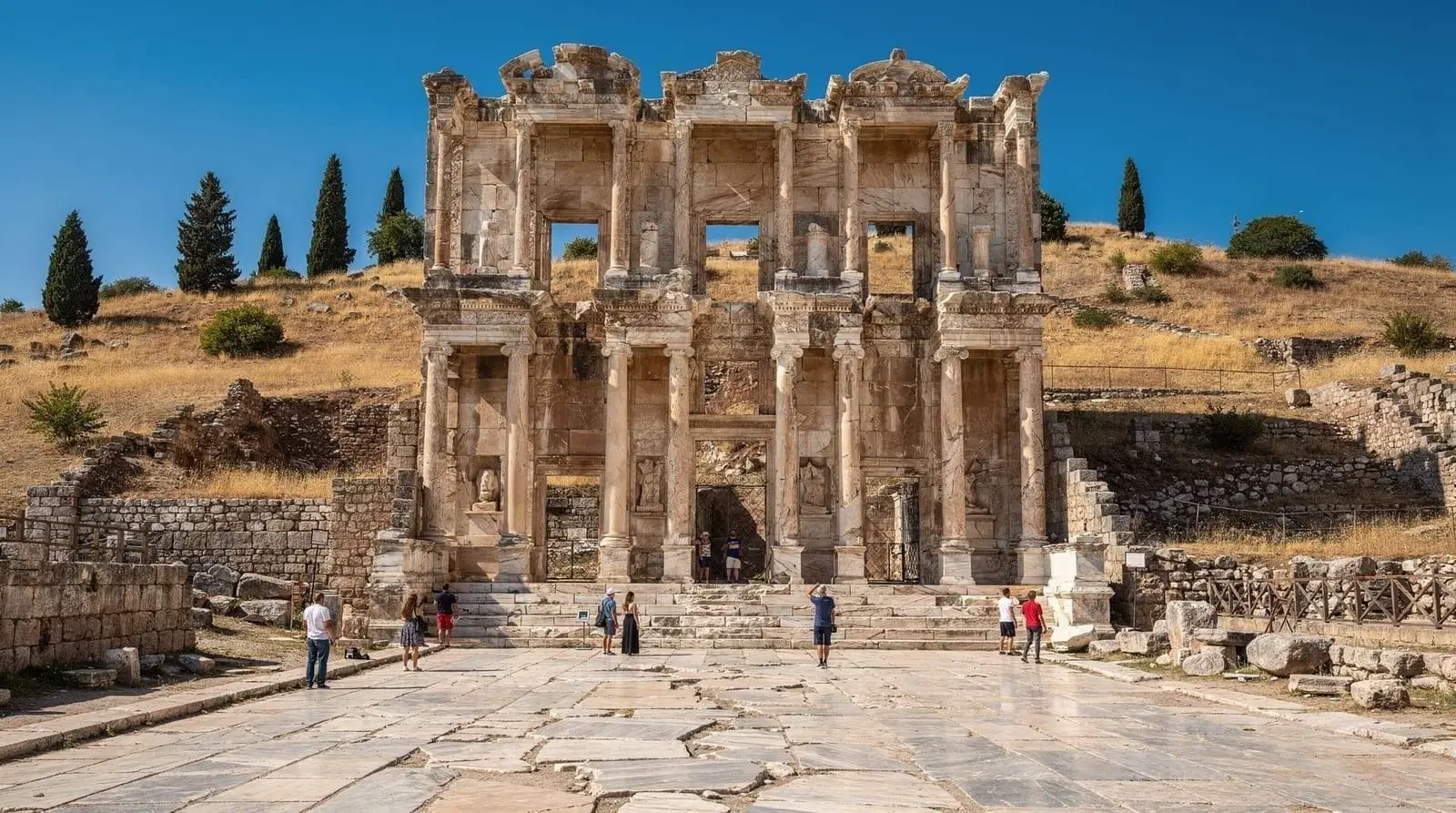
Ephesus
Best-preserved ancient Roman city — Library of Celsus, marble streets, 25,000-seat theatre. Fly Istanbul to Izmir; plan at least one overnight in Selçuk.
Ephesus Entry Ticket with Mobile Phone Audio Tour
Quick facts
- Distance from Istanbul
- ~550 km southwest; fly to Izmir (ADB), then 1h by road
- Getting there
- Fly IST/SAW → Izmir ADB (~1h flight); then bus or taxi ~80 km to Selçuk
- UNESCO status
- Ephesus, listed 2015
- Entry fee
- ~850–1,100 TRY (≈ 22–28 USD); Terrace Houses extra ~500 TRY
- Base town
- Selçuk (5 km from site) — small, affordable, practical
Ephesus was one of the great cities of the ancient world — at its peak in the 1st and 2nd centuries CE, a Roman metropolis of 250,000–500,000 people, second in size only to Rome itself in the eastern Mediterranean. It was the capital of the Roman province of Asia, the site of one of the Seven Wonders of the Ancient World (the Temple of Artemis, now largely missing), and a city where St Paul preached and the Gospel of John may have been written. The ruins visible today are substantially from the Roman Imperial period and are among the best-preserved and most extensive ancient urban sites in the world.
Getting here from Istanbul requires honest logistics: Ephesus is 550 km from Istanbul. You need to fly to Izmir (ADB), which takes about 1 hour, then travel 80 km south to Selçuk and the site. “Day trips from Istanbul” by plane are sold and do work — you fly early, visit the ruins, and fly back. But you will spend 4–5 hours in transit for 3–4 hours at the site, which is very little time for a site of this scale. One overnight in Selçuk, staying near the ruins, gives you a full unhurried day — which is what Ephesus deserves.
| Where | Selçuk, Aegean coast — fly Istanbul to Izmir (ADB), then ~1h by train or road |
| Cost | Around 850–1,100 TRY entry, plus ~500 TRY for Terrace Houses |
| Time needed | 3–4 hours at the site minimum; a half-day realistically |
| Getting there | Flight IST/SAW→ADB (~1h) + train or taxi to Selçuk (~1h) |
| Best time | April–May or September–October; avoid midday in July–August |
For a full step-by-step version of this route with timings and booking tips, see the Ephesus from Istanbul guide.
Getting to Ephesus from Istanbul
By flight to Izmir + ground transfer: Fly Istanbul (IST or SAW) to Izmir Adnan Menderes Airport (ADB), about 1 hour. From Izmir airport, options to Selçuk and Ephesus: train (Izmir TCDD from the airport station, about 1 hour to Selçuk, very comfortable and cheap at around 80–120 TRY), taxi (about 1.5 hours, 1,200–1,800 TRY), or tour shuttle. This is the most cost-effective and comfortable route.
Organised day tour from Istanbul: Several operators offer flight-inclusive day tours from Istanbul to Ephesus. You fly early morning, have a guided visit, and return the same evening. Total cost typically 2,500–5,000 TRY per person (≈ 65–130 USD) including flights, guide, and lunch. Exhausting but possible.
From Kuşadası (cruise port): Many visitors arrive at Ephesus from cruise ships docking at Kuşadası, 18 km from Selçuk. This is a significant part of the site’s visitor flow and means the morning hours (09:00–12:00) can be very crowded. Independent travellers should time accordingly.
The site: what to see and how to read it
The site divides naturally into upper and lower sections, connected by the Curetes Street marble-paved road.
Enter from the upper (east) gate if you want to walk downhill — this is the logical direction and easier on the legs. The alternative lower entrance is near the Library of Celsus, which draws the cruise ship crowds.
Hercules Gate: The monumental arch marking the beginning of Curetes Street. Two-storey columns still stand; relief carvings of Hercules are visible.
Temple of Hadrian: One of the most photographed structures on Curetes Street. A small but elegantly proportioned 2nd-century temple with intricate relief carvings on the arch — a Medusa head, Tyche (goddess of fortune), and the founding myths of the city.
The Terrace Houses (Hanghäuser / Yamaç Evleri): Covered with a modern walkway and roof, the Terrace Houses are the site’s most atmospheric section and require a separate additional ticket (around 500 TRY / ≈ 13 USD). The rich residential quarter of Roman Ephesus: six houses occupied from the 1st to the 7th century CE, with intact mosaics, frescoes, marble-floored rooms, and underfloor heating systems. More intimate and detailed than the large monuments. Strongly recommended.
Library of Celsus: The defining image of Ephesus. Built in 117 CE as a mausoleum for the Roman consul Tiberius Julius Celsus and converted to a library holding around 12,000 scrolls, its two-storey facade was reconstructed by Austrian archaeologists in the 1970s. The allegorical statues in the niches (Sophia, Arete, Ennoia, Episteme — wisdom, virtue, intelligence, knowledge) are replicas; the originals are in Vienna’s Ephesus Museum. Entry from the lower gate area.
Great Theatre: A 25,000-seat theatre carved into the hillside of Mount Pion. One of the largest in the ancient world and still structurally impressive. The Apostle Paul is described in Acts 19 as having preached here before a riot broke out. Continue past the theatre down Harbour Street toward the former harbour — now silted up, 10 km from the sea — and the Arcadian Way.
Temple of Artemis: One of the Seven Wonders of the Ancient World and almost nothing survives. A single reconstructed column stands in a field near Selçuk, 2 km from the main site. The base of the original temple (4× the size of the Parthenon) is partially visible. Worth a visit for context, but most visitors are underwhelmed.
The Ephesus Archaeological Museum in Selçuk
The town of Selçuk has an excellent archaeological museum with finds from Ephesus that should be visited before or after the site. The museum houses two statues of Artemis (the Ephesian version — a fertility deity covered in egg-shaped protrusions, not the Greek huntress), extensive marble portrait busts, and the bronze Eros collection. Entry around 300–400 TRY (≈ 8–10 USD).
House of the Virgin Mary
Seven kilometres from Ephesus in the Bülbüldağı mountains, a small stone building is believed by some Christians to be the place where Mary lived out her last years, brought there by St John. The site has no historical documentation from antiquity but carries strong local tradition and has been visited by several Popes. Entry around 200–300 TRY. Whether you find it moving depends on your own framework; the mountain setting is peaceful regardless.
Selçuk: the base town
Selçuk (population ~35,000) is 5 km from the Ephesus site and the practical base. The town has:
- Selçuk train station with frequent services to Izmir
- A cluster of good, cheap pensions and small hotels (800–1,800 TRY per night / ≈ 20–45 USD)
- The archaeological museum (see above)
- The Isabey Mosque (14th century, working mosque with original carved marble)
- The Basilica of St John (built over the supposed tomb of the evangelist John; ruins and entry fee around 200 TRY)
Eating in Selçuk: The restaurants on and near the main street are straightforward and good. Mehmet and Ali’s Kitchen (informal name for the spot many travellers mention) and the establishments near the stork-nest columns serve standard Aegean menu items. Meze plates of white bean salad, grilled aubergine, and hummus with fresh bread are the regional staples. Expect 300–500 TRY per person.
Kuşadası: the alternative base
Kuşadası is a larger, more commercial resort town 18 km from Ephesus. Hotel options include large beachfront resorts but the atmosphere is heavily geared toward cruise passengers and package holidays. Prices are higher than Selçuk for equivalent accommodation; proximity to the site is similar. Choose Selçuk for archaeological focus; Kuşadası if beach time is a priority.
Guided visit vs independent: which suits you
| Guided visit | Independent visit | |
|---|---|---|
| Cost | Higher (guide fee + logistics) | Lower — just entry tickets |
| Context | Strong — dates, myths, layout explained | Requires reading ahead or an audio guide |
| Pace | Fixed to the group | Fully flexible, can linger at the Terrace Houses |
| Crowds | Guide can route around tour-bus waves | You need to time your own visit (08:00 start) |
| Best for | First-time visitors, limited time | Repeat visitors, those overnighting in Selçuk |
A licensed guide adds real value at Ephesus because so much of what you see is inference from foundations and fragments — a good guide turns rubble into a readable city. If budget or time rules that out, the mobile audio tour below covers the essentials, and our Ephesus visiting guide has a self-guided route with the context filled in.
Ephesus entry ticket with mobile audio tourCombining Ephesus with Pamukkale
The standard extended Aegean itinerary is Izmir → Ephesus (1 day) → drive south ~3 hours to Pamukkale (1 day) → fly back from Izmir or Antalya. This requires 3 nights minimum from Istanbul. See the Pamukkale page for specifics on the travertines and Hierapolis, the combined Ephesus and Pamukkale guide for logistics, or the 7-day Istanbul–Cappadocia–Ephesus–Pamukkale itinerary if you want to fold in Cappadocia too. Our Selçuk town guide covers where to stay and eat if you overnight.
Summer heat warning
July and August at Ephesus are harsh. The marble streets and open site have minimal shade; temperatures regularly hit 38–42°C by midday. The terrace of the Terrace Houses is the only air-cooled section of the site. If visiting in summer, arrive at 08:00 when the gates open and leave by 12:00. Bring 1.5+ litres of water per person; the site sells water at elevated prices.
April–May and September–October are dramatically better. Spring has wildflowers growing between the ruins. October is golden light and minimal crowds.
The history of Ephesus in brief
Ephesus was not a continuously Greek or Roman city — it has earlier layers that explain its position. The site was inhabited in the Bronze Age; archaeological finds include Mycenaean pottery suggesting contact with the Aegean world around 1400 BCE. The city as a recognisable urban settlement was founded by Ionian Greeks around 1000 BCE, positioned near the mouth of the Cayster River (now the Küçük Menderes) which provided harbour access.
The classical city’s defining feature was the Temple of Artemis — the Artemis of Ephesus, a local fertility deity with no relation to the virgin huntress of Greek mythology beyond the name. The temple, completed around 550 BCE with Lydian royal patronage, was the largest building in the Greek world. It was burned in 356 BCE by a man named Herostratus, who wanted fame. It was rebuilt, larger than before, and became one of the canonical Seven Wonders of the Ancient World. The Romans later converted it to a church of the Virgin Mary. Almost nothing survives: a single reconstructed column stands in a field 2 km from the main site.
The Roman period (1st–3rd centuries CE) was Ephesus’s peak. As capital of the province of Asia, it had a commercial court (agora), a cultural centre (library), massive public baths, a state-of-the-art sewage system, and a harbour that made it the point of entry for goods, people, and ideas from across the Mediterranean.
The early Christian community was significant. Paul lived in Ephesus for approximately three years (Acts 19). John brought Mary here according to tradition. The Council of Ephesus in 431 CE proclaimed Mary as “Mother of God” (Theotokos). The city’s gradual decline from the 5th century onward was partly due to the harbour silting up — Ephesus is now 10 km from the sea. It was largely abandoned by the 15th century.
The site path in detail
The main site has two entrances: upper (east, accessed by the main road from Selçuk) and lower (near the Library of Celsus, accessed from the Kuşadası side). Walking uphill from the lower entrance is harder; walking downhill from the upper entrance is the comfortable way.
Upper gate (east) → walking south:
-
State Agora: The civic centre, with a large colonnaded square and the Basilica (Roman civic hall). The foundations are the first things you see entering from the upper gate. Less visually dramatic than later sections but historically central.
-
Odeon: A small 1,400-seat covered theatre used for council meetings and performances. Well-preserved stepped seating, though the roof is gone.
-
Curetes Street: The main marble-paved street descending toward the Library. Name derives from a priestly caste (Curetes) whose inscriptions appear along the route. Lined with statues, fountains, and the facades of shops and public buildings.
-
Gate of Hercules: The ornamental arch marking the upper boundary of the ceremonial street.
-
Temple of Hadrian: The most elegant small structure on the site. Corinthian columns, intricate carved arch with mythological figures. Dating from 117 CE.
-
Terrace Houses (separate ticket): The residential hillside complex.
-
Library of Celsus: The culminating monument of the street, with its two-storey reconstructed facade.
Lower section:
-
Commercial Agora: The mercantile market, 110 × 110 metres, with a central open space surrounded by colonnaded shops. Less well-preserved than the civic agora.
-
Great Theatre: The 25,000-seat structure against Mount Pion. Fully intact seating and stage wall. Performance events still held here occasionally.
-
Harbour Street (Arcadian Way): A 600-metre colonnade leading toward the silted harbour. Exceptional preservation of the street surface; four columns at intervals. This was the main processional route arriving from the sea.
What the Terrace Houses teach us about Roman life
The Terrace Houses are not just prettier ruins — they are a unique window into how wealthy Romans actually lived. Unlike the public monuments that dominated Roman civic life, the Terrace Houses are private domestic spaces with their original contents partially preserved and conserved in situ.
House 2 (the larger, better-preserved complex) gives the clearest picture. The peristyle (courtyard with columns and a central fountain) was the social heart of the household. Reception rooms off the peristyle had floor mosaics with mythological subjects (Perseus and Andromeda, Triton). The walls were frescoed from floor to ceiling — not just decorative but status displays, with expensive pigments (lapis lazuli blue, malachite green) visible in sections.
The underfloor heating system (hypocaust) is visible in several rooms — clay pillars supporting the floor, space beneath for hot air to circulate. A sophisticated system for a 1st-century CE house.
Most remarkably: several rooms were clearly mid-occupation when abandoned, with broken vessels, inscribed tablets, and household objects still on floors or preserved in collapse debris. The sense of a life interrupted is unlike anything in the open site.
Selçuk for the rest of the day
If you have an afternoon after the Ephesus site (finishing by 13:00 after an early start), Selçuk’s other sites fill the remaining time.
Stork nests on Selçuk’s Roman aqueduct columns: White storks nest on the column capitals of the 6th-century Byzantine/Roman aqueduct that still stands along the main road. Visible from the street; a striking and unannounced sight.
Basilica of St John (Aziz Yuhanna Bazilikası): Built by Emperor Justinian in the 6th century over the supposed tomb of John the Evangelist. The basilica was once one of the largest in the world; now a ruined but well-explained archaeological site with a reconstructed section. Entry around 200 TRY. The tomb chamber is marked at the cross-axis. The site gives views over the aqueduct and toward the Ephesus plain.
İsabey Mosque (1375): A Seljuk/early Ottoman mosque in a transitional architectural style, immediately adjacent to the Basilica of St John complex. Unusually for its age, still in regular use. Free entry. The carved marble doorway and the courtyard columns (reused ancient pieces from Ephesus) are the highlights.
Frequently asked questions about Ephesus
Is Ephesus worth visiting from Istanbul?
Yes — it is one of the best ancient sites in the world, and the flight to Izmir is short. The question is whether to do a rushed same-day trip or spend one night. Ephesus is large and should be explored over at least 3–4 hours; the Selçuk museum, House of the Virgin Mary, and Temple of Artemis add more. One overnight is worthwhile if you can manage it.
How do I get from Istanbul to Ephesus?
Fly Istanbul (IST or SAW) to Izmir (ADB), about 1 hour. From Izmir airport, take the train to Selçuk (about 1 hour, cheap, comfortable) or a taxi. The Ephesus site is 5 km from Selçuk. Total travel time Istanbul to Ephesus: 2.5–3 hours.
What is the entry fee for Ephesus?
Approximately 850–1,100 TRY for the main site entry (≈ 22–28 USD), plus a separate ticket for the Terrace Houses (around 500 TRY / ≈ 13 USD). Both prices are subject to change with Turkish inflation — confirm at the ticket office on arrival. Buying an audio guide adds another 150–200 TRY.
Are the Terrace Houses worth the extra ticket?
Emphatically yes. The Terrace Houses have the most detailed and intimate archaeological content on the site — original frescoes, mosaics, underfloor heating, household objects in situ, and excellent interpretation panels. They are covered and cooler than the open site. They are the part most visitors say they would have missed without a recommendation.
What should I do if visiting on a cruise from Kuşadası?
Cruise ships dock at Kuşadası, 18 km from Ephesus. Tour coaches from the port fill the site between 09:00 and 13:00 most days (especially May–October). If you are independent, hire a taxi from the port early (before 08:30 to arrive when the gates open at 08:00), walk the site downhill from the upper entrance, and be back at the port by early afternoon. A licensed guide hired locally makes a substantial difference.
Can I combine Ephesus with Pamukkale?
Yes. The drive from Selçuk to Pamukkale takes about 3 hours heading southeast. This is the standard Aegean extension — fly Istanbul to Izmir, visit Ephesus (Day 1), drive to Pamukkale (Day 2), fly home from Izmir or Antalya (Day 3). Three nights from Istanbul. See Pamukkale for details.
When is the best time to visit Ephesus?
April–May and September–October. The site has minimal shade and intense summer heat makes July–August visits miserable by midday. Spring brings wildflowers growing between the ruins and comfortable temperatures. October has golden light and the smallest crowds of the warm season. Winter (November–March) is cool, much quieter, and has lower entry fees in some years — but the site is open.
Is a guide worth it at Ephesus?
For most first-time visitors, yes. So much of the site is foundations and fragments that a knowledgeable guide (or a good audio guide) makes the difference between “old stones” and understanding a functioning Roman metropolis. If you are short on time or budget, the mobile audio tour ticket covers the essentials; see our guided vs independent comparison above.
Should I overnight in Selçuk or day-trip from Istanbul?
Overnight if you can. A same-day flight trip from Istanbul gives you roughly 3–4 hours at the site after 4–5 hours of transit, which is tight for a site this large. One night in Selçuk lets you see the site unhurried, visit the Archaeological Museum, and explore the town — see the Selçuk town guide for where to stay.
Top experiences
Bookable activities with verified prices and instant confirmation on GetYourGuide.


