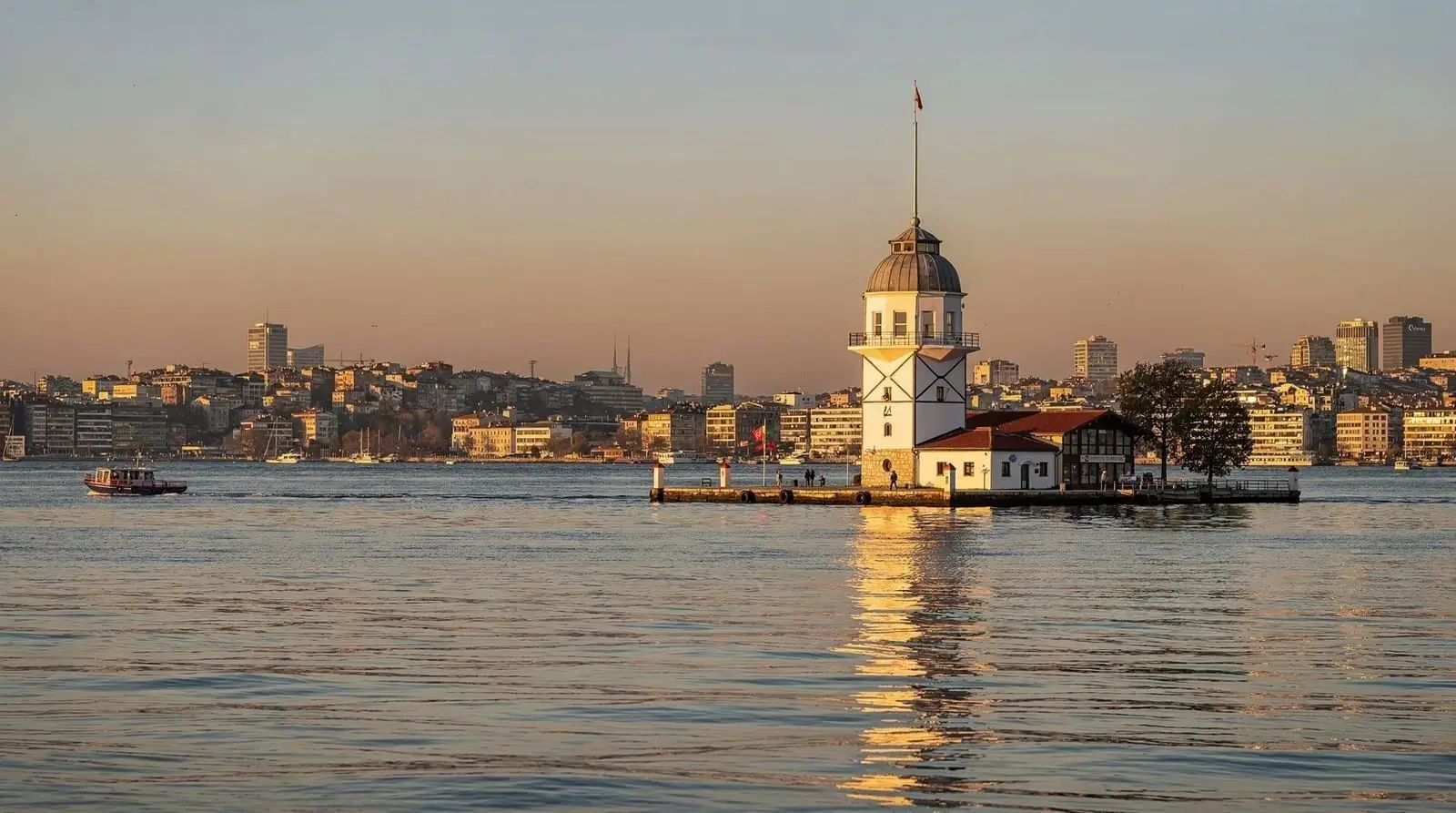
Maiden's Tower
A small Byzantine-era tower on a Bosphorus islet off Üsküdar — now a museum with audio guide, a café, and one of Istanbul's most recognised silhouettes.
Istanbul: Maiden's Tower Entry Ticket with Audio Guide
Quick facts
- Location
- Islet 200 m offshore from Üsküdar, Asian side
- Opening hours
- Daily 09:00–19:00 (last boat departure ≈ 18:30)
- Entry fee (2025)
- ≈ 150 TRY (~4.5 USD) + audio guide
- Boat access
- From Üsküdar pier — service runs continuously
- History
- Current structure 18th century; site used since Byzantine era
- James Bond connection
- Featured in 'The World Is Not Enough' (1999)
What the Maiden’s Tower actually is
| Where | Islet 200 m off Üsküdar, Asian side |
| Cost | ~150 TRY entry, includes boat and audio guide |
| Time needed | 30–45 minutes; naturally paired with Üsküdar |
| Getting there | Boat from Üsküdar pier (~5 min crossing) |
| Best time | Late afternoon for the classic photograph |
For the fuller step-by-step visit including timing and photography angles, see our Maiden’s Tower visiting guide.
The Maiden’s Tower (Kız Kulesi in Turkish — also known historically as Leander’s Tower in European references) sits on a tiny rocky islet approximately 200 metres off the Üsküdar waterfront, where the Bosphorus narrows toward the entrance to the Sea of Marmara. The current structure is primarily 18th century (rebuilt 1719 under the Grand Vizier Nevşehirli İbrahim Pasha, with subsequent modifications in 1763 and later), though the site has been used for various structures since at least the Byzantine period — a Byzantine tower is documented here from the 12th century.
It is small. The tower is about 29 metres tall; the islet itself is barely larger than the tower’s footprint. A café and small restaurant operate on the ground floor; the museum and audio guide cover the tower’s history and legends; the upper observation deck gives an unobstructed view back toward the European skyline, the old city, and the Bosphorus strait.
The practical visit is 30–45 minutes. You take a short boat from the Üsküdar pier (the ride itself takes about 5 minutes), enter the tower, explore the exhibition, have a çay (tea) at the café if you wish, and return on the same service. The entry ticket with audio guide covers the boat and the museum; the audio guide explains the history and the legends in English (and other languages).
The legends
Two separate legends are attached to the tower, often conflated:
The Princess Legend (the original Turkish legend): an Ottoman sultan is told by an oracle that his beloved daughter will die from a snakebite. He imprisons her in the tower for safety. On her 18th birthday, he sends her a basket of exotic fruits as a gift; a snake hidden in the basket bites her, and she dies. The story is a classic Persian-influenced Ottoman narrative about the futility of trying to escape fate.
Leander’s Legend (the European name): the European designation “Leander’s Tower” derives from the Greek myth of Hero and Leander — the youth Leander who swam the Hellespont (the Dardanelles strait, near Çanakkale) nightly to visit his beloved Hero, and drowned in a storm. The myth geographically belongs to the Dardanelles, not the Bosphorus, but was transposed to this tower in European literary tradition. The connection is historically inaccurate but culturally persistent.
Historical uses: the tower has served as a lighthouse, a quarantine station during the plague epidemics of the 18th and 19th centuries, a customs control point, and as a telegraph station. It appeared in the 1999 James Bond film “The World Is Not Enough” in the opening sequence — the explosion of the tower’s model is one of the film’s set pieces.
The view from the tower
The observation deck at the top of the tower looks back toward the European shore: Sultanahmet, the minarets of Hagia Sophia and the Blue Mosque rising above the old city peninsula, Sarayburnu (Seraglio Point), and the entrance to the Golden Horn. On a clear day the view is excellent. This is a west-facing view, which means afternoon and sunset light illuminates the European shore directly.
From the Üsküdar waterfront looking east to west, the tower itself is the main photographic subject — particularly in late afternoon when the tower is in the foreground against the European skyline lit by the setting sun. This is one of Istanbul’s canonical photographs, and the timing (roughly 16:00–17:00 depending on season) is consistent.
Getting to the tower
From Üsküdar ferry pier: the boat to the tower departs from the Üsküdar iskele (pier) area. Look for the service labelled “Kız Kulesi”; it runs roughly every 20–30 minutes during opening hours. The fare is included in the entry ticket.
By ferry to Üsküdar: from Eminönü or Karaköy, the Şehir Hatları/IDO ferry to Üsküdar takes 20–25 minutes. Üsküdar is then a very short walk from the Kız Kulesi boat service.
Combined with an Üsküdar visit: the tower makes natural sense as one element of an Üsküdar half-day — visit the Şemsi Ahmed Pasha mosque and the Mihrimah Sultan mosque in the morning, then take the boat to Kız Kulesi in the early afternoon.
Honest assessment: is it worth the entry fee?
The tower is a pleasant 45-minute experience and one of Istanbul’s most recognisable landmarks. The entry fee (approximately 150 TRY in 2025, around 4.5 USD) is not expensive. The café inside is overpriced relative to Üsküdar shore alternatives, but the view from your table is unique.
The tower’s historical significance is secondary to its visual role — it is primarily iconic rather than historically important, and the museum inside is modest. The audio guide adds genuine value. If you are in Üsküdar anyway (which you should be), spending 45 minutes and 150 TRY to go there is easily justified. It is not a major standalone attraction worth a special Bosphorus crossing from the European side on its own.
Frequently asked questions about Maiden’s Tower
Can you stay overnight at the Maiden’s Tower?
The tower previously had a restaurant and briefly operated as a small guesthouse, but as of 2024 the overnight accommodation was not operating. The café and museum function are the primary current use. Check current status before planning around a dinner booking here, as operating hours and services have changed periodically.
Is the audio guide available in English?
Yes. The audio guide is available in English, Turkish, German, French, and Arabic (verify current language options on booking, as availability can change after restorations and management changes).
What is the best time to photograph the tower from Üsküdar?
The tower is on the Asian shore, facing west toward the European city. Late afternoon (approximately 15:00–17:00 depending on season) gives the best light, with the European skyline illuminated behind the tower. Sunrise photographs from the Asian shore are also possible but require an early ferry crossing.
Is the tower included in any Istanbul passes?
Check current pass inclusion — the Istanbul Museum Pass and E-Pass have had varying coverage of the Maiden’s Tower, and post-restoration management changes may affect this. Verify on the official pass websites before purchasing.
The tower’s longer history
The islet’s use predates the current 18th-century structure by many centuries. A Byzantine tower is documented here from approximately the 12th century; some sources reference earlier structures used as a toll-collection point for ships passing through the strait. Given the islet’s position directly at the narrowing of the Bosphorus approaching the Sea of Marmara, it was always a strategically and commercially significant point — a lighthouse, a customs post, or a defensive outpost.
The Ottoman use of the site shifted over the centuries. In the 18th century it served as a quarantine station during plague epidemics — the logic being that ships arriving from potentially infected ports could be held at a point both accessible for inspection and isolated from the city proper. This use — the islet as a place of enforced separation from the city — echoes in both the quarantine history and the princess-imprisoned-for-safety legend.
The 19th century saw the tower used as a lighthouse and as a telegraph relay station; it was linked by cable to the European shore to transmit signals between Istanbul and the eastern provinces.
The tower was renovated comprehensively in 2021–2022 and now functions as a museum; the café and audio guide arrangement post-renovation represents the most visitor-accessible the tower has been in its modern history.
The tower in Turkish popular culture
The Maiden’s Tower appears in numerous Turkish films, novels, and songs — it is one of the most symbol-laden buildings in Istanbul, partly because of the legend, partly because of its unusual situation (the only Ottoman building to stand alone on water within the city), and partly because of its role as the visual marker of the Bosphorus entrance.
Beyond the Bond film, the tower appeared in several Turkish television dramas (the melodrama Kız Kulesi takes its name from the landmark) and is referenced in Turkish poetry from the Ottoman period to the present. For Turkish visitors, the tower carries a weight of cultural association that foreign visitors may not fully register.
Comparing it to other Bosphorus viewpoints
The tower itself provides a specific view — from the water, looking back toward the Asian shore (Üsküdar) and across to the European shore (Sultanahmet visible in the distance). The experience of being on the water in a small structure, equidistant from both shores, is unlike any land-based viewpoint.
For comparison:
Galata Tower: land-based, 67 metres high, 360-degree urban panorama from the European side. Better for the full-city overview.
Çamlıca Hill: land-based, highest point on the Asian shore, panoramic including the bridges. Better for the broad Istanbul-and-Bosphorus picture.
Bosphorus cruise: best for the extended view along the strait, both shores simultaneously, the palaces and villages in sequence.
The Maiden’s Tower gives you none of these and something different: the intimacy of the strait itself, the sense of being at the margin between Europe and Asia, and one of the narrowest points of the Bosphorus experienced from within it.
Practical visitor notes
Weather: the islet is exposed to Bosphorus winds, which can be significant in winter and in the transition months. The boat crossing is short (5 minutes) but can be rough in strong wind. Dress accordingly in cooler months.
Combining with a Bosphorus cruise: some private Bosphorus cruise operators include a pass close to the Maiden’s Tower as part of their route, without stopping. If you want to enter the tower, you need the specific boat service from Üsküdar rather than a sightseeing cruise.
Photography from the ferry: the public ferry from Eminönü to Üsküdar passes relatively close to the Maiden’s Tower, and the 20-minute crossing gives multiple angles on the tower from the water — without needing to pay for a separate boat service. The tower from the ferry, with the Asian shore behind it, is a different but worthwhile photograph.
Keeping your day flexible: if you would rather not commit to a fixed hour, a flexible entry ticket with audio guide for the tower lets you choose the moment on the day, which helps when you are timing the visit around late-afternoon light.
The café: the café inside the tower serves tea and simple snacks at slightly above street prices (a çay runs approximately 30–40 TRY vs 10–15 TRY at a street-level çay house). The setting justifies the premium; the quality is adequate rather than exceptional. Sit at the window facing west toward the European shore for the view that makes the visit worthwhile.
Photographing the Maiden’s Tower: the definitive guide
The Maiden’s Tower is one of Istanbul’s most photographed subjects, and the conditions for good photography are specific enough to be worth planning around.
From Üsküdar waterfront: the best static land-based position is from the promenade directly north of the Üsküdar ferry pier, looking south and slightly west. The tower appears in the midground with the European city behind it. Late afternoon (15:00–17:00, varying by season) gives the most satisfying light — the European shore is lit from the west, and the tower is in the light with the Bosphorus glittering between.
From the ferry: the public Eminönü–Üsküdar crossing passes the tower at a distance of about 300–400 metres. A 50–85mm equivalent lens captures the tower with the Asian shore behind it as you approach; turning around and shooting back gives the tower with the European skyline. Both photographs are available within the same 20-minute journey.
From a Bosphorus cruise: cruises passing through the Bosphorus entrance give a view of the tower from further south, in the context of the broader Bosphorus with the Bosphorus Bridge visible in the distance. The composition is wider and less intimate.
From the tower itself: the view from the top of the tower faces primarily west toward the European city, with a partial northward view up the Bosphorus. The photograph that most visitors take — the old city skyline from the tower, with the Maiden’s Tower in the foreground — is not achievable from the tower itself (you cannot photograph a building while standing on top of it). The outward view is good photography for the old city at a moderate distance.
The problem with midday: direct overhead sun in summer flattens the tones of both the tower’s stone and the water’s surface. The image becomes grey and shadowless. The same scene at 16:30 in September has a completely different quality.
The tower in winter
Winter visits are rarely mentioned in tourist coverage, but the Maiden’s Tower in cold weather has a particular quality worth noting. The Bosphorus mist that forms on cold mornings — a meteorological consequence of the temperature difference between the relatively warm sea water and the cold air — partially obscures the tower and the European shore in atmospheric grey. This is not a bad condition for photography; it is a different, more subdued atmosphere that has its own visual appeal. Photographers interested in the atmospheric rather than the postcard-vivid aspects of Istanbul will find winter Üsküdar waterfront mornings specifically rewarding.
The boat service to the tower continues through winter; the crossing is more exposed to wind, and the café inside is particularly welcome when cold. Entry tickets are the same price year-round.
Context: what Maiden’s Tower adds to an Istanbul visit
The tower is not architecturally significant; the current structure is 18th century and modest. It is not historically important in the way that Hagia Sophia or Topkapı Palace are. What it is: visually iconic, geographically specific to the Bosphorus entrance, and meaningful within Turkish cultural memory in a way that requires some knowing-about to appreciate.
For visitors with limited time, the tower is a pleasant 45-minute add-on to an Üsküdar half-day rather than a destination requiring a specific journey. For visitors with a full week and an interest in Istanbul’s layered symbolism — Byzantine, Ottoman, modern Turkish nationalist, pop cultural — the tower is worth understanding on its own terms.
The combination of the ferry crossing from Eminönü, the tower visit, and the Üsküdar waterfront walk back is a coherent half-day programme that provides the Bosphorus crossing experience, a close encounter with one of Istanbul’s most recognisable structures, and the contrast between the European-facing tourist zones and the Asian-shore neighbourhood character — a comparison that clarifies what Istanbul is as a city in a way that staying entirely on the European side cannot.
Related destinations and connections
The tower connects naturally to Üsküdar (the departure point), the Bosphorus (the strait it sits in), and Kadıköy (20 minutes south on the Asian shore) for a fuller Asian-side day. Visitors combining the tower with a Bosphorus cruise have the option of seeing the tower from the water without the boat service cost — though the angle and the intimacy of an on-site visit are different.
For the photograph of the tower from the European side: the ferry from Karaköy to Üsküdar passes close to the tower. Position yourself on the port (left-facing) side as you depart Karaköy, facing east toward the Asian shore, and the tower will be visible for several minutes of the crossing at a range of 300–500 metres.
If you’d rather see the tower as part of a longer excursion instead of a standalone stop, our best Bosphorus cruise guide and which Bosphorus cruise to choose cover the routes that pass it, and the Bosphorus landmarks guide puts it in context with the palaces and fortresses further up the strait.
Is the boat crossing safe in poor weather?
The 5-minute crossing is generally safe but can be choppy in strong Bosphorus winds, particularly in winter. Operators suspend the service in genuinely severe conditions. If you’re visiting on a windy day, check with the pier staff before queuing.
How does Maiden’s Tower compare to a full Bosphorus cruise for a first-timer?
They serve different purposes. Maiden’s Tower is a 45-minute, low-cost add-on to an Üsküdar visit; a full Bosphorus cruise is a dedicated activity of 1.5–2+ hours covering the palaces, fortresses and waterside mansions along the strait. If you only have time for one, a cruise gives the broader picture — see the best Bosphorus cruise guide for options.
Top experiences
Bookable activities with verified prices and instant confirmation on GetYourGuide.
