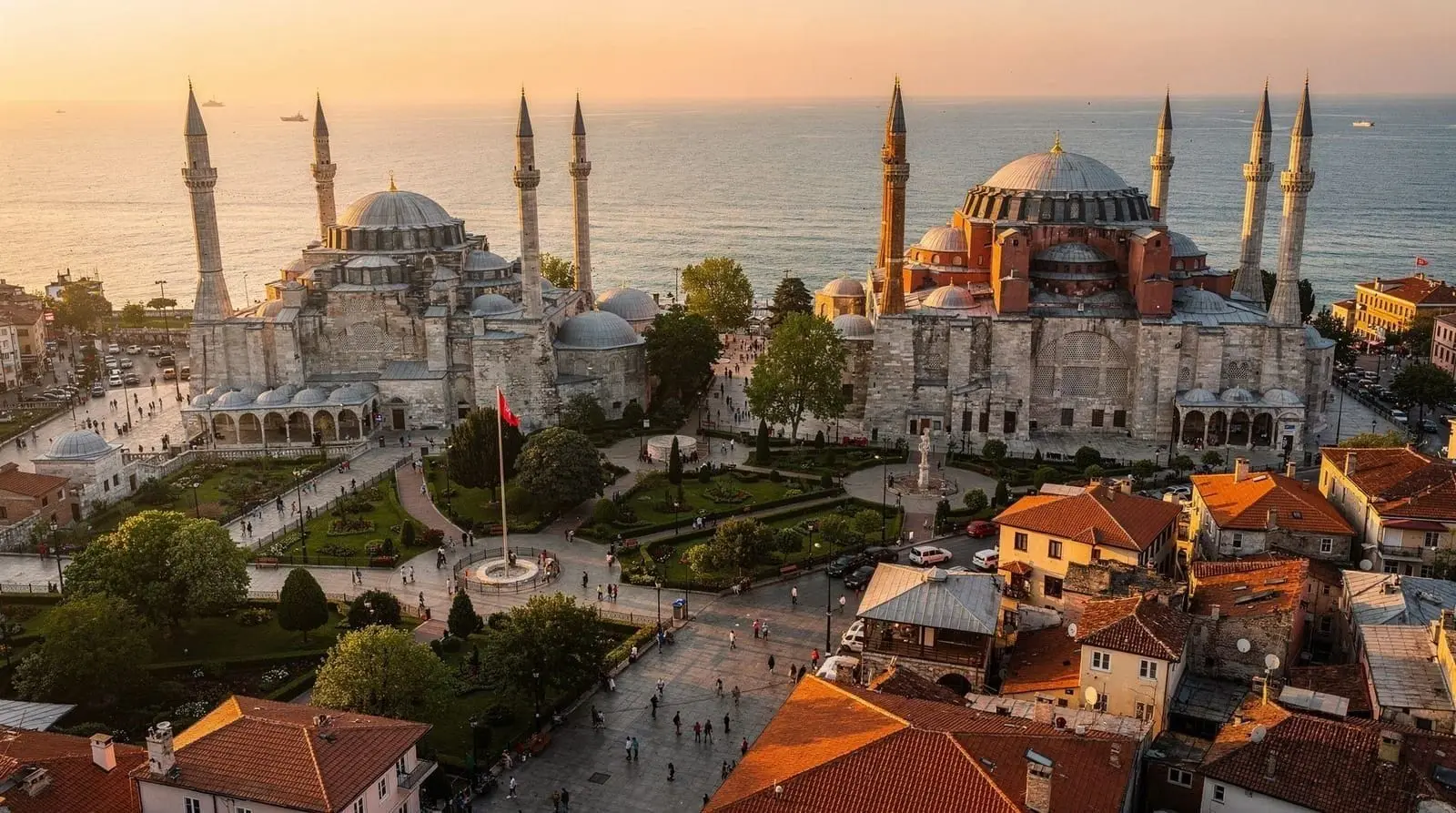
Sultanahmet — Istanbul's historic core
Explore Sultanahmet, Istanbul's old city: Hagia Sophia, the Blue Mosque, Topkapı Palace, and the Grand Bazaar, all within walking distance.
Full-Day Walking Tour of Istanbul's Old City
Duration: 5 hours
Quick facts
- Best for
- History, UNESCO sites, Ottoman and Byzantine monuments
- Time needed
- 2–3 full days
- Getting here
- Tram T1 stop Sultanahmet or Çemberlitaş
- Best time
- Weekday mornings, spring and autumn
The neighborhood where three empires left their mark
Sultanahmet occupies a small peninsula — the First Hill — between the Golden Horn and the Sea of Marmara. Constantine the Great chose this exact spot for the new Roman capital in 330 CE, and for the next 1,600 years, empires built over each other’s foundations here. The Byzantine hippodrome became an Ottoman square. A Christian cathedral became a mosque, then a museum, then a mosque again. The Ottoman imperial court rose next to the remnants of the Byzantine palace complex.
Today Sultanahmet is Istanbul’s most visited district, and that shows. The streets between Hagia Sophia and the Blue Mosque fill quickly in summer. But the density of genuine historical monuments per square kilometer is hard to match anywhere in Europe or the Middle East.
This guide covers what’s here, how long each site takes, how entry tickets work (prices change, so check the official sites for current rates), and how to manage a sensible itinerary without spending half your day in queues.
| Where | First Hill, historic peninsula between the Golden Horn and the Sea of Marmara |
| Cost | Free (Blue Mosque, Hippodrome) to paid sites (ticket prices change; check each official site) |
| Time needed | 2–3 full days to cover the major sites without rushing |
| Getting there | Tram T1, stop Sultanahmet or Çemberlitaş |
| Best time | Weekday mornings, April–May or September–October |
The Hippodrome and its monuments
Sultanahmet Square — stretching between the Blue Mosque and the main boulevard — follows the line of the ancient Hippodrome of Constantinople, built in the 3rd century CE and expanded by Constantine. The Hippodrome could hold 100,000 spectators for chariot races. Almost nothing of the structure remains, but three ancient monuments still stand along what was the racing track’s central spine (the spina):
Obelisk of Theodosius: A 3,500-year-old Egyptian obelisk from Karnak, brought to Constantinople in 390 CE. The carved reliefs on the marble base show the Emperor Theodosius watching races from the imperial box. Free to see, always accessible.
Serpent Column: A bronze casting from 479 BCE, originally at Delphi, commemorating the Greek victory at Plataea. Now headless (the serpent heads disappeared over the centuries), but the column itself is intact.
Column of Constantine Porphyrogennetos: A rougher stone column at the south end, once clad in bronze plaques. The plaques were stripped by Crusaders in 1204.
Spending 20–30 minutes at the Hippodrome monuments is free and puts everything else in historical context. The German Fountain (a 19th-century gift from Kaiser Wilhelm II) at the north end is also here.
Hagia Sophia
Hagia Sophia is the single most significant structure in Sultanahmet and arguably in all of Istanbul. Built by the Emperor Justinian and completed in 537 CE, it was the largest enclosed space in the world for nearly a thousand years. In 1453, the Ottoman Sultan Mehmed II converted it to a mosque; in 1934, Atatürk converted it to a museum; in 2020, it was reconverted to a functioning mosque.
As of 2026, it operates as a mosque with a dedicated tourist section. Entry requires modest dress (shoulders and knees covered; women need to cover their hair — scarves are available at the entrance). Entry is free during prayer times, but the tourist areas are closed; entry rules and ticket prices are set by the Ministry of Culture and Tourism and change, so check the current rules and price on the official site before going.
The interior — the vast dome, the surviving Byzantine mosaics (Christ Pantocrator in the gallery, the Deësis mosaic), the marble floors, the golden mosaics above the altar — requires at minimum 90 minutes to appreciate properly. Allow 2 hours if you’re interested in the upper gallery. Book skip-the-line access in advance during peak season (June–August), when walk-in queues can exceed 90 minutes.
The Blue Mosque (Sultan Ahmed Mosque)
The Blue Mosque, or Sultan Ahmed Mosque, faces Hagia Sophia across the Hippodrome square. Built between 1609 and 1616 by the architect Sedefkâr Mehmed Ağa for Sultan Ahmed I, it is the only mosque in Istanbul with six minarets — a distinction that reportedly required the Sultan’s personal intervention when the minarets equaled those of the Grand Mosque in Mecca.
The interior takes its popular name from the 20,000 Iznik tiles in shades of blue, turquoise, and white that cover the walls. The dome system (a large central dome surrounded by smaller semi-domes) directly echoes Hagia Sophia. Entry is free for tourists, but the mosque is closed to tourists during prayer times — typically five periods of 60–90 minutes spread through the day.
Check the day’s prayer schedule before visiting. If you arrive during closure, wait 30–40 minutes. Dress code is strictly enforced: shoulders covered, knees covered, shoes removed (bags provided), women cover hair. Guards enforce this at the entrance.
Topkapı Palace
Topkapı Palace was the administrative and residential heart of the Ottoman Empire from the 1460s to the 1850s. It’s not a single building but a series of courtyards with pavilions, audience halls, treasury rooms, and the Imperial Harem — essentially an entire walled city at the tip of the Sultanahmet peninsula.
A full Topkapı visit takes 3–4 hours minimum. The main palace ticket (price set by the museum and subject to change; check the official site) covers the courtyards and main rooms. The Harem requires a separate ticket (priced separately; check the official site) and is a separate guided section; it’s worth adding if Ottoman palace life interests you. The Treasury holds Topkapı’s most famous objects: the Topkapı Dagger (three enormous emeralds on the handle), the 86-carat Spoonmaker’s Diamond, and holy relics including the Prophet Muhammad’s cloak and sword.
Tickets are timed. In peak season, booking in advance is strongly recommended — walk-in tickets on summer weekday mornings can have 2-hour delays for Harem entry.
The Basilica Cistern
The Basilica Cistern (Yerebatan Sarnıcı) sits beneath a 19th-century building on the north side of the Hippodrome complex, a 5-minute walk from Hagia Sophia. Built in 532 CE by Justinian using 336 columns scavenged from ruined temples across the empire, it held 80,000 cubic meters of water for the city and the palace complex.
The atmosphere — dim lighting, water reflecting off columns, the sound of dripping — is genuinely unlike anything above ground. Look for the two Medusa heads at the base of columns in the northwest corner: one upside down, one sideways. The reason they’re positioned that way is debated.
Ticket prices are set by the venue and change, so check the current price on the official site before going. The cistern is small enough to see in 45–60 minutes. It’s a good option for the hottest part of a summer afternoon — it stays cool underground.
Grand Bazaar and Spice Bazaar
The Grand Bazaar (Kapalıçarşı) is a 15-minute walk west of the Hippodrome through the Çemberlitaş area. With approximately 4,000 shops across 60 streets under a covered roof, it is one of the oldest and largest covered markets in the world. Open Monday–Saturday, approximately 9am–7pm.
What to buy honestly: ceramics, lamps, textiles, tea sets, lokum (Turkish delight), and silver jewelry are the best-value categories. Carpets are legitimate but expensive and require knowledge to assess value. Avoid “antiques” unless you’re an expert — most are reproductions. Prices are not fixed; negotiating is expected for larger purchases, but you won’t get dramatically below the first offer in a heavily tourist-facing shop.
The Spice Bazaar (Mısır Çarşısı) is near Eminönü, a 10-minute walk from the Grand Bazaar or one tram stop on the T1. Smaller, more manageable, and more food-focused: spices, dried fruits, Turkish delight, teas, and pickles. The surrounding streets (Tahtakale) have cheaper, less tourist-facing versions of many items.
Süleymaniye Mosque
Süleymaniye Mosque sits on the Third Hill, a 15-minute walk from the Grand Bazaar. Built by the architect Sinan in 1557, it is considered his masterwork — the balance between interior volume and structural clarity is remarkable. The mosque itself is free to enter, functioning, and far less crowded than the Blue Mosque.
The surrounding complex includes the tombs of Sultan Süleyman and his wife Hürrem Sultan, a medrese (Islamic school), an imaret (soup kitchen), and a hamam. The view from the terrace gardens behind the mosque over the Golden Horn toward Galata is one of the best free views in Istanbul.
Practical tips for visiting Sultanahmet
Crowds and timing: Hagia Sophia and the Blue Mosque are busiest between 10am and 4pm in summer. Arrive at Hagia Sophia by 8:30am when it opens. Visit the Hippodrome monuments between sites as a free break. The Basilica Cistern is useful for midday because it’s underground and cool.
Getting around within Sultanahmet: Almost everything is walkable. The Tram T1 is useful to get to the Grand Bazaar (stop Kapalıçarşı) or to Eminönü for the Spice Bazaar and Bosphorus ferries.
Dress code: All mosques require covered shoulders and knees (both men and women), shoes removed, and women to cover their hair. Bring a scarf or buy one near the entrance. Mosque dress rules are enforced; no exceptions.
Eating near Sultanahmet: The immediate square is overpriced for sit-down meals. Walk one street back from the main tourist drag for better-value options. Simit carts are everywhere and excellent. For a proper sit-down meal, the Balık ekmek boats at Eminönü (fish sandwich from a floating grill, 80–120 TRY) are worth the tram ride.
Guided walking tours: A licensed guide adds significant context to Hagia Sophia and Topkapı — the history is dense and the visual details reward explanation. Half-day and full-day old-city tours are the most efficient use of a guided day.
Restrooms and quiet breaks: Paid facilities (approximately 10–20 TRY) are available near the Hippodrome and inside the major paid sites; free options are limited on the square itself. Cafés set back from the main tourist drag, such as those near the Arasta Bazaar behind the Blue Mosque, are a reliable spot for a sit-down break with a proper restroom.
Weather planning: Summer heat in the open Hippodrome square is significant by midday — plan outdoor monument time for morning or early evening and use the Basilica Cistern or museum interiors to escape the worst of it. Winter (December–February) sees far fewer visitors and shorter queues, at the cost of some closures and reduced hours around religious holidays.
The Archaeological Museums
Most visitors focus entirely on the monumental religious and palace buildings and overlook the Istanbul Archaeological Museums complex immediately adjacent to Topkapı’s first gate.
There are three museums in the complex: Archaeological Museum: Contains one of the largest and most significant collections of classical antiquities outside Greece and Rome — including the Alexander Sarcophagus, an extraordinary 4th-century BCE carved marble sarcophagus from Sidon with battle scenes attributed (probably incorrectly but strikingly) to Alexander the Great, and the Sarcophagus of the Mourning Women. Also Hittite and Mesopotamian collections.
Museum of the Ancient Orient: Pre-Islamic Anatolian and Middle Eastern finds, including early treaty tablets and Babylonian material.
Tiled Kiosk (Çinili Köşk): A 15th-century Ottoman pavilion with early tile work, the oldest surviving non-religious Ottoman building in Istanbul.
All three are on a single ticket (ticket prices are set by the museums and change; check the official site). For visitors with art-historical or archaeological interests, the Archaeological Museum is worth 2–3 hours. For others, a 45-minute visit to the Alexander Sarcophagus and main floor is worthwhile.
The Hippodrome in depth
The Hippodrome was not just a racing venue — it was the political and ceremonial heart of Byzantine Constantinople. The Emperor’s imperial box (the Kathisma) was directly connected to the Great Palace complex, allowing the Emperor to appear before 100,000 citizens for chariot races, state ceremonies, and public entertainments without leaving the palace grounds.
The Nika Revolt of 532 CE — the most serious internal crisis of Justinian’s reign — began in the Hippodrome, where rival chariot-racing factions (Blues and Greens) united against the Emperor. Approximately 30,000 people were killed in the suppression; the revolt’s aftermath led directly to Justinian’s rebuilding program, including the current Hagia Sophia.
The three surviving monuments from the spina (the central barrier) tell successive layers of history:
- The Egyptian Obelisk of Theodosius (originally 3,500 years old at the time of installation) came from Karnak; its marble base shows 4th-century court life
- The Serpent Column is a genuine 479 BCE object from Delphi, one of the oldest artifacts in Istanbul
- The Column of Constantine Porphyrogennetos is a 10th-century Ottoman addition that replaced bronze sheathing stripped by the Fourth Crusade
The fact that a Pharaonic obelisk, a victory monument from the Persian Wars, and a medieval Byzantine column stand on the same street in the middle of a modern city is the Sultanahmet experience in concentrated form.
The Turkish and Islamic Arts Museum
On the west side of the Hippodrome square, in the former palace of Ibrahim Pasha (16th century), the Turkish and Islamic Arts Museum (Türk ve İslam Eserleri Müzesi) has collections of Ottoman and pre-Ottoman Islamic art — carpets, Quran manuscripts, calligraphy, ceramics, metalwork, and ethnographic material from throughout the Muslim world.
The carpet collection is considered the finest in Turkey and one of the most significant globally. The building itself (Ibrahim Pasha was Süleyman the Magnificent’s Grand Vizier) has historical significance.
Ticket prices change, so check the official site before going. Relatively quiet — one of the most undervisited major museums in Sultanahmet. Allow 90 minutes.
Eating in and around Sultanahmet
The streets immediately on the Hippodrome side of the Blue Mosque are heavily tourist-facing and expensive. Better options:
Tarihi Sultanahmet Köftecisi Selim Usta (Divanyolu Caddesi): A köfte (meatball) restaurant that has been in business since 1920. Fixed menu of grilled köfte, pilaf, and beans. Fast, inexpensive, legitimately good. Approximately 250–350 TRY for a full meal as of mid-2026.
Dönerci Şahin Usta (near Çemberlitaş): Döner kebab, not a tourist restaurant. Queue-based service. Approximately 150–200 TRY for a plate.
Balık ekmek at Eminönü: Walk to the waterfront for grilled fish sandwiches from the boats — 80–120 TRY, the best value lunch near Sultanahmet.
Hamdi Restaurant (near Eminönü): A proper Turkish restaurant on multiple floors with a rooftop view over the Golden Horn. Meat-focused menu, mid-range prices. Popular with local businesspeople and tourists alike. Reservations useful for the rooftop at lunch.
For a genuine café break with views: the Mosaic Museum café (accessible from the Arasta Bazaar) is quiet and has an outdoor terrace.
Connecting to the rest of Istanbul
Sultanahmet is the natural first stop, but it’s only part of Istanbul. From here:
- Cross the Galata Bridge on foot or by tram to reach Karaköy and Beyoğlu
- Ferry from Eminönü to Kadıköy or Üsküdar for the Asian side
- Walk or take a taxi to Balat and Fener for a different layer of the old city
- Take the T1 tram to Kabataş for ferries to Ortaköy and Dolmabahçe Palace
For day trips out of the city — Princes’ Islands, Bursa, or a longer excursion to Cappadocia — ferries and buses depart from Eminönü and the nearby Büyük Otogar bus terminal.
How to split 2–3 days across Sultanahmet
Cramming everything into one day is the single most common Sultanahmet mistake. This split spreads the major sites so each gets the time it deserves, without wasted backtracking.
| Day | Focus | Roughly |
|---|---|---|
| Day 1 | Hippodrome monuments, Hagia Sophia, Blue Mosque | Morning-to-afternoon, all within a 5-minute walk |
| Day 2 | Topkapı Palace (with Harem) and the Archaeological Museums | Full day — Topkapı alone needs 3–4 hours |
| Day 3 (optional) | Basilica Cistern, Grand Bazaar, Süleymaniye, Spice Bazaar | Half day walking loop uphill and back down to Eminönü |
If you only have one day, prioritise Hagia Sophia and the Blue Mosque in the morning (before 10am), the Basilica Cistern at midday, and save Topkapı for a dedicated return visit — trying to add the Palace to an already-packed first day is what causes most visitors to rush the Harem or skip it entirely.
Frequently asked questions about visiting Sultanahmet
How much time should I spend in Sultanahmet?
Two full days is a realistic minimum: one day for Hagia Sophia, the Blue Mosque, and the Hippodrome; one day for Topkapı and the Basilica Cistern. Add a third morning for the Grand Bazaar and Süleymaniye. Rushing all of it into one day produces frustration and missed details.
Is the Blue Mosque free to enter?
Yes, entry is free. However, the mosque is closed to tourists during prayer times — five periods daily that last 60–90 minutes each. Check the current prayer schedule (posted at the entrance and available online) before planning your visit.
Which is better to visit — Hagia Sophia or the Blue Mosque?
They serve different purposes. Hagia Sophia is a more significant historical structure with a paid entry and requires advance booking. The Blue Mosque is free, has impressive Iznik tile decoration, and gives a clearer sense of a functioning Ottoman mosque. Visiting both in the same morning is feasible if you time around prayer closures. See the comparison guide for a full breakdown.
Do I need to book Topkapı Palace in advance?
In summer (June–August) and during holiday weekends, yes — especially for the Harem, which has timed entry. Book via the official Turkish e-Devlet ticketing portal or via GetYourGuide to secure a time slot. In spring and autumn, walk-in is usually manageable, though queues at opening can still be 30–45 minutes.
Is Sultanahmet safe to walk around at night?
Yes, generally — it’s a heavily patrolled, well-lit tourist district. The main square and the streets around Divanyolu Caddesi stay busy into the evening. Standard city precautions apply: watch for the shoe-shine and carpet-shop scams that specifically target this neighbourhood, and stick to metered taxis or ride-hailing apps late at night. See the Istanbul scams guide for the specific tricks to know before you go.
Where should I stay if I want to be based in Sultanahmet?
Small hotels and boutique guesthouses cluster around the Hippodrome and toward the Sea of Marmara side, putting you within walking distance of every major site. The trade-off is that Sultanahmet quiets down early compared to Beyoğlu or Karaköy — for nightlife, most visitors base themselves across the Golden Horn instead. See staying in Sultanahmet vs Beyoğlu for the full comparison.
Top experiences
Bookable activities with verified prices and instant confirmation on GetYourGuide.


