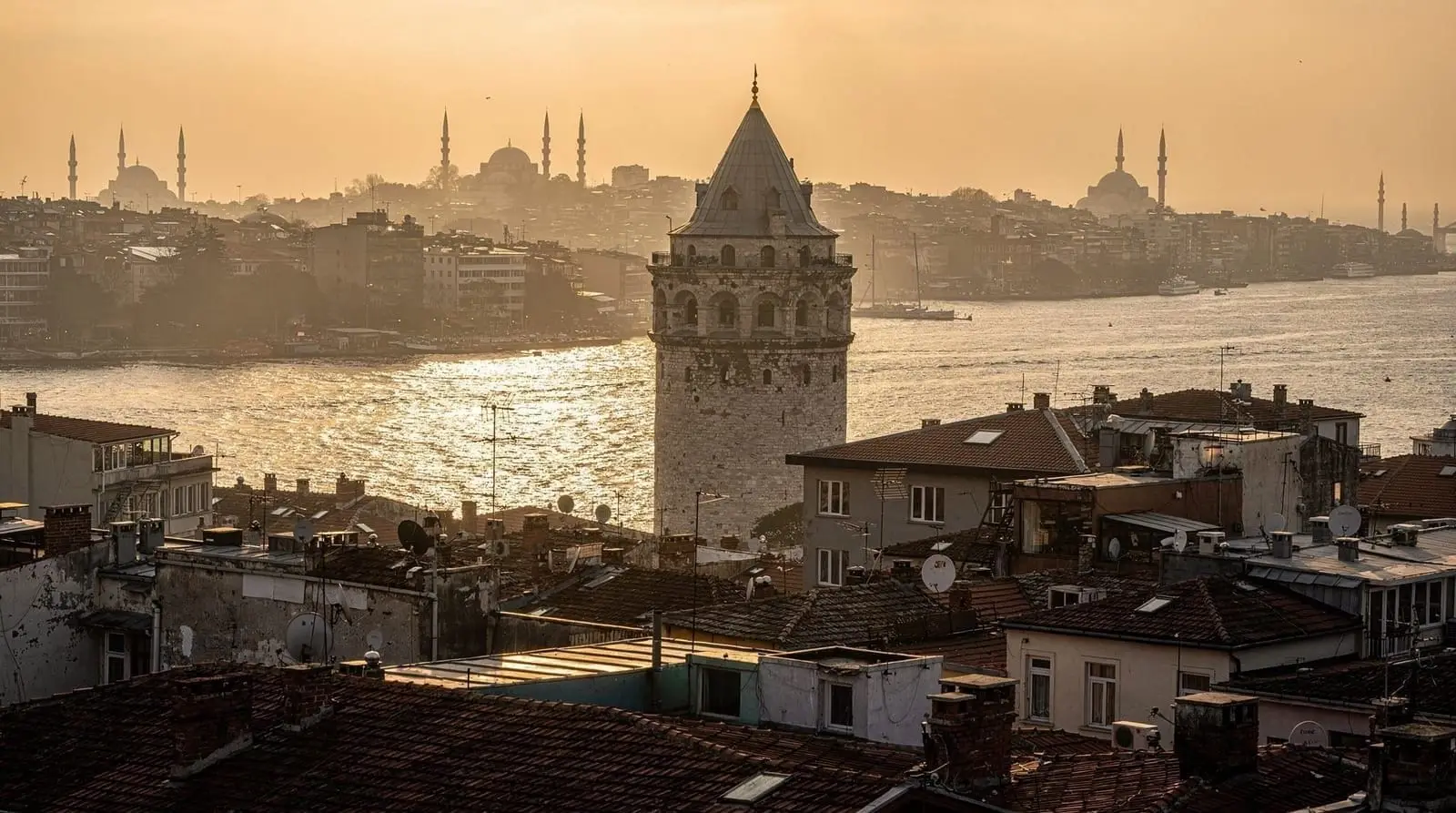
Galata Tower
Medieval tower rising 67 m above Karaköy with panoramic 360° views of Istanbul, the Bosphorus, and the Golden Horn. Skip-the-line tickets sell out fast.
Istanbul: Galata Tower Entry Ticket w/ Audio Guide
Quick facts
- Height
- 66.9 m (219 ft)
- Built
- 1348 by Genoese colony
- Opening hours
- Daily 08:30–22:00
- Entry fee (2025)
- ≈ 750 TRY (~22 USD / 20 EUR)
- Nearest tram
- Karaköy (T1), 8-min walk uphill
- Booking
- Online strongly recommended
| Where | Galata, on the European side, above Karaköy |
| Cost | Around 750 TRY entry; skip-the-line tickets a small premium |
| Time needed | 2–3 hours including queue and balcony time |
| Getting there | T1 tram to Karaköy, then an 8–10 min uphill walk |
| Best time | Early morning or ~45 min before sunset; avoid 11:00–15:00 in summer |
What you actually see from the top — and what to expect on the way up
Galata Tower is the single most recognised silhouette on Istanbul’s European skyline. The cylindrical Genoese tower, completed in 1348 as the “Tower of Christ,” stands 66.9 metres tall and commands a sweeping 360-degree view over the old city, the Golden Horn, the Bosphorus strait, and the Asian shore. On a clear afternoon, you can pick out Hagia Sophia’s half-dome, the minarets of the Blue Mosque, the hills of Üsküdar, and container ships threading the Bosphorus in the distance.
The view is the reason to come. The interior has limited exhibition space covering the tower’s seven centuries of history — used variously as a Genoese watchtower, an Ottoman fire observatory, and a prison. The famous aviator Hezarfen Ahmed Çelebi reportedly glided from the tower to the Asian shore in 1638 using artificial wings, an episode that appears in Ottoman chronicles. Whether apocryphal or not, it makes for a good story to share on the narrow outdoor balcony.
The balcony itself is a single ring, about a metre wide, accessed via a steep internal staircase from the lift exit. It gets crowded quickly — four or five people shoulder-to-shoulder around a tight curve. On busy days (especially weekends in summer), the queue at the top to step outside can add 20–30 minutes to your visit. Plan accordingly.
Book a Galata Tower entry ticket with audio guide — online booking is strongly recommended regardless, since on-the-door tickets regularly sell out by mid-morning.
Getting there from the old city and Karaköy
The tower sits in the Galata neighbourhood, administratively part of Beyoğlu. From Sultanahmet, the most direct route is to take the T1 tram to Karaköy (two stops from Sirkeci, four from Sultanahmet), then walk uphill through the old Galata quarter for about 8–10 minutes. The climb is steep and cobbled — wear shoes with grip.
Alternatively, take the Tünel funicular from Karaköy to Tünel Square, which deposits you just 5 minutes from the tower on level ground. The Tünel is the world’s second-oldest underground urban railway, opened 1875, and costs a single Istanbulkart tap.
From Taksim Square, it is a 15-minute downhill walk through Beyoğlu and İstiklal Avenue, then into the backstreets of Galata. This route is pleasant and lets you browse the vintage music shops and indie galleries lining the lower end of İstiklal.
Ticket options and what they cost
As of mid-2025, the standard museum entry is approximately 750 TRY (around 22 USD or 20 EUR at the exchange rates that month — note that Turkey’s inflation makes TRY prices shift frequently). The ticket includes the lift and audio guide in several languages.
Pre-purchased skip-the-line tickets typically cost a small premium (10–20%) but bypass the on-site queue, which can stretch 45 minutes or more on summer weekends. If you are visiting the tower as part of a combo with another attraction — for example the Dolmabahçe Palace — bundled tickets offer moderate savings.
The Istanbul Museum Pass and Istanbul E-Pass both include Galata Tower, so if you plan multiple paid sites in a single trip, do the maths before buying standalone tickets.
Best time of day
Midday (11:00–15:00) is the most crowded period, particularly in July and August when visitor numbers peak. The light is also harsh for photography.
Sunset visits are the most popular for good reason: the sky above the old city turns from amber to deep red, and the Bosphorus takes on a copper sheen. Expect the outdoor balcony to be at capacity. Arrive at least 45 minutes before sunset and queue early.
Morning (08:30–10:00) is the calmest window. The city is quieter, the light is soft and even from the east, and you will likely have stretches of the balcony to yourself. This is the practical choice for photographers.
Evening (after 20:00) gives you the illuminated skyline, but the balcony has limited capacity and the lift queue can be erratic near closing time.
What visitors often miss in the neighbourhood
The tower is embedded in one of Istanbul’s most textured medieval neighbourhoods. A few things worth noting while you are there:
Galata Mevlevihanesi (Galata Dervish Lodge), about a 10-minute walk toward Beyoğlu, is one of the oldest Mevlevi lodges in Istanbul, now a museum where whirling dervish ceremonies are performed on certain evenings. If you want to see a sema without the dinner-show packaging of the tourist venues, this is the more authentic option.
Karaköy Güllüoğlu is one of Istanbul’s most reputable baklava houses, located in Karaköy at the base of the hill. The pistachio baklava costs roughly 15–20 TRY per piece and is genuinely good; the café seating is minimal and shared, which is part of the point.
Galata’s antique and instrument shops line the streets between the tower and the Tünel. Vintage instruments, old maps, and second-hand books fill windows here — this district has been a merchants’ quarter since the Byzantine era.
Practical honesty: what to skip and what to watch for
The tower has a café and a restaurant at the top. Both are overpriced relative to the quality (a tea that costs 10–12 TRY at a streetside çay kiosk downstairs costs 60–80 TRY here), and the seating takes you away from the balcony view. Skip the café unless you specifically want to sit down at altitude.
A known scam near the tower: individuals approach visitors claiming to be “official guides” who will “explain the history for a small fee.” They are not official and their information is often fabricated. The audio guide included with most tickets covers the history clearly.
Entry queues form even on weekdays in peak season. If you arrive without a pre-booked ticket on a Saturday in July, a 45-minute wait at the entrance is realistic. The skip-the-line lane is separate and moves significantly faster.
The neighbourhood around the tower is safe and well-lit by Istanbul standards, but the cobbled streets heading downhill toward Karaköy are dimly lit at night and uneven — watch your step.
Combining Galata Tower with nearby sites
A logical half-day routing from the old city:
- Morning: Take the T1 tram to Karaköy, walk uphill to Galata Tower (arrive by 09:00).
- After the tower: Walk north into Beyoğlu via the antique streets, stopping at the Galata Dervish Lodge.
- Mid-morning: Continue up to İstiklal Avenue, explore the pasaj arcades, have a proper Turkish breakfast at one of the side-street lokanta restaurants.
- Afternoon: Walk or take the Tünel back to Karaköy for the café and food scene along the waterfront.
Alternatively, pair the tower with Dolmabahçe Palace in a single afternoon — both are on the European shore, about 25 minutes apart by taxi or Bosphorus ferry. A combo ticket handles both admissions.
For a broader Galata area itinerary, the guided tour that combines the tower with Chora/Kariye and Balat makes efficient use of a day across different parts of the European city.
Getting context: Galata in Istanbul’s history
The Genoese established their commercial colony at Galata in the 13th century under an agreement with the Byzantine Empire. The tower anchored the northern defensive wall of the colony and served as a watchtower and prison through the Ottoman period. After the conquest of Constantinople in 1453, Mehmed II allowed the Genoese colony to continue as a trading settlement under the new Ottoman administration — hence the survival of so many pre-Ottoman structures in the neighbourhood.
By the 19th century, Galata had become one of Istanbul’s most cosmopolitan districts, home to Levantine merchants, Greek and Armenian communities, and the Ottoman banking sector (the street now called Bankalar Caddesi). The Galata Mevlevihanesi was a focal point of Sufi practice. This layered history is what makes the neighbourhood interesting beyond the tower itself — the tower is the landmark, but the streets around it are the substance.
Galata Tower vs the other Istanbul viewpoints
| Viewpoint | View character | Cost | Crowds |
|---|---|---|---|
| Galata Tower | 360° panorama, old city + Bosphorus + Golden Horn | ~750 TRY | High, especially sunset |
| Süleymaniye Mosque terrace | Golden Horn and old city rooftops, no ticket | Free | Low–moderate |
| Çamlıca Hill (Asian side) | Widest single view of the whole city | Free | Low |
| Rooftop bars in Beyoğlu | Bosphorus slice + drinks | Price of a drink | Moderate |
Galata Tower wins on convenience and the classic postcard angle — old city on one side, Bosphorus on the other, all from a single fixed point. If you want the view without the queue or the fee, our best views in Istanbul guide covers the free alternatives.
Accessibility
The tower has a lift to the main viewing floor. However, the outer balcony is accessed via a steep spiral staircase with low clearance and is not accessible to visitors using wheelchairs or with limited mobility. The cobbled streets of the Galata neighbourhood are challenging for wheels; the main approach from Karaköy is uneven.
Frequently asked questions about Galata Tower
Do I need to book in advance?
Yes, strongly recommended. On-the-door tickets are available but frequently sell out by mid-morning on busy days (spring through autumn). Online booking also locks in your entry window, reducing balcony congestion.
Is the audio guide worth it?
The audio guide covers the tower’s history in reasonable depth and is available in English, German, French, Spanish, and Turkish. It is included in most pre-booked tickets and adds genuine context to what is otherwise a fairly sparse interior exhibition.
How high is the tower and how many floors?
The tower is 66.9 metres to the balcony. There are nine floors inside, with a lift serving the main levels. The conical roof adds approximately another 15 metres above the balcony rim.
Can I see Cappadocia or other places from the top?
No — Cappadocia is some 700 km away in central Anatolia. What you can see clearly on a good day: Sultanahmet and the old city, the Golden Horn inlet, the Bosphorus strait, the Asian shore including Üsküdar and Kadıköy, the Princes’ Islands on clear days, and the bridges spanning the Bosphorus to the north.
Is the restaurant at the top worth visiting?
The restaurant (Galata Tower Restaurant & Café) has the view, but the food-to-price ratio is poor. A main course runs 400–600 TRY (12–18 USD) for food that is serviceable but not memorable. Better to eat in Karaköy or Beyoğlu at a fraction of the cost.
Are there fake tickets being sold near the tower?
Unofficial individuals do occasionally approach tourists claiming to sell discounted tickets or offering to skip the queue. Always buy directly from the official on-site booth or via a verified platform. The official entry ticket with audio guide gives you a confirmed QR code with no ambiguity.
What’s the difference between the Istanbul Museum Pass and the E-Pass for this site?
Both passes include Galata Tower. The Museum Pass covers 12 specific museums and is better value if you plan to visit most of them. The E-Pass (formerly IKSB Pass) covers 40+ attractions including hop-on hop-off bus. If your itinerary focuses on three or four major sites, calculate whether the pass price beats individual tickets — it usually does for three or more major paid sites.
Is Galata Tower worth it if I’m short on time?
If you have to choose one Istanbul viewpoint, Galata Tower is a reasonable pick for the classic composition — old city skyline on one side, Bosphorus on the other — but it is not the only option. A free alternative like the Süleymaniye Mosque terrace or Çamlıca Hill gives a comparable (in some ways better) view without the ticket or the queue; see the comparison above and our best views in Istanbul guide.
How does Galata Tower compare to staying in Beyoğlu vs Sultanahmet?
The tower sits between the two main tourist bases. If you’re deciding where to stay, our Sultanahmet vs Beyoğlu guide covers the trade-offs — Beyoğlu puts you a short walk from the tower and the nightlife of İstiklal, while Sultanahmet keeps you closer to Hagia Sophia and the Blue Mosque.
The Galata quarter’s deeper history
The area around the tower has accumulated layers of history that reward some attention. The Genoese established Galata (from the Latin Galata, itself possibly from a Gaelic or Galatian root) as their main Black Sea trading colony in the 13th century, operating under treaty with the Byzantine emperors who wanted Genoese naval support. The tower was completed in 1348 and served as the central defensive and administrative structure of the colony.
After the Ottoman conquest in 1453, the Genoese colony at Galata negotiated a separate surrender agreement with Mehmed II — they surrendered peacefully and were permitted to continue their trading operations, their religious buildings, and most of their civil institutions in exchange for acknowledgement of Ottoman sovereignty. This explains why the tower, the church of San Pietro (later converted to a mosque), and much of the Genoese urban fabric survived the conquest intact. The neighbourhood remained multi-ethnic through the Ottoman period — Genoese and then Levantine merchants, Jews who had moved from the old city, Greek residents, Armenians, and various European diplomatic communities all occupied Galata and the adjacent areas.
By the 19th century, as the Ottoman Empire modernised and as the railway brought a new wave of European commercial interests, the Galata neighbourhood transformed into Istanbul’s financial district. Bankalar Caddesi (now home to SALT Galata’s headquarters in the former Ottoman Bank building) was the centre of Ottoman finance, insurance, and trade. The architecture from this period — heavy neoclassical bank buildings, commercial offices, consular compounds — is still visible in the streets between the tower and the Bosphorus.
The 20th century brought decline and then partial revival. The Jewish, Greek, and Levantine populations largely emigrated during the middle decades of the century. The neighbourhood became progressively poorer and more neglected. The gentrification of the 2000s and 2010s brought the gallery district, the specialty coffee scene in Karaköy, and the boutique accommodation that now fills the old buildings — a pattern familiar from similar neighbourhoods in European cities.
Nearby architecture worth noticing
Walking from the Karaköy pier uphill to the tower, several specific buildings warrant attention:
The Ottoman Bank building (now SALT Galata), on Bankalar Caddesi: a grand 1892 neoclassical structure designed by Alexandre Vallaury, the French-trained architect responsible for several of Istanbul’s major late-Ottoman buildings. The interior is accessible to the public as a gallery and research centre.
The Kamondo Stairs (Kamondo Merdivenleri): a curved double staircase on Bankalar Caddesi, built around 1861 by the Camondo banking family (Sephardic Jewish merchants who were one of the major Ottoman banking dynasties). The staircase is a piece of urban furniture rather than a monument — it connects street levels and is still used as a shortcut. It appears frequently in Istanbul photography and features in a famous Henri Cartier-Bresson photograph.
The Galata Mevlevihanesi (Whirling Dervish Lodge): north of the tower on Galip Dede Caddesi, this 17th-century lodge is one of the oldest surviving Mevlevi complexes in Istanbul. Now operating as a museum with periodic sema ceremonies. The adjacent tekke cemetery contains graves dating from the early Ottoman period.
The Armenian Church of Surp Krikor Lusavorich: on the streets between the tower and the waterfront, one of several non-Muslim religious buildings that survived the Ottoman period in Galata. The building is periodically open for services.
Planning a full day in Galata and Beyoğlu
For visitors with a full day to spend in the northern European city, a logical routing:
Morning (09:00–12:00): Start at Karaköy with breakfast at a neighbourhood café — a proper Turkish breakfast (beyaz peynir, simit, börek, olives, eggs, tea) runs around 150–200 TRY at local venues near the waterfront. Walk up to the tower by 09:30 to be ahead of midday crowds. Spend 1.5–2 hours at the tower, including the balcony and the small exhibition. Walk the Kamondo Stairs on the way up or down.
Mid-morning (11:30–13:00): Continue north through Galata into Beyoğlu. Browse the music and instrument shops on Galip Dede Caddesi. Stop at the Mevlevihanesi for a quick visit. Reach the southern end of İstiklal Avenue.
Lunch (13:00–14:00): Side street restaurants in lower Beyoğlu or Asmalımescit — döner and meze for 150–250 TRY, or a sit-down lunch at a meyhane for 300–500 TRY.
Afternoon (14:00–17:00): Walk the full length of İstiklal Avenue to Taksim (30–40 minutes with stops), exploring the pasaj arcades, bookshops, and any galleries of interest. Return via a different route — the side streets parallel to İstiklal through Cihangir or Asmalımescit.
Late afternoon (17:00–19:00): Return to Karaköy for the waterfront, SALT Galata’s evening exhibition if one is running, and the ferry pier views. Baklava from Güllüoğlu before heading back.
This routing covers approximately 8–10 km of walking; comfortable shoes are essential on Galata’s cobbled streets.
Top experiences
Bookable activities with verified prices and instant confirmation on GetYourGuide.

