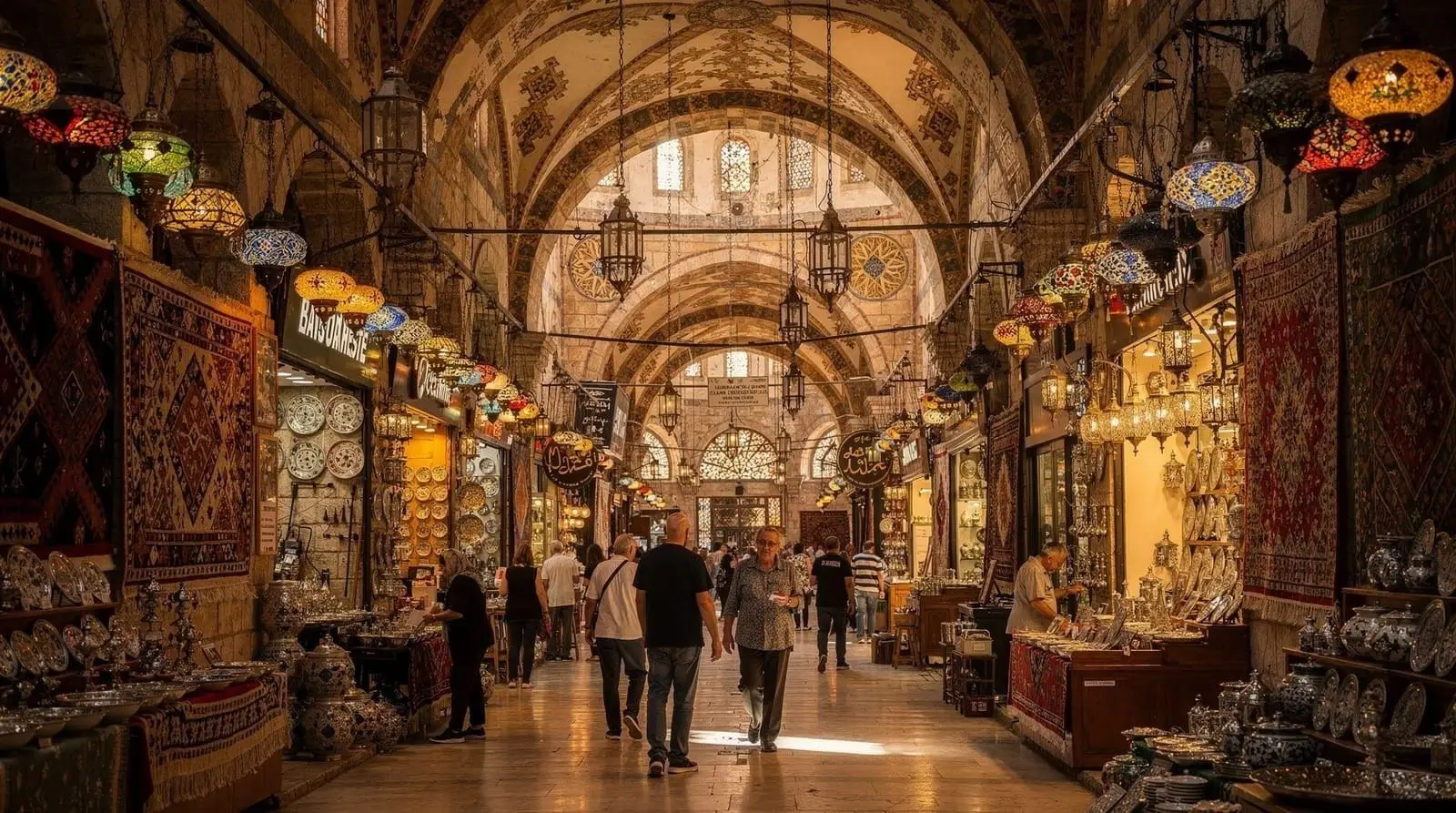
Grand Bazaar — honest shopping guide for Istanbul visitors
Navigate Istanbul's Grand Bazaar without getting scammed — what to buy, fair prices, how to haggle, and what to skip entirely.
Istanbul: Grand Bazaar Shopping Tour with Local Guide
Quick facts
- Size
- ~4,000 shops, 61 covered streets
- Hours
- Mon–Sat 9am–7pm (closed Sunday and public holidays)
- Entry
- Free
- Getting here
- Tram T1 to Kapalıçarşı or Beyazıt stop
- Best time
- Weekday mornings before noon
The world’s oldest shopping mall — and how to navigate it honestly
| Where | Old city, Tram T1 to Kapalıçarşı or Beyazıt |
| Cost | Free entry; goods from ~150 TRY to thousands for carpets |
| Time needed | 1–2 hours to a half day |
| Getting there | T1 tram, or 15-min walk from Sultanahmet |
| Best time | Weekday mornings before noon |
For a deeper shopping-specific walkthrough, see the Grand Bazaar shopping guide.
The Grand Bazaar (Kapalıçarşı — “covered bazaar”) has existed in some form since the 1450s, when Sultan Mehmed II built two halls here after the conquest of Constantinople. It expanded over the following centuries and survived multiple earthquakes and fires. The current layout — 61 covered streets, approximately 4,000 shops, 22 gates — is largely its 19th-century configuration.
Around 250,000 to 400,000 visitors pass through daily in peak season. That number tells you something useful: this is not a quiet artisan market. It is a major tourism operation with a retail infrastructure built around international visitors. Some shops have been owned by the same families for generations. Others have changed hands repeatedly and optimize purely for one-time sales.
Navigating the Grand Bazaar well requires knowing what’s worth buying, which areas to focus on, and which sales tactics to ignore.
Getting there
Tram T1: Alight at Kapalıçarşı (Grand Bazaar) or Beyazıt stops. The Beyazıt gate is the main tourist entrance.
From Sultanahmet: A 15-minute walk via Çemberlitaş (past the Column of Constantine). Or take one T1 tram stop from Çemberlitaş to Kapalıçarşı.
Hours: Monday to Saturday, approximately 9am–7pm. Closed Sundays, official public holidays, and religious holidays (the first day of Eid is a full closure; Ramadan brings reduced hours in some shops).
Entry is free. No ticket required. The Bazaar is a working commercial district.
What’s actually worth buying
Ceramics and tile work: Hand-painted İznik-style ceramics (plates, bowls, tile panels) are among the best buys in the Bazaar. The quality range is enormous — from factory-produced pieces painted by machine to genuine hand-painted work. Look for uneven brush strokes, slight color variation, and the word “el yapımı” (handmade) — though the claim requires verification. Good pieces range from 200–2,000 TRY (~6–58 USD) depending on size.
Turkish lamps (Moroccan-style glass lamps): Ubiquitous in the Bazaar, these are made in Turkey and genuinely decorative. The mosaic glass varieties (pieced glass, not painted) are the better quality. Prices are highly negotiable; start at 40–50% of the first asking price.
Textiles: The Bazaar is strong on silk scarves, cotton towels (peshtemal/hammam towels), and embroidered items. Factory-produced towels sold as “Turkish cotton” are sometimes made elsewhere. Hand-woven peshtemals are a safe, practical buy at 150–400 TRY.
Turkish delight (lokum): Several shops in and near the Bazaar sell lokum by weight. Quality varies; the best uses real rose water and pistachios rather than artificial flavoring and hazelnuts. Expect 200–600 TRY per 500g for genuinely good product. Karaköy Güllüoğlu (near the Galata Bridge, not in the Bazaar itself) is the most respected name for baklava and lokum.
Spices: Better at the Spice Bazaar nearby, which is more food-focused. The Grand Bazaar’s spice shops are fine but slightly more tourist-inflected.
Silver jewelry: The Bazaar’s jewelry streets (Kuyumcular Caddesi and side streets) have hundreds of silver shops, including both tourist-facing and trade-facing dealers. The karat markings are usually accurate; look for the Turkish hallmark. Custom pieces can be made.
Carpets: Legitimate to buy but genuinely expensive if quality is good, and requires knowledge to assess value. The “discount for last piece” and “this is a one-day sale” lines are standard scripts. High-quality carpets are long-term investments; cheap ones are usually poor quality. Only buy if you’ve done research.
What to avoid or approach with caution
“Antiques”: The Bazaar has antique dealers selling coins, jewelry, and small objects. Most pieces offered to tourists as “genuine Byzantine coins” or “Roman bronzes” are reproductions. Exporting genuine antiques from Turkey is illegal and confiscated. If you’re specifically interested in antiques, use dealers who are members of the official association and can provide documentation.
Fake brands: Counterfeit luxury goods (handbags, watches, scarves) are sold openly in some alleys. The quality is low, and importing counterfeit goods creates legal risk at your home customs.
The tea invitation: A shopkeeper invites you for çay (tea) with no obligation. This is often genuine hospitality — the “obligation to buy” culture in the Grand Bazaar is real but not usually aggressive. If you don’t want to be in a sales situation, say politely that you’re just looking. If you accept tea, you can still leave without buying.
“My friend’s shop”: Strangers who approach you outside the Bazaar offering to show you a “better” shop are earning a commission on whatever you buy there. The shop they take you to will have higher prices to cover that commission.
How to negotiate
Fixed prices in the Grand Bazaar are the exception. Most shops expect negotiation.
A reasonable approach:
- Show genuine interest in a specific item before asking the price
- When quoted a price, express mild hesitation and offer 60–70% of it
- The shopkeeper counters; you counter again; you settle somewhere in the middle
- If the gap remains too large, saying “thank you, I’ll think about it” and walking away often produces a better offer
Walking away and being called back is extremely common. You’re not being impolite; you’re participating in the expected process.
Don’t negotiate aggressively over small amounts. If the difference is 50 TRY, let it go — the relationship of good faith matters if you’re buying from the same vendor again, and the amount doesn’t justify extended bargaining.
Navigating the layout
The Grand Bazaar is genuinely confusing. Every gate leads to a different section; the streets are named but the names are not always posted; the interior can feel like a maze.
A few reference points:
- Kuyumcular Caddesi (Jewelers’ Street) runs roughly north-south through the center — it’s the main artery
- İç Bedesten (Inner Bazaar or Old Bazaar) is the oldest part, in the center, selling higher-end antiques, jewelry, and collectibles
- The eastern gates (Beyazıt gate area) have more tourist-facing goods; the western areas toward Sahaflar Çarşısı (used book market) are quieter and more local
If you get lost: follow the crowd toward whichever gate is nearest, or ask any shopkeeper — they’re accustomed to orienting confused visitors and will point you out.
Around the Grand Bazaar
Sahaflar Çarşısı (Book Market): Adjacent to the Beyazıt gate, a small outdoor market selling used and new books, maps, and academic titles. Some secondhand bookshops have interesting old Istanbul photographs and maps. Worth 10 minutes.
Çemberlitaş Hamamı: A 5-minute walk from the Grand Bazaar’s east gate. Built in 1584 by the architect Sinan, still in operation, and one of the most accessible genuine Ottoman hammam experiences in Istanbul. See the hammam experiences guide.
Spice Bazaar: A 10-minute walk east (or one T1 tram stop to Eminönü). Smaller, more food-focused, and a natural complement to a Grand Bazaar visit.
A practical visit plan
For a 2-hour visit: Enter at the Beyazıt gate, walk to the İç Bedesten (turn left, follow signs for “Bedesten”), browse the older shops in the center, exit via the northeast toward the jewelry streets, walk the main artery toward Kuyumcular Caddesi, and exit toward Nuruosmaniye.
For a half-day visit: Add the Spice Bazaar (tram to Eminönü), the Sahaflar book market, and a break at one of the Bazaar’s interior tea houses. The tea house on the rooftop of the Grand Bazaar (Fes Café at the entrance to Halıcılar Caddesi) has a view over the rooftops.
Eating and drinking inside the Grand Bazaar
The Bazaar has a surprising number of eating options within and immediately around it:
Havuzlu Restaurant (inside the Bazaar, near the İç Bedesten): One of the older restaurants within the market, serving Turkish dishes in a historic setting. Tourist-facing but reasonably priced by Sultanahmet standards.
Fes Café (Halıcılar Caddesi 62): Rooftop café above the Bazaar with a view over the market rooftops. Good for a break mid-visit; prices are moderate.
Çay (tea) everywhere: Every section of the Bazaar has small tea stalls or vendors carrying trays of çay in tulip-shaped glasses. A glass costs 30–60 TRY. Accepting tea from a shopkeeper who offers it is a normal social gesture and does not obligate you to buy.
Outside the gates: The streets immediately surrounding the Bazaar toward Beyazıt and Çemberlitaş have a range of small restaurants and börekçis (pastry shops) serving ready-made food at local prices. Walking two streets away from the main gates usually halves the prices compared to the tourist-facing spots at the entrances.
The history and what survived
The core of the Grand Bazaar — the İç Bedesten (Old or Inner Market) — was built around 1455–1461, within a decade of the Ottoman conquest of Constantinople. It was one of Mehmed II’s first major construction projects in the new capital. The outer Bazaar grew around it over the next two centuries.
The Bazaar survived major fires in 1515, 1550, 1618, 1649, 1687, and 1701, as well as earthquakes. After each disaster, it was rebuilt largely in its existing form. The current domed roofline and gate structure dates primarily to the 19th century, after a significant earthquake in 1894.
The İç Bedesten is the most historically significant section — a domed hall with thick walls and heavy gates, originally designed as a secure storage and trading facility for the most valuable goods (precious metals, jewelry, fine textiles). Today it houses antique dealers and the higher-end jewelry trade. This section is older, quieter, and has more visual character than the outer market areas.
Ethical buying: what to know
The Grand Bazaar has a mixed reputation for consumer ethics. Some things to keep in mind:
Carpet certification: If buying a high-value carpet, ask for a certificate of origin (documenting it was made in Turkey) and a customs declaration for export. Reputable dealers provide these. Without them, you have no recourse if quality is not as represented.
Silver hallmarks: Turkish silver is hallmarked by law. The hallmark system shows the silver content (Sterling = 925, lower grades exist). Check for the Turkish crescent-and-star hallmark and the assay number. Items presented as silver without these marks may be silver-plated base metal.
Sizing for clothing: Turkish sizing can run smaller than US or UK sizing. Try on; don’t rely on the label. Leather goods — especially jackets — may be described as a material they aren’t. Genuine leather is identifiable by smell and by checking the back of the material.
Price memory: If you see something you want, buy it then. The “this is the last piece” and “I’ll give you special price if you buy today” lines are scripts. But if you genuinely walk away intending to return and the item is gone when you come back (as they sometimes are, particularly with genuine one-of-a-kind items), that’s a real loss.
The bazaar during Ramadan
During Ramadan, some shops in the Bazaar maintain reduced hours, particularly in the morning when fasting vendors may open late. The evenings after iftar (sunset meal) see an uptick in energy and some extended hours. The atmosphere is different — quieter in the mornings, livelier in the evenings. The Bazaar does not close during Ramadan; it adjusts.
Major Islamic holidays (Eid al-Fitr, Eid al-Adha) typically produce a 1–2 day full closure of most shops. Check timing if your visit coincides with a holiday.
The bazaar vs. local alternatives
For visitors who want genuinely local shopping without tourist pricing:
Fatih Market (Pazarı): A large weekly outdoor market in the Fatih district, Wednesdays. Clothes, household goods, produce — almost no tourists. A 20-minute tram ride from Sultanahmet.
Kadıköy Market: On the Asian side, the main produce and food market near the ferry terminal. Excellent for food purchases (cheese, olives, dried goods, spices) at local prices. See the Kadıköy guide.
Arasta Bazaar: Behind the Blue Mosque — smaller, more curated, less pressure than the Grand Bazaar. Better for kilims and smaller decorative items.
Grand Bazaar vs Spice Bazaar vs Arasta: which for what
| Grand Bazaar | Spice Bazaar | Arasta Bazaar | |
|---|---|---|---|
| Focus | Ceramics, textiles, jewelry, carpets | Spices, sweets, food gifts | Kilims, smaller decorative items |
| Size | ~4,000 shops, genuinely mazy | Much smaller, one main hall | Small, single street |
| Pressure | Moderate–high in tourist zones | Lower, more transactional | Lowest of the three |
| Best for | A dedicated shopping session | Food souvenirs, a quick browse | A calmer alternative near the Blue Mosque |
See the Spice Bazaar guide for that market specifically, and pair either with a stop at Çemberlitaş Hamamı if you want to add a hammam experience to the same day — our best hammams in Istanbul guide and hammam etiquette guide cover what to expect.
Typical visitor itineraries involving the Grand Bazaar
For a Grand Bazaar-centered morning:
- 9am: Enter via Beyazıt gate (opens exactly at 9am)
- 9:00–9:45am: İç Bedesten (quietest time, best for browsing antiques and jewelry)
- 9:45–11am: Main carpet and textile section, central streets
- 11am–12pm: Ceramics and lamp section, then exit toward Çemberlitaş
- Lunch: Local restaurant on Divanyolu Caddesi or near Çemberlitaş
- Afternoon: Sultanahmet sites (15-minute walk east)
For a shopping-and-food combination:
- Grand Bazaar in the morning (9am–11am)
- Spice Bazaar via tram to Eminönü (11:30am–12:30pm)
- Balık ekmek at the Eminönü quay (lunch, 80–120 TRY)
- Ferry to Kadıköy for the afternoon food market
For a bazaar-and-hamam day:
- Grand Bazaar morning (9am–12pm)
- Çemberlitaş Hamamı (book in advance, 2–3 hours) — one of Istanbul’s most accessible historic hammams, 5 minutes from the Grand Bazaar east gate
- Late afternoon at Sultanahmet or Eminönü
Frequently asked questions about the Grand Bazaar
Is the Grand Bazaar free to enter?
Yes, entry is free. It’s an open commercial district, not a museum. No ticket is required at any gate.
What are the best things to buy in the Grand Bazaar?
Ceramics, peshtemal (hammam towels), Turkish lamps, lokum (if quality), silver jewelry, and silk scarves. Avoid “antiques” unless you’re knowledgeable, and be skeptical of branded goods.
Should I haggle in the Grand Bazaar?
Yes, for most purchases. Fixed pricing exists mainly in the larger, more corporate shops; smaller shops expect negotiation. Starting at 60–70% of the asking price and working toward a middle point is the standard approach.
When is the Grand Bazaar closed?
Sundays and official Turkish public holidays. It also has reduced hours during major Islamic holidays (Ramadan, Eid). Open Monday–Saturday approximately 9am–7pm.
Is the Grand Bazaar worth visiting if I don’t plan to shop?
It’s worth seeing for the architecture and atmosphere — the covered streets, arched ceilings, and variety of goods are visually interesting even if you don’t buy anything. Allow 30–45 minutes for a walk-through. The sensory overload of vendors, colors, and sounds is part of the Istanbul experience.
How do I get from the Grand Bazaar to the Spice Bazaar?
Walk east via Çemberlitaş and along the main road toward Eminönü (15 minutes on foot). Or take the T1 tram one stop to Eminönü from the Kapalıçarşı stop.
Where should I stay if I want easy access to the Grand Bazaar?
Sultanahmet is the most convenient base, a 15-minute walk or one tram stop away. If you’re weighing it against staying in Beyoğlu for nightlife, see the Sultanahmet vs Beyoğlu guide for the trade-offs.
Top experiences
Bookable activities with verified prices and instant confirmation on GetYourGuide.

