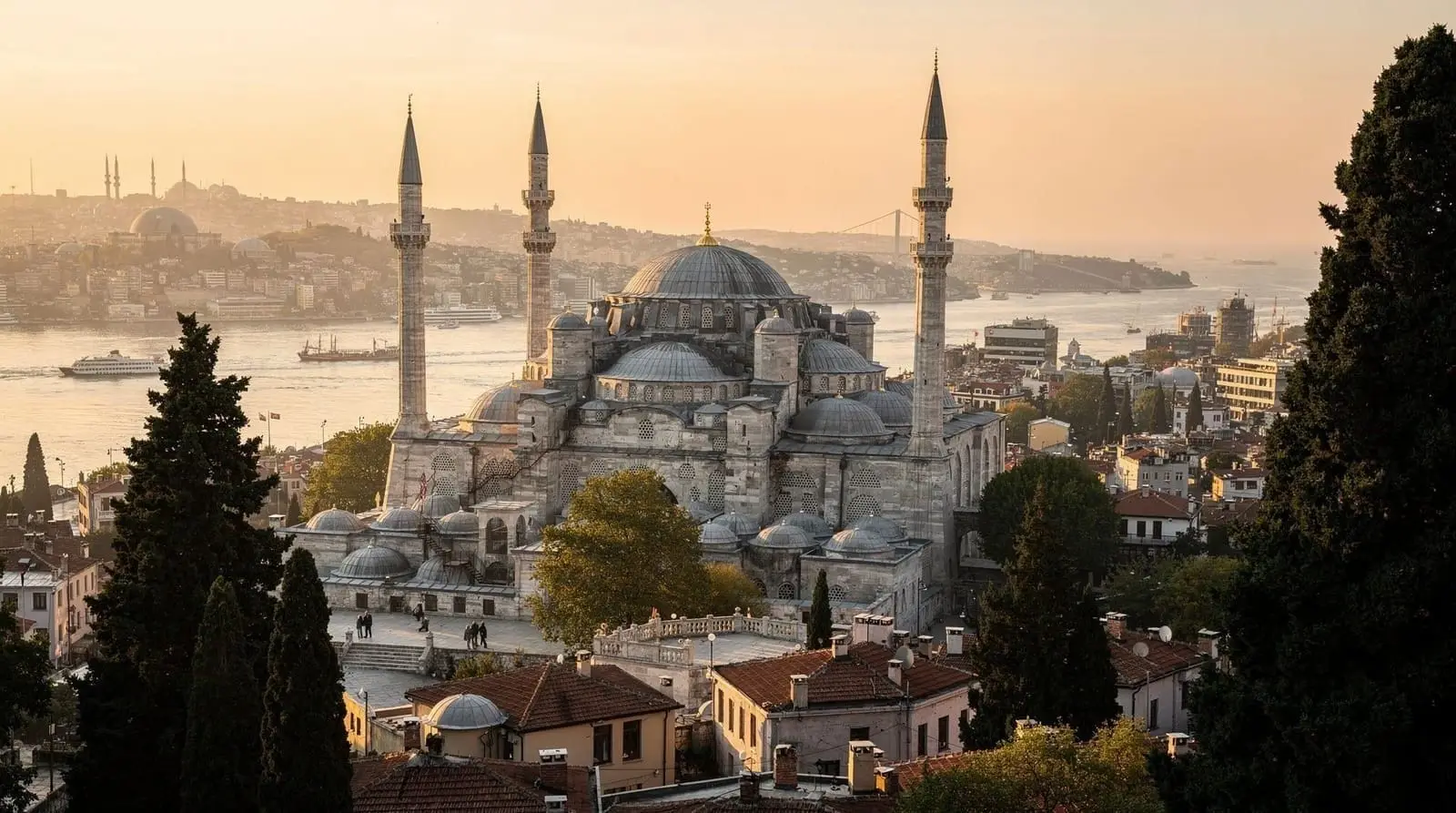
Süleymaniye Mosque — visitor guide
Visit Istanbul's Süleymaniye Mosque — Sinan's masterpiece, free entry, fewer crowds than the Blue Mosque, and a view over the Golden Horn.
Istanbul: Suleymaniye Mosque Guided Tour
Quick facts
- Built
- 1550–1557 (architect Sinan)
- Entry
- Free (closed during prayer times)
- Time needed
- 45–75 minutes
- Getting here
- Tram T1 to Grand Bazaar, walk 15 min; or bus to Süleymaniye
- Dress code
- Shoulders and knees covered; women cover hair
Sinan’s most considered work
The Blue Mosque gets most of the tourists. The Süleymaniye Mosque, 15 minutes’ walk away on the Third Hill, gets most of the architectural attention from people who look seriously.
| Where | Third Hill, Vezneciler — 15 min uphill from the Grand Bazaar |
| Cost | Free — active mosque, no ticket |
| Time needed | 45–75 minutes for the mosque, courtyard and terrace |
| Getting there | Tram T1 to Vezneciler, then a 10-min uphill walk |
| Best time | Weekday morning or late afternoon, outside prayer closures |
The Süleymaniye was built between 1550 and 1557 by the architect Sinan for Sultan Süleyman the Magnificent, the longest-reigning and most powerful Ottoman sultan. Sinan was in his sixties when he designed it — experienced enough to have absorbed the lessons of Byzantine engineering (especially from Hagia Sophia, which he studied extensively) and Ottoman mosque-building, and to synthesize them into something genuinely his own.
He reportedly said of the Süleymaniye: “With this building I have reached the journeyman level.” He later called the Selimiye Mosque in Edirne his masterwork. The comparison tells you something about Sinan’s standards. The Süleymaniye is, by most outside assessments, one of the most architecturally accomplished buildings in Istanbul.
What makes it architecturally significant
The central dome is 26.5 meters in diameter and 47 meters high — slightly smaller than the Blue Mosque but visually cleaner. Sinan reduced the number of load-bearing elements compared to earlier Ottoman mosques, opening the interior and letting the dome read as floating on a ring of windows. The result is an interior that feels larger than its dimensions suggest.
The wall decorations are restrained compared to the tile-heavy Blue Mosque interior: some Iznik tiles, plain white plaster elsewhere, stained glass windows in the clerestory. The emphasis is on the architecture itself rather than surface decoration. This is a deliberate choice — Sinan’s later mosques consistently prioritize structural clarity over applied ornament.
The stained glass windows are the best in any Istanbul mosque — some of the original 16th-century pieces remain, including in the mihrab niche. The color and quality of the glass are exceptional.
The courtyard (avlu) in front of the mosque is a formal Ottoman mosque courtyard with an ablution fountain at the center, four minarets (two short, two tall) at the corners, and columns salvaged from Byzantine and earlier structures. The columns come from Alexandria and Constantinople — typical Ottoman practice.
The külliye — the larger complex
Sinan built the Süleymaniye as the center of a külliye (a mosque complex with associated institutions). The buildings extending around the mosque include:
Tombs of Süleyman and Hürrem: The türbe (mausoleum) of Sultan Süleyman is behind the mosque in a walled garden, an octagonal structure with faience tile decoration. His wife Hürrem Sultan (Roxelana) has a separate, smaller türbe adjacent. Both are usually accessible to visitors.
Four medrese (theological schools): Now converted to use as a library and other functions.
Darüşşifa (hospital/medical school): Now a maternity hospital.
Imaret (soup kitchen): The imaret has been restored and operates as the Darüzziyafe restaurant — one of the better traditional Ottoman restaurant experiences in Istanbul, in a genuine 16th-century building.
Tabhane (hostel for traveling scholars): Also restored.
The whole complex occupies the Third Hill and constitutes one of the most complete surviving Ottoman külliye in Istanbul. You can walk through most of it for free.
Views from the terrace
Behind the mosque, a garden terrace overlooks the Golden Horn — the inlet separating old city from modern Beyoğlu, visible in full width from here. The Galata Tower is visible across the water; beyond it, the residential and commercial districts of Beyoğlu stretch north. To the right, the Galata Bridge and the Bosphorus; to the left, the old land walls and the direction of Balat and Fener.
It’s one of the best free vantage points in Istanbul. In the late afternoon, the light across the Golden Horn is excellent for photography.
Unlike the paid rooftop bars and viewing terraces scattered around Beyoğlu and Galata, this terrace costs nothing and rarely has more than a handful of other visitors, even at peak tourist season. Locals use it too — it’s a genuine neighbourhood gathering spot in the evenings, with families and students sitting on the low garden walls, not just a stop on a tour itinerary. Bring a bottle of water and there’s no reason to rush the view; benches along the terrace edge make it easy to linger for 15–20 minutes rather than the usual two-minute photo stop.
Entry and dress code
Entry is free. The Süleymaniye is an active mosque. There is no entry fee for tourists.
The mosque closes during prayer times (five times daily). The closures last approximately 30–60 minutes each. The schedule is posted at the entrance.
Dress requirements: The same as all functioning mosques in Istanbul.
- Shoulders covered (both men and women)
- Knees covered (both men and women)
- Women: hair covered (scarves available at the entrance)
- Shoes removed at the entrance (bags provided)
The dress code is enforced, though occasionally more flexibly than at the Blue Mosque due to slightly lower tourist volume. Don’t rely on this — dress appropriately.
Getting there
By foot from the Grand Bazaar: Approximately 15 minutes, uphill through the Tahtakale district. The bazaar is at the base of the Third Hill; the Süleymaniye is at the top.
By tram: T1 to Vezneciler/İstanbul Üniversitesi stop, then a 10-minute uphill walk.
By bus: Several buses stop on the main road below the mosque complex.
The approach from the Grand Bazaar on foot takes you through a quieter district of wholesale shops and residential streets that sees fewer tourists — worth taking rather than a taxi.
Combining with nearby sites
Grand Bazaar: The most natural combination — visit the Grand Bazaar first, then walk uphill to the Süleymaniye.
Eminönü and the Spice Bazaar: Descend from the Süleymaniye toward the Golden Horn for the Spice Bazaar, then along the waterfront to Eminönü for ferries or a Bosphorus cruise.
Chora / Kariye Mosque: Further along the old city toward the land walls. A taxi or longer walk, but both sites together constitute the best Sinan (Süleymaniye) and Byzantine mosaic (Chora) pairing in the city.
Balat and Fener: Continue west from Süleymaniye to the Golden Horn neighborhoods. A full-morning walk connects Süleymaniye, Fener, Balat, and Chora in sequence.
Honestly: the crowd advantage
The Süleymaniye’s most practical advantage for visitors is that it has substantially fewer tourists than the Blue Mosque — sometimes 80–90% fewer on the same morning. You can stand in the center of the prayer hall and look at the dome without being jostled, which is exactly why a guided tour of the mosque works better here than at busier sites — you can actually hear the guide. You can spend time with the stained glass. You can sit quietly in the courtyard.
This doesn’t mean the Süleymaniye is architecturally superior to the Blue Mosque in an absolute sense — they’re doing different things — but the experience of visiting is considerably better. If you have time for only one mosque visit and the Blue Mosque queue or prayer closure schedule is working against you, the Süleymaniye is the stronger choice for a calm, unhurried visit.
Sinan’s life and other Istanbul works
Mimar Sinan (c. 1489–1588) was the Ottoman Empire’s chief architect for nearly 50 years under three sultans. He designed over 370 structures — mosques, madrasas, bridges, hamams, caravanserais, palaces, and mausoleums across the empire from the Balkans to Egypt.
His Istanbul works beyond the Süleymaniye include:
- Rüstem Pasha Mosque (1561): A small mosque in the Tahtakale district, famous for its extraordinary quality of İznik tiles. Often overlooked by tourists; accessible via a staircase from the street.
- Kılıç Ali Pasha Mosque (1580): In Tophane, near Karaköy.
- Mihrimah Sultan Mosque (Üsküdar, 1547–1548): The first mosque Sinan designed for a principal patron.
- Çemberlitaş Hamamı (1584): Still operating, near the Grand Bazaar — one of the most accessible genuine Ottoman hamam experiences in Istanbul. See the hammam experiences guide.
For those interested in Sinan’s architecture specifically, the combination of Süleymaniye (his most prominent Istanbul work) and Rüstem Pasha (his most tile-focused Istanbul work) on the same day is the most efficient pairing. Rüstem Pasha is a 10-minute walk downhill from Süleymaniye toward Eminönü.
The Darüzziyafe restaurant
The imaret (soup kitchen) of the Süleymaniye complex has been converted into a restaurant — Darüzziyafe — operating in a genuine 16th-century vaulted building. The kitchen serves traditional Ottoman-influenced dishes: lamb stews, stuffed vegetables, pastries, Ottoman desserts.
Prices are moderate-to-high for Istanbul (main courses approximately 350–700 TRY as of mid-2026). The setting — stone arches, historical building, location within the külliye — justifies a slight premium over the street-level options. It fills up for lunch on weekdays; reservations recommended for groups.
This is one of the few places in Istanbul where you can eat in an Ottoman architectural context without it being purely tourist-facing.
Ramadan at Süleymaniye
The Süleymaniye complex has historically been a center for Ramadan activities. The terrace behind the mosque and the surrounding gardens see iftar (sunset meal) gatherings, and the mosque itself attracts larger congregations for the evening tarawih prayers during Ramadan.
Visiting during Ramadan requires some timing adjustment: evening prayer times are extended, and the mosque may be busier in the evenings than usual. However, the atmosphere around the külliye in Ramadan evenings is genuinely worth experiencing if your schedule allows.
The mosaic churches comparison
The Chora / Kariye mosque (Byzantine, mosaics from the 14th century) represents the peak of Byzantine art in Istanbul, while the Süleymaniye represents Ottoman architecture at its peak. Visiting both gives you the two major art-historical traditions of the city in their finest examples. They’re 4 km apart; a taxi or bus connects them.
Hagia Sophia sits chronologically and architecturally between them — the Byzantine original that the Ottomans both inherited and responded to. The three together form the definitive Istanbul architectural itinerary.
Planning your visit from the Grand Bazaar
The most natural approach to the Süleymaniye is from the Grand Bazaar — they’re directly connected by the uphill streets of the Bazaar Quarter, and the combination works well as a morning or afternoon.
From the Grand Bazaar’s north side (toward Beyazıt University): take Kapıağası Sokak or Kirazlı Mescit Sokak uphill toward the mosque complex. The walk is 10–15 minutes and takes you through a local neighborhood rather than a tourist corridor.
Alternatively, from the Bazaar’s east side (Çemberlitaş gate): walk north up Vezirhan Caddesi toward the mosque.
Return route options:
- Walk downhill through Tahtakale to the Spice Bazaar and Eminönü
- Continue west on foot to Balat and Fener (30 minutes walking)
- Take a taxi to Chora / Kariye (15–20 minutes, 150–250 TRY)
The sultan Süleyman and the historical context
Sultan Süleyman I (r. 1520–1566), known in the West as “the Magnificent” and in Ottoman sources as “the Lawgiver” (Kanuni), was the longest-reigning Ottoman sultan and the one under whom the empire reached its greatest territorial extent. He personally commanded 13 military campaigns, oversaw a codification of Ottoman law that bore his name for centuries, and maintained a court that attracted poets, architects, and scholars.
The Süleymaniye was commissioned when Süleyman was at the peak of his power and reign. Sinan had already built several smaller mosques for Süleyman and for senior officials; the Süleymaniye was the Sultan’s own imperial statement. The choice of the Third Hill — visible from the Bosphorus, dominating the city’s skyline from the water — was deliberate.
Süleyman died on campaign in Hungary in 1566, nine years after the mosque was completed. His body was returned to Istanbul and buried in the türbe behind the mosque — the building he had built as his monument and final resting place.
His wife Hürrem Sultan (Roxelana) — a Ruthenian slave who became his legal wife, an unprecedented move in Ottoman tradition — died in 1558 and was buried in a separate adjacent türbe. Their tombs are accessible from the garden behind the mosque.
The relationship between Süleyman and Hürrem — her influence on his decisions, the way she redefined the role of the Ottoman consort, and her political correspondence with foreign rulers — is one of the most documented personal histories in Ottoman sources. Several documentaries and historical novels have treated it; the Turkish television series “Magnificent Century” dramatized it with historical license.
Practical orientation and visitor logistics
Getting there on foot from Sultanahmet: Approximately 25–30 minutes, walking west along Divanyolu Caddesi (the main road through Sultanahmet toward the Grand Bazaar), then turning right (north) uphill through the bazaar quarter. The climb is real — the Third Hill is the highest of Istanbul’s seven traditional hills, and the approach from Sultanahmet involves a sustained uphill walk through the bazaar area.
By tram: T1 to the Vezneciler stop (two stops west of Sultanahmet toward the Grand Bazaar), then a 10-minute uphill walk through the university district.
From the Grand Bazaar: 15 minutes uphill on foot, through the fabric and wholesale goods quarter — quieter than the tourist areas.
Visiting time: The mosque itself takes 45–75 minutes for the interior, courtyard, and terrace view. Add time for the surrounding külliye if you’re interested in Ottoman imperial complexes more broadly.
Combining with the hammam: Çemberlitaş Hamamı — one of the best preserved and most accessible 16th-century Ottoman hammams in Istanbul — is a 15-minute walk southeast of the mosque, near the Grand Bazaar. Sinan designed it in 1584. See the hammam experiences guide for details.
Photography: The exterior and interior are freely photographed. The view from the terrace is best in the late afternoon with warm light on the Golden Horn. Interior photography is permitted but be mindful of worshippers.
The honest comparison with the Blue Mosque
For travelers trying to choose between the Blue Mosque and Süleymaniye on a tight schedule:
| Aspect | Blue Mosque | Süleymaniye |
|---|---|---|
| Crowds | Very high | Low–moderate |
| Tile work | More (20,000 tiles) | Less |
| Architecture | Good | Better (specialists’ view) |
| Views | None from inside | Golden Horn terrace |
| Historical significance | High (Ottoman) | High (Sinan) |
| Accessibility | Central Sultanahmet | 20-min walk from center |
The Blue Mosque is more convenient and more recognizable. The Süleymaniye is more architecturally sophisticated and far less crowded. For a visitor with 4+ days in Istanbul, visiting both is straightforward. For a visitor with 2–3 days, the Blue Mosque is more logistically efficient as a quick Sultanahmet add-on.
For a visitor specifically interested in Islamic architecture, the Süleymaniye is the priority.
A realistic hour at Süleymaniye
For visitors who want structure rather than wandering, this order covers the complex without doubling back.
First 15 minutes — Enter through the courtyard, look at the ablution fountain and the salvaged Byzantine columns, then remove shoes and step into the prayer hall. Stand near the center to take in the dome and the stained-glass mihrab wall before it fills with the next visitor wave.
Next 15 minutes — Walk the perimeter of the interior slowly; this is where the lack of crowds pays off most, since you can actually stop under the dome without being jostled.
Next 15–20 minutes — Exit to the garden behind the mosque for the türbe of Süleyman and Hürrem Sultan, then continue to the terrace for the Golden Horn view.
Final 10–15 minutes — Walk the külliye’s outer edge — the medrese buildings and the Darüzziyafe restaurant courtyard — before heading back downhill toward the Grand Bazaar or Spice Bazaar.
This structure works for both a quick weekday-morning visit and a slower late-afternoon one; the only variable is how long you linger on the terrace, which is worth extending if the light is good.
Frequently asked questions about Süleymaniye Mosque
Is Süleymaniye Mosque free to enter?
Yes. Entry is free; it’s an active mosque. Dress code applies: covered shoulders and knees, hair covered for women, shoes removed at the entrance.
How does Süleymaniye compare to the Blue Mosque?
The Blue Mosque is more ornate (more tile work) and more famous, but also far more crowded. The Süleymaniye is architecturally more sophisticated by most assessments — Sinan’s structural work is cleaner and more original — and it’s significantly less crowded. If you want a quieter, more authentic mosque experience, Süleymaniye is the better choice.
Who built the Süleymaniye Mosque?
The architect was Sinan (full name Mimar Sinan), the Ottoman Empire’s most important architect, who also designed the Selimiye Mosque in Edirne and over 370 other structures. He built the Süleymaniye for Sultan Süleyman I (the Magnificent) between 1550 and 1557.
Are the tombs of Süleyman and Hürrem Sultan open to visitors?
Usually yes — the türbe garden behind the mosque typically allows visitor access. Opening times vary; the complex closes during prayer times along with the mosque.
How long does a visit to Süleymaniye Mosque take?
45–75 minutes for the mosque interior, courtyard, and terrace view. Add time for the surrounding külliye buildings and the tombs if you’re interested in the broader complex.
Can I combine Süleymaniye Mosque with the Grand Bazaar in one visit?
Yes, and it’s the most natural pairing — they’re a 10–15 minute uphill walk apart through the Tahtakale district. Most visitors do the Grand Bazaar first, then walk uphill to Süleymaniye, finishing with the terrace view over the Golden Horn.
Is Süleymaniye Mosque worth it if I’ve already seen the Blue Mosque?
Yes — the two mosques are different enough that seeing both rewards the extra time. The Blue Mosque is more famous and more heavily tiled; Süleymaniye is architecturally more refined by most specialists’ assessments and offers a genuine viewpoint the Blue Mosque lacks. If you only have time for one, use the comparison table above to decide based on what matters more to you.
Top experiences
Bookable activities with verified prices and instant confirmation on GetYourGuide.
