Basilica Cistern — visitor guide and honest tips
Visit Istanbul's Basilica Cistern underground — entry tickets, what to see, Medusa heads, and when to go for the best atmosphere.
Istanbul: Basilica Cistern Skip-the-Line Entry Ticket and Audio Guide
Quick facts
- Built
- 532 CE (Emperor Justinian I)
- Entry
- Check the current price on the official site
- Time needed
- 45–60 minutes
- Getting here
- Walk 5 minutes from Hagia Sophia; Tram T1 Sultanahmet stop
- Best time
- Midday in summer (underground, stays cool)
A Roman reservoir beneath a busy street
| Where | Sultanahmet, 150m northwest of Hagia Sophia |
| Cost | check the current price on the official site |
| Time needed | 45–60 minutes |
| Getting there | Walk 5 min from Hagia Sophia; Tram T1 Sultanahmet |
| Best time | Midday in summer — underground and naturally cool |
The Basilica Cistern (Yerebatan Sarnıcı, sometimes called the Sunken Palace) was built in 532 CE by Emperor Justinian I, the same emperor who built Hagia Sophia two years earlier. It sits about 150 meters northwest of Hagia Sophia, under what was then the Stoa Basilica — a large public square. Today a modest 19th-century building sits above the entrance, giving no hint of what’s underneath.
The cistern held 80,000 cubic meters of water, enough to supply the Byzantine Great Palace and a significant portion of the city. Water arrived via aqueduct from the forests north of the city. It was actively used until the Ottoman period, then largely forgotten — the Ottomans had their own water systems — and rediscovered only in the 1540s when a local historian noticed residents lowering buckets through holes in the floor of their homes.
It was restored and opened to the public in the late 1980s. A second restoration and light installation was completed in 2022, significantly improving the atmosphere.
What you actually see
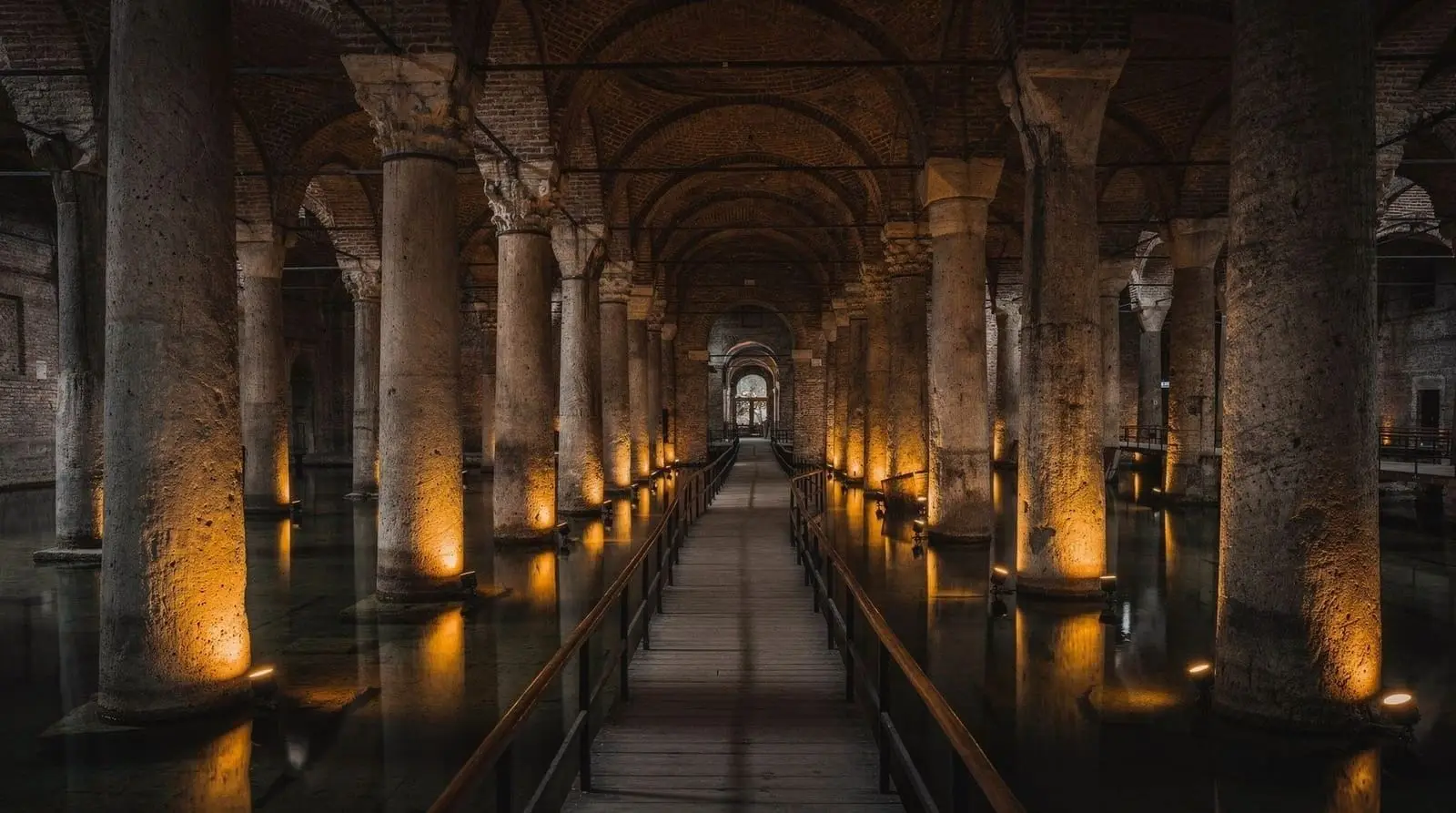
The cistern is 138 meters long, 64.6 meters wide, and supported by 336 marble columns arranged in 12 rows of 28. Most columns are 8 meters tall. They were not purpose-made for the cistern — they were salvaged from ruined Roman temples and buildings across the empire, which is why they’re a mixture of styles and materials (Corinthian, Doric, Ionic capitals) and slightly different heights. Some are monolithic; others are assembled from drums.
The water level today is kept deliberately low for visitors — roughly 20–30 centimeters deep in most areas, enough to reflect the columns and the lighting. In the Byzantine period, the cistern was filled to several meters.
The atmosphere is the main draw: dim lighting, the sound of water, the smell of stone and water, the visual depth of columns disappearing into low-lit distance. The 2022 lighting upgrade added colored light projections on the ceiling and columns that some visitors find beautiful and others find excessive. It’s worth seeing either way.
The Medusa heads
In the northwest corner, two column bases use carved Medusa heads as supports. One is upside down; the other is turned sideways. This is the cistern’s most famous detail and the subject of consistent debate.
The most likely explanation is purely structural: the cistern builders needed to fill gaps, and the Medusa blocks happened to fit — their orientation was determined by the height needed, not by symbolic intent. The idea that they were deliberately inverted “to neutralize the evil eye of Medusa” is a pleasant story but not well-supported by evidence.
The Medusa heads are Roman sculptures, probably 2nd or 3rd century CE, salvaged from somewhere in Constantinople or the surrounding region. Their craftsmanship is good; the detail in the hair and features is visible if you’re patient and the lighting cooperates.
The “Wishing Column” (Hen’s Eye Column)
One column is decorated with carved teardrop and eye patterns, distinguished from all the others. It’s sometimes called the “Wishing Column” or “Peacock Eye Column” (Tavus Gözü). A hole worn smooth at head height is where visitors insert a thumb and rotate it 360 degrees while making a wish — similar to the Weeping Column in Hagia Sophia.
No serious historical explanation for the column’s decoration has been confirmed; it may simply have been the base of a fountain or decorative column in a public space elsewhere, then repurposed here.
Practical entry information
Entry fee: Ticket prices change, so check the current price on the official site of the Basilica Cistern. Book skip-the-line entry with an audio guide online to avoid queues — the cistern has a relatively small daily capacity and sellouts do occur in summer on busy days.
Hours: Typically 9am–7pm in summer (later in some periods), 9am–5pm in winter. Check the official site before visiting, as the 2022 restoration changed some of the operating hours.
Night Shift: A separate “Night Shift” ticket exists for evening visits with different lighting conditions — a more atmospheric option if you want to avoid the daytime crowds.
Photography: Freely permitted. The 2022 installation is designed to be photogenic; low-light photography of the columns with phone cameras works well.
Accessibility: There are steps at the entrance (52 of them to descend). The cistern floor is mostly flat walkways over the water, but there are some steps within. Not fully wheelchair accessible.
Temperature: Underground and naturally cool — approximately 13–15°C year-round. In summer heat (35°C outside), the cistern is a genuine relief. Bring a light layer.
How long to spend here
45–60 minutes is the average and sufficient. The space is not large — once you’ve walked the main pathways, seen the Medusa heads, and found the Wishing Column, you’ve seen everything. People who linger tend to do so for photography or to sit and absorb the atmosphere, not because there’s more to discover.
It is not the kind of site that benefits from multiple hours. If you have limited time in Sultanahmet and have to choose between the Basilica Cistern and one of the larger paid sites (Topkapı Palace, Hagia Sophia), the larger sites offer more historical depth. The cistern is shorter but memorable.
Combining with other Sultanahmet sites
The cistern’s location makes it a natural pairing in a Sultanahmet day. From the Hagia Sophia exit, it’s a 5-minute walk west. From the Blue Mosque, approximately the same. The Grand Bazaar is a 15-minute walk west.
A well-structured day: Hagia Sophia (morning), Blue Mosque (check prayer schedule), Basilica Cistern (midday — coolest), Hippodrome monuments (free, outdoor), Grand Bazaar or early dinner.
The Cistern also pairs efficiently with a combined-ticket tour (Basilica Cistern and Grand Bazaar tour exists via GYG).
The Cistern of Theodosius — a lesser-known alternative
For visitors specifically interested in Byzantine infrastructure, there is a second, smaller cistern — the Cistern of Theodosius (Şerefiye Sarnıcı) — open since 2018, located near Beyazıt Square, about 1.5 km from Yerebatan. It’s smaller, less dramatic, and significantly less crowded. GYG sells tickets with audio guide. Worth combining if you’re already visiting the Grand Bazaar nearby.
Basilica Cistern vs. Cistern of Theodosius
Both are Byzantine underground reservoirs open to visitors, but they suit different priorities:
| Basilica Cistern (Yerebatan) | Cistern of Theodosius (Şerefiye) | |
|---|---|---|
| Size | 138m × 64.6m, 336 columns | Smaller, fewer columns |
| Crowds | High, especially midday in summer | Significantly quieter |
| Atmosphere | Dramatic lighting, Medusa heads | More minimal, less theatrical |
| Location | Sultanahmet, next to Hagia Sophia | Near Beyazıt Square, by the Grand Bazaar |
| Best for | First-time visitors, photography | Repeat visitors, a quieter underground stop |
If you have time for only one, the Basilica Cistern’s fame and scale make it the right choice for a first Istanbul visit. If you’ve already seen it on a previous trip, or want a calmer version of the same experience while you’re at the Grand Bazaar anyway, the Theodosius cistern is a worthwhile 30-minute detour.
Booking and avoiding the queue
Online booking is genuinely worth the few minutes it takes, and not just for peace of mind. In peak season (June–August) the cistern’s daily capacity is limited by the walkway width, and the ticket office queue at the entrance can run 30–45 minutes by mid-morning. Booking a timed-entry ticket in advance — via GYG or the official site — lets you walk past that queue directly to the entrance turnstile. The audio-guide bundle adds a modest amount to the base ticket price and is worth it here specifically, because the Medusa heads and the Wishing Column reward the extra context far more than a silent walkthrough does.
The 2022 light installation — what changed
The cistern underwent a significant renovation between 2020 and 2022. The renovation included:
- New walkway infrastructure over the water
- A digital art and light installation by Turkish artist Refik Anadol (the “Unseen Realities” immersive projection)
- Improved general lighting and drainage
- New visitor facilities
The Refik Anadol installation projects fluid, organic visual patterns in blue and green onto the columns and water surface. Reactions from visitors are genuinely mixed: some find it dramatically enhances the atmosphere; others feel it detracts from the original space. The honest assessment is that it’s visually impressive on its own terms, though it does change the experience from what it was pre-renovation.
If you’re looking for the raw, minimally lit underground experience that made the cistern famous (and was the basis for the James Bond film “From Russia with Love”), what you’ll find today is more curated and visually designed. The “Assassin’s Creed Revelations” and “Dan Brown-esque” atmosphere is now more explicitly theatrical.
This isn’t necessarily worse — the installation works — but it’s different.
Historical context: Istanbul’s Byzantine water system
The Basilica Cistern was one of several large Byzantine cisterns built across Constantinople to ensure water supply security. The city was surrounded by sea on three sides and had limited natural freshwater sources; large storage cisterns were the solution.
Two other large open cisterns (aqueduct-fed) survive partly intact in the city:
- The Cistern of Aspar (Çukurbostan) in the Fatih district — now mostly overgrown
- The Cistern of Aetios (Karagümrük) — now used as a sports field
Several smaller underground cisterns are scattered through Sultanahmet and the surrounding districts. The Cistern of Theodosius (Şerefiye Sarnıcı), opened as a visitor site in 2018, is the most accessible alternative — near Beyazıt Square, quieter than Yerebatan, and different in character.
The water supply system relied on the Valens Aqueduct (Bozdoğan Kemeri), which still stands over the main road through Fatih district — visible from the tram. Built in 368 CE, restored multiple times, and still functioning for limited purposes into the 19th century. Walking or driving under it is one of the unexpectedly moving moments in the city.
The cistern in popular culture
The Basilica Cistern has appeared in several films and games:
- “From Russia with Love” (1963): The gondola chase scene was filmed here (or in a close recreation — the actual water level and layout differ from the film)
- “Assassin’s Creed: Revelations” (2011): The cistern is a key location in the game
- Dan Brown’s “Inferno” (2013) / film (2016): A climactic scene is set here (with significant dramatic license taken with the layout)
These appearances have contributed to the cistern’s fame among younger visitors. The actual location is distinctive enough to match its fictional versions reasonably well.
Connecting with the rest of Sultanahmet
After the Basilica Cistern, logical next steps depend on time of day:
- Morning: Walk north 5 minutes to Hagia Sophia or south to the Blue Mosque and Hippodrome
- Midday: The cistern’s cool temperature makes it ideal for the hottest part of the day; follow it with the Hippodrome monuments (shaded benches available) and then the Grand Bazaar later in the afternoon
- If combining bazaars: The Spice Bazaar is a 10-minute tram ride east to Eminönü
- For history depth: The Topkapı Palace entrance is 5 minutes northeast
The cistern also sits close to several of Istanbul’s working archaeological layers. The Çemberlitaş Column (Column of Constantine — the scorched brick column on the main road between Sultanahmet and the Grand Bazaar) dates to 330 CE, when Constantine dedicated it as the center of his new capital. It is free and always visible; almost always passed by without pause. Worth 5 minutes.
Who built it and why
Emperor Justinian I’s decision to build the cistern in 532 CE was part of a broader post-Nika Revolt rebuilding program. The Nika Revolt — the most violent civil uprising in Constantinople’s history — had destroyed much of the city’s center. Justinian’s response was a massive construction program that produced not just Hagia Sophia, but the cistern, rebuilt city walls, new churches, and improved water infrastructure across the city.
The architect is not specifically recorded. The builder of record is Justinian himself — the typical Byzantine convention of attributing construction to the emperor regardless of who actually directed the work.
The original cistern served the Great Palace of Constantinople — the enormous imperial residential complex that stretched from the Hippodrome to the sea walls. The palace itself has largely disappeared; the cistern survived because it was underground and made of stone. Its 6th-century infrastructure outlasted the palace it served by 1,500 years.
The column salvage: 336 columns from ruined buildings across the empire. This was standard Byzantine practice (spolia — reuse of architectural elements) but the scale here is remarkable. The columns are not a matched set; they vary in height, material, and style. The shorter columns have had drums added to bring them to a standard height. The taller ones show the original length.
Several columns have carved decorations at the base or capital that are clearly from earlier, different buildings — a Corinthian capital that doesn’t quite align with the column shaft, for instance, or a column base that sits slightly off-center. These are archaeological traces of the buildings the cistern was built from.
Planning your Sultanahmet day around the Basilica Cistern
The cistern fits naturally into a Sultanahmet day as a midday anchor — its underground temperature makes it ideal for the hottest hours:
Suggested sequence (full Sultanahmet day):
- 8:30am: Hagia Sophia — arrive at opening to avoid queues
- 10:30am: Hippodrome monuments (free, outdoor) — walk and orient
- 11:00am: Blue Mosque — check prayer schedule; 45–60 minutes inside
- 12:30pm: Basilica Cistern — coolest part of the day, 45–60 minutes
- 2:00pm: Lunch near Çemberlitaş (local restaurants, 250–450 TRY)
- 3:00pm: Grand Bazaar — closes at 7pm; afternoons are busy but manageable
- 5:30pm: Tram to Eminönü for Spice Bazaar (open until 7:30pm) or Galata Bridge fish sandwich
This circuit covers the core Sultanahmet sights without backtracking and uses the Basilica Cistern’s coolness advantage deliberately.
For a 2-day Sultanahmet visit:
- Day 1: Hagia Sophia + Hippodrome + Blue Mosque + Basilica Cistern
- Day 2: Topkapı Palace (full day, including Harem) + Grand Bazaar
Frequently asked questions about the Basilica Cistern
What is the Basilica Cistern?
The Basilica Cistern (Yerebatan Sarnıcı) is a 6th-century underground Roman water reservoir beneath central Istanbul, built by the Emperor Justinian I in 532 CE. It held up to 80,000 cubic meters of water to supply the Byzantine Great Palace. Today it’s a visitor site notable for its 336 columns, low-lit atmosphere, and two carved Medusa heads used as column bases.
Why are the Medusa heads upside down?
Most likely for structural reasons — the blocks were the right height to level the columns when inverted. The idea that they were inverted to “neutralize evil” is a popular but unverified explanation.
How long does a visit to the Basilica Cistern take?
45–60 minutes for most visitors. The space is compact and the main features are seen in a single circuit of the walkways.
Is it cold inside the Basilica Cistern?
Yes — about 13–15°C year-round. A light layer is useful even in summer.
Do I need to book tickets in advance?
In peak season (June–August), booking online is recommended. The cistern has limited capacity and can sell out by midday. Booking 1–2 days ahead eliminates queuing at the entrance.
Is the Basilica Cistern suitable for children?
Generally yes — the atmosphere is engaging for children who like “underground” settings. The steps (52 down, 52 up) are manageable. Strollers are not practical. The dim lighting and pools are fenced off, so it’s relatively safe.
Top experiences
Bookable activities with verified prices and instant confirmation on GetYourGuide.

