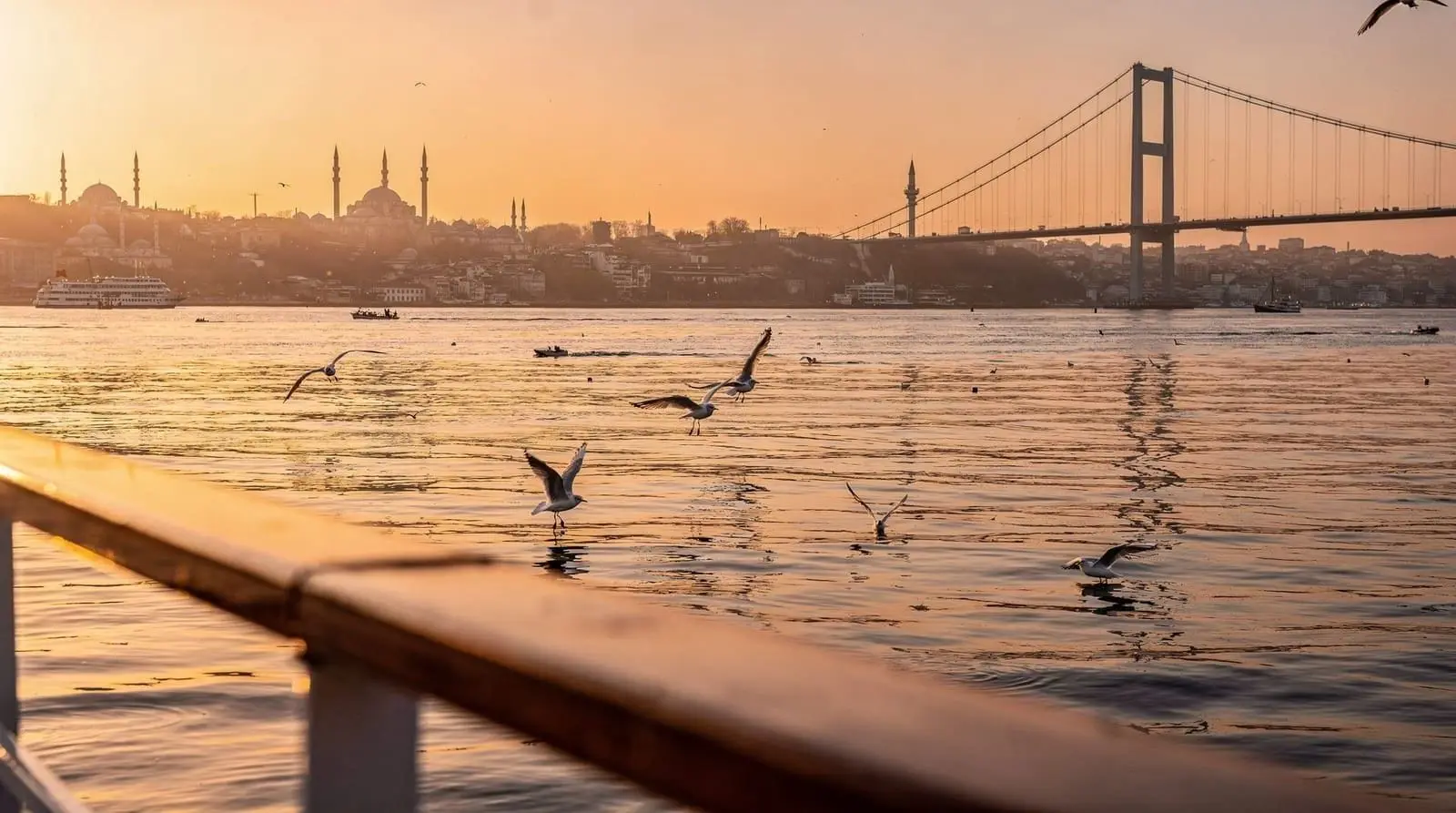
Bosphorus strait
The 31 km waterway dividing Europe and Asia through Istanbul — cruise options, ferry routes, waterfront palaces, and how to see it without overpaying.
Istanbul: Bosphorus Sightseeing Cruise with Sunset Option
Quick facts
- Length
- 31 km (Istanbul section ≈ 17 km)
- Width
- 550 m to 3,300 m
- Bridges
- 3 suspension bridges crossing Europe to Asia
- Ferry types
- Public IDO ferries + private sightseeing cruises
- Cheapest crossing
- Eminönü–Kadıköy or Karaköy–Üsküdar ferry (Istanbulkart)
- Best cruise duration
- 2–3 hours for a comfortable sightseeing run
The Bosphorus in plain terms: what it is and why it matters
| Where | Strait dividing Europe and Asia through central Istanbul |
| Cost | Under 100 TRY (public ferry) to 3,500 TRY (dinner cruise) |
| Time needed | Half a day for a proper sightseeing cruise |
| Getting there | Eminönü, Karaköy, or Kabataş piers (T1 tram) |
| Best time | Late afternoon for golden-hour light on the European shore |
The Bosphorus (Boğaziçi in Turkish — “throat of the cow” in literal translation) is a natural strait connecting the Black Sea to the north with the Sea of Marmara to the south, and through the Marmara to the Aegean and the Mediterranean beyond. Istanbul straddles both shores: the European city to the west, the Asian city to the east. Every ship travelling between the Black Sea and the Mediterranean passes through — tankers, container ships, Bosphorus cruise boats, public ferries, and fishing trawlers move simultaneously through the same channel, which narrows to 550 metres at its tightest point near Kandilli.
For a visitor, the Bosphorus is the physical context that makes Istanbul legible. Seeing the city from the water, with the domes of Hagia Sophia and the minarets of the old city rising above the European shore, the pastel-painted waterfront yalı mansions of the Bosphorus villages, the Ottoman-era forts at Rumeli and Anadolu Hisarı, and the three bridge spans — these are what separate an Istanbul visit from a generic urban trip. The water is central, not decorative.
This page covers how to see the Bosphorus properly, what cruise options exist at various price points, what you will see on a standard route, and what the surrounding shore destinations (Ortaköy, Beşiktaş, Üsküdar, Kadıköy, and others) add to a Bosphorus-oriented itinerary.
What you see on a standard Bosphorus cruise route
Most Bosphorus sightseeing cruises follow a similar route: from the Eminönü or Karaköy pier, north along the European shore to the first Bosphorus Bridge (Boğaziçi Köprüsü, opened 1973), returning south along the Asian shore or continuing further north toward the second bridge (Fatih Sultan Mehmet Köprüsü, 1988) on longer routes.
European shore, northward from Eminönü:
- Dolmabahçe Palace (Dolmabahçe Sarayı): the 600-metre white marble facade of the 1856 Ottoman palace, the first landmark of scale north of the old city. The ceremonial gate facing the water is the most photographed element.
- Çırağan Palace (now Kempinski hotel): another waterfront Ottoman palace, 1870s, immediately north of Dolmabahçe. The restaurant terrace is accessible to non-guests.
- Ortaköy: the small neighbourhood mosque (Mecidiye Camii, 1854) photographed against the first Bosphorus Bridge behind it is one of Istanbul’s canonical images. The area has a Sunday street market and a concentration of waffle and mussel vendors.
- Bebek: upscale residential neighbourhood on the European shore, pleasant waterfront café strip. Several cruise routes stop here.
- Rumeli Hisarı (Rumelian Castle): a fortress built by Mehmed II in 1452 — the year before the Ottoman conquest of Constantinople — to control Bosphorus traffic. The walls are intact; the interior is a museum. The view from the ramparts is exceptional.
- Fatih Sultan Mehmet Bridge (second Bosphorus bridge): more industrial surroundings here, but the bridge span itself is impressive.
Asian shore, southward:
- Anadolu Hisarı (Anatolian Castle): a smaller Ottoman fort on the Asian shore, built 1394 — older than the Rumeli Hisarı opposite it. The two forts together controlled the narrowest point of the strait.
- Kanlıca: known for the thick yoghurt sold on the waterfront — an Istanbul cliché that is also true; the yoghurt is unusually good.
- Üsküdar: the southernmost Asian shore district visible from the Bosphorus, with the distinctive Maiden’s Tower (Kız Kulesi) just offshore.
- Kadıköy: the main Asian-side commercial and food district, visible as the ferry turns south toward the Marmara.
Choosing a cruise: the honest options
The range of cruise products is wide — from the 2.50 TRY public ferry to dinner cruises charging 3,000 TRY or more per person. The choice depends on what you want from the experience.
Option 1: Public Şehir Hatları ferry (cheapest)
The municipal ferry service (Şehir Hatları / IDO) runs scheduled routes that include a Bosphorus sightseeing excursion — the “Boğaz Hattı” — departing from Eminönü pier in the morning and returning in the late afternoon. The route goes as far north as Anadolu Kavağı on the Asian shore, where you have about 2–3 hours ashore before the return journey. Total journey is approximately 6 hours. Cost: a standard Istanbulkart fare each way (well under 100 TRY total).
Honest assessment: this is the best value Bosphorus experience available. The boat is a working ferry, not a tour boat — meaning you get the genuine scene rather than a commentary loop, and you share the journey with locals commuting to Bosphorus villages as well as other tourists. Seats fill up fast on summer weekends; arrive early. The only limitation is the fixed timetable (typically one or two departures per day) and the lack of guided commentary.
Option 2: Standard sightseeing cruise
Private operators run 2–3 hour sightseeing cruises with audio commentary and outdoor deck space, departing from Eminönü and Karaköy throughout the day. Prices run approximately 500–800 TRY (15–24 USD) per person. The commentary varies in quality; the better tours include detailed identification of the landmarks and some historical context.
The sightseeing cruise with sunset option is the most popular format — the same boat runs both a daytime and a late-afternoon departure, giving you the choice of clear midday light or the golden-hour glow on the European shore palaces.
Option 3: Sunset luxury yacht cruise
For smaller groups and a more relaxed experience, smaller private or semi-private yachts operate sunset cruises with drink service, typically holding 10–20 passengers. Prices range from 1,000–2,000 TRY (30–60 USD) per person and represent reasonable value for the significantly better deck space and atmosphere compared to the large sightseeing boats.
The Bosphorus sunset cruise on a luxury yacht gives you the iconic Ortaköy mosque and bridge photograph from the water at the best light.
Option 4: Dinner cruise
The dinner cruise market is large in Istanbul, and quality varies enormously. Most dinner cruises include a fixed-menu dinner, unlimited drinks (or a drinks package), and a Turkish night show with belly dancing and folk music. Prices typically run 2,000–3,500 TRY (60–105 USD) per person.
Honest assessment: the food on dinner cruises is uniformly functional at best — buffet or set-menu Turkish dishes prepared for large groups. The entertainment ranges from surprisingly good to actively cringeworthy. The view from the water at night is genuinely beautiful. Whether this combination justifies the price depends on your interest in the show element. If you primarily want the night view, a later-departing sightseeing cruise achieves the same at a fraction of the cost.
Standard Bosphorus dinner cruise — the full Turkish night experience with dinner and show.
Option 5: Private charter
For groups, private yacht charters are available by the hour or half-day. Prices vary significantly by boat size and season; a basic private boat for 6–8 people might run 5,000–8,000 TRY for a 3-hour cruise. This is the best option for families or groups who want to control the pace and route.
A private Golden Horn and Bosphorus day cruise adds the Golden Horn inlet (Haliç) to the standard Bosphorus route — worth doing if you have the time and the group.
Public ferries vs. sightseeing cruises: the practical comparison
| Public Ferry (Boğaz Hattı) | Sightseeing Cruise | Sunset Yacht | |
|---|---|---|---|
| Price | Under 100 TRY | 500–800 TRY | 1,000–2,000 TRY |
| Duration | 6 hours | 2–3 hours | 2 hours |
| Commentary | None | Audio guide | Live guide |
| Flexibility | Fixed schedule | Multiple departures | Time slot |
| Crowd level | Mixed locals/tourists | Tourist-focused | Smaller groups |
The public ferry is superior value for independent travellers with time. Sightseeing cruises are better for those with limited schedules who want curated commentary. Sunset yachts are the best experience per lira for a couple or small group.
The Golden Horn: a separate waterway
The Bosphorus proper is the strait between Europe and Asia. The Haliç (Golden Horn) is a subsidiary inlet that cuts into the European shore, separating the old city (Sultanahmet peninsula) from the modern neighbourhoods of Galata and Beyoğlu. Ferries cross the Golden Horn via the Galata Bridge; several Bosphorus cruise routes also include a pass through the Golden Horn, adding views of the historic Fener and Balat neighbourhoods from the water.
The Golden Horn has been the subject of major environmental cleanup since the 1990s — it was severely polluted for much of the 20th century from industrial discharge. It is now substantially cleaner, and ferries operate the full length to Eyüp (end of the Golden Horn), passing the historic shipyards and the city walls.
The three bridges: which ones you see and when
Boğaziçi Köprüsü (July 15 Martyrs Bridge, formerly Bosphorus Bridge): the southernmost and most photographed, opened 1973. Visible on all standard cruise routes. The Ortaköy mosque foreground is the canonical composition.
Fatih Sultan Mehmet Köprüsü (FSM Bridge): 5 km to the north, opened 1988. Visible on longer cruise routes and on the public Boğaz Hattı service.
Yavuz Sultan Selim Bridge: northernmost, opened 2016, significantly further north near the Black Sea entrance. Not visible on standard tourist cruise routes unless specifically billed as a “three bridges” itinerary.
Photography: best positions and timing
From the water heading north in morning: the European shore palaces are in direct light. From the water heading south in afternoon: the same palaces and the old city skyline are lit from the west. Late afternoon / sunset: the Ortaköy mosque and bridge composition is best from a boat positioned midstream in the late afternoon. Night: the bridges are illuminated; the shoreline lights are attractive but require a camera with decent low-light performance.
Best single viewpoint not requiring a boat: the top of Galata Tower for the broad panorama, or the upper terraces of Üsküdar for the European skyline from the Asian shore.
Bosphorus shore destinations overview
The strait connects several distinct neighbourhoods and shore communities, each covered in dedicated pages:
European shore (north of Sultanahmet):
- Ortaköy: mosque + bridge photograph, street food, Sunday market
- Beşiktaş: working neighbourhood, Dolmabahçe Palace, maritime market
Asian shore:
- Üsküdar: historic Asian waterfront, Maiden’s Tower, religious and residential
- Kadıköy: vibrant food and culture district, best food market in Istanbul
- Balat/Fener: historical Greek and Jewish neighbourhoods on the European Golden Horn shore
Getting on the water: practical pier information
Eminönü (European side, old city): main public ferry hub, sightseeing cruise departures, Bosphorus and Princes’ Islands routes. Reachable via T1 tram to Eminönü stop.
Karaköy (European side, adjacent to Galata): IDO terminal, many sightseeing cruise operators depart from here. T1 tram to Karaköy.
Kabataş (European side, north of old city): T1 tram end-of-line stop, ferries to Asian side and Princes’ Islands.
Üsküdar and Kadıköy: Asian-side departure points for cross-strait ferries and some sightseeing routes.
Bosphorus cruises by season
Cruise operations run year-round, but conditions and pricing shift noticeably with the calendar:
| Season | Conditions | Crowds | Notes |
|---|---|---|---|
| Apr–Jun | Clear skies, mild temperatures | Building toward peak | Good balance of light and comfort |
| Jul–Aug | Hot, hazy midday light | Highest of the year | Book sunset slots ahead; early evening departures sell out |
| Sep–Oct | Clear, golden light, cooler | Moderate | Many regulars consider this the best window |
| Nov–Mar | Cold, occasional mist or snow | Lowest | Fewer departures; dress warmly for open decks |
For photography specifically, September–October offers the most reliable combination of clear air and low midday haze, while April–May adds greenery along the shore that the autumn months lack.
Combining a Bosphorus cruise with the surrounding shore
A cruise alone leaves a lot of the strait’s context unexplored. A fuller half-day plan: take a morning sightseeing cruise from Eminönü or Karaköy, disembark at Beşiktaş rather than returning to the starting pier if your route allows it, walk the flat waterfront path to Ortaköy for lunch and the mosque-and-bridge photograph, then take a bus or taxi back. This turns a single cruise into a half-day itinerary that mixes the water view with time actually standing on the shore, which the cruise itself doesn’t allow beyond the deck rail.
Frequently asked questions about the Bosphorus
What is the cheapest way to see the Bosphorus?
The cheapest meaningful option is the public Şehir Hatları “Boğaz Hattı” ferry from Eminönü — a round trip to Anadolu Kavağı costs under 100 TRY total and covers the full length of the strait. Alternatively, any cross-strait ferry (Eminönü to Kadıköy, Karaköy to Üsküdar) gives 20 minutes of Bosphorus water for a single Istanbulkart tap.
Is a Bosphorus cruise worth it?
For most first-time visitors: yes. Seeing Istanbul’s skyline, the Bosphorus Bridge, and the waterfront palaces from the water provides a geographical context for the city that is not replaceable by any land-based viewpoint. The question is how much you pay for it — the public ferry is equally valid to a 1,500 TRY sightseeing cruise for the visual experience.
What is the difference between morning and sunset cruises?
Morning cruises (09:00–12:00) have calmer water, clearer visibility, and fewer competing boats. Sunset cruises (departing 2–3 hours before sunset) have better photography light on the European shore and the golden-hour atmosphere that makes the Bosphorus photographs distinctive. Crowds are higher in the afternoon.
Can I swim in the Bosphorus?
Not advisable in most areas — strong currents, heavy ship traffic, and varying water quality make swimming in the strait itself dangerous. There are designated swimming areas at a few specific Bosphorus-adjacent beaches north of the city, but these are local knowledge. The main attraction is viewing, not swimming.
How does the Bosphorus affect Istanbul’s weather?
The strait moderates Istanbul’s climate, keeping temperatures cooler in summer and milder in winter than the interior of Anatolia. Sea breezes are reliable in summer. The Bosphorus current runs north-to-south at the surface (Black Sea water flowing toward the Marmara), while a countercurrent runs south-to-north at depth — this was described by ancient mariners and was only fully studied in the 20th century.
Do cruise boats run in winter?
Yes, sightseeing cruises operate year-round, though with reduced frequency and fewer departures in December through February. Winter Bosphorus cruises have their own appeal: uncrowded boats, atmospheric mist, and the possibility of snowflakes over the old city skyline. Dress warmly — the open deck is cold in winter.
What is the Maiden’s Tower and can I see it from a Bosphorus cruise?
The Maiden’s Tower (Kız Kulesi) is a small tower on a tiny islet just off the Üsküdar waterfront on the Asian shore, about 200 metres from land. It is clearly visible from Bosphorus cruises and from the Üsküdar waterfront. Boat service operates from Üsküdar pier for closer visits and entry. It appears in the James Bond film “The World Is Not Enough” (1999) and in various Turkish legends, most famously involving a sultan’s daughter imprisoned to prevent a prophecied death by snake bite.
The Bosphorus and Istanbul’s founding mythology
The Bosphorus has been central to Constantinople’s strategic and commercial importance since the city was founded. The ancient Greek colony at Byzantium (the settlement that became Constantinople and then Istanbul) was positioned precisely to control Bosphorus traffic — every ship from the Aegean to the Black Sea had to pass through, making the toll-collecting position enormously valuable. The city that grew here grew wealthy on that control, and the Byzantine and Ottoman empires both understood the strait as the core of their geographic advantage.
The Bosphorus’s strategic importance did not diminish until the 20th century, when air power and land routes reduced the significance of maritime chokepoints. Even today, the Montreux Convention (1936) regulates military ship access to the Black Sea through the Bosphorus — a reminder that the strait’s geopolitical weight remains real. Turkey, as the governing state, controls transit under the Convention; this has been a source of tension with Russia (particularly regarding Ukraine since 2022) and with NATO regarding Black Sea access.
Yalı mansions: what they are and why they matter
The wooden waterfront mansions (yalı, from the Greek for “seafront”) that line the Bosphorus shore are among the most distinctive architectural features of the strait. These are Ottoman-era summer residences built by wealthy Ottoman and Levantine families from the 17th century onwards — timber-framed structures built directly on the watershore, often with a private jetty for boat access and a garden stretching up the hill behind.
The yalı represent a combination of Ottoman domestic architecture and the pleasure of the Bosphorus location. Several of the most historically significant survive: the Amcazade Hüseyin Paşa Yalısı (1699, one of the oldest surviving) near Kanlıca on the Asian shore, and the Köprülü Amcazade complex, are among the most cited. Many others have been lost to fire, neglect, or demolition. The surviving yalı are now private residences worth tens of millions of dollars; the most expensive property on the Bosphorus is consistently among the most expensive real estate in Turkey.
From a Bosphorus cruise, you can see a range of yalı in varying states of preservation and restoration. The pastel colours — ocre, terracotta, dusty pink, faded green — are characteristic. A few have been converted to boutique hotels; the majority are private.
Rumeli Hisarı: the castle that sealed the conquest
Rumeli Hisarı (Rumelian Castle) on the European shore, at the narrowest point of the Bosphorus (about 660 metres wide), was built by Mehmed II in a remarkable 4-month construction programme in 1452 — the year before the Ottoman conquest of Constantinople. The castle’s purpose was direct: to control Bosphorus traffic and prevent supplies and reinforcements from reaching the Byzantine city from the Black Sea. With the complementary Anadolu Hisarı on the Asian shore (built by Bayezid I in 1394), the two castles effectively sealed the strait.
The castle is well-preserved and open to visitors, with entry approximately 100 TRY (3 USD). Climbing the towers gives a striking view of the narrows from the ramparts. It is one of Istanbul’s most rewarding and least crowded historical sites; it is on the long cruise route and can be reached by bus from Beşiktaş or Kabataş.
Top experiences
Bookable activities with verified prices and instant confirmation on GetYourGuide.


