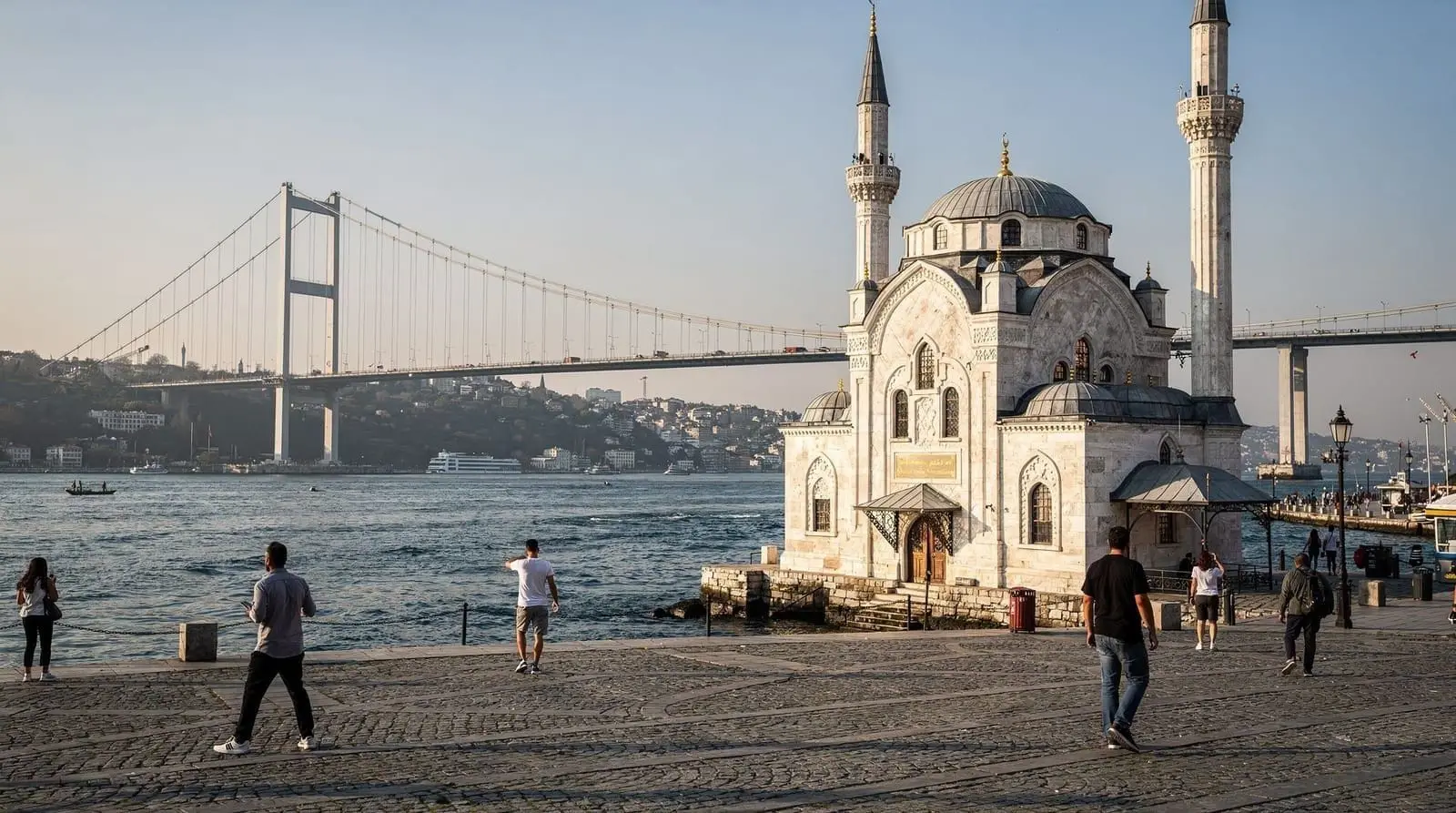
Ortaköy
Bosphorus neighbourhood famous for its mosque beneath the first bridge — waffles, mussel dolma, Sunday market, one of Istanbul's best photographs.
Istanbul: Bosphorus Sightseeing Cruise with Sunset Option
Quick facts
- Location
- European Bosphorus shore, 10 km north of Sultanahmet
- Landmark
- Ortaköy Mosque (Mecidiye Camii, 1854) + Bosphorus Bridge
- Known for
- Waffles, mussel dolma, Sunday market, waterfront square
- Getting there
- Bus 25E/DT2 from Beşiktaş; taxi ~15 min from Taksim
- Weekend crowds
- Very busy Saturday–Sunday, especially afternoons
- Best time
- Weekday morning or late afternoon for the photograph
The photograph and what’s around it
| Where | European Bosphorus shore, ~10 km north of Sultanahmet |
| Cost | Free to visit; kumpir ~150–200 TRY, waffles ~80–120 TRY |
| Time needed | 1–2 hours standalone; half a day with Beşiktaş/Dolmabahçe |
| Getting there | Bus 25E/DT2 from Beşiktaş, or taxi ~15 min from Taksim |
| Best time | Weekday late afternoon for the mosque-and-bridge photo |
Ortaköy is primarily known for one image: the Baroque Mecidiye Camii (Ortaköy Mosque), built in 1854 for Sultan Abdülmecid I, framed against the first Bosphorus Bridge behind it. The composition — white marble Ottoman mosque against the suspension bridge span — appears on postcards, travel magazines, and social media feeds to the point of ubiquity. It is still worth seeing in person, because the scale and the light are things a photograph cannot fully convey. Our Ortaköy mosque guide has the full visiting details for the mosque itself.
Bosphorus sightseeing cruise with sunset option, passing OrtaköyThe best angle is from the waterfront square directly in front of the mosque, shooting slightly westward in late afternoon when the sun catches the mosque’s stone and the bridge’s cables are silhouetted. This is a 5-minute photograph if you arrive at the right time, and a 20-minute wait if you arrive behind a crowd of other photographers.
Around this photograph is a neighbourhood worth spending an hour or two in. The waterfront square has a cluster of café terraces; the streets behind it hold a Sunday flea market (craft items, jewellery, handmade goods — quality varies but browsing is pleasant); and the street food concentration along the main road is dense and reasonably good.
Street food: what to eat in Ortaköy
Ortaköy has two signature foods that are worth the reputation:
Kumpir: the Turkish stuffed baked potato, Ortaköy’s most famous dish. A large potato is baked, the flesh mixed with butter and cheese, then loaded with a selection of toppings — olives, corn, pickles, sauces, various prepared fillings. It is substantial and filling; one kumpir from the stalls along the main street costs approximately 150–200 TRY (4.5–6 USD). Several competing vendors line the same street; the queues generally indicate quality, though differences between the main vendors are marginal.
Midye dolma (mussel stuffed with spiced rice): not unique to Ortaköy but heavily present here. Vendors carry trays of stuffed mussels; you take a mussel, squeeze lemon juice on it, eat it from the shell, and the vendor counts how many you have consumed. Price is approximately 5–8 TRY per mussel. The correct ritual is to use the empty shell from the previous mussel as a scoop for the next one. Note: only eat midye dolma from vendors whose mussels are clearly fresh and from reliable sources. The waterfront vendors in Ortaköy are generally fine; street vendors in back alleys, less so.
Waffle shops: Ortaköy is one of the locations that popularised the Turkish street waffle — a rectangular waffle served with Nutella, banana, fruit, and various toppings. These are everywhere and are exactly what they appear to be: a sweet street food at around 80–120 TRY.
The mosque: a brief look
The Mecidiye Camii is small — seating capacity roughly 300 — and architecturally distinctive for its European Baroque styling. It was designed by Nikoğos Balyan, the same Armenian architect who worked on Dolmabahçe Palace, and the design language is consistent: arched windows, ornate plasterwork, a generally non-Ottoman feeling for a mosque building. It functions as an active mosque; visitors can enter outside prayer times, covering appropriately (shoulders and knees covered; women cover hair).
Entry is free, as with most working mosques in Istanbul. The interior is modest compared to the great imperial mosques of the old city — this is worth a 10-minute visit rather than an extended one.
Getting there
No direct tram or metro line serves Ortaköy. Options from central Istanbul:
- Bus 25E or DT2 from Beşiktaş (approximately 10 minutes, Istanbulkart fare).
- Taxi or rideshare from Taksim: 10–15 minutes, 100–150 TRY.
- On foot from Beşiktaş: 20-minute walk north along the Bosphorus waterfront — a pleasant route.
- By Bosphorus ferry or cruise boat: Ortaköy is a visible stop on most Bosphorus cruise routes; some sightseeing boats pass close to the mosque.
Combining Ortaköy with a broader day
Ortaköy sits between Beşiktaş (15 minutes south) and Bebek (20 minutes north). A logical sequence for a Bosphorus shore day:
- Morning: Dolmabahçe Palace (2–3 hours).
- Lunch: Beşiktaş market area.
- Afternoon: Walk or take a short bus ride north to Ortaköy.
- Late afternoon: photograph of the mosque and bridge at golden hour.
- Evening: Bosphorus sunset cruise departing from Kabataş or Beşiktaş pier.
Frequently asked questions about Ortaköy
Is the Ortaköy market worth visiting?
The Sunday market covers jewellery, ceramics, scarves, handmade goods, and craft items. Quality ranges from genuinely made-in-Turkey craft products to generic souvenirs. Prices are negotiable; the market has a pleasant atmosphere without being overwhelming. Worth an hour on a Sunday morning before the afternoon crowds arrive.
Can I take the Bosphorus ferry directly to Ortaköy?
Public Şehir Hatları ferries do not stop at Ortaköy on regular scheduled routes. Some private sightseeing cruises pass close by. The most practical access is by bus from Beşiktaş or Kabataş.
Is it crowded on weekends?
Yes, significantly. The main waterfront square and the kumpir stalls become very crowded on Saturday and Sunday afternoons from approximately 13:00 onwards. Weekday visits are substantially calmer.
What is midye dolma and is it safe to eat?
Midye dolma is mussels stuffed with spiced rice (usually with currants, pine nuts, cinnamon, and herbs). The filling is cooked; the mussel provides the shell container and adds a briny flavour. The hygiene question is real: mussels are filter feeders and can concentrate pollutants or bacteria. The waterfront vendors in Ortaköy are established businesses that have reputational incentives for quality, and mussels here have a reasonable track record. However, if you have a shellfish sensitivity or are travelling with young children or immune-compromised individuals, skip them. Eat them cold from the shell with a squeeze of lemon juice, not from a reheated batch.
Is the Ortaköy nightlife scene good?
Ortaköy has an after-dark restaurant scene and a few bars, but it is not a nightlife district in the way that Beyoğlu or the Kadıköy Barlar Sokak area are. The waterfront terraces fill up on summer evenings. For proper nightlife — clubs, live music — Taksim and Beyoğlu are more appropriate.
Ortaköy vs Beşiktaş vs Bebek: the Bosphorus shore compared
| Ortaköy | Beşiktaş | Bebek | |
|---|---|---|---|
| Signature sight | Mosque-and-bridge photograph | Dolmabahçe Palace | Upscale waterfront cafés |
| Food | Kumpir, waffles, midye dolma | Fish market, casual eateries | Higher-end restaurants |
| Crowds | Very busy weekends | Moderate, transit hub | Quieter, more residential |
| Best for | The classic photo + street food | Palace visit + market lunch | A calmer waterfront stroll |
These three sit within a single walkable-to-bus stretch of the European Bosphorus shore; see the Beşiktaş neighbourhood guide and the Dolmabahçe Palace visiting guide for pairing them into one day, or the Bosphorus landmarks guide for the fuller shoreline picture.
Ortaköy in historical context
The neighbourhood’s name derives from Ottoman Turkish meaning “middle village” — it was one of several fishing and residential villages along the Bosphorus shore that were absorbed into greater Istanbul as the city expanded. Before the bridges, these Bosphorus communities were relatively self-contained; the ferries connected them to the city centre, but the daily rhythm was that of a fishing and market village.
The Ortaköy mosque (Mecidiye Camii) was commissioned by Sultan Abdülmecid I in 1848 — the same sultan who commissioned Dolmabahçe Palace — and was designed by Nikoğos Balyan, part of the Armenian family of architects who produced many of the mid-19th-century Ottoman buildings in the European style. The mosque’s interior is small but accomplished: high windows, white plasterwork, a central dome over an intimate prayer space. For a mosque designed by a non-Muslim architect in a European aesthetic, it sits comfortably within the Ottoman tradition.
The neighbourhood also has a significant Jewish heritage — one of Istanbul’s older synagogues, the Etz ha-Hayyim synagogue, is in Ortaköy and was an important institution of the Sephardic community before the major emigrations of the 20th century.
The Bosphorus Bridge and its impact on the neighbourhood
The first Bosphorus Bridge (Boğaziçi Köprüsü, now officially the 15 Temmuz Şehitler Köprüsü — the 15 July Martyrs Bridge) was completed in 1973. Its concrete approach roads and anchorages transformed the Ortaköy waterfront irreversibly — the bridge’s European approach cuts directly through what had been residential streets above the mosque. The relationship between the bridge’s engineering infrastructure and the 19th-century mosque below it is what produces the famous photograph, and it is a genuinely odd juxtaposition that was not designed but emerged from the collision of different historical moments.
The bridge was renamed after the July 2016 coup attempt — the bridge was one of the strategic points occupied by elements of the coup forces, and its renaming is part of the memorialisation of the events.
Walking the waterfront north from Ortaköy
North of Ortaköy, the Bosphorus shore continues through Kuruçeşme, Arnavutköy, and eventually Bebek — a string of villages and neighbourhoods where the most expensive waterfront yalı mansions are concentrated. This is a pleasant walk of approximately 45 minutes to Bebek, past expensive restaurants, waterfront cafés, and the gardens of Ottoman-era properties. Bebek itself has a good café strip and a reputation as an upscale neighbourhood; a çay or coffee at a Bebek waterfront café is a reasonable end to a Bosphorus shore afternoon.
From Bebek, buses return to Taksim or Beşiktaş, making a one-way walk practical.
Photography tips for the Ortaköy composition
The standard photograph — mosque in foreground, bridge span in background — has several variables:
Horizontal vs. vertical: a horizontal frame captures the full bridge span and the mosque within the same shot. A vertical frame emphasises the bridge’s height and the mosque’s verticality.
Positioning: from the waterfront square looking slightly westward gives the most direct alignment of mosque and bridge. Moving further east toward the pier gives a different angle where the bridge span stretches more dramatically across the frame.
Light timing: direct afternoon sun from the west illuminates the white marble of the mosque brilliantly from approximately 15:00–17:30 depending on season. Morning light comes from the east and hits the back face of the mosque, making the waterfront square the lit foreground.
Avoiding crowds in the shot: weekday early-morning (before 09:00) or late evening (after 19:30) visits produce empty or near-empty frames. Weekend afternoons are essentially impossible for a crowd-free composition.
The bridge cables: on very clear days, the full cable structure of the bridge span is sharply visible and adds graphic interest to the composition. On hazy summer days, the cables may disappear into the humidity. Winter clear days often give the sharpest results.
Eating beyond kumpir: the actual restaurant scene
The kumpir and waffle stalls are the street-food face of Ortaköy, but the neighbourhood also has a cluster of more substantial restaurants along the waterfront and on the side streets. These range from mid-range fish restaurants (fish is consistently good here; a full fish lunch runs 400–700 TRY / 12–21 USD per person) to the fancier end of the Bosphorus dining spectrum.
House Café, which has an Ortaköy branch, is one of Istanbul’s better casual dining chains — reliable quality, good salads and sandwiches, reasonable prices (200–350 TRY for a main). It handles the tourist overflow from the street food area efficiently.
For a proper Bosphorus-view meal, several restaurants have outdoor terraces on the water’s edge. These are more expensive than the street food options by a significant margin — plan for 800–1,500 TRY per person for a full meal with a drink at a waterfront table — but the setting is distinctive. If you would rather eat while the shoreline slides past, a Bosphorus dinner cruise with a show is an easy alternative to a fixed waterfront table.
The neighbourhood at different times of year
Spring (April–May): arguably the best season for Ortaköy. Mild temperatures, the first outdoor terrace weeks, the Sunday market at full operation, and the crowds not yet at summer intensity. The Bosphorus light is clear and the gardens near the mosque are in bloom.
Summer (June–August): Ortaköy is very popular with Istanbul residents who want a Bosphorus afternoon without going to a beach. The waterfront square, the kumpir stalls, and the Sunday market are at maximum capacity. The water here is not swimmable (Bosphorus currents and traffic make it unsafe); the appeal is the atmosphere and the view rather than the beach activity. Peak heat runs 32–37°C in July; the Bosphorus breeze helps.
Autumn (September–October): quieter than summer, the light is excellent for photography, and the restaurants shift their menus toward heavier autumn dishes. Lüfer (bluefish) comes into season in the Bosphorus in October — a fish that Istanbul chefs regard highly and that is at its best caught locally in autumn.
Winter (November–March): the kumpir and waffle stalls operate year-round. The Sunday market is smaller but present. The main appeal in winter is the atmospheric combination of the mosque silhouette and the bridge cables against a grey winter sky — a very different composition from the summer postcard, and one that fewer visitors make the effort for. The waterfront restaurants tend to be half-empty and actively welcoming.
The Çırağan Palace and the luxury hotel strip
Directly south of Ortaköy (between Ortaköy and Beşiktaş) is Çırağan Palace, a contemporary Ottoman palace from the 1860s built for Sultan Abdülaziz, now operating as the Kempinski hotel. The palace shares a similar trajectory with Dolmabahçe: mid-19th-century Ottoman imperial waterfront construction, European Baroque styling, Bosphorus facade.
The Çırağan Kempinski’s terrace is open to non-guests and is one of Istanbul’s more famous places for tea or a drink with a Bosphorus view. The prices are hotel-luxury level (tea at 200–300 TRY; a cocktail at 600–900 TRY), but the setting — marble terrace directly on the Bosphorus, the water a few metres away — is difficult to replicate without staying at the property. Worth knowing about for a special occasion.
Between Ortaköy and Çırağan there is also the Swissôtel Istanbul, another major waterfront property with several restaurants and bars that are open to non-guests. The competition between these adjacent luxury properties benefits the non-staying visitor — bar and terrace quality at this level is generally high.
The artisan market in more depth
The Ortaköy Sunday market is smaller than Istanbul’s major flea markets (Çukurcuma in Beyoğlu, the Kadıköy flea market) and is specifically focused on craft goods and handmade jewellery. The vendors are predominantly independent craft makers rather than resellers of mass-produced goods.
Things to look for: silver jewellery made in Turkey (there are several vendors doing local designs rather than imported pieces), handmade ceramics from Kütahya and İznik traditions, hand-embroidered textiles, and leather goods from Turkish manufacturers. The quality range is wide; browsing and comparing before buying is sensible.
Bargaining culture: in this market, modest bargaining (offering 10–15% less than the asking price) is normal for larger purchases. Vendors generally have a floor price and will indicate when you’ve reached it. Aggressive bargaining of the Grand Bazaar sort is less common and less expected here.
Can I see Ortaköy as part of a Bosphorus cruise?
Yes — most sightseeing and sunset cruises departing from Kabataş or Beşiktaş pass close to Ortaköy and the bridge, giving a water-level view of the same composition. See the best Bosphorus cruise guide and which Bosphorus cruise to choose for picking the right one, or the Bosphorus by public ferry guide for a cheaper self-guided version.
Where Ortaköy fits in a longer Istanbul stay
Ortaköy works best as a relaxed counterpoint to the dense sightseeing of the old city. If you are still deciding how to split your days, the Istanbul neighbourhoods overview shows how the Bosphorus shore differs from Sultanahmet, and the European vs Asian side guide helps you decide whether to cross the water at all. Travellers on a short visit can slot it into the Istanbul in 2 days or Istanbul in 3 days plans as a late-afternoon stop.
For the wider picture of the strait itself, the Bosphorus page covers the full shoreline, and the best views in Istanbul guide places the Ortaköy frame among the city’s other great vantage points. If the photograph is your main goal, the most Instagrammable spots in Istanbul guide lists other places worth pairing with it, and getting around Istanbul explains the buses and Istanbulkart fares you will use to reach the shore.
Top experiences
Bookable activities with verified prices and instant confirmation on GetYourGuide.
