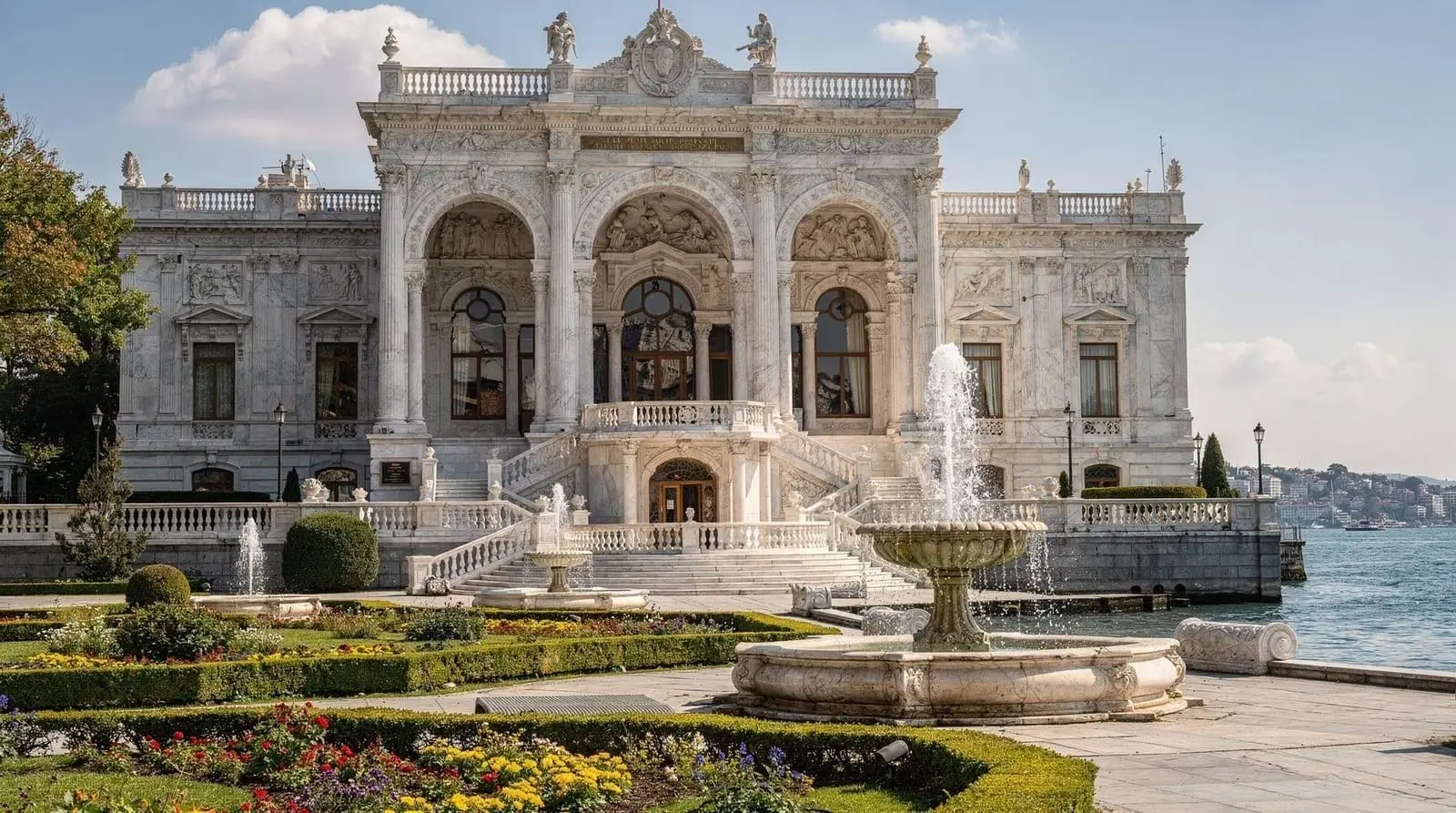
Dolmabahçe Palace
Ottoman Empire's 19th-century European-style palace on the Bosphorus — 285 rooms, 14 tonnes of gold leaf, and where Atatürk died in 1938. Book ahead.
Istanbul: Dolmabahce Palace and Harem Skip-the-Line Ticket
Quick facts
- Built
- 1843–1856 by Sultan Abdülmecid I
- Rooms
- 285 rooms, 44 halls, 6 hammams, 68 toilets
- Opening hours
- Tue–Sun 09:00–17:00 (closed Mon)
- Entry fee (2025)
- ≈ 1,500 TRY (~44 USD / 40 EUR) for main palace + Harem
- Nearest transport
- Kabataş tram (T1) — 10-min walk; ferry from Karaköy
- Compulsory guide
- Guided tours only — independent roaming not permitted inside
What Dolmabahçe actually is — and how it differs from Topkapı
| Where | Bosphorus waterfront, near Beşiktaş |
| Cost | ~1,500 TRY (~44 USD) for palace + Harem combined |
| Time needed | 2–3 hours for both sections |
| Getting there | Kabataş tram (T1), 10-min walk south |
| Best time | Weekday mornings; closed Mondays |
Dolmabahçe Palace (Dolmabahçe Sarayı) was built between 1843 and 1856 as a deliberate statement of Ottoman modernity. Sultan Abdülmecid I commissioned French architect Nikoğos Balyan and his family to design a palace that would signal to European powers that the Ottoman Empire was a contemporary state, not a medieval holdout. The result is an enormous waterfront structure that draws on Baroque, Rococo, and Neoclassical European styles — a direct architectural rejection of the traditional Ottoman courtyard arrangement of Topkapı Palace.
The contrast between the two palaces is significant and worth noting for visitors planning to see both. Topkapı is a warren of smaller pavilions and courtyards accumulated over 400 years, with Islamic decorative vocabulary dominant. Dolmabahçe is a single overwhelming building — 600 metres of Bosphorus facade, 285 rooms and 44 halls — designed as a coherent European palace in one construction project. Both are worth visiting; they represent different centuries and different political imaginations of what the Ottoman state should look like.
The practical point: Dolmabahçe is significantly more expensive than Topkapı and requires a guided tour (no independent roaming is permitted inside). Tours run continuously; you join a group at the entrance and move through at the guide’s pace.
The interior: what to actually see
The Ceremonial Hall (Muayede Salonu) is the centrepiece — a 2,000-square-metre ballroom with the largest ceiling chandelier in the world (weighing 4.5 tonnes, a gift from Queen Victoria). Fourteen tonnes of gold leaf were used in the decoration of the palace, and this room holds the highest concentration. It is genuinely stunning in an unabashed way.
The Harem section requires a separate ticket or a combined ticket at entry. The Harem at Dolmabahçe housed the sultan’s household and operates on a different tour circuit from the main palace (Selamlık). Book both together if you plan to see them — a combined skip-the-line ticket is the most time-efficient option.
Atatürk’s bedroom: the founder of the Turkish Republic died in Dolmabahçe Palace on 10 November 1938, in a room that has been preserved as close to its 1938 state as possible. All clocks in the palace are stopped at 09:05, the time of his death, as a mark of respect. This practice continues; it creates an unusual atmosphere throughout the building. The bedroom is a genuine and moving moment within what can otherwise feel like an overwhelming procession of decorative excess.
The Bosphorus gate and gardens: the main ceremonial gate facing the Bosphorus is one of Istanbul’s most photographed architectural details — a white marble gateway in full Baroque style that opens directly onto the water. The gardens between the palace and the water are publicly accessible and free to enter; many visitors walk the garden without paying palace entry, which gives at least the exterior scale.
Book skip-the-line entry for the palace and Harem — queues at the entrance can run 45–60 minutes in summer. Pre-booked tickets allow you to proceed directly to the guided tour staging area.
Practical logistics: getting there and what it costs
By tram: T1 tram to Kabataş (end of line), then a 10-minute walk south along the Bosphorus to the palace gate. This is the cheapest and most reliable option.
By ferry: Bosphorus ferries stop at Dolmabahçe pier (on some routes); check current IDO/BUDO timetables, as service frequency varies.
By taxi: straightforward from Taksim (10–15 min, 100–200 TRY) or Sultanahmet (20–30 min, 200–350 TRY depending on traffic).
Entry fees (2025 prices — verify on-site as TRY inflation makes these volatile): Main palace (Selamlık) approximately 900 TRY; Harem approximately 700 TRY; combined approximately 1,500 TRY (around 44 USD / 40 EUR at mid-2025 rates). The palace is closed Mondays.
Duration: the guided tour of the main palace takes approximately 1–1.5 hours. The Harem tour is separate and roughly the same length. Budget 3 hours total if you plan to see both sections.
Is it worth the entry fee?
The honest answer is yes — if you have any interest in 19th-century Ottoman history, architectural excess, or the transitional period from empire to republic. The Ceremonial Hall alone justifies the ticket for most visitors. The Atatürk association adds genuine historical weight.
If you are on a tight budget, Topkapı Palace offers more history per lira and is arguably more representative of the long arc of Ottoman civilisation. If you are choosing between the two, Topkapı has the older and more distinctive Ottoman material; Dolmabahçe is the more spectacular single room.
Visitors who find excessive decorative opulence numbing should set their expectations accordingly — the palace is not subtle.
| Dolmabahçe Palace | Topkapı Palace | |
|---|---|---|
| Period | 1850s, single construction | 15th–19th century, accumulated |
| Style | European Baroque/Rococo/Neoclassical | Traditional Ottoman pavilions |
| Guided access | Compulsory guided tour | Independent roaming permitted |
| Cost | Higher | Lower, more history per lira |
| Standout feature | Ceremonial Hall chandelier | Harem, Topkapı treasury |
What to skip if you’re combining both palaces in one day
Seeing both Dolmabahçe and Topkapı on the same day is feasible but genuinely tiring, given Topkapı’s scale and Dolmabahçe’s compulsory guided pacing. If you have to trim, skip the Yıldız Palace complex and Çırağan Palace terrace visit for another day — they’re worthwhile but not essential alongside two full imperial palace visits. Prioritise Topkapı’s Harem and Treasury in the morning when energy is highest, then take the Dolmabahçe guided tour in the afternoon, when its fixed pace and shorter overall duration suit lower energy levels better than Topkapı’s sprawling, self-paced layout would. If you do plan both palaces in one day, a combined Topkapı and Dolmabahçe ticket keeps the entry arrangements in one booking.
Combining Dolmabahçe with nearby sites
Beşiktaş: the neighbourhood directly behind the palace is one of Istanbul’s most pleasant residential areas, with a twice-weekly street market (pazarı) and several good lokanta restaurants. The Beşiktaş ferry pier connects to Kadıköy and Üsküdar on the Asian shore.
Galata Tower: a combined Dolmabahçe + Galata Tower ticket is available and covers both sites in a single day efficiently. The two sites are about 25 minutes apart by taxi or ferry + walk.
Çırağan Palace: immediately north of Dolmabahçe along the Bosphorus is Çırağan Palace, a contemporary Ottoman palace from the 1860s now operating as the Kempinski hotel. The hotel is open to non-guests for afternoon tea or a drink at the waterfront terrace, which has one of Istanbul’s best Bosphorus views.
Yıldız Palace complex: up the hill behind Beşiktaş is Yıldız Palace, a more intimate Ottoman imperial residence with landscaped gardens open to the public. Quieter and less visited than Dolmabahçe; good for a contrast to the overwhelming scale of the main palace.
Frequently asked questions about Dolmabahçe Palace
Can I visit without a guide?
No. The palace operates only on guided tours, and independent movement through the interior rooms is not permitted. You join a timed tour group at the entrance. Tours operate in Turkish with some English-language groups available; ask at the ticket office or pre-book an English-language option.
How long should I allow?
The Selamlık (main palace) tour takes approximately 75 minutes. The Harem tour is similar in length. If you plan to visit both, allow 3 hours including queuing, garden time, and the walk between tour staging areas.
Is the palace really closed on Mondays?
Yes, Dolmabahçe is closed on Mondays (a common closure day for Istanbul’s state-run museums and palaces). Tuesday through Sunday, opening hours are 09:00–17:00 (last admission around 15:30 — check on arrival as this varies seasonally).
Why are the clocks stopped at 09:05?
Atatürk died in the palace on 10 November 1938 at 09:05. All clocks in the palace have been stopped at this time as an ongoing mark of respect. This practice is maintained and applies throughout the building.
Is it accessible for visitors with mobility limitations?
Partially. The ground-floor sections of the Selamlık are accessible via ramps for wheelchair users. The upper floors and parts of the Harem section involve stairs. Contact the palace directly for current accessibility arrangements.
How does Dolmabahçe compare to Topkapı?
The two palaces represent entirely different Ottoman periods and aesthetic philosophies. Topkapı (15th–19th century) is an accumulation of traditional Ottoman architecture, tile work, and Islamic art. Dolmabahçe (1850s) is a single European-style palace designed to project modernisation. If you have time for only one, Topkapı has broader historical scope; Dolmabahçe has more theatrical spectacle in a single building.
The politics of the palace’s construction
Understanding why Dolmabahçe was built requires some context. By the 1840s the Ottoman Empire was in a period of acute external pressure and internal reform. The Tanzimat reforms (beginning 1839) were attempting to modernise the empire’s legal and administrative systems along European lines; European powers were simultaneously treating the empire as a client state to be managed and a market to be exploited. Building a palace that visually echoed Versailles, Schönbrunn, or Buckingham Palace was not simply an exercise in imperial vanity — it was a diplomatic signal that the Ottoman court was a peer of European royal courts, entitled to be treated as an equal.
The irony is that the construction of the palace, which cost approximately 5 million Ottoman liras (an enormous sum financed largely by debt to European banks), accelerated the financial crisis that would eventually lead to the Ottoman default of 1876. The very modernity the palace was meant to signal was purchased at terms that deepened Ottoman financial dependency on the European powers it was trying to impress.
The Harem: what it actually was
The word “harem” (from Arabic harim, meaning “forbidden” or “sanctuary”) describes the private residential quarters of the Ottoman imperial household — the sections of the palace restricted to the sultan, his household, and authorised servants and eunuchs. It was not primarily a space of concubines, though the popular imagination has long reduced it to that.
In practice, the Harem at Dolmabahçe housed the sultan’s mother (Valide Sultan — the most powerful position in the Harem hierarchy), his wives (kadın efendiler, of whom he could have up to four), the concubines (who were typically of slave origin but could advance in rank through education, skill, and favour), and the servants and eunuchs who managed the household. The Valide Sultan had her own suite of rooms, her own staff, and substantial political influence — several Valide Sultans exercised effective regency during the reigns of young or incompetent sultans.
The Harem section at Dolmabahçe is architecturally similar to the Selamlık (public section) but feels more residential and intimate. It is worth visiting specifically for this domesticity — the contrast between the state apartments and the Harem apartments reveals how the imperial household managed the tension between ceremonial public function and private life.
Atatürk’s presidency and the palace
After the abolition of the Ottoman sultanate (1922) and the establishment of the Turkish Republic (1923), Dolmabahçe Palace had an uncertain future — it was an imperial institution in a republic that had deliberately broken with imperial symbols. Atatürk, pragmatically, used the palace as his Istanbul residence when visiting the city. The room where he died (Room 71, or the “Atatürk Room”) has been preserved in detail. His personal effects — reading glasses, a clock, his uniform — are displayed; the clock in his room was stopped at 09:05 and has never been restarted.
The practice of stopping all clocks in the palace is not merely a sentimental gesture; it is a state decision reaffirmed by each subsequent administration. The palace’s curatorial management is handled by the National Palaces Administration (Milli Saraylar), which oversees all Ottoman imperial properties in Turkey. This institutional continuity from the Ottoman imperial household to the modern Turkish state is one of the more unusual aspects of Turkish historical management.
What to eat and where to stay near Dolmabahçe
Eating near the palace: the Beşiktaş neighbourhood directly behind the palace has the best nearby eating options. The Çarşı area (10-minute walk from the main palace gate) has fish restaurants, meyhane venues, and standard lokanta options at local prices. Avoid the tourist-facing restaurants on the main boulevard immediately in front of the palace, which charge palace-proximity premium for undistinguished food.
Coffee and tea: the tea garden in Maçka Park (the park running uphill behind Dolmabahçe toward Nişantaşı) is a pleasant stop after the palace visit — tea at local prices in a genuinely pleasant setting.
Hotels near the palace: the Çırağan Palace Kempinski (the former Ottoman palace immediately north, now a luxury hotel) is the closest luxury option and has one of Istanbul’s best Bosphorus waterfront terraces. The price point is significant (rooms starting around 5,000 TRY per night), but the terrace bar is open to non-guests at standard luxury hotel drink prices (400–600 TRY for a cocktail).
What the palace reveals about the 19th-century Ottoman Empire
Visiting Dolmabahçe after Topkapı Palace makes the history readable in the architecture. Topkapı represents the Ottoman Empire at its confident peak — the world’s largest Muslim empire in the 16th century, with no need to justify itself to outside powers. The palace’s form (pavilions distributed through a garden complex, not a unified European facade) reflects an internal logic rather than an external audience.
Dolmabahçe represents the Ottoman Empire in a position of acute anxiety — smaller territorially, militarily weaker than European powers, economically dependent on foreign capital, and politically pressured by European interference. The palace’s European aesthetic is a direct response to that position: a statement of equivalence (“we are a modern European-style court”) that simultaneously acknowledges the terms of comparison that the European powers had set.
This is not a small or incidental observation. The tension between Ottoman tradition and European modernisation — summarised architecturally in the contrast between these two palaces — runs through the entire 19th and early 20th centuries and eventually produces the Kemalist revolution: the decision to abandon the imperial-Ottoman framework entirely and rebuild Turkey as a secular, Westernised republic. Dolmabahçe is, in this reading, a way-station on the road from Topkapı to Ankara.
The Balyan architectural dynasty
The Balyan family of Armenian architects were the primary designers of Ottoman public buildings in the 19th century — not just Dolmabahçe, but also Çırağan Palace, the Ortaköy mosque, and numerous other waterfront buildings that define the Bosphorus shore’s visual character. Nikoğos Balyan (the primary architect of Dolmabahçe) worked with his father Karabet and later with brothers and sons in a multi-generational practice that effectively maintained a near-monopoly on Ottoman state architectural commissions from the 1820s through the 1870s.
The Baly family’s work is a striking instance of Ottoman institutional flexibility: an Armenian Christian family, with European architectural training (Nikoğos studied in Paris), designing the buildings through which the Muslim Ottoman court expressed its identity and ambitions. The buildings reflect their training (Baroque, Rococo, Neoclassical European styles) as much as any specifically Ottoman tradition. This cultural hybridity — European aesthetic vocabulary in service of Ottoman state purposes, designed by Armenian craftsmen — is one of the most interesting aspects of the period’s architecture.
Planning the visit: what to prioritise if time is short
If you have limited time (under 2 hours):
Must see: the Ceremonial Hall (Muayede Salonu) with the 4.5-tonne Bohemian crystal chandelier — this is the palace’s centrepiece and justifies the ticket price on its own. Allow 30–45 minutes in the Selamlık tour to reach it and appreciate it properly.
Worth adding if you have time: Atatürk’s bedroom (Room 71) — the stopped clocks, the preserved personal effects, and the institutional memory of the space are genuinely moving. The Harem section adds the domestic scale that contrasts with the ceremonial areas.
Can skip if pressed: the garden area and the exterior waterfront walk can be done before or after the main tour without additional cost; the formal guided tour covers the most significant interior spaces.
If you are visiting both Dolmabahçe and Topkapı in the same day — which is feasible but tiring — start with Topkapı in the morning (it requires more time due to its complexity and scale) and do Dolmabahçe in the afternoon. The contrast between the two is much sharper after experiencing them in sequence.
The waterfront gate: what to look for
The main ceremonial gate facing the Bosphorus (Saltanat Kapısı — the “Gate of the Sultanate”) is one of the most elaborate pieces of Ottoman Baroque decorative work in Istanbul. The gate is white marble with extensive carved gilding, large urns, and an overall exuberance that is designed to be seen from the water — arriving by boat and approaching through this gate was the ceremonially correct entry for foreign dignitaries. The current main public entrance is from the land side; to see the waterfront gate as it was intended to be seen, you need to approach from the Bosphorus, either on a Bosphorus cruise or on the ferry to Kabataş/Dolmabahçe pier.
The gardens between the gate and the waterfront are publicly accessible without an admission ticket and include a formal garden layout with fountains and clipped hedges. Walking the garden and viewing the palace facade from the waterfront gives the exterior scale without requiring the paid interior tour.
Where Dolmabahçe fits in a wider Istanbul plan
Dolmabahçe sits on the European shore, away from the cluster of monuments in Sultanahmet, so it rewards a day of its own or a half-day paired with the neighbourhoods around it. If you are still deciding how to shape your days, the Dolmabahçe Palace visiting guide goes into the practical side of the tour, and the Istanbul in 3 days itinerary shows one way to slot the palace between the old city and the Bosphorus.
The palace also pairs naturally with the waterfront districts nearby. Beşiktaş is the obvious neighbour for lunch and a ferry connection, while Ortaköy is a pleasant continuation along the shore once the tour is over. Taking the water route between them gives you the palace facade from the Bosphorus itself, which is how the building was designed to be seen.
For a broader sense of how the palace compares with the other imperial buildings of the city, the Ottoman Istanbul guide and the palaces and mosques overview in the best mosques guide help place Dolmabahçe in the longer story. Readers who like architecture will also enjoy the Istanbul architecture guide, which traces how European styles reached the Ottoman capital.
Top experiences
Bookable activities with verified prices and instant confirmation on GetYourGuide.

