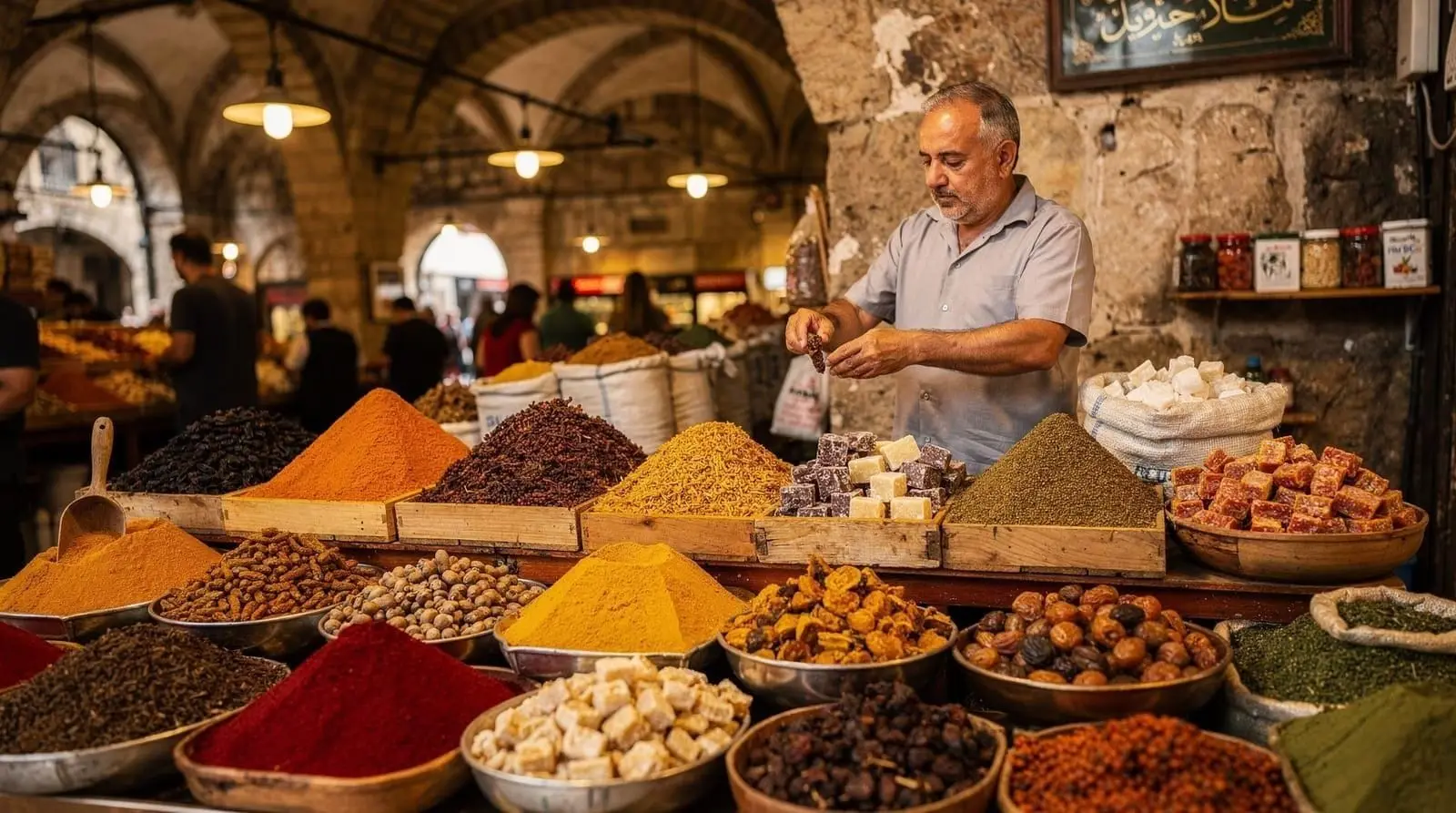
Spice Bazaar — Istanbul's Egyptian Bazaar guide
Visit Istanbul's Spice Bazaar (Mısır Çarşısı) — what to buy, honest pricing, how to combine it with a Bosphorus cruise, and what to skip.
Istanbul: Morning Bosphorus Cruise and Spice Bazaar Tour
Quick facts
- Other name
- Egyptian Bazaar (Mısır Çarşısı)
- Hours
- Mon–Sat 8am–7:30pm, Sun 9am–7pm
- Entry
- Free
- Getting here
- Tram T1 to Eminönü stop
- Best time
- Weekday mornings before 11am
The bazaar that actually smells like what it sells
The Spice Bazaar (Mısır Çarşısı, or Egyptian Bazaar) is smaller and more focused than the Grand Bazaar — an L-shaped covered market near Eminönü, originally built as part of the New Mosque complex in the 1660s. The rents from its shops were intended to fund the mosque’s upkeep, which is why it’s attached to the mosque’s outer wall.
The name “Egyptian Bazaar” comes from its historical role as the terminus for spice shipments arriving from Egypt via the Ottoman trade routes. By the 18th and 19th centuries, the spice trade had shifted and the bazaar diversified into general goods, but the name and the orientation toward food, spices, and natural products survived.
Today the Spice Bazaar has around 85 shops inside its two main covered halls, plus an outdoor area (Tahtakale) extending around and behind it. It’s genuinely food-focused: sacks of dried spices, towers of Turkish delight, hanging dried figs and apricots, teas, coffee, salep, and various herbal preparations.
| Where | Mısır Çarşısı, Eminönü, next to the New Mosque |
| Cost to enter | Free — it’s a working market, not a ticketed sight |
| Time needed | Around 30–60 minutes, longer if combined with Eminönü’s street food |
| Getting there | Tram T1 to Eminönü, or a 10–15 min walk from Sultanahmet |
| Best time | Weekday mornings before 11am, before tour groups arrive |
What to buy and what prices are honest
Spices: The Bazaar sells every spice used in Turkish cooking — sumac, isot pepper, red pepper flakes (pul biber), cumin, coriander, saffron, za’atar mixes, baharat blends. Saffron deserves a special mention: genuine saffron is expensive (genuine Iranian or Turkish saffron runs 15,000–25,000 TRY per 100g at mid-2026 prices). Any saffron priced dramatically lower is likely adulterated with safflower or turmeric. Ask to smell it — real saffron has a distinct metallic, slightly sweet aroma.
Turkish delight (lokum): Several shops in the Bazaar specialize in lokum. The better ones sell from large trays by weight, with visible labels of ingredients. Look for rose water lokum (gül), pistachio (fıstıklı), or pomegranate varieties. Prices run approximately 300–800 TRY per kg (~9–23 USD). Avoid pre-boxed “tourist delight” in cellophane boxes at the front of the shop — it’s typically lower quality and overpriced.
Teas and herbal preparations: Turkey has a strong tradition of herbal teas (linden/ihlamur, chamomile/papatya, sage/adaçayı, rosehip/kuşburnu). The Bazaar sells these by weight or in decorative tins. Fair prices are about 100–300 TRY for 100g of quality dried herbs.
Dried fruits: Figs (incir), apricots (kayısı), dates, and mulberries from the Aegean and Anatolian regions. These are genuinely good and much cheaper than in Western supermarkets.
Coffee: Turkish coffee is sold by weight in the Bazaar. The Kurukahveci Mehmed Efendi shop, just outside the main Spice Bazaar entrance on the corner near the Galata Bridge approach, has been selling freshly ground Turkish coffee since 1871 — the queue is usually long but moves quickly, and the coffee is the best price-to-quality option in the area.
A fair-price cheat sheet
Prices swing wildly between the busiest stalls near the entrance (aimed at tour groups) and the shops one or two rows back. This is roughly what mid-2026 fair value looks like for the things most visitors actually buy:
| Item | Fair price (mid-2026) | Red flag |
|---|---|---|
| Pul biber / dried spices | 150–350 TRY per 100g | Unlabelled “mystery spice” mixes with no ingredient list |
| Turkish delight (loose, by weight) | 300–800 TRY per kg | Pre-boxed cellophane “tourist” trays at the front of the shop |
| Genuine saffron | 15,000–25,000 TRY per 100g | Bright-red saffron under 2,000 TRY per 100g |
| Dried figs / apricots | 250–450 TRY per kg | Vendors who won’t let you taste or smell before buying |
| Turkish coffee (fresh-ground) | 100–250 TRY per 100–250g | Pre-ground “instant” tins marketed as artisanal |
| Herbal teas (linden, sage, rosehip) | 100–300 TRY per 100g | Loose “miracle cure” blends with vague health claims |
Treat any price far below this range as a quality warning, not a bargain — it usually means adulterated saffron, filler-heavy spice blends, or stale stock repackaged for tourists. For a deeper primer on haggling tactics that actually work in Istanbul’s markets, see the bargaining in the bazaar guide.
The outdoor areas: where locals actually shop
The streets around the Spice Bazaar — the Tahtakale district extending west — have several blocks of wholesale and retail shops selling kitchen equipment, bulk spices, dried goods, and general supplies. These are primarily for local wholesale buyers, not tourists, but you can browse. Prices are lower than inside the Bazaar. Navigation is less organized.
The Balık Pazarı (fish market) alley runs alongside the exterior on the Eminönü side — fresh fish stalls, a few meyhanes (taverns), and cafés. The balık ekmek (fish sandwich boats) moored at the quay just outside serve grilled mackerel in bread, arguably the best cheap lunch in Istanbul at approximately 80–120 TRY (~2.50–3.50 USD as of mid-2026).
Combining the Spice Bazaar with nearby attractions
Eminönü and the Bosphorus ferries: The Spice Bazaar is 2 minutes’ walk from the Eminönü ferry terminal, where public and tourist ferries depart to Kadıköy, Üsküdar, the Princes’ Islands, and on Bosphorus sightseeing routes. After the Bazaar, a ferry ride is the natural complement.
Grand Bazaar: A 10–15 minute walk west (or one T1 tram stop). The two bazaars are usually visited in the same half-day outing. If you have limited time, the Spice Bazaar is the more manageable and focused of the two.
New Mosque (Yeni Cami): Immediately adjacent to the Spice Bazaar — the mosque that the Bazaar was originally built to fund. Free entry. Worth a 10-minute look inside; the interior has good Iznik tile work and is far less crowded than the Blue Mosque.
Galata Bridge: Walk across to Karaköy and then uphill to Galata Tower — a natural extension of an Eminönü morning.
Practical tips
Crowds: The Spice Bazaar is significantly less overwhelming than the Grand Bazaar. Even on busy days, the two main halls are navigable without feeling trapped. The outdoor Tahtakale area gets busy on Saturday mornings when local shoppers arrive.
Negotiating: Less expected here than at the Grand Bazaar. Many shops have visible price lists for standard items. You can try for a small discount on larger purchases (say, a 10% reduction on a big spice order), but aggressive bargaining is less the norm.
Packaging: Most dry goods can be vacuum-packed or bagged for travel. Ask explicitly if the shop can pack for airline transport — most can.
Fake saffron warning: The saffron scam is real. Bright-red “saffron” at implausibly low prices (under 2,000 TRY per 100g) is almost certainly adulterated. Buy from shops that let you examine and smell the product.
Dietary labeling: Turkish delight often contains gelatin (from animal sources); if vegetarian or vegan, ask — some shops make gelatin-free versions.
The honest assessment
The Spice Bazaar is worth visiting for an hour. It’s more manageable, more genuine in its food focus, and less aggressively tourist-facing than the Grand Bazaar. The smells alone make the walk through worthwhile. The best purchases are practical ones (spices, teas, dried fruit) rather than gift-shop items.
If you’re visiting both bazaars in the same day, do the Spice Bazaar first (morning, when it’s less crowded), eat a balık ekmek at the quay, then walk or tram to the Grand Bazaar.
For a deeper tour of Istanbul’s food markets and street food culture — including the bazaars and the food stalls of the Asian side — the food walking tours available via GYG cover territory that self-guided visits tend to miss. See the food and drink guide.
The food scene around Eminönü
The Eminönü waterfront around the Spice Bazaar is one of Istanbul’s most concentrated food areas — street food, wholesale grocers, specialty shops, and tea houses within a few hundred meters.
Balık ekmek (fish sandwich boats): Moored at the Eminönü quay, these floating grills have been there since the 1960s. Grilled mackerel (or other fish, depending on the season), lettuce, onion, and tomato in bread. Approximately 80–120 TRY as of mid-2026. Genuinely good, and among the most iconic street food experiences in Istanbul. Eat standing at the railings by the water.
Eminönü street food cluster: The area behind the Galata Bridge approach has vendors selling corn on the cob, roasted chestnuts (kestane — in autumn and winter), midye dolma (stuffed mussels, eaten on the street from the vendor’s tray — the vendor squeezes lemon, you eat from the shell), and various baked goods.
Pandeli Restaurant: Upstairs above the main gate of the Spice Bazaar, accessed via an exterior staircase. Operating since 1901, it’s one of Istanbul’s oldest continuously operating restaurants, serving traditional Ottoman-influenced Turkish food in a blue-tiled dining room. Tourist-facing but legitimate; lunch main courses approximately 400–700 TRY. Famous for being the restaurant where Atatürk occasionally ate.
Kurukahveci Mehmed Efendi: Just outside the Spice Bazaar entrance on the corner, this coffee shop has been grinding and selling Turkish coffee since 1871. The queue is always long; it moves fast. Buy freshly ground coffee (roasted to order) in 100g or 250g bags for approximately 100–250 TRY. The best-value coffee purchase in the city.
The tea houses of Tahtakale: In the lanes behind the Spice Bazaar, several tea houses serve the local wholesale traders — very simple, inexpensive, serving only çay and perhaps some pastries. These see almost no tourists and offer the cheapest çay in the area.
The New Mosque (Yeni Cami)
The Spice Bazaar is structurally part of the New Mosque complex — the market arcade was built to generate rental income for the mosque’s upkeep. The mosque itself (officially the New Queen Mother Sultan Mosque, Yeni Valide Sultan Camii) was completed in 1665.
Entry is free. The interior has good Iznik tile work — considered by some scholars to be among the better post-17th-century Ottoman tile installations in Istanbul — and an attractive courtyard. It’s far less crowded than the Blue Mosque despite being architecturally comparable in several respects.
If you’re visiting the Spice Bazaar and the mosque is between prayer closures, step inside for 15 minutes. The tile panels in the mihrab area in particular reward attention.
The Golden Horn and the Galata Bridge
From the Spice Bazaar, the Golden Horn — the inlet that separates the historic peninsula from Beyoğlu — is visible and crossable via the Galata Bridge, a 5-minute walk west.
The Galata Bridge has two levels: the upper level carries car and tram traffic (and pedestrian walkways); the lower level is lined with restaurants facing the water — tourist-facing and somewhat overpriced, but useful if the weather is good and you want a seated meal with a Golden Horn view. The restaurants serve standard Turkish food (fish dishes, meze) for approximately 400–800 TRY per person.
The bridge is a constant gathering point for fishermen dangling lines from the upper pedestrian walkway into the Golden Horn — at any time of day, regardless of whether they catch anything. The ritual persistence is photogenic.
Crossing the bridge on foot takes 10 minutes and puts you in Karaköy — the entry point to the Beyoğlu district, the Galata Tower, and the modern city north of the old peninsula.
Connecting to the Bosphorus
The Eminönü ferry terminal, immediately west of the Spice Bazaar, is the departure point for multiple ferry routes:
- Kadıköy: Every 20–30 minutes, 25-minute crossing, approximately 30 TRY with Istanbulkart
- Üsküdar: Every 15–20 minutes, 20-minute crossing
- Bosphorus public ferry to Anadolu Kavağı: Morning departures, approximately 90 minutes each way, the cheapest Bosphorus panoramic experience
- Princes’ Islands: Seasonal ferries from nearby Kabataş terminal (accessible by T1 tram)
A natural extension of a Spice Bazaar morning is taking a ferry to Kadıköy for lunch and the Asian side food market, returning in the afternoon. Round trip costs approximately 60 TRY with Istanbulkart.
For a dedicated Bosphorus tour, guided cruises depart from Eminönü — see the Bosphorus guide.
Turkish food culture and what the Spice Bazaar represents
The Spice Bazaar reflects a genuine dimension of Turkish food culture — the tradition of buying fresh spices, dried goods, and prepared foods from specialist shops rather than supermarkets. In Istanbul’s residential neighborhoods, small spice shops (aktarlar) still operate on this model, selling herbs, spices, and dried goods to locals who come weekly.
The aktarlar tradition isn’t just culinary — dried herbs are used medicinally in Turkish folk tradition. Linden flower (ihlamur) for colds, sage (adaçayı) for digestion, rose hips (kuşburnu) for vitamin C. A significant portion of the Spice Bazaar’s tea and herb trade serves buyers who use these preparations as home remedies rather than beverages.
Turkish cooking relies on specific spice profiles worth understanding:
- Sumac: Bright, lemony, used on salads, meat dishes, and bread
- Pul biber (Urfa/Aleppo pepper): Mild-to-medium heat, slightly oily, a substitute for red pepper flakes that has more flavor complexity
- İsot biber (Urfa pepper): Dark purple, smoky-sweet, mild — a very different flavor from the bright red varieties
- Baharat: A blended spice mix (varies by region and maker) used in meat dishes and rice
- Mahlep: Cherry kernel, used in pastries and breads
Buying a small selection of these to use at home is among the most useful and least touristy purchases available in Istanbul.
Practical packing and transport notes
Spice purchases travel well:
- Dried spices in sealed bags or tins are safe in checked luggage (no liquid restrictions apply)
- Turkish delight can be packed in carry-on luggage; standard box sizes fit easily
- Dried herbs in small bags are light and compact
EU customs rules allow up to 2kg of spices and dried herbs per person imported without issue. Check your home country’s import rules for food products, particularly regarding fresh vs. dried goods.
Vacuum packing: Most Spice Bazaar shops can vacuum-seal spice purchases on request — this preserves freshness and prevents spillage. Ask at the counter.
A realistic half-day plan around the bazaar
For visitors who want more than a quick walk-through, the Spice Bazaar anchors a genuinely enjoyable half-day loop rather than a standalone 30-minute stop.
9:00–9:45 — Arrive before the tour groups, browse the two covered halls for spices, tea, and lokum while stall-holders are still setting up and have time to talk.
9:45–10:15 — Step into the New Mosque courtyard next door for a quiet look at the tile work, then queue briefly at Kurukahveci Mehmed Efendi for fresh-ground coffee.
10:15–11:00 — Walk the Balık Pazarı alley and eat a balık ekmek at the quay, or continue to the Grand Bazaar for a broader shopping stop if that’s the day’s priority.
11:00 onward — Either take a Bosphorus-bound ferry from Eminönü, or cross the Galata Bridge on foot to Karaköy and up to the Galata Tower. Either extension turns a 30-minute market visit into a full, food-and-view-led Istanbul morning. For a broader sense of how this fits a first Istanbul itinerary, see the Istanbul in one day guide.
Frequently asked questions about the Spice Bazaar
What is the difference between the Spice Bazaar and the Grand Bazaar?
The Grand Bazaar has ~4,000 shops and is primarily a general retail market for clothing, jewelry, ceramics, and souvenirs. The Spice Bazaar (Mısır Çarşısı) has about 85 shops and specializes in food: spices, dried fruits, teas, Turkish delight, and herbal goods. The Spice Bazaar is smaller, more focused, and easier to navigate.
Is the Spice Bazaar free to enter?
Yes. No ticket required. It’s an active commercial market.
What is the best thing to buy in the Spice Bazaar?
Practically: sumac, pul biber (red pepper flakes), cumin, Turkish coffee, dried figs and apricots, and rose water lokum. These are good quality, pack well, and represent genuine value for Western visitors.
Is the Spice Bazaar open on Sundays?
Yes, unlike the Grand Bazaar, the Spice Bazaar is open on Sundays (approximately 9am–7pm). Hours may be reduced on major religious holidays.
Where can I get the best baklava near the Spice Bazaar?
Karaköy Güllüoğlu, across the Galata Bridge in Karaköy, is the most respected name in Istanbul for baklava. The original branch has been there for decades. It’s a 10-minute walk from the Spice Bazaar via the bridge. Prices reflect quality: expect 300–500 TRY per 500g for premium varieties.
Is it safe to buy saffron in the Spice Bazaar?
From established shops with clear pricing and visible product, yes. Avoid bright-red “saffron” at suspiciously low prices — real saffron is expensive and the scam involves dyeing cheap alternatives. The smell test is your best tool: genuine saffron has a distinct, unmistakeable aroma.
Can I bargain at the Spice Bazaar?
Less than at the Grand Bazaar, since many shops post visible prices for standard weights, but a modest discount (around 10%) is reasonable to ask for on larger purchases. Politely asking “en iyi fiyat?” (best price?) is usually enough; aggressive haggling isn’t the local norm here.
How much time should I budget for the Spice Bazaar?
Thirty to sixty minutes covers the two covered halls comfortably. Add another 30–45 minutes if you plan to eat a balık ekmek at the quay, browse the outdoor Tahtakale streets, or step into the New Mosque next door.
Top experiences
Bookable activities with verified prices and instant confirmation on GetYourGuide.

