Turkish coffee guide — how to drink it, where to find the best in Istanbul
Istanbul: Turkish Coffee Trail
Duration: 3 hours
What is Turkish coffee and how do I order it?
Turkish coffee is unfiltered coffee brewed in a small copper pot (cezve) with grounds left in the cup. Order by sweetness — sade (unsweetened), az şekerli (slightly sweet), orta (medium sweet), or çok şekerli (sweet). Drink slowly, let the grounds settle, and stop before the last sip. 25–50 TRY per cup at a café in 2026.
Quick answer: Order Turkish coffee by sweetness level (sade = unsweetened through çok şekerli = very sweet). Let grounds settle for 2 minutes before drinking. Stop before the last sip. At Mandabatmaz in Beyoğlu for the best traditional cup, or Fazıl Bey in Kadıköy for the Asian side version. 25–50 TRY per cup in 2026.
Turkish coffee’s place in Istanbul’s culture
Turkish coffee is one of the few foods on the UNESCO Intangible Cultural Heritage list (since 2013) — a recognition of its cultural role in hospitality, socialising, and ritual as much as its culinary merit.
| Where to drink it | Mandabatmaz (Beyoğlu), Fazıl Bey (Kadıköy), any neighbourhood kahvehane |
| Cost | 25–50 TRY at a café, 15–25 TRY at a kahvehane |
| Time needed | 5–10 minutes brewing, 10–15 more if drinking slowly |
| To buy and take home | Kurukahveci Mehmet Efendi near the Spice Bazaar |
| Best paired with | Lokum (Turkish delight) or a small chocolate |
In Istanbul, coffee is not primarily a morning drink. That role belongs to tea (çay), which is drunk at breakfast, with meals, throughout the working day. Coffee is an afternoon and evening drink — served after a meal, offered to guests as a hospitality gesture, drunk slowly in conversation. The pace it implies is fundamental to understanding how Turks use it.
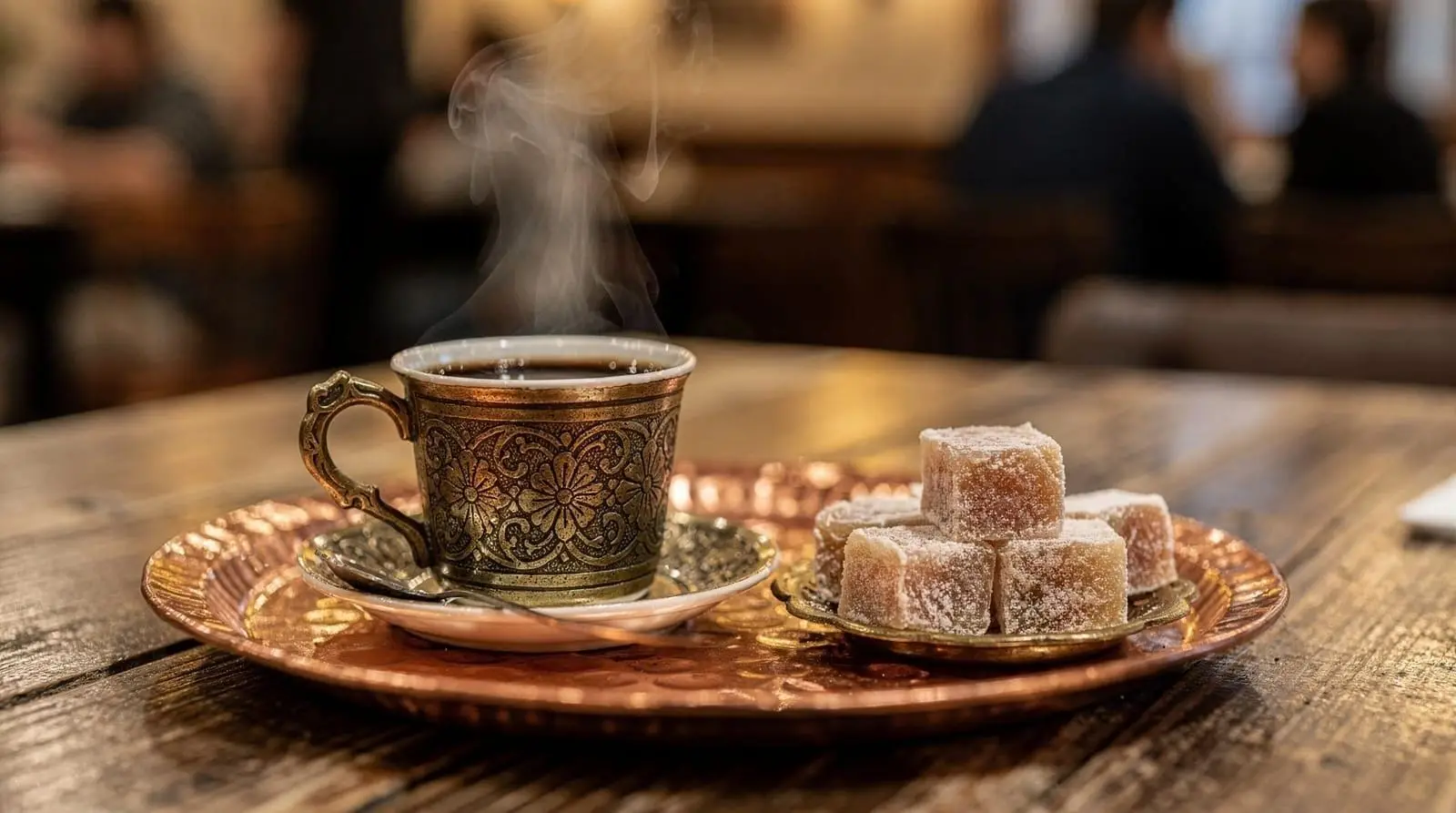
The traditional format — a copper cezve, very fine grounds, brewed slowly, poured into a small porcelain cup — has been largely unchanged since coffee arrived from Yemen via Aden in the 16th century. Istanbul’s first coffeehouse (kahvehane) opened in 1554, and the institution it established — a place for men to gather, talk politics, play backgammon, and drink coffee — shaped Ottoman social life for centuries.
How Turkish coffee is made
The cezve (or ibrik — the terms are used interchangeably, though technically the ibrik is a pitcher, not a brewing pot) is a small, long-handled pot with a wide base and narrow neck. The shape matters: the narrow neck creates a foam (köpük) by containing it as the coffee heats.
The process:
- Cold water is measured into the cezve — one demitasse (roughly 80ml) per serving.
- Finely ground coffee (about 1 heaped teaspoon per serving) is added.
- Sugar, if ordered, is added at this stage — it is not added after brewing.
- The mixture is stirred then placed on low heat.
- As it heats, a foam forms. This foam is important — at better establishments, it is spooned into the cup first before the coffee is poured, to preserve it.
- The pot is removed just before boiling (boiling destroys the foam and makes the coffee bitter) and poured directly into the cup.
- The grounds settle to the bottom over 2–3 minutes.
The quality indicators: consistent foam across the surface, not over-extracted, at the right temperature. Bad Turkish coffee — boiled, machine-made, instant — is plentiful in tourist areas. Good coffee requires a proper cezve and attention.
How to order Turkish coffee
The sweetness is specified at the point of ordering, because sugar is added during brewing, not after:
- Sade — no sugar (literally “plain”). The coffee character is most apparent; also the most acquired taste.
- Az şekerli — slightly sweet. One small spoonful of sugar per cup. Usually the best balance of sweetness and coffee flavour.
- Orta — medium sweet. Two spoonfuls. The traditional default at most Turkish households.
- Çok şekerli — very sweet. Three or more spoonfuls. More a sweet coffee drink than a coffee experience.
Turkish coffee is always served with a small glass of water to cleanse the palate before drinking, and usually with a piece of lokum (Turkish delight) or small chocolate.
The best places for Turkish coffee in Istanbul
Mandabatmaz (Beyoğlu)
Located in a narrow passage (Olivia Geçidi) off İstiklal Caddesi, Mandabatmaz (“it does not make you dizzy” — a reference to its balanced caffeine) has been serving traditional Turkish coffee since 1967. The space is tiny — 10–12 standing spots around a few counters. The coffee is genuinely excellent: thick, well-foamed, served at the right temperature.
Price: 40–50 TRY per cup. The experience of drinking it standing in a tight passage with local regulars is part of the value. Open 8am–10pm. Near Galata Tower.
Fazıl Bey (Kadıköy)
The Kadıköy equivalent — a neighbourhood institution on the Asian side, open since 1923. The coffee is from old-school roasters, the atmosphere unpretentious. A favourite of Kadıköy regulars.
Price: 30–40 TRY. Getting there requires a ferry (25 minutes from Eminönü, ~15 TRY) or bridge crossing. Worth it as part of a Kadıköy afternoon.
Kurukahveci Mehmet Efendi (Eminönü)
Not a café but a roastery and retail shop — arguably the most famous coffee shop in Turkey, operating since 1871 near the Spice Bazaar. The smell of fresh-roasted coffee hits you half a block away. The main draw is buying to take home: they grind to order at 100–150 TRY per 250g.
There is also a small standing counter where you can drink coffee on site. The queue at peak times (mornings, weekends) can be 20–30 minutes.
Çırçır Café (Sultanahmet area)
One of the more honest coffee spots near the old city — properly made, not from a machine, reasonable prices by area standards. A useful option if you need good coffee without crossing to Beyoğlu.
Neighbourhood kahvehane
Traditional coffee houses (kahvehane) are found in working neighbourhoods throughout the city: Fatih, Üsküdar, Kadıköy, Karaköy. These are primarily male spaces where regulars play backgammon and watch football. They serve proper Turkish coffee for 15–25 TRY — the cheapest option and the most authentic context. Tourists are rarely refused entry but will be an anomaly.
The coffee trail: exploring by neighbourhood
Beyoğlu to Galata is the best concentration: Mandabatmaz at the top, several neighbourhood kahvehane on side streets, and the descent through Karaköy with its mix of traditional and specialty coffee spots. A 2-hour coffee walk covers 4–5 stops.
Eminönü / Spice Bazaar area: Mehmet Efendi for buying, the street-facing kiosks along Hasırcılar for quick standing-coffee at 20 TRY. Dense with activity, less elegant than Beyoğlu.
Kadıköy: Fazıl Bey plus a handful of newer specialty shops that serve both Turkish and third-wave espresso. The mix is interesting — traditional and contemporary coffee culture coexisting.
The Turkish Coffee Trail tour covers Beyoğlu specifically over 3 hours, moving between traditional venues with context about the Ottoman coffee house tradition and the modern revival.
The fortune-telling workshop
Coffee fortune-telling (tasseography, or fal) is an optional layer on top of the coffee experience — a social ritual built around the dried grounds left in an inverted cup.
After drinking, the cup is turned upside down on the saucer and left for 10–15 minutes to cool. The reader then interprets the patterns of dried grounds: animals, landscapes, symbols that are said to represent the drinker’s future. It is not a formal art form — different readers interpret differently — but the ritual is consistent.
The coffee-making and fortune-telling workshop in Istanbul runs for about 2 hours and covers both the coffee preparation (hands-on) and the fal reading tradition. It is a reasonable choice for a rainy afternoon and combines well with nearby sightseeing.
Pairing coffee with food
Turkish coffee is almost always served with something sweet:
- Lokum (Turkish delight) — the classic pairing. The sweetness offsets the bitter coffee.
- Small chocolate — more modern, found at contemporary cafés.
- Water — always provided; drink it before the coffee to cleanse the palate.
In a traditional context, coffee follows a meal rather than accompanying it — the signal that the meal is over and conversation time begins. At a café, it stands alone.
Practical notes
Timing: Allow 5–10 minutes for proper brewing (a rushed Turkish coffee is worse than no Turkish coffee). Don’t order it if you’re in a hurry.
Temperature: Turkish coffee cools quickly. Drink it within 10 minutes of being served.
Grounds: They settle in 2–3 minutes but are always present. You’ll feel increasing grit in the last few sips — this is the signal to stop. The last quarter-inch of a cup is grounds, not coffee.
Comparison with espresso bars: Istanbul has numerous specialty coffee shops serving Italian-style espresso. These are available and fine, but separate from the Turkish coffee tradition. Starbucks and similar chains are present but irrelevant to this guide.
Turkish coffee inside a wider Istanbul food day
Coffee rarely stands alone on an Istanbul itinerary — it’s usually a stop between other things. A natural pairing is a morning at the Spice Bazaar followed by a coffee-buying stop at Mehmet Efendi, or an afternoon in Karaköy working from specialty coffee shop to specialty coffee shop before descending to Mandabatmaz. If food is the wider focus of your trip, the Turkish food guide and the best Turkish breakfast guide cover where coffee fits after a proper kahvaltı spread, and the baklava and Turkish desserts guide covers the sweet pairings in more depth than the summary above.
For a single-neighbourhood coffee crawl, Beyoğlu has the highest density of worthwhile stops within a 20-minute walk — Mandabatmaz, several kahvehane on the side streets, and the descent into Karaköy.
Turkish coffee vs. other regional traditions
Istanbul sits at a crossroads of coffee traditions, and visitors sometimes conflate them. Here’s how the main ones compare:
| Style | Preparation | Where you’ll find it in Istanbul |
|---|---|---|
| Turkish coffee | Unfiltered, simmered in a cezve with grounds left in | Kahvehane, dedicated cafés, Mehmet Efendi |
| Arabic coffee (kahve) | Lightly roasted, cardamom-spiced, pale and floral | Rare in Istanbul; occasionally at Middle Eastern restaurants |
| Italian-style espresso | Pressure-brewed, filtered | Specialty coffee shops in Karaköy, Kadıköy, Beyoğlu |
| Filter/third-wave coffee | Pour-over or batch brew | Modern specialty cafés, mostly Kadıköy and Karaköy |
None of these is “more Istanbul” than the others at this point — the city genuinely runs on both traditional kahvehane culture and a thriving specialty coffee scene, and trying both is part of understanding how the city actually drinks coffee day to day.
Bringing coffee culture home
Beyond a bag of ground coffee from Mehmet Efendi, the fal (fortune-telling) tradition and the ritual of the cezve are the parts of Turkish coffee culture that travel least well but matter most for understanding why it made UNESCO’s Intangible Cultural Heritage list. If you want to actually replicate the brewing at home rather than just drink it here, a cezve and a jar of finely ground coffee (ask specifically for “Turkish grind,” which is far finer than espresso grind) from the Grand Bazaar or Mehmet Efendi is the honest starting kit — see the Grand Bazaar shopping guide for where to buy kitchenware without the tourist markup. If you’d rather have this guided than done solo, a guided shopping trip pairing Turkish coffee tasting with a tour of the bazaars covers both the buying and the tasting in one outing.
Frequently asked questions about Turkish coffee guide — how to drink it, where to find the best in Istanbul
What makes Turkish coffee different from espresso?
Where can I get the best Turkish coffee in Istanbul?
What is the fortune-telling tradition?
Is Turkish coffee available everywhere in Istanbul?
What do I do with the grounds at the bottom of the cup?
Can I take Turkish coffee home as a souvenir?
What is the difference between Turkish coffee and Arabic coffee?
Top experiences
Bookable activities with verified prices and instant confirmation on GetYourGuide.