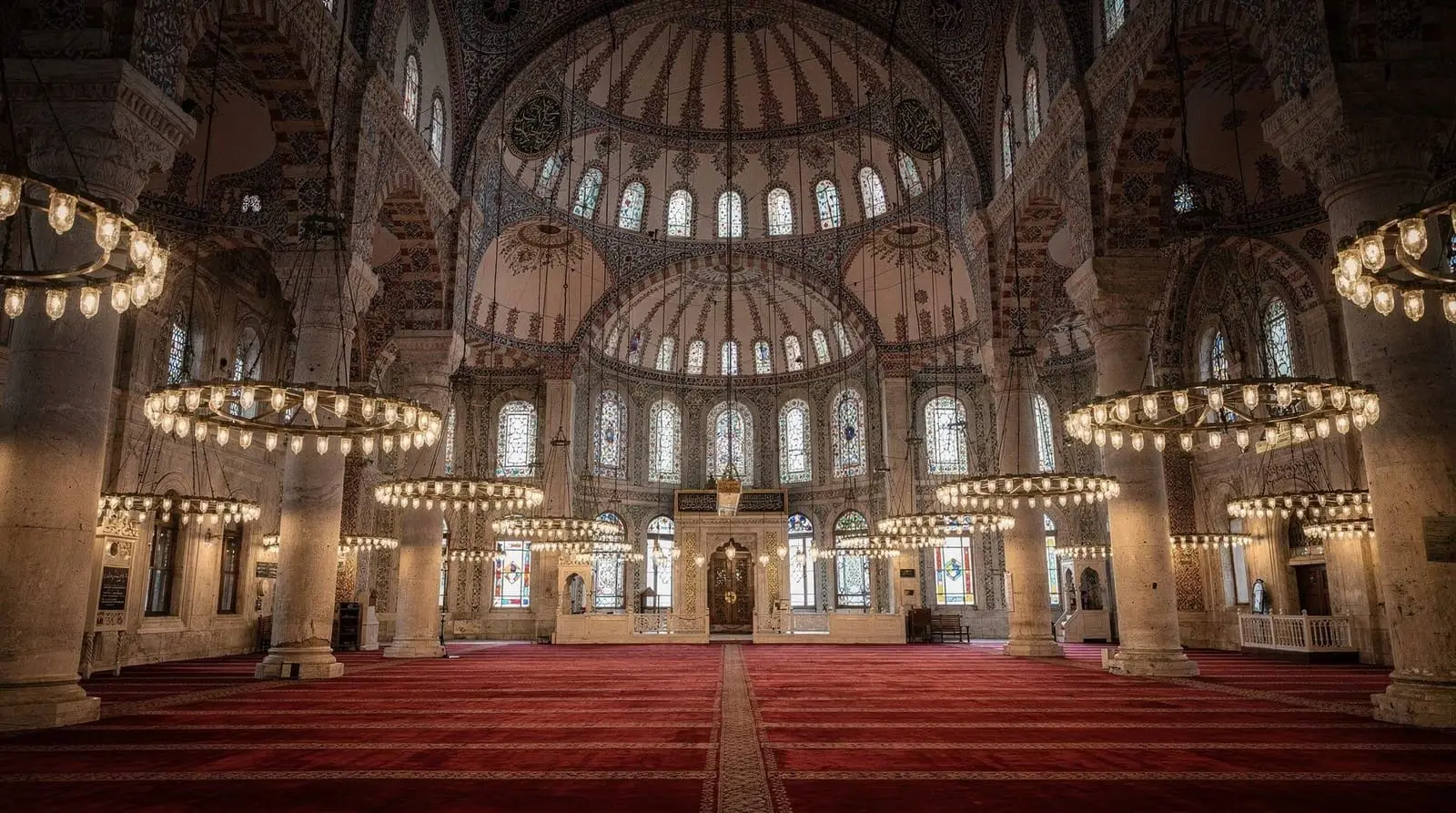
Mosque etiquette for visitors in Istanbul
Istanbul’s mosques are active places of worship, not heritage display spaces. Understanding that distinction shapes how you approach a visit. Most of the rules are simple and not burdensome; the reward is access to some of the most extraordinary interior spaces in the world. The first time I visited the Blue Mosque I fumbled the shoe-bag process in front of a small queue of far more practised worshippers — nobody minded, but I’ve never forgotten to bring my own scarf for a companion since.
| Cost | Free at all major mosques |
| Dress code | Shoulders/knees covered, head covering for women |
| Closed during | Each of the 5 daily prayer times, ~30–45 min |
| Photography | Generally fine, no flash, not during active prayer |
| Bring | Your own lightweight scarf, socks for cold floors |
The universal rules (all mosques)
Remove your shoes: There is no exception. Plastic bags or shoe holders are provided at the entrance for your footwear. Shoes go into the bag; the bag comes with you. Wearing shoes into the prayer hall is not a minor mistake — it is a significant breach of respect.
Cover your legs and shoulders: Men should have trousers covering their knees; shorts are not acceptable in the prayer hall. Women should cover legs to at least below the knee, cover their arms, and cover their head. Scarves are usually available to borrow at mosque entrances if you arrive without one. Tight or transparent clothing is not appropriate even if it technically covers the required areas.
Head covering (women): Required in all mosques. Bring your own — it is more reliable and more hygienic than borrowed scarves. A lightweight scarf or shawl that covers from the hairline to the shoulders is sufficient.
Silence and pace: The mosque is active with worshippers even when tourists are present. Speak quietly. Do not call out to companions across the hall. Do not run or rush.
Prayer times: Mosques close to tourists during each of the five daily prayer times. The closure is typically 30–45 minutes. Hagia Sophia and the Blue Mosque post their current prayer times online and at the entrance. Plan your visit around these windows; arriving 15 minutes before a prayer time means waiting outside.
Photography: Generally permitted in the main prayer hall without flash. Photography during active prayer is not acceptable — if people are praying in the direction of Mecca (qibla), you should not cross in front of them or photograph them. Follow signs at specific mosques regarding any restricted areas.
Hagia Sophia specifically
Hagia Sophia (Ayasofya) converted back to functioning mosque status in 2020. As of 2025, entry is free for worshippers at all times. Tourist visiting is organised around the prayer schedule — there are designated visitor corridors and timeframes. During prayer times, tourists are asked to wait in specific areas.
The mosaics and Byzantine artwork that Hagia Sophia is famous for are largely covered during prayers (covered with curtains) and visible during the designated visiting windows. Given how significant these mosaics are, check the current prayer schedule and plan to arrive during a non-prayer window.
The upper gallery, where some of the finest mosaics are located (Deësis mosaic, Empress Zoë mosaic), is accessible during visitor hours. The queue can be long; arrive early. See the Hagia Sophia visiting guide for current logistics.
Blue Mosque (Sultan Ahmed Mosque)
The Blue Mosque remains an active mosque with particularly high visitor numbers. Entry has been free historically (verify current arrangements before visiting, as admission policies have periodically been debated). The mosque has a dedicated tourist entrance and queue — separate from the worshipper entrance.
The interior is covered in over 20,000 Iznik tiles in blue and white, which give the mosque its popular name (its actual name is Sultan Ahmed Mosque, Sultan Ahmet Camii). The six minarets are architecturally distinctive. See the Blue Mosque visiting guide.
Süleymaniye Mosque
The largest mosque in Istanbul and widely considered Mimar Sinan’s masterpiece of mosque architecture. Less overwhelmingly crowded than the Blue Mosque and Hagia Sophia; a more contemplative visit is possible here. In the mosque garden, the türbe (mausoleum) of Sultan Süleyman I and Roxelana (Hürrem Sultan) are open to visitors. See the Süleymaniye guide.
Eyüp Sultan Mosque
This mosque, near the Golden Horn, is significant enough that it merits special mention. It is one of the holiest sites in Istanbul — the burial place of Eyüp el-Ansari, companion of the Prophet Muhammad. It attracts a large number of Muslim visitors, particularly for Friday prayers and during Ramadan.
The tone here is more devout and less tourist-oriented than Sultanahmet mosques. Dress code is strictly observed. Photography within the immediate prayer area near the tomb is not permitted. Be particularly conscious of your manner here.
Comparing the big three, side by side
| Mosque | Crowd level | Etiquette strictness | Free entry |
|---|---|---|---|
| Hagia Sophia | Very high | Moderate, structured visitor windows | Yes |
| Blue Mosque | Very high | Moderate | Yes (historically — verify current policy) |
| Süleymaniye | Moderate | Moderate, more contemplative | Yes |
| Eyüp Sultan | Moderate-high (higher on Fridays/Ramadan) | Strict | Yes |
Understanding the “why” makes the rules easier
If the rules above feel like a checklist to memorise, it helps to understand the underlying logic instead: every requirement — shoes off, head covered, quiet voices, waiting through prayer closures — exists because these are functioning places of worship first and sightseeing destinations second. Once you see it that way, remembering not to walk in front of someone praying stops being an etiquette rule and starts being obvious. A guided visit early in your trip, with someone who can explain the history and the religious context together, makes every subsequent mosque visit easier to navigate on your own.
Blue Mosque and Hagia Sophia guided walking tourThe etiquette nobody mentions
The worshipper priority rule: If someone is actively praying and you need to pass, wait rather than walking in front of them. The space directly in front of a praying person is their personal space; crossing it is considered disrespectful.
Ramadan: During Ramadan, mosque activity increases substantially. Evening teravih prayers (after the isha prayer) can last until late night. The last ten days of Ramadan see particularly intense observance. Visiting major mosques during Ramadan is possible and often more atmospheric, but more care is needed around prayer times.
Free entry: The Blue Mosque, Süleymaniye, and most neighbourhood mosques are free. Anyone at the entrance asking for a ticket payment before entry is collecting money that is not required — a known scam near tourist-area mosques. See Istanbul scams guide.
Ablution fountains: The decorative fountains (şadırvan) in mosque courtyards are used for ritual washing before prayer. They are not tourist features; avoid treating them as photo props when worshippers are using them.
Beyond the big three
Istanbul has thousands of neighbourhood mosques, and many are worth visiting precisely because they see almost no tourists. Our best mosques in Istanbul guide and free mosques in Istanbul guide round up options beyond Hagia Sophia and the Blue Mosque, including the New Mosque at Eminönü and the Eyüp Sultan mosque guide in more depth than covered above. If you’re visiting during Ramadan specifically, our dedicated Ramadan in Istanbul guide explains how mosque behaviour and hours shift for the month, and our byzantine Istanbul guide is useful background if you want the pre-Ottoman history behind buildings like Hagia Sophia.
Fitting mosque visits into your days
Mosque visits work best when they are planned around the prayer rhythm rather than squeezed in between other stops. Group the big Sultanahmet interiors together, check the posted prayer times that morning, and keep a flexible item nearby — a walk, a café stop or a museum — for the moments when a closure catches you out. Our Istanbul in one day plan and the 3-day itinerary show how the main sights can be sequenced so that you are never standing outside a closed door. If you would rather have the timing handled for you, a guided Blue Mosque and Hagia Sophia tour can keep the visits in a sensible order.
Visitors who want more background before going in will find it in the Sultanahmet destination page, the Hagia Sophia page and the Blue Mosque page. For a wider look at manners beyond the mosque — greetings, hospitality, how to behave in homes and shops — read the Turkish customs and etiquette guide and the broader mosque etiquette guide.
What to wear and carry
Think in layers. A light scarf that doubles as a shawl, long trousers or a long skirt in a breathable fabric, and shoes that slip on and off easily make the whole process smoother. Socks are a good idea, since you will be walking on carpet in the prayer hall. If you are building a wardrobe for the trip as a whole, the Istanbul packing list covers what to bring so that one outfit works for mosques, bazaars and ferries alike. Seasonal choices matter too: see Istanbul in summer if you worry about covering up in the heat, and the Istanbul first-time tips for other small habits that help a first visit go well.
Respect beyond the rules
Etiquette is mostly attentiveness. Notice how worshippers move, where they gather, and which areas are roped off, and adjust. If you are travelling with children, explain beforehand why voices drop and shoes come off; the Istanbul with kids guide has more on keeping family visits calm. If you want an honest view of what is worth your time, the Hagia Sophia vs Blue Mosque comparison helps you decide how much of your schedule to give each interior, and the Süleymaniye destination page points to a quieter alternative.
Frequently asked questions about mosque visits in Istanbul
Can women visit mosques alone in Istanbul?
Yes — completely. Women visiting solo or in groups are common and entirely normal. The dress code (covering head, shoulders, and knees) applies equally. There are usually separate sections for women in the prayer hall; in tourist-visiting contexts, mixed access to the main areas is normal with appropriate behaviour.
Do you have to be Muslim to enter a mosque?
No. Istanbul’s major mosques are open to respectful non-Muslim visitors. The etiquette rules are the conditions for respectful visiting; compliance is expected but no faith background is required.
How long should you spend in a mosque?
For significant interiors like Hagia Sophia and the Blue Mosque, 30–60 minutes is sufficient for a thorough visit. Süleymaniye rewards a slower pace — the courtyard, the mausoleum garden, and the view of the Golden Horn from the terrace are worth additional time.
Can you photograph the prayer hall?
In most cases, yes — without flash, from non-intrusive positions, and not during active prayer. Check specific signs at each mosque. Avoid photographing individuals at prayer without their obvious consent.
What should I wear to visit Istanbul mosques?
Men: long trousers, shoulders covered (short sleeves are fine). Women: long skirt or trousers, top covering shoulders, scarf for head. Bright colours and patterns are fine. The key is coverage, not colour or style.