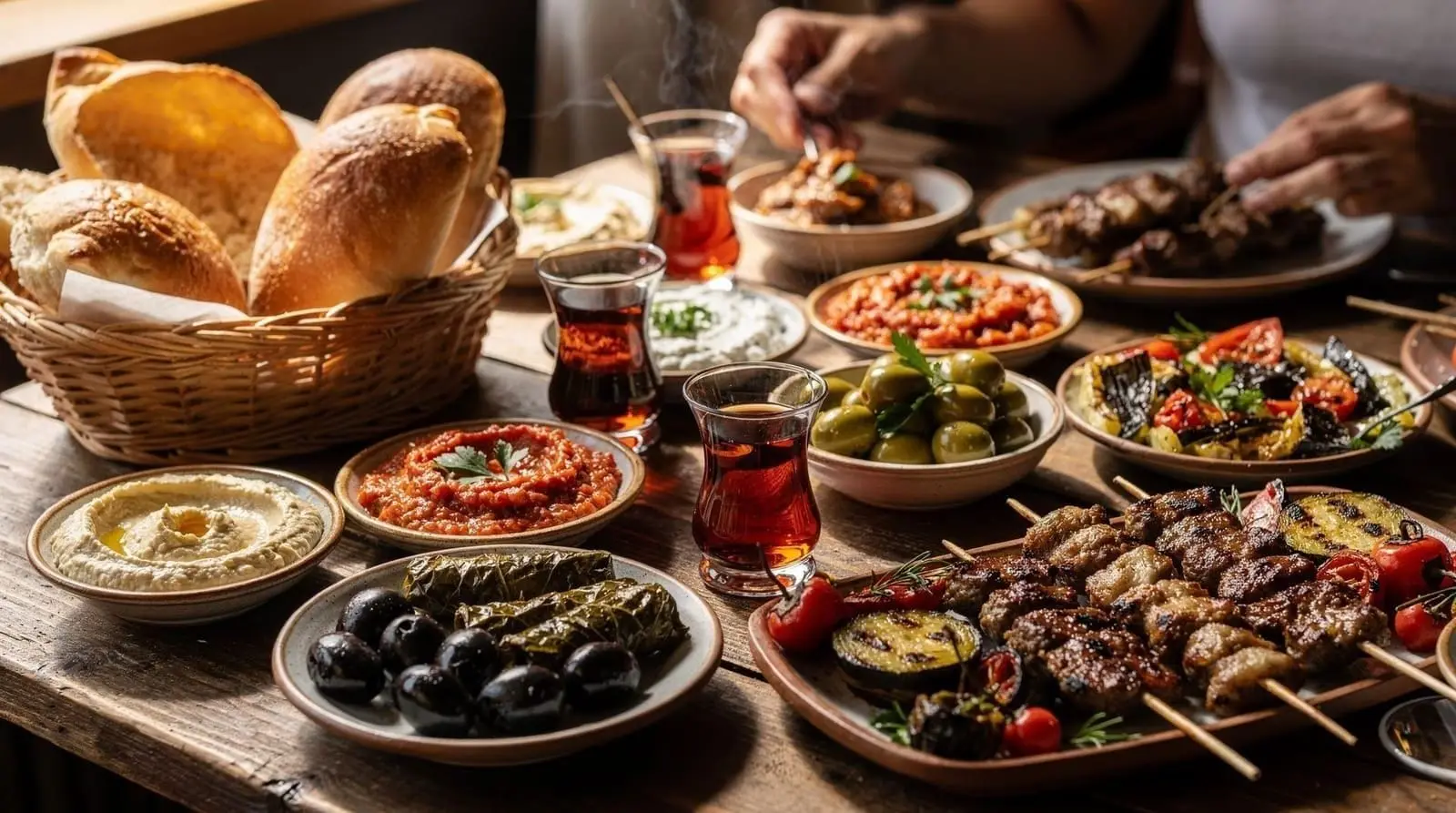
A first-timer's guide to Turkish food in Istanbul
Turkish food in Istanbul is genuinely excellent, broadly accessible, and much cheaper than it looks from a distance. The challenge is not finding good food; it is navigating the tourist-trap versions near major sites, where mediocre meals are priced at multiples of what the same dish costs two streets away.
| Where | Kadıköy, Karaköy and Beyoğlu backstreets beat anywhere within sight of Sultanahmet |
| Cost | Around 80–150 TRY for a lokanta meal, 400–800 TRY for two at a meyhane |
| Time needed | A few hours to graze; a full evening for a proper meyhane |
| Getting there | Ferry or metro to Kadıköy/Karaköy; tram to Eminönü for the fish boats |
| Best approach | Walk two or three streets away from any major monument before choosing where to eat |
The fundamentals: what Turkish food actually is
Turkish cuisine is a synthesis of Ottoman imperial cooking — drawing from Anatolia, the Balkans, the Middle East, and Central Asia — filtered through a city of 16 million people and a street food culture that rivals any in the world. The staples:
Bread: Fresh white bread (ekmek) with everything. Pide (flat bread). Simit (sesame-covered bread rings, sold from street carts, eaten for breakfast or as a snack).
Mezze: Cold appetisers that open any serious meal. Haydari (yogurt with herbs), cacık (yogurt with cucumber and dill), hummus, ezme (spiced tomato paste), patlıcan salatası (aubergine salad). Order several and share. These are not a tourist invention — they are how Turkish meals actually begin.
Kebabs: The international category that obscures the variety. Döner (sliced rotisserie meat, the fast-food version), şiş kebab (skewered chunks), Adana kebab (minced spiced meat, from the city of Adana), İskender kebab (döner on bread with yogurt and butter, originally from Bursa). Each has a different character; none is a generic “kebab” in the British fast-food sense.
Fish: Istanbul’s position on the Bosphorus and Marmara makes fish central to its identity. Balık ekmek (fish sandwich) from the floating boats at Eminönü is one of the most iconic street foods — a whole-grilled fish fillet in a white roll with salad, for roughly 50–80 TRY (under 2.50 USD). The fish changes by season; mackerel (uskumru), sea bass (levrek), and sea bream (çipura) are common.
Lokanta cooking: The everyday working-class Turkish restaurant. Trays behind a glass counter display pre-cooked dishes (pilaf, stews, beans, stuffed peppers, vegetables). You point, they plate, you pay 80–150 TRY for a full meal. This is honest food for honest prices, and it is excellent.
What to eat and where: specific recommendations
Breakfast (kahvaltı): A proper Turkish breakfast is a spread — eggs (menemen is a shakshuka-like scramble with tomatoes and peppers), white cheese (beyaz peynir), olives, tomatoes, cucumber, honey, and çay (black tea). Van kahvaltısı (Van-style breakfast) is the most lavish regional variant. In Istanbul, neighbourhood breakfast places in Beşiktaş, Moda (Kadıköy), and Karaköy serve proper spreads for 150–300 TRY per person. Full guide: best Turkish breakfast spots.
Street food in Eminönü and the Spice Bazaar area: Balık ekmek at the floating boats. Midye dolma (stuffed mussels, sold by the piece on the street, typically by the Galata Bridge). Kestane (roasted chestnuts in winter). Corn on the cob. Simit from carts. This is not tourist food — it is everyday food that happens to be accessible to visitors.
Meyhane culture: A meyhane is a Turkish tavern — a place for meze, rakı (anise spirit), and long evenings. The meyhane strips of Beyoğlu (particularly Çiçek Pasajı area and the backstreets of Asmalımescit) and Kadıköy are where this experience lives. Order cold mezze first, drink rakı with water and ice, add hot dishes as the evening progresses. A full meyhane evening for two with drinks runs 400–800 TRY (12–24 USD) at a genuine neighbourhood place.
Karaköy Güllüoğlu: The definitive address for baklava in Istanbul. Founded in 1949 in Karaköy. Buy by weight; the classic pistachio baklava (fıstıklı baklava) costs roughly 1,200–1,800 TRY per kilo (mid-2025). Eat it fresh at their tables. The tourist area alternatives near the Grand Bazaar are acceptable but inferior.
Çiya Sofrası in Kadıköy: Among the most genuinely interesting restaurants in Istanbul. Musa Dağdeviren has spent decades preserving Anatolian recipes that are disappearing elsewhere. The lunch menu changes daily; dishes from Antakya, Urfa, and obscure regional traditions sit alongside Istanbul standards. There are queues. Worth them.
A guided food walking tour solves the problem of not knowing where to look — local guides know the unlabelled lokantas and the stalls that don’t need to advertise.
What to drink
Çay: Black tea (not green) from a small tulip-shaped glass. This is Turkey’s drink. It is offered everywhere, at any time of day, often for free or 10–20 TRY. Never refuse it unless you genuinely cannot drink more.
Rakı: The national spirit. Anise-flavoured, turns cloudy white when water is added (hence “lion’s milk,” aslan sütü). Served with cold mezze at meyhanes. Strong (typically 45% ABV) and not for hurrying.
Ayran: Cold salted yogurt drink, served with most kebab and lokanta meals. The correct pairing for döner. It sounds odd if you haven’t had it; it works.
Turkish coffee: Made in a small copper cezve over sand or heat. Unfiltered; the grounds settle at the bottom of the cup. Drunk slowly, ideally with a glass of water. The ceremony of Turkish coffee (kahve) is UNESCO-recognised.
What to skip
Restaurants that display photographs of food on laminated menus near major tourist sites usually serve mediocre, overpriced versions of Turkish classics. The balık ekmek near the Grand Bazaar is typically inferior to the boats at Eminönü and costs more. “Turkish pizza” (lahmacun) sold at obvious tourist cafés near Sultanahmet is a flattened shadow of proper lahmacun.
The rule is simple: walk away from the main pedestrian corridors by two or three streets. The quality goes up and the price comes down.
Prices by category, at a glance
Rough benchmarks help more than absolute rules, since prices drift with the lira. Use this as a sanity check when a menu near a monument looks steep:
| Dish / category | Fair price (mid-2025/2026) | Where to find it honestly priced |
|---|---|---|
| Simit (street) | 8–15 TRY | Any cart, anywhere away from a monument entrance |
| Balık ekmek (fish sandwich) | 50–80 TRY | Eminönü floating boats, not the stalls right by the Galata Bridge tourist rail |
| Lokanta full meal | 80–150 TRY | Neighbourhood lokantas in Kadıköy, Karaköy, back streets of Beyoğlu |
| Turkish breakfast spread | 150–300 TRY/person | Moda, Beşiktaş, Karaköy — see the best Turkish breakfast spots |
| Meyhane evening for two | 400–800 TRY | Backstreets of Asmalımescit, Kadıköy meyhane strip |
| Baklava (by kilo) | 1,200–1,800 TRY/kg | Karaköy Güllüoğlu, Hafız Mustafa |
If a menu near Sultanahmet or the Grand Bazaar quotes noticeably above these ranges for an equivalent dish, that is your signal to keep walking.
Regional specialties worth seeking out
Istanbul’s food culture is really a compressed map of Anatolia, and a handful of dishes reward a small detour beyond the obvious kebab-and-baklava circuit. Turkish coffee, unfiltered and drunk slowly, has its own etiquette worth knowing before you order it — see the Turkish coffee guide. Meze and rakı culture, the backbone of any real meyhane evening, is covered in more depth in the meze and rakı guide, including how to pace a multi-course table without over-ordering. For dessert beyond baklava — künefe, dondurma, muhallebi — the baklava and Turkish desserts guide has the honest breakdown of what’s worth the calories. And if street food is your main interest rather than sit-down meals, the Istanbul street food guide maps out the best carts and stalls by neighbourhood, including Kadıköy and Karaköy, the two districts where the food genuinely outperforms the more famous old-town spots.
Food tours as a navigation tool
A traditional street food tour with a local guide is particularly useful for first-timers who find the city overwhelming. The guide navigates the transport, knows which stalls are worth stopping at, and explains context that transforms the eating into understanding.
For deeper dining experiences: the Istanbul food tours guide and where to eat in Istanbul cover restaurant recommendations with honest price context.
Frequently asked questions about Turkish food in Istanbul
Is Turkish food spicy?
Not typically, by South Asian or Mexican standards. Some dishes from the southeast (Adana kebab, dishes from Urfa) have heat. Most Istanbul cooking is flavoured with herbs, spices, and dried peppers without strong chilli heat. If you cannot eat spicy food, you will be fine in Istanbul.
Are there vegetarian options in Istanbul?
More than you might expect. Meze culture is largely vegetable-based — many cold appetisers contain no meat. Börek (filled pastry), gözleme (thin flatbread stuffed with cheese, potato, or spinach), stuffed grape leaves (yaprak sarma), and various vegetable stews are all widely available. Kadıköy and Beyoğlu have more dedicated vegetarian restaurants; Sultanahmet less so.
What is the cheapest good meal in Istanbul?
A lokanta meal — soup, main dish, salad, bread — for 80–150 TRY. A balık ekmek from the Eminönü boats for 50–70 TRY. A simit for 8–10 TRY. Istanbul’s street food culture makes eating well on a very small budget entirely possible.
What is baklava made of?
Thin layers of filo pastry, filled with ground nuts (typically pistachio, walnut, or almond), soaked in syrup (sugar syrup or honey). Turkish baklava uses less butter than Greek or Lebanese versions and is often drier and more nut-forward. Karaköy Güllüoğlu and Hafız Mustafa are the benchmark Istanbul addresses.
Do I need to tip in Istanbul restaurants?
A modest tip is customary but not obligatory. At a lokanta, rounding up or leaving small change is fine. At a sit-down restaurant or meyhane, 5–10% is a reasonable range if service isn’t already included; check the bill, as some tourist-area restaurants add a service charge automatically.
Is tap water safe to drink with meals?
Istanbul tap water is treated and generally safe, but most locals and restaurants default to bottled water, and it’s what you’ll be served unless you ask otherwise. Bottled water is inexpensive, so ordering it is the path of least friction rather than a strict necessity.