Best museums in Istanbul — an honest guide to what is worth your time
Istanbul: Archaeological Museums Entry Ticket & Audio Guide
Which are the best museums in Istanbul?
The top five are the Istanbul Archaeological Museums (world-class Hellenistic and ancient Near East collection), the Topkapı Palace complex, the Chora Church mosaics, the Turkish and Islamic Arts Museum in Sultanahmet, and Istanbul Modern on the Tophane waterfront. The Museum of Innocence (Orhan Pamuk's private museum in Beyoğlu) is the most unusual and worth a half-day for readers of his novels.
Istanbul’s museum landscape
Istanbul has one of the richest museum landscapes of any city in the world, built on the archaeological inheritance of the Ottoman Empire and the collecting ambitions of 19th-century reformers who created the modern museum system before many European countries had done so. Osman Hamdi Bey — the painter-archaeologist who founded the Archaeological Museums and who painted The Tortoise Trainer (a famous canvas on display there) — also introduced the 1884 law that stopped antiquities from leaving Ottoman territory, ensuring that Istanbul’s collections retained what other imperial capitals were losing.
This guide covers the best of the established museums, is honest about which are worth time and money, and mentions the lesser-known ones that reward a longer visit.
| Where | Mostly Sultanahmet (old city), plus Beyoğlu and the Bosphorus shore |
| Cost | Around 100–1,000 TRY per site depending on the museum |
| Time needed | Half a day for 2–3 museums; a full week to cover most of the significant sites |
| Getting there | Tram (T1) for the Sultanahmet cluster; funicular/tram for Beyoğlu sites |
| Best time | Weekday mornings, first thing after opening, to beat tour groups |
Istanbul Archaeological Museums — the best collection most tourists miss
The trio of buildings in Gülhane Park (behind Topkapı) holds one of the world’s great archaeological collections: the Alexander Sarcophagus, Sumerian cuneiform tablets, the world’s oldest peace treaty, Byzantine mosaic floors, Greek and Roman sculpture from across the eastern Mediterranean, and the oldest surviving Turkish poem.
Worth half a day. Undervisited. Entry ~300–400 TRY. See Museums & monuments and the full visiting guide.
Tickets with audio guide add essential context to a collection that deserves more than bare labels.
Topkapı Palace
The palace complex itself functions as a museum — six centuries of Ottoman imperial history across multiple buildings and courtyards. The treasury (Topkapı Dagger, Spoonmaker’s Diamond), the Sacred Relics, and the Harem are the primary museum components. One of the most visited sites in Turkey. Entry ~750 TRY + ~350 TRY for the Harem. Full visiting guide at Museums & monuments.
Turkish and Islamic Arts Museum (TIEM)
The Türk ve İslam Eserleri Müzesi on the Hippodrome occupies the Ibrahim Pasha Palace, the finest surviving Ottoman secular palace from the 16th century. The collection includes Islamic manuscripts, Anatolian carpets from the 13th century onward, calligraphy, metalwork, and ethnographic material on Turkish nomadic life. The carpet collection is considered one of the most important in the world.
Entry ~300–400 TRY. Audio guide available. Covers 2–3 hours. Well-installed and undervisited. See Sultanahmet.
Turkish and Islamic Arts Museum entry with audio guide provides context for the carpet and manuscript collections that would otherwise be difficult to interpret independently.
Istanbul Modern
Turkey’s leading contemporary art museum reopened in 2023 in a striking new building by Renzo Piano on the Tophane waterfront (Karaköy end). The permanent collection covers modern Turkish art from the early Republic onward — a visual history of Turkish modernism that is genuinely illuminating for visitors who want to understand the cultural context of 20th-century Turkey. The temporary exhibition programme hosts major international shows.
Entry ~200 TRY (~6 USD). Open Tuesday–Sunday 10 am–6 pm (Thursday until 8 pm). Budget 1.5–2 hours. See Karaköy.
Chora Church (Kariye Camii)
Technically a mosque, but the Byzantine mosaics here are museum-quality art: 14th-century narrative cycles of extraordinary quality in the narthex corridors, and the Anastasis fresco in the Parekklesia. Better mosaics than anywhere else in Istanbul; significantly fewer visitors than the main sites. Requires a separate journey to Edirnekapı. Full guide at Museums & monuments.
Museum of Innocence (Masumiyet Müzesi)
Orhan Pamuk’s Nobel Prize for Literature was partly on the strength of his 2008 novel The Museum of Innocence, set in Istanbul in the 1970s. The physical Museum of Innocence (in Çukurcuma, Beyoğlu, in a traditional building Pamuk bought for the purpose) houses 83 display cases containing the actual objects mentioned in the novel — the accumulated detritus of a love affair, including 4,213 cigarette butts. The concept sounds gimmicky; the execution is surprisingly moving.
Entry ~150–200 TRY. Budget 1–2 hours (more for Pamuk readers). An extremely unusual museum experience. The surrounding Çukurcuma neighbourhood has antique shops worth browsing. See Beyoğlu and İstiklal Avenue.
Pera Museum
The Pera Museum (Pera Müzesi) in Beyoğlu occupies a converted 19th-century hotel and houses a well-curated collection of Orientalist paintings, Ottoman weights and measures, and Kütahya tiles. The most famous work is Osman Hamdi Bey’s The Tortoise Trainer (1906) — Istanbul’s version of the Mona Lisa in terms of reproduction. Regular temporary exhibitions.
Entry ~100 TRY (~3 USD). Budget 1.5 hours. Well-installed with good English labelling.
Dolmabahçe Palace
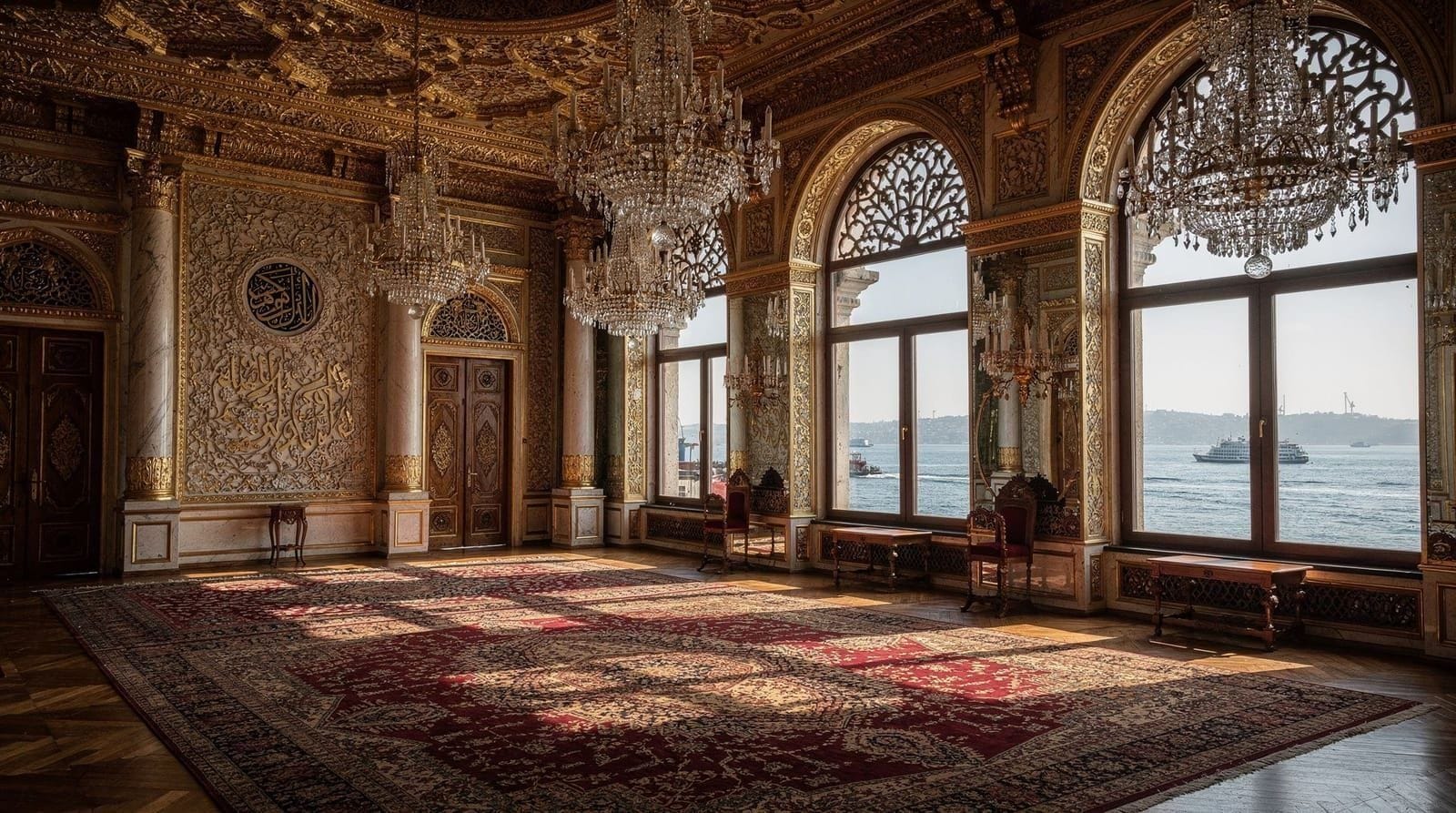
Part palace-museum, part historical site. Dolmabahçe (1856) can only be seen via guided tours (included in the ticket). The interior is extraordinary and strange — European baroque rooms built for Ottoman court protocols. Atatürk’s deathroom is preserved exactly as it was on November 10, 1938 at 9:05 am. Entry and Harem combined ~800–1,000 TRY. Budget 2–3 hours. See Dolmabahçe Palace.
İstanbul Naval Museum (Deniz Müzesi)
The Naval Museum in Beşiktaş covers Ottoman and Turkish naval history with several significant objects, including the imperial barges (kayıks) used for ceremonial Bosphorus crossings by the sultans. The 19th-century iron barges are spectacular objects in a dedicated building. Entry ~100–150 TRY. Budget 1–1.5 hours. Undervisited.
How to choose between them
With so many options, the useful question is not “which museum is best” but “what kind of visitor am I”. Each place above rewards a different appetite, and matching the museum to your own curiosity matters more than any ranking.
If you like ancient history and objects you can stand close to, the Archaeological Museums are the obvious first choice, and they pair naturally with the palace next door. Our Archaeological Museums guide explains how the three buildings fit together so you do not wander without a plan. If you prefer the story of an empire told through rooms, thrones and courtyards, Topkapı and Dolmabahçe are the two to prioritise, and seeing both gives you a before-and-after picture of how the Ottoman court changed its idea of a palace.
If decorative arts are your thing, the Turkish and Islamic Arts Museum is quietly one of the best-value stops in the old city. If you want to understand the Byzantine side of the city, combine the Chora mosaics with the Byzantine Istanbul guide and the Hagia Sophia visiting guide, which together give the older layer of Istanbul more context than any single museum label can. And if modern Turkey interests you more than the distant past, Istanbul Modern, the Pera Museum and the Museum of Innocence form a coherent Beyoğlu-side day.
Building a sensible museum day
The most common mistake is stacking too many serious museums into one day. Museum fatigue is real: after two large collections, attention drops and the third one blurs into the first two. A better rhythm is one major museum in the morning while you are fresh, a long lunch somewhere pleasant, and then either a lighter second visit or no museum at all.
A few pairings tend to work well:
- Old city morning: the Archaeological Museums and Gülhane Park, then a slow walk toward the Topkapı gate. A map of Sultanahmet helps you see what sits close together.
- Palace day: Topkapı in the morning and a calmer afternoon, since the palace alone is demanding. Read the Istanbul in one day guide if you are tempted to squeeze everything in.
- Beyoğlu day: Istanbul Modern first, then the Çukurcuma streets and the Museum of Innocence, finishing on İstiklal. The Beyoğlu neighbourhood guide suggests where to eat and wander in between.
- Mosaics and quiet: the Chora Church on its own, followed by a walk through the old residential streets nearby, which suits anyone who wants an unhurried, low-crowd half-day.
Because the sights are spread over several districts, leave time for getting between them. The getting around Istanbul guide covers the practical options, and the tram line through Sultanahmet makes the old-city cluster easy to link without a taxi.
Practical tips for any museum visit
Go early. Tour groups tend to arrive mid-morning, and the first hour after opening is usually the calmest time to see a collection properly. Weekdays are generally quieter than weekends, and the shoulder seasons are kinder than high summer; if you are still choosing dates, the best time to visit Istanbul explains the trade-offs.
Dress for walking and for varied indoor temperatures. Old stone buildings can feel cool even on a warm day, while crowded galleries in peak season can feel stuffy. Comfortable shoes matter more than anything else you pack, because museum floors are unforgiving over a long day.
Take a bag that is easy to carry and expect security checks at the larger sites. Photography rules differ from place to place, and some rooms or objects may not be photographed, so follow the signs rather than assuming. Audio guides are worth considering at the collections where labels are sparse, as they turn a row of objects into a narrative.
Finally, check opening days and hours before you go. Closing days differ between museums, and a day built around a single closed door is a frustrating one. The details we give in this guide are a starting point; confirm them close to your visit, since fees and schedules change.
Museums on a budget
You do not need to pay for everything to see Istanbul’s cultural side. Choose one or two paid highlights that truly matter to you and fill the rest of your time with free and low-cost experiences. Our free things to do in Istanbul guide lists what costs nothing, and the Istanbul travel budget guide helps you decide where spending is worth it. Active mosques are free to enter, which makes them a natural complement to a paid museum day; the free mosques guide explains which ones to prioritise and how to behave inside.
If museums are the centre of your trip, the pass options covered below are worth comparing against buying individual tickets, because the answer depends entirely on how many sites you genuinely intend to visit rather than how many you hope to.
What to skip (honest assessment)
Miniaturk: a miniature park with 1:25 scale models of Turkish monuments. Marketed aggressively. Unless you have children, not a useful visitor experience.
Panorama 1453 Museum: a 360-degree panoramic painting of the Ottoman conquest of Constantinople. Impressive as a spectacle; limited as history. Worth visiting only if panorama paintings are specifically interesting to you.
Toy Museums: there are two private toy museums in Istanbul. Not recommended unless you specifically enjoy this format.
For a museum-focused Istanbul itinerary, see Istanbul in 4 days.
Should you buy the Istanbul Museum Pass?
If you plan to visit four or more pass-covered sites (Topkapı, the Archaeological Museums, the Basilica Cistern and others) in five days, the pass usually pays for itself and lets you skip the ticket queue at each one — genuinely useful at Topkapı, which has the longest line of any museum in the city. If you’re only doing two museums, buy tickets individually instead. Our Istanbul pass comparison breaks down this specific pass against the wider e-Pass and tourist-pass options, and the Istanbul e-Pass review and Istanbul tourist pass review go deeper on the alternatives if museums aren’t your only priority.
For the two big palace museums specifically, our dedicated Topkapı Palace visiting guide and Topkapı Harem guide cover ticket tiers and queue-avoidance in more detail than fits here, and the Dolmabahçe Palace visiting guide does the same for the Bosphorus palace. If mosaics are your priority over paintings, the Chora Museum guide and Basilica Cistern visiting guide are both worth reading before you go, and the Turkish and Islamic Arts Museum page has current opening hours.
Istanbul Museum Pass — skip the line is worth booking online in advance if your itinerary includes Topkapı; the on-site queue there routinely runs 45 minutes or longer in high season.
Frequently asked questions about Best museums in Istanbul — an honest guide to what is worth your time
How many museums are there in Istanbul?
Which Istanbul museums are free?
What is the Istanbul Museum Pass?
Is Istanbul Modern worth visiting?
What is the Museum of Innocence?
Top experiences
Bookable activities with verified prices and instant confirmation on GetYourGuide.