Hierapolis guide — Roman spa city above Pamukkale
Pamukkale and Hierapolis Full-Day Guided Tour
What is Hierapolis at Pamukkale?
Hierapolis is an ancient Greco-Roman spa city built on the plateau above Pamukkale's white calcium terraces. Founded around 190 BCE, it has a large Roman theatre, Anatolia's largest ancient cemetery (the Necropolis), the Temple of Apollo, and an archaeology museum. Entry is included with the Pamukkale combined ticket.
Hierapolis: the city that grew on hot springs
| Where | Plateau above Pamukkale village |
| Cost | around 600-800 TRY combined Pamukkale-Hierapolis ticket |
| Time needed | 2-3 hrs main sites, 4-5 hrs for the full Necropolis |
| Getting there | Walk up through the terraces, or vehicle on the upper road |
| Best time | April-May or September-October, mornings |
Hierapolis (“sacred city”) was founded around 190 BCE by the Seleucid king Eumenes II of Pergamon, who exploited the existing thermal springs to establish a spa city. The site was later given to the Kingdom of Pergamon and then absorbed into the Roman Province of Asia after 133 BCE. Under Roman rule, Hierapolis became a significant bathing resort, producing textiles (particularly wool, dyed using the mineral-rich water), and later developing as an early Christian centre.
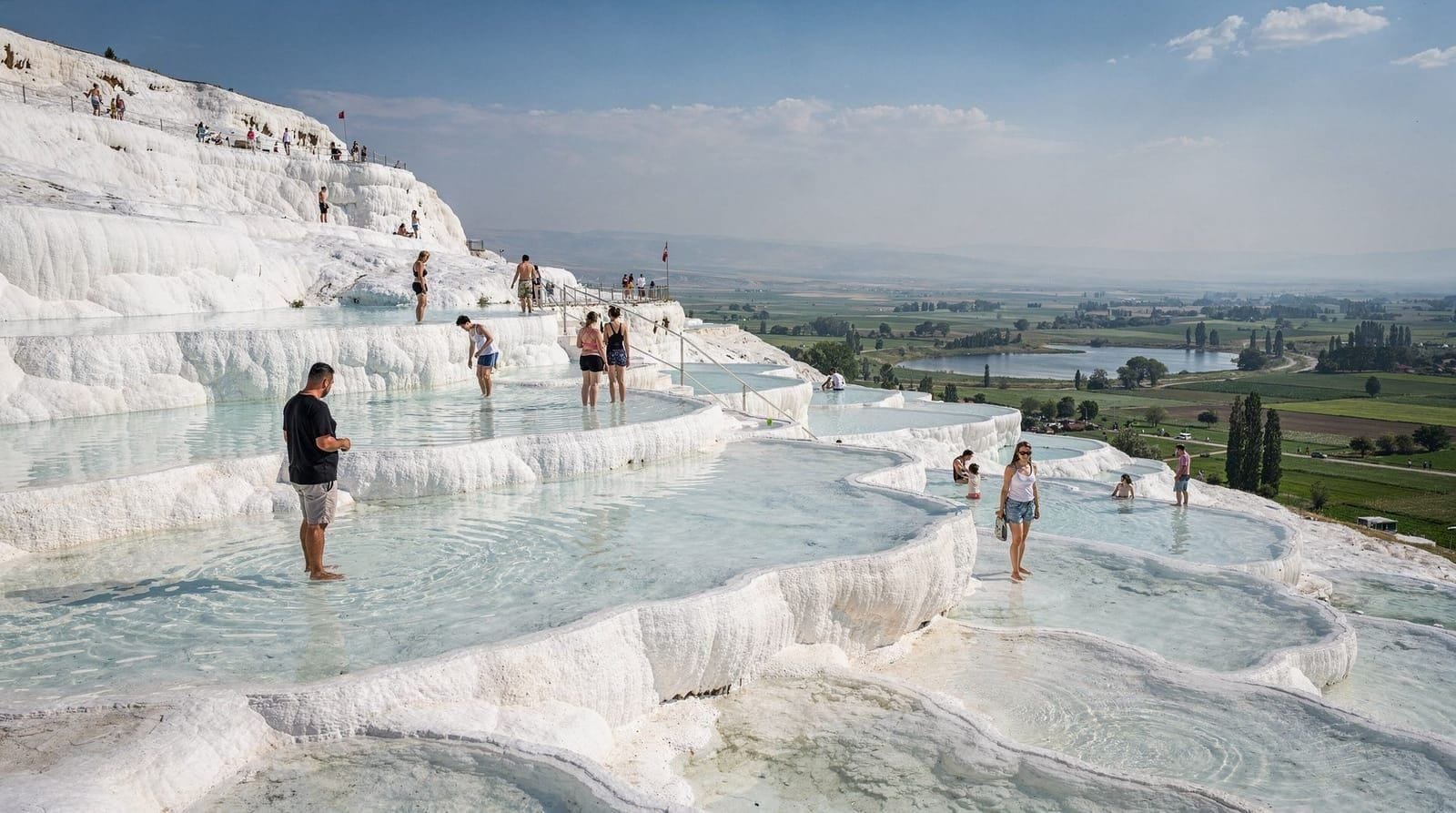
The city sits at approximately 350 metres altitude on the white calcium plateau above Pamukkale village. The geology that produced the terraces also produced the hot springs that made Hierapolis viable. The city was constructed directly on the calcium formations — an unusual relationship between settlement and landscape.
Hierapolis was effectively abandoned after a series of earthquakes in the 614 CE period, leaving the ruins largely intact in the undisturbed limestone environment.
Main sites within Hierapolis
Roman Theatre
The theatre at Hierapolis dates primarily to the reign of Hadrian (2nd century CE) and was enlarged under Septimius Severus. It seated approximately 15,000 spectators.
The most remarkable feature is the stage facade (scaenae frons) — the decorative backdrop wall behind the performance area. At Hierapolis, this is exceptionally well-preserved, retaining several storeys of column niches and detailed relief panels. The reliefs depict scenes from the life of Apollo (to whom the city’s most important temple was dedicated) and the mythological genealogy of the Flavian dynasty.
Climbing the cavea gives good views over the white Pamukkale terrace hillside and the agricultural valley below. The theatre occasionally hosts events — check locally for performances during summer festivals.
Allow 30-45 minutes at the theatre.
Hierapolis Archaeology Museum
The museum occupies the restored Roman baths building (2nd century CE) at the southern end of the site. Italian archaeologists have excavated Hierapolis since the 1950s, and the museum represents the accumulated findings.
Key exhibits include:
- A large Hellenistic-period sarcophagus with relief carvings
- Marble sculpture from the theatre stage facade and religious sites
- Small finds (glass vessels, bronze objects, ceramics, jewellery) spanning the Hellenistic through Byzantine periods
- Inscriptions recording municipal decrees, honors, and dedications
- Reconstruction drawings showing the theatre and urban layout
English labelling is adequate. Allow 45-60 minutes.
The Necropolis
The Necropolis at Hierapolis is the largest ancient cemetery in Anatolia — an extraordinary accumulation of burial monuments spanning roughly 800 years of use, from the 4th century BCE through the Byzantine period.
The cemetery extends northward from the Frontinus Gate along the road that entered the ancient city. Walking the Necropolis road, you pass tumuli (earth mounds over stone burial chambers), sarcophagi (often decorated with relief carvings), house tombs (multi-room structures resembling miniature houses), and larger mausolea. The variety of form and chronological range makes this one of the richest accessible ancient cemeteries in Turkey.
The full Necropolis walk takes approximately 1-1.5 hours for the most accessible section (the first kilometre beyond the gate). A complete exploration requires 2-3 hours.
The Necropolis is accessible from the Frontinus Gate end or from the northern approach road. Morning or evening lighting is better for photography of the relief details on sarcophagi.
Frontinus Gate
The main monumental entrance to Hierapolis from the north, the Frontinus Gate (97 CE) is triple-arched with flanking towers. It was dedicated to the proconsul Sextus Julius Frontinus — the same Frontinus who wrote the famous treatise on Rome’s aqueduct system. The gate is well-preserved and provides a logical starting point for walking into the ancient city from the north.
Temple of Apollo and the Plutonium
The Temple of Apollo (3rd century BCE, expanded in the Roman period) was the major religious site of Hierapolis. The temple itself is partially surviving; the standing columns are among the most visible ancient structures on the plateau.
Immediately adjacent to the temple is the Plutonium — a small cave from which volcanic CO2 gas emerges continuously. In antiquity, the Plutonium was considered the gateway to Hades, associated with Pluto and the underworld. The priests of Apollo conducted ceremonies here, exploiting the gas to demonstrate divine power: small animals (birds, bulls) brought near the cave opening would die from CO2 asphyxiation while the priests survived (by holding their breath or remaining near the gas boundary at head height).
The Plutonium was excavated and studied by Italian researchers in the 2010s. Gas samples confirmed CO2 concentrations lethal to small animals at ground level. The site is fenced with a visible “danger — volcanic gas” warning. Do not approach beyond the fence.
City Colonnade
A main colonnaded street ran through Hierapolis from the Frontinus Gate southward to the Domitian Gate at the other end. Sections of the column bases and paving are visible along the central route. The scale of the colonnade gives a sense of the city’s ambition.
The Roman Baths (outside the museum building)
Beyond the bath complex converted into the museum, several other bathing structures are scattered across the site, in varying states of ruin. These smaller baths illustrate how central thermal bathing was to civic life at Hierapolis — the city had multiple bathing complexes serving different neighbourhoods, not a single central facility, reflecting the scale of demand from both residents and visitors drawn by the springs’ reputed healing properties. Most of these secondary structures are unlabelled and easy to walk past without noticing; a guide or a careful read of the site map helps identify them for what they genuinely are, rather than dismissing them as generic rubble scattered across the plateau.
Combined itinerary with Pamukkale terraces
A logical full-day sequence:
8:00-9:30 am: Terrace walk from lower entrance to Hierapolis plateau.
9:30-11:00 am: Hierapolis main sites — Frontinus Gate, Theatre.
11:00 am-12:00 pm: Antique Pool (early, before crowds).
12:00-1:00 pm: Lunch (restaurant near the pool area).
1:00-2:30 pm: Hierapolis Museum.
2:30-4:00 pm: Necropolis walk.
4:00-5:00 pm: Temple of Apollo and Plutonium.
5:00 pm: Walk down through terraces (late afternoon light on the formations).
The Pamukkale and Hierapolis full-day guided tour covers the main sites with a licensed guide and includes transport from the local area.
For visitors coming from İzmir on a private basis, the private Pamukkale and Hierapolis full-day tour from İzmir provides guided access with flexible scheduling.
Practical information
Entry and ticketing
Hierapolis is included in the combined Pamukkale-Hierapolis ticket (approximately 600-800 TRY / 17-22 USD in 2026). The Antique Pool is a separate ticket (approximately 400-600 TRY). The museum is generally included in the combined ticket.
Getting there
Hierapolis is accessed via Pamukkale village. From the village, you can walk through the terraces (1.5 km to the plateau) or take a vehicle on the upper road.
Opening hours
Daily approximately 8 am to 7 pm (summer), shorter hours in winter.
The early Christian significance of Hierapolis
Hierapolis plays a specific and important role in early Christian history. According to the Acts of Philip (an apocryphal text) and church tradition, the Apostle Philip was martyred here around 80 CE, during the reign of Domitian. He was reportedly crucified upside down or otherwise executed for converting the proconsul’s wife to Christianity.
A substantial octagonal martyrium was built over the supposed site of Philip’s death. The Martyrium of St. Philip (5th century CE) stands near the northeastern edge of the plateau. Partially excavated, its octagonal plan with radiating chapels is visible; the site is a 20-minute walk from the main theatre. Italian archaeologists in the 2000s identified what they believe to be Philip’s actual tomb nearby — a discovery that received significant attention from the Catholic Church.
For visitors interested in early Christianity, Hierapolis’s Philip connection pairs well with the House of the Virgin Mary above Ephesus and the Basilica of St. John in Selçuk — all within a few hours of each other on the Aegean coast. If you are combining the two Aegean sites, the Ephesus visiting guide and the Ephesus and Pamukkale together guide cover logistics for doing both without exhausting yourself.
Thermal bathing at Hierapolis: past and present
The Hierapolis thermal springs were the original reason for the city’s existence. Ancient travellers came for the warm mineral baths, which were credited with curing a range of ailments. Several ancient bath complexes survive at Hierapolis in varying states of preservation.
Today, the Antique Pool (Kleopatra’s Pool) is the main active bathing site. See Pamukkale visiting guide for full details.
In Pamukkale village below, several hotels have thermal pools supplied by the same geological system. Staying overnight in the village allows private or semi-private thermal bathing in the evening or early morning — a more relaxed version of the Antique Pool experience.
Hierapolis in the broader archaeological context
Hierapolis was not unique in its use of thermal springs for settlement — the broader region of western Anatolia (ancient Lydia and Phrygia) has several other spa cities. Allianoi near Bergama (ancient Pergamon), Laodikeia near Denizli, and the springs at İzmir were all exploited similarly.
But Hierapolis’s specific combination of extreme geology (the scale of the calcium terraces, the Plutonium) and its resulting cultural history — from the ancient spa city through the Christian martyrdom of Philip to the Byzantine continuation — makes it unusually layered for an archaeological site.
The ongoing Italian Mission work continues to produce new findings. The 2010s excavation of the Plutonium’s gas measurements and the identification of the Philip tomb were both published in peer-reviewed archaeological journals. Hierapolis is a living research site, not just a tourist attraction.
For combining Hierapolis with Ephesus: Ephesus and Pamukkale together.
Photography guide for Hierapolis
The Hierapolis site presents specific photography challenges and opportunities:
Theatre: Best photographed from the upper cavea looking down at the scaenae frons, in the morning (the theatre faces roughly west, so morning light hits the stage facade beautifully). In the afternoon, the stage is in shadow.
Necropolis: The carved sarcophagi catch afternoon light well (facing north-south along the road). Avoid midday overhead sun which flattens the relief carvings.
Terraces from Hierapolis: The view from the plateau edge down to the calcium terraces and village is best in the morning (terraces facing east) or at golden hour. The terraces appear most vivid white in early-to-mid morning.
Frontinus Gate: The three arches frame the road to the Necropolis. Best photographed from the Necropolis side (gate facing north) in the morning light.
Visiting Hierapolis with children
Hierapolis is generally very suitable for children:
- The open spaces of the Necropolis and the colonnaded street allow energetic exploration without the constraints of museum-style visiting
- The Roman theatre is fun to climb — the upper rows offer the children the best view
- The Antique Pool is perhaps the most memorable element for children — swimming with Roman columns is genuinely exciting
- The Pamukkale terrace walk (barefoot, warm water underfoot) appeals to younger visitors
The main caution: the Necropolis has many open sarcophagus lids and low walls that children might climb on. These are ancient monuments; keep children from touching or climbing the carved surfaces.
Practical notes for families: bring more water than you think necessary, since shade is scarce across the plateau and children dehydrate faster than adults in the heat. A hat and reapplied sunscreen matter more here than at most Turkish sites, given the exposed white limestone reflecting additional light and heat back upward. If children tire of ruins quickly, sequence the visit so the Antique Pool comes last — it functions as the reward at the end of a day of walking rather than an early stop that makes returning to dry archaeology feel like a letdown.
Accessibility at Hierapolis
The site is large, uneven in places, and mostly unshaded, which makes it a genuine challenge for visitors with mobility limitations. The main colonnaded street and the area around the Frontinus Gate are relatively flat and walkable, but the Necropolis road has uneven ancient paving, and the theatre’s upper rows require climbing worn stone steps without handrails in most sections. The museum building, being a converted Roman bath, has a level entrance and is the most accessible single stop on site.
Visitors with limited mobility who still want a meaningful Hierapolis experience should prioritise the Frontinus Gate, the near section of the Necropolis (the first few hundred metres), and the museum, while treating the full theatre climb and the distant Necropolis sections as optional extras rather than must-sees.
Hierapolis in Turkish and international scholarship
The Italian Archaeological Mission at Hierapolis (MAIER) has produced extensive scholarship on the site. For visitors wanting to read more:
Francesco D’Andria’s work on the Martyrium of St. Philip and the search for the Apostle’s tomb was widely covered in English-language media when the announced discovery was made in 2011. The findings are described in detail in the mission’s annual reports.
The Plutonium research (Beschi, D’Andria et al.) published in 2011-2013 included gas measurements confirming the lethal CO2 levels and archaeological evidence for ancient use of the site in religious ceremonies. These studies were published in the journal Archeologia e Calcolatori and are accessible online.
For a broader context of Roman-era spa cities in western Anatolia, see studies of Allianoi near Bergama — another thermal city whose archaeology (largely flooded by a dam project) provides comparison material for Hierapolis.
Where Hierapolis fits in a wider Turkey trip
Hierapolis works best as the southern anchor of a route that starts in Istanbul. If you are still shaping the trip, the Istanbul, Cappadocia, Ephesus and Pamukkale 7-day itinerary shows how the Aegean stops sit alongside the capital, and the Turkey highlights 10-day itinerary gives the ruins more breathing room. Readers who want the Aegean side only can start from the Ephesus destination page and add Hierapolis afterwards.
Be realistic about what “from Istanbul” means. The day-trip reality check explains why distant sites like this one need a night on the ground, and the Ephesus from Istanbul guide covers the same logic on the coast. For the seaside base that many travellers use between the two ruin sites, see the Kuşadası guide and the Selçuk town guide.
If you would rather fold Hierapolis into a longer loop with Cappadocia, the Cappadocia from Istanbul guide describes how that other extension is organised, so you can compare the two before committing nights to either.
Getting to Hierapolis from Istanbul
Pamukkale and Hierapolis are roughly 500 km southeast of Istanbul — not a day-trip distance. Most visitors fly into Denizli (the nearest airport, about an hour’s transfer from the site) or combine the visit with a wider Aegean coast itinerary that also covers Ephesus. See the Pamukkale from Istanbul guide for flight options, overnight-stay logistics, and how to fit Hierapolis into a multi-day Turkey trip rather than trying to rush it from the capital.
Frequently asked questions about Hierapolis guide — Roman spa city above Pamukkale
How long does it take to see Hierapolis?
Is the Hierapolis theatre impressive?
What is the Plutonium at Hierapolis?
Is there a good museum at Hierapolis?
Can I visit Hierapolis without seeing the Pamukkale terraces?
Top experiences
Bookable activities with verified prices and instant confirmation on GetYourGuide.