Pamukkale visiting guide — white terraces, Hierapolis, and the Antique Pool
Pamukkale and Hierapolis Full-Day Guided Tour
What do you do at Pamukkale?
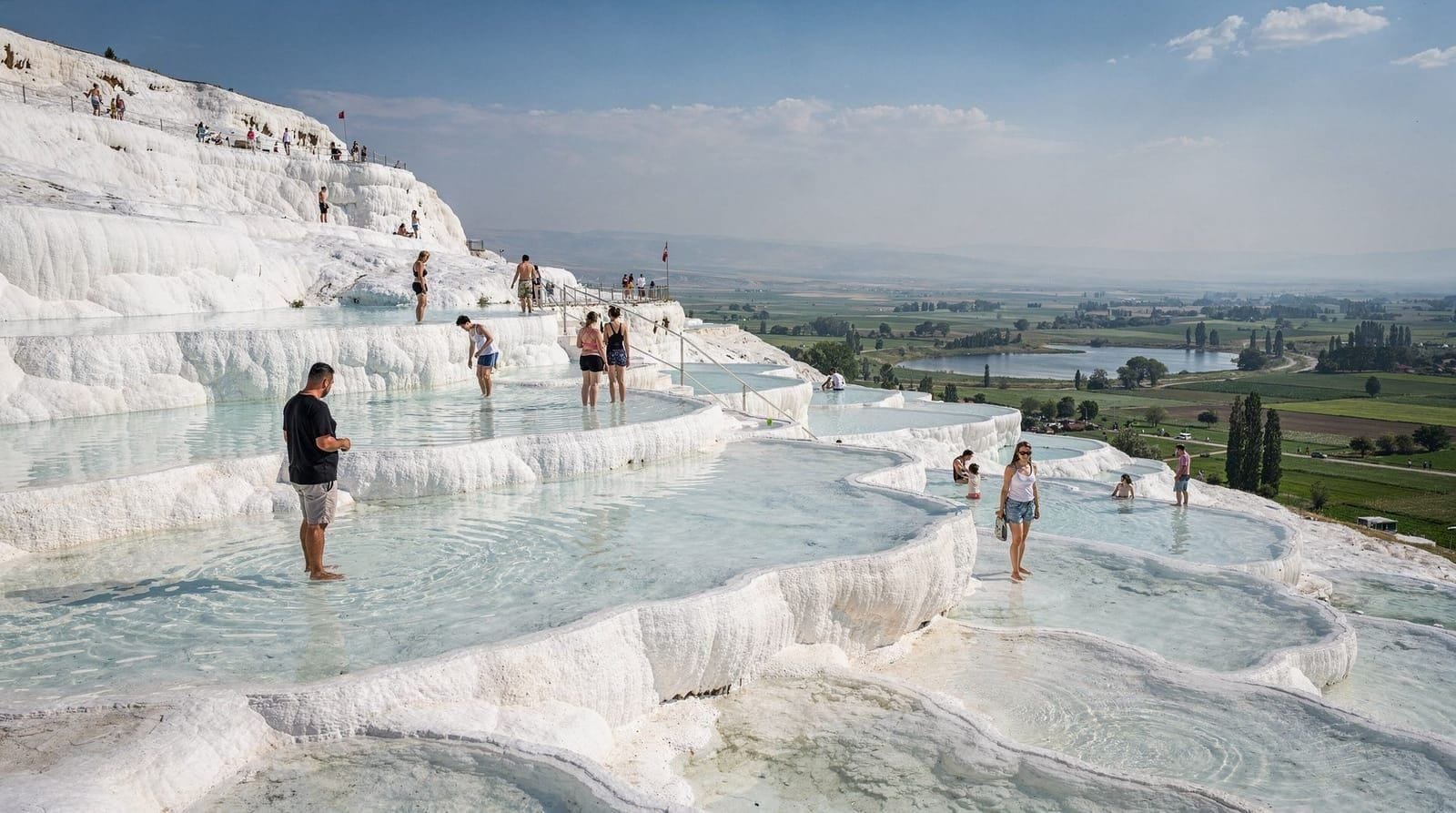
Walk barefoot on the white calcium travertine terraces (shoes must be removed), visit the Hierapolis ruins above (Roman theatre, Necropolis, Temple of Apollo), and swim in the Antique Pool (Kleopatra's Pool) among submerged Roman columns. Allow a full day; arrive early before crowds.
Pamukkale: geology, antiquity, and a swimming pool in the ruins
Pamukkale is two things simultaneously: a natural geological wonder and a 2,000-year-old spa resort. The geology came first — thermal springs rich in calcium carbonate have been flowing over the edge of a hillside for hundreds of thousands of years, depositing white travertine terraces as the calcium precipitates from the water. Humans, recognising the therapeutic properties of the warm mineral water, built a city on the plateau above.
That city was Hierapolis — founded around 190 BCE, developed through the Hellenistic and Roman periods, and eventually abandoned when a series of earthquakes in the 7th century CE effectively ended urban life there. The ruins spread across the white plateau above the terraces, visible from the town of Pamukkale village below.
Together, the terraces and Hierapolis form a UNESCO World Heritage Site with no real equivalent anywhere else in the world. A visit requires half a day minimum; a full day is significantly better.
This page is the on-the-ground companion to the rest of our Pamukkale coverage. For the ruins alone, the Hierapolis guide goes deeper into the ancient city, and the Pamukkale destination page gives the wider regional picture. If Pamukkale is one stop among several, Ephesus is the usual partner site.
| Where | Denizli province, western Turkey |
| Cost | Combined ticket ~600–800 TRY; Antique Pool +400–600 TRY |
| Time needed | Half a day minimum, full day recommended |
| Getting there | Fly to Denizli or İzmir, then transfer/bus |
| Best time | Early morning, April–May or September–October |
What to skip if you’re short on time
Not every part of the site rewards equal time. If you have three hours rather than a full day, prioritise the terrace walk and the Antique Pool over the deeper Hierapolis exploration — the Necropolis and Roman Theatre are genuinely interesting but more skippable under time pressure than the terraces themselves, which are the reason most visitors come. The Hierapolis Archaeology Museum, while good, is the first thing to cut if the schedule is tight; its contents (sculpture and funerary artefacts) are the least differentiated from other Turkish archaeological museums you may visit elsewhere.
If you can only do one thing, do the terrace walk at sunrise or early morning — it’s free of the tour-group congestion that defines the midday experience and delivers the most photographed, most distinctive part of the site.
Getting to Pamukkale
Pamukkale village is in the Denizli province of western Turkey, approximately 250 km east of İzmir and 200 km north of Antalya.
From Istanbul: fly to Denizli (DNZ, approximately 1 hour 15 minutes) then 45-minute transfer. Or fly İzmir (ADB, 1 hour) then bus/car (approximately 3 hours). See Pamukkale from Istanbul guide.
From İzmir: bus via Aydın and Denizli, approximately 2.5-3 hours.
From Selçuk/Ephesus: bus or private transfer, approximately 3 hours via Aydın.
From Antalya: bus or private transfer, approximately 3.5-4 hours.
The white terraces
What they are
The calcium travertine terraces form when bicarbonate-rich thermal water (emerging at approximately 35°C) flows over the surface and loses CO2, causing the calcium to precipitate as calcite. Over thousands of years, this builds up in layered formations — pools, waterfalls, and ridged terraces. The active flow zone is the white section visible from the valley below.
The walking route
Entry to the terraces is from the lower village side (main lower entrance) or from the Hierapolis plateau (upper approach). The lower entrance is the standard start; after walking through the terraces, you reach the Hierapolis plateau above.
- Remove shoes at the entrance gate: This is mandatory, not optional. Bags are provided for your footwear. The calcium surface is soft and shoes would damage it.
- The designated walking path leads through the active terrace zone, approximately 1.5 km to the Hierapolis plateau. The path is wet and warm in sections — this is normal.
- Wading is permitted in designated sections where water pools. The depth is typically ankle to knee. Swimming is not permitted on the terraces themselves.
- Photography: The terraces photograph best in morning or evening light when the white formations glow. Midday light flattens the image.
What affects the terrace conditions
Water flow varies seasonally and by year. Authorities have redirected some thermal water flow to restore terrace sections previously damaged by overuse. In peak spring (April-May), flow is usually at its most photogenic. In autumn, sections may have less water pooling. This varies year to year.
Some sections of the terraces are partially discoloured — algae and mineral deposits other than pure white calcite affect the colour. The most actively flowing sections are the brightest white.
Hierapolis — the Roman spa city
The plateau above the terraces is occupied by the ruins of Hierapolis, spread across approximately 3 km of elevated ground.
Roman Theatre
The large theatre (1st-2nd century CE) is one of the best-preserved in western Turkey. The stage facade is largely standing, with elaborate relief carvings depicting scenes from mythology and the cult of Artemis. The seating (cavea) can be climbed; the view from the top rows is excellent.
The Necropolis
The largest ancient cemetery in Anatolia, stretching along the road that enters Hierapolis from the north. Tumuli, sarcophagi, mausolea, and house-tombs extend for approximately 2 km. Dating from roughly the 4th century BCE through the Byzantine period, the Necropolis illustrates 800 years of burial tradition. The better-preserved sarcophagi have relief carving. Walking through it takes approximately 45-60 minutes.
Temple of Apollo
Near the Plutonium — a cave from which CO2 emerges due to volcanic activity. In ancient times this was interpreted as an entrance to the underworld, controlled by the priests of Apollo. The CO2 concentration in the Plutonium kills small animals; this was used to demonstrate priestly power. The site is fenced but visible. The Temple of Apollo foundations and columns are adjacent.
Frontinus Gate
The main entrance gate to Hierapolis (2nd century CE), triple-arched with towers. Well-preserved. The road through it was paved with large marble slabs.
Hierapolis Archaeology Museum
The archaeological museum is inside the restored Roman baths building at the southern end of the site. It contains marble sculpture, funeral reliefs, and artefacts from excavations at Hierapolis (primarily Italian archaeologists since the 1950s). Allow 45-60 minutes. Usually included in the combined site entry ticket.
The Antique Pool (Kleopatra’s Pool)
The Antique Pool (Antik Havuz) is a separate facility within the Hierapolis site area. In the 7th century CE, an earthquake toppled columns and architectural fragments from the Temple of Apollo into a natural thermal spring. The spring was later developed as a bathing pool, and visitors now swim in the warm, gently carbonated water among the original Roman column drums, capital fragments, and architectural blocks.
The pool water temperature is approximately 35-36°C. The depth ranges from 1.5 to 3 metres. Non-swimmers can wade at the shallow end.
Entry: approximately 400-600 TRY (11-17 USD), separate from the main site ticket. Changing rooms, locker hire (approximately 50-100 TRY), and towel hire are available at the facility.
Best time: Morning (8-10 am) before tour groups arrive, or late afternoon (after 3 pm) when groups have left. Mid-morning peak (11 am-2 pm) has the pool at its most crowded.
The experience is genuinely unusual — swimming in a thermal pool with Roman column fragments as obstacles is something that exists only here.
Full-day structure
For a full-day visit (arriving around 8 am):
8:00-9:30 am: Terrace walk from the lower entrance to Hierapolis plateau (1.5 km, barefoot). Photography in the morning light. Arrive at the plateau before tour groups.
9:30-11:30 am: Hierapolis exploration — Frontinus Gate, walk toward the theatre, Necropolis beginning.
11:30 am-12:30 pm: Antique Pool (before the midday peak). Swim 45-60 minutes.
12:30-1:30 pm: Lunch near the pool facilities or walk to the main Hierapolis restaurant area.
1:30-3:30 pm: Roman Theatre, Hierapolis Museum, Temple of Apollo.
3:30-4:30 pm: Return walk through terraces (downhill) or the road route.
Late afternoon: Pamukkale village for tea, rest, or a sunset view of the illuminated terraces from below.
The Pamukkale and Hierapolis full-day guided tour covers the main site with a licensed guide and includes transport from the area. For visitors staying in İzmir and wanting a private guide, the private Pamukkale and Hierapolis tour from İzmir is the best option.
Practical information
Entry fees (2026 estimates)
- Pamukkale terraces + Hierapolis combined ticket: approximately 600-800 TRY (17-22 USD)
- Antique Pool: approximately 400-600 TRY (11-17 USD), separate ticket
- Hierapolis Museum: usually included in combined ticket
What to bring
- No footwear on the terraces (bags provided, but bring your own small bag)
- Swimwear and towel for the Antique Pool
- Water (bring your own — limited water points on site)
- Sun protection (very exposed plateau, especially in summer)
- Light jacket for morning terrace walk (the water is warm but the breeze at 350 metres altitude can be cool)
- A change of dry clothes if you’re doing both the terrace walk and the Antique Pool in one visit — the terraces leave feet and lower legs wet, and swimming adds a second change
Toilets and facilities
Toilets and a small snack kiosk are available near the main lower entrance and again near the Antique Pool facility. Facilities directly on the terrace path itself are limited, so plan accordingly before starting the 1.5 km walk up to the Hierapolis plateau.
Photography
The terraces photograph best at dawn and in the first two hours of morning light. By 10 am, the flat overhead sun makes the white calcium less dramatic. Late afternoon light (3-5 pm) is the second-best window. The Antique Pool photographs well at any time with natural light.
Combining with a wider Turkey itinerary
Pamukkale rarely stands alone in a Turkey itinerary — it’s most commonly paired with Ephesus (a 2.5–3 hour transfer via Aydın) or fitted into a broader Aegean circuit that includes Selçuk, Kuşadası, or a Cappadocia extension. See the Ephesus and Pamukkale together guide for the standard two-night routing, or the 7-day Turkey highlights itinerary for a fuller circuit combining Istanbul, Cappadocia, Ephesus, and Pamukkale in a single trip.
The Antique Pool in more detail
The Antique Pool deserves a dedicated explanation since it is unlike any other bathing experience in Turkey.
The pool is rectangular, approximately 30 by 15 metres. The depth ranges from 1.5 to 3 metres at the deepest point. The bottom and sides are uneven natural rock and archaeological debris — you will feel fragments of ancient columns and masonry underfoot. The water is clear despite its mild milkiness (from dissolved calcium carbonate) and warm at a consistent 35-36°C.
The original Roman baths complex of which this pool was a part was destroyed by the 7th century CE earthquake that dropped architectural elements into the spring. The result — columns, capitals, fragments of pediment — makes the pool floor a genuinely surreal swimming environment. You are not simply swimming near ruins; you are swimming in them.
The pool is operated as a private facility by the Pamukkale Thermal Hotel, which has a poolside terrace, changing rooms, lockers, and a small café. Entry is ticketed separately from the Hierapolis site and is available to non-hotel guests. The pool hours (approximately 8 am to 6 pm in summer, shorter in winter) mean you can combine it with your Hierapolis visit.
Best strategy: Arrive at the pool between 8 am and 10 am before tour groups from the coast arrive. The pool has capacity for roughly 50-80 people before it feels crowded. Mid-morning is often peaceful; the 11 am-2 pm window tends to be busiest.
Alternatives if the Antique Pool feels too crowded
On peak summer days, even the early-morning window at the Antique Pool can feel busier than expected once cruise-connected coach tours arrive from the coast. A few options if this happens:
Return in late afternoon: the 3–5 pm window, after most day-tripping groups have departed for their coastal hotels, is often nearly as quiet as the early morning slot, with the added benefit of softer light for photography.
Use your guesthouse’s thermal pool instead: several Pamukkale village guesthouses have their own smaller thermal pools fed by the same spring system, at a fraction of the crowd level (and often included in the room rate). This isn’t the Roman-column experience, but it’s a genuine warm-water alternative if the main pool is uncomfortably full.
Accept the crowd as part of the experience: some visitors find that a moderately busy Antique Pool, with the shared novelty of swimming among ancient columns, is still worthwhile even without the solitude of an empty pool. The columns and the water temperature don’t change with crowd size.
Understanding the geology of Pamukkale
The calcium travertine formation at Pamukkale is produced by a continuous geological process that has been running for hundreds of thousands of years. The specifics:
Thermal water emerges from springs at approximately 35°C. The water is rich in calcium bicarbonate, which is soluble in warm water. As the water flows over the surface, it loses CO2 (the carbon dioxide escapes into the atmosphere), destabilising the calcium bicarbonate. The calcium precipitates as calcium carbonate (calcite), which deposits on the surface over which the water flows. Over time, these deposits build up into the terraced pools and waterfall formations visible today.
The formation is actively maintained today but at a reduced rate compared to natural peak conditions. Decades of tourism (people swimming on the terraces, vehicles driving over them, hotels built directly on the formations until 1988) caused significant damage and reduced the water flow available for natural formation. Authorities responded by demolishing the hotels, banning swimming outside designated areas, and rerouting some thermal water specifically for terrace maintenance.
The geological process means the terraces are constantly changing. Sections active today may be drier in ten years; sections currently dry may be activated by redirected flow. This makes Pamukkale a site that looks different on every visit.
The town of Denizli as a gateway
Most visitors fly into or out of Denizli Çardak Airport (DNZ) for Pamukkale. The city of Denizli itself (approximately 65 km from the airport, 20 km from Pamukkale) is a medium-sized city of approximately 700,000 people and is primarily an industrial and textile manufacturing centre. It has no significant tourist attractions, but the otogar (bus station) is the main transport hub for buses to and from the west.
If you arrive by overnight bus from Istanbul, you arrive at Denizli otogar. From there, dolmuş run to Pamukkale village throughout the day (approximately 30-40 minutes, approximately 50-80 TRY / 1-2 USD) or taxi (approximately 300-400 TRY / 8-11 USD).
If you have time before a late flight out of Denizli, the city’s Kaklık Cave (near the town of Honaz, 20 km south of Denizli) is a notable geological site — an underground cave with thermal springs that creates a small travertine formation similar to Pamukkale but underground. Accessible by car or taxi; not a standard tourist destination but genuinely unusual.
See Ephesus and Pamukkale together for the combined Ephesus-Pamukkale logistics.
Planning Pamukkale around the rest of your trip
Pamukkale sits far from Istanbul, so it works best when you plan it as part of a longer journey rather than an afterthought. Our day-trip reality check explains honestly why the distant highlights deserve an overnight stay, and the Istanbul trip planning guide shows where an Aegean extension fits around your time in the city.
On the coast side, Selçuk is a comfortable base for Ephesus, and Kuşadası is the other common starting point if you want a resort-style stay before heading inland. The Ephesus destination page pulls those sites together.
If you are weighing Pamukkale against Turkey’s other big drawcard, the Cappadocia from Istanbul guide covers that extension, and the Turkey highlights 10-day itinerary shows how both can sit in a single trip. Before you book flights, check the Turkey e-visa guide for entry requirements, and the best time to visit Istanbul page for seasonal context that also helps when timing the rest of your route.
Terraces versus Antique Pool versus Hierapolis
| Element | Time | Cost | Priority if short on time |
|---|---|---|---|
| Terrace walk | 1–1.5 hours | Included in combined ticket | Essential |
| Antique Pool | 45–60 min | +400–600 TRY | High |
| Roman Theatre & Necropolis | 1.5–2 hours | Included | Medium |
| Archaeology Museum | 45–60 min | Usually included | First to cut |
Frequently asked questions about Pamukkale visiting guide — white terraces, Hierapolis, and the Antique Pool
Can you still walk on the Pamukkale terraces?
Is the Antique Pool worth it?
What is Hierapolis?
Are the Pamukkale terraces as white as in photos?
What should I skip at Pamukkale?
How hot is the Antique Pool?
Top experiences
Bookable activities with verified prices and instant confirmation on GetYourGuide.