Ephesus visiting guide — complete site guide with map and tips
Ephesus Entry Ticket with Mobile Phone Audio Tour
How long do you need at Ephesus?
Allow 3 hours minimum for the main site. Add 1.5 hours for the Terrace Houses (separate ticket, essential) and 1 hour for the House of the Virgin Mary if combined. Arrive at opening time (8 am) before cruise ships arrive at 10 am. The site is very hot in summer — bring water and sun protection.
Why Ephesus stands apart
Ephesus (Efes in Turkish, Ἔφεσος in ancient Greek) was one of the wealthiest and most significant cities of the Roman world. As the capital of the Roman province of Asia, it sat on a major trade route connecting Rome to the eastern empire, had a natural harbour (since silted up), and at its peak in the 1st-2nd centuries CE housed approximately 200,000 people.
What survives is extraordinary: kilometres of marble-paved streets, a library facade that can compete with Rome for grandeur, a theatre that could seat 25,000, bath complexes, temples, fountains, and the Terrace Houses — private residences with mosaic floors, wall frescoes, and bronze pipe plumbing that give a more intimate view of Roman urban life than almost anywhere in the Mediterranean.
Ephesus is 560 km from Istanbul and requires a flight to İzmir. It is worth every km of that journey.
| Where | Near Selçuk, İzmir province, 560 km from Istanbul |
| Cost | Around 600-800 TRY entry + 300-400 TRY Terrace Houses |
| Time needed | 3 hrs minimum, 4-5 with Terrace Houses and museum |
| Getting there | Fly Istanbul-İzmir, then train/taxi to Selçuk |
| Best time | Opening time (8 am), before cruise groups arrive at 10 am |
Practical information before you arrive
Getting to Ephesus
From İzmir (ADB airport or central İzmir): train from İzmir Basmane or Adnan Menderes Airport station to Selçuk (approximately 55-75 minutes, approximately 50-80 TRY / 1-2 USD). From Selçuk, Ephesus is 3 km — taxi (approximately 100-150 TRY / 3-4 USD) or dolmuş (shared minibus).
From Kuşadası (cruise port): approximately 20 km by taxi (approximately 250-400 TRY / 7-11 USD one way).
See Ephesus from Istanbul guide for Istanbul-to-Ephesus logistics.
Entry fees and tickets (2026 estimates)
- Main site entry: approximately 600-800 TRY (17-22 USD)
- Terrace Houses (separate ticket at main gate): approximately 300-400 TRY (8-11 USD) — do not skip
- Museum Pass Turkey: covers main site entry; check current Terrace Houses inclusion
Buy both tickets at the Upper Gate before entering. The Terrace Houses ticket is purchased in the same location — buy it when you enter, not when you reach the houses.
Opening hours
Daily approximately 8 am to 7 pm (May-September), 8 am to 5 pm (October-April). Ticket office closes 30-45 minutes before site closing.
The site: walking route from Upper to Lower Gate
The standard visit proceeds from the Upper Gate (Magnesian Gate) downhill through the site to the Lower Gate area. Distance approximately 2.5-3 km walking.
Upper Gate area
The entrance brings you past the Varius Baths on the right and the Odeum (a small covered theatre for council meetings and private performances, seating approximately 1,400) on the left. The Odeum is well-preserved and often overlooked by visitors rushing toward the main street.
Further along, the State Agora — the civic centre of the ancient city — has column bases and the ruins of the Basilica (1st century CE) on its north side. The Isis Temple sanctuary and the Prytaneion (city hall, where the eternal flame of Hestia was maintained) are accessible here.
Curetes Street
Curetes Street is the main colonnaded road through Ephesus, descending from the upper area toward the library. Named after a guild of priests, it was lined with statuary, fountains, and monument dedications.
Walking Curetes Street, you pass:
Trajan’s Fountain (Nymphaeum Traiani): A large monumental fountain built in 102-114 CE, dedicated to Emperor Trajan. The colossal Trajan statue that once stood in the central arch (now in the Ephesus Museum in Selçuk) is one of the finest of its period.
The Latrines: A public Roman toilet facility from the 1st century CE. The communal seating arrangement (stone benches with holes over running water) was a social space rather than a private one. Often cited by guides as an example of Roman civic sanitation.
Brothel inscription: Near the Curetes Street/Harbour Street intersection, a marble pavement inscription that guides variously interpret as an advertisement for a nearby establishment, a street marker, or a shoe map to the brothel. Regardless of interpretation, it is the most photographed piece of text in Ephesus.
Library of Celsus
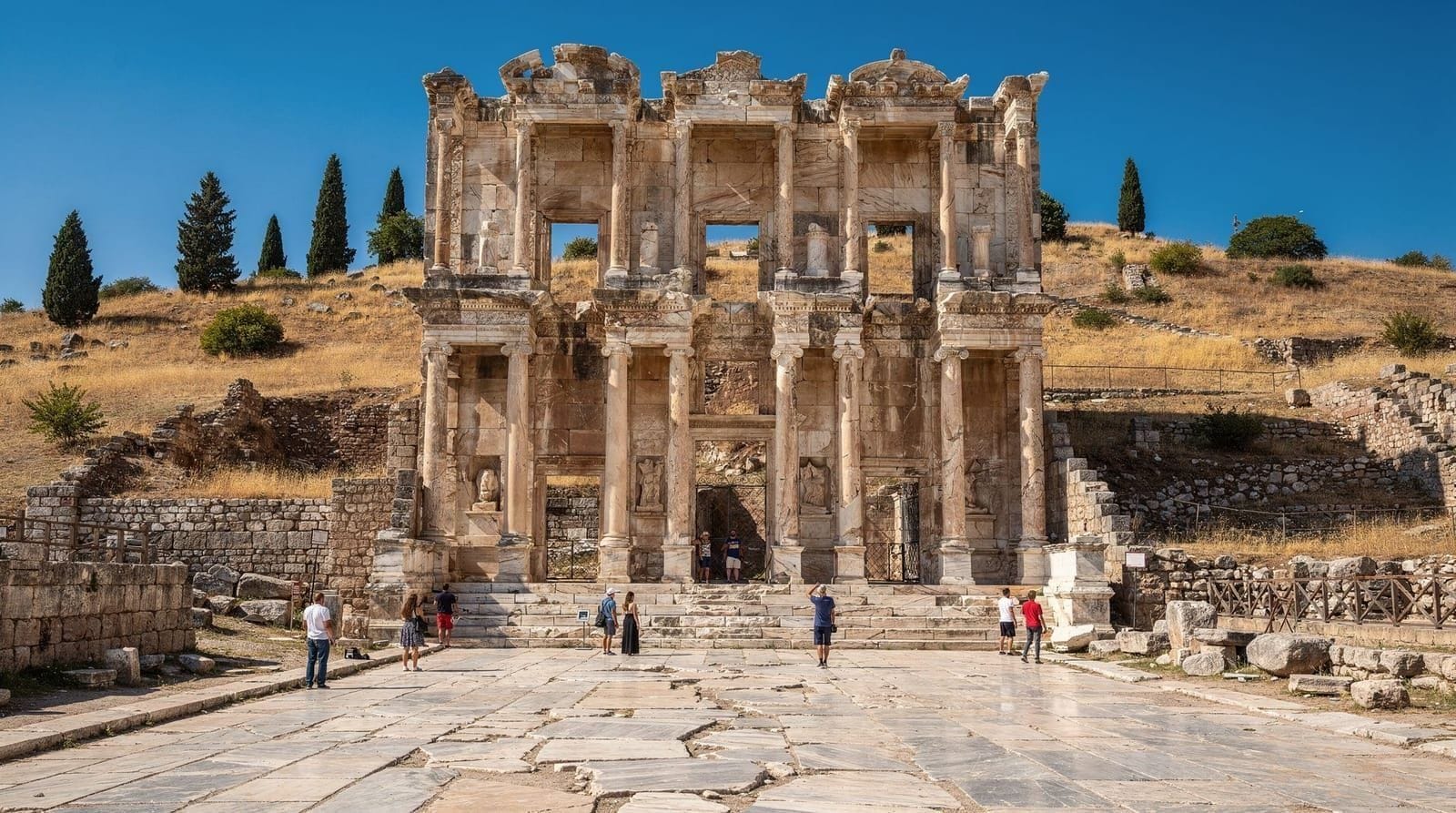
The Library of Celsus (circa 117-125 CE) is the defining monument of Ephesus. The two-storey facade with niched statues representing Sophia (Wisdom), Episteme (Knowledge), Ennoia (Thought), and Arete (Valour) was reconstructed in the 1970s and is now one of the most impressive ancient facades in the world.
The library served as both a monumental tomb for Tiberius Julius Celsus (buried in the basement) and a working library of approximately 12,000 scrolls. The scrolls were stored in niches in the inner walls with an air gap between the outer wall to protect from moisture.
Allow time here — this is the centre of the Ephesus experience, and it deserves more than a quick photograph.
Gate of Mazaeus and Mithridates
The ceremonial gate between the Library of Celsus and the Lower Agora (commercial market), built by two freed slaves of Augustus. An inscription dedicates it to Augustus, Livia, Julia, and Agrippa. It is a well-preserved example of civic benefaction architecture.
Marble Street
From the library toward the theatre, Marble Street was the main processional route leading to the Harbour. Grooves worn into the marble by cart wheels over centuries are visible. The street was flanked by colonnaded walkways.
Great Theatre
At the Lower Gate end, the Great Theatre (capacity approximately 25,000) is built into the western slope of Mount Pion. The structure visible today dates primarily to the 1st-2nd centuries CE, though there was an earlier Hellenistic theatre on the site.
The theatre is still occasionally used for concerts and performances. The stage facade (scaenae frons) is largely intact. From the upper rows, you can see the ancient harbour area (now agricultural fields 2 km away) and the Arcadian Way — the road that once connected theatre to harbour.
The Riot of the Silversmiths (Acts 19 of the Christian Bible) describes how Demetrius the silversmith incited a crowd against Paul of Tarsus in this theatre, fearing that Paul’s monotheism threatened the cult of Artemis and their trade in silver statues of the goddess. The theatre’s use as a gathering place for civic confrontation is consistent with its archaeology.
The Terrace Houses — don’t skip them
The Terrace Houses (Hanghäuser) are located partway along Curetes Street, accessed through a separate entrance on the south side. They are protected by a modern metal-and-glass structure that covers the entire hillside section of excavation.
These are private residences from the 1st century BCE to the 7th century CE — multi-storey townhouses built into the hillside, excavated and preserved with extraordinary care. They contain:
- Mosaic floors in geometric and figural patterns
- Wall frescoes depicting mythological scenes, theatre masks, erotic imagery, and garden scenes
- Bronze pipe plumbing and underfloor heating (hypocaust) systems
- Graffiti scratched into the plaster walls by residents and visitors — including gladiatorial scenes, ship drawings, and Greek and Latin text
The Terrace Houses are in active excavation — Austrian archaeologists have worked here since the 1960s and continue annual excavations. The combination of ongoing work and excellent preservation makes this unlike any other archaeological site in Turkey.
Spend at least 45-60 minutes here. The entry supplement (approximately 300-400 TRY / 8-11 USD) is one of the best archaeological value propositions in Turkey.
Beyond the main circuit: House of the Virgin Mary and Hierapolis
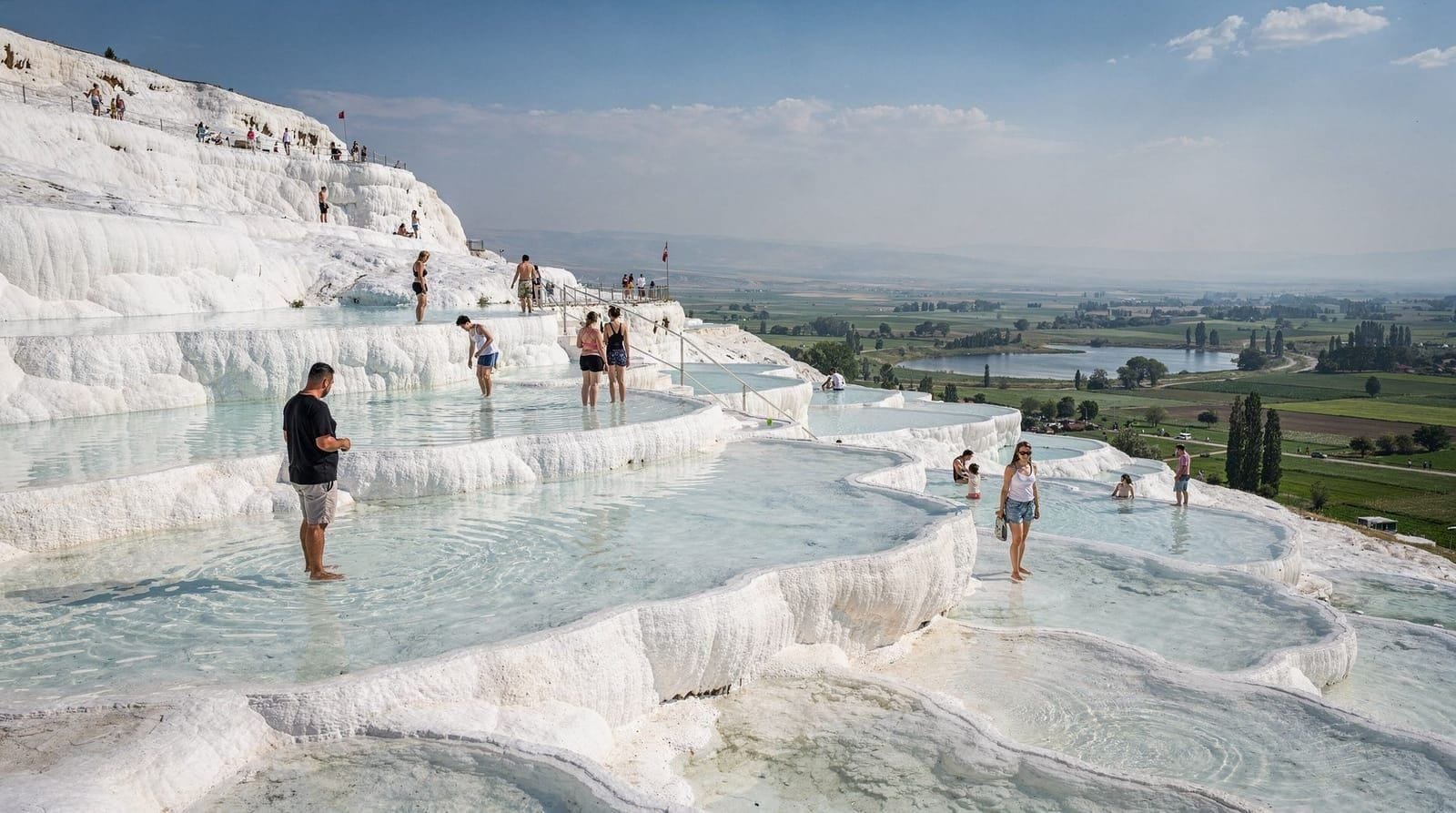
Two sites are commonly combined with an Ephesus visit but sit outside the main ticketed circuit. The House of the Virgin Mary is about 7 km into the hills above the site — a quiet pilgrimage chapel worth the taxi fare even for non-religious visitors, for the setting alone. Further afield, Hierapolis sits above the Pamukkale terraces, about three hours east, and is the natural second stop if you’re extending beyond a single day — see Ephesus and Pamukkale together for how to combine the two without rushing either.
If you’re travelling from Istanbul rather than basing yourself in the region, the Ephesus from Istanbul guide covers the flight and transfer logistics in full, including whether a same-day round trip is realistic for your schedule.
Touring with a guide
İzmir private guided Ephesus tour with skip-the-line provides a licensed archaeologist-guide and skip-the-line entry, which is particularly valuable during summer when queues at the Upper Gate can be 20-30 minutes.
For visitors based in Selçuk: the full-day Ephesus and House of Virgin Mary tour from Selçuk combines both the main site and Mary’s House in one day with a guide and transport.
For audio guide independent visitors: the Ephesus entry ticket with mobile audio tour provides a good self-guided option.
| Option | Context provided | Best for |
|---|---|---|
| Licensed human guide | Highest — answers questions, points out easily-missed details | First-time visitors, history enthusiasts |
| Mobile audio guide | Good — structured commentary at your own pace | Independent travellers who want flexibility |
| Signage only, no guide | Basic — English panels cover the essentials | Repeat visitors, tight budgets |
A human guide is the strongest option if this is your only visit — the Terrace Houses in particular reward someone who can point out the graffiti, the plumbing, and the fresco details that are easy to walk past unremarked. An audio guide is a solid middle ground if you’d rather move at your own pace.
Practical tips
Beat the cruise crowds
Cruise ships from Kuşadası (20 km west) typically disgorge visitors between 9:30 and 11:30 am. The site becomes significantly more crowded during this window. Arriving at 8 am gives you 1.5-2 hours of peaceful exploration.
What to bring
- Water (essential — very limited water points inside the site)
- Sun hat and sunscreen (highly exposed in summer)
- Comfortable walking shoes with grip (marble surfaces are slippery, especially in wet weather)
- The Terrace House ticket (buy at the entrance before starting)
Photography notes
The Library of Celsus facade faces east — morning light (8-10 am) hits the facade beautifully for photography. From the theatre upper rows toward midday, the view of the harbour plain is best.
Food and where to eat afterwards
No food is sold inside the site, and there’s little shade to picnic in comfortably, so most visitors save eating for Selçuk. The town has a good range of small restaurants around the market and train station area, serving typical Aegean mezes, grilled fish, and lamb dishes at reasonable prices — a main course with sides typically runs 250-450 TRY (7-13 USD). Aim to finish the site by early afternoon and treat lunch in Selçuk as the reward; by then you’ll have earned a proper sit-down meal after several kilometres of walking on uneven marble in the sun.
Where to sleep and what else to see nearby
Staying in Selçuk rather than commuting from further away makes the early start far easier, and the town has plenty to fill an afternoon once the ruins are done. The Selçuk town guide covers the market, the basilica and the places to eat, while the Ephesus destination page gives a wider overview of the area. If your base is the coast, the Kuşadası guide explains how the port connects to the site.
Fitting Ephesus into a longer trip
Ephesus works best as one stop in a wider route rather than a stand-alone excursion. The 7-day Istanbul, Cappadocia, Ephesus and Pamukkale itinerary shows where it sits in a classic loop, and the Pamukkale visiting guide helps you plan the next leg. For the honest picture of what a “day trip” from the city really involves, read the day-trip reality check before booking anything.
Passes and entry rules
If you are also visiting museums and sites in Istanbul, the Istanbul Museum Pass guide and are Istanbul passes worth it help you judge whether a pass suits your itinerary. Before you travel, check the Turkey e-Visa guide for entry requirements, and see the Ephesus and Pamukkale trip tips for extra practical advice from the blog.
Ephesus through the centuries: a timeline
Understanding the different periods helps navigate the site:
Archaic/Classical period (c. 800-300 BCE): Ephesus as a Greek city. The first Temple of Artemis (rebuilt after the famous burning by Herostratos in 356 BCE). The city was associated with Heraclitus the philosopher and the cult of Artemis.
Hellenistic period (334-133 BCE): After Alexander the Great’s capture of the city, Ephesus was rebuilt on its current site (the original city was relocated to avoid flooding). The Great Harbour, the new agora, and much of the urban grid were established.
Roman period (133 BCE - 395 CE): Peak prosperity. Under Augustus, Ephesus became the capital of the Roman province of Asia. The Library of Celsus, the Great Theatre (current form), the Terrace Houses, and most of what you see today dates to this period.
Early Christian period (1st-4th centuries CE): Paul of Tarsus in Ephesus; the Riot of the Silversmiths; the tradition of John and Mary. The Council of Ephesus (431 CE) — a key moment in Christian theological history — was held here.
Late Roman and Byzantine periods (4th-7th centuries CE): The temple of Artemis was demolished for building material. The city gradually declined as the harbour silted and the economic importance shifted. A major earthquake in 614 CE accelerated the decline.
Medieval period: The Basilica of St. John (6th century) in Selçuk replaced Ephesus as the religious centre. The ancient city was gradually covered by erosion and agriculture. Systematic archaeological excavation began in the 1860s.
Access and logistics from the site
Getting from the site to the train station: The Ephesus Lower Gate is approximately 3 km by road from Selçuk train station. Walk directly into Selçuk on the flat road (approximately 40 minutes), or take a short taxi (100-150 TRY / 3-4 USD) from the Lower Gate car park.
Access for cruise visitors from Kuşadası: The Kuşadası cruise port is approximately 20 km from the Ephesus Lower Gate. Licensed tour operators and taxis from the port offer transfers. Many cruise passengers prefer guided shore excursions that include transport. See Kuşadası guide for specific guidance.
Water and facilities: Water is available at the main entrance area but not inside the site. Buy water before entering. Toilets are at the Upper Gate entrance, the Terrace Houses, and near the Lower Gate. No food is sold inside the site — eat before or after.
Seasonality: when to go
| Season | Weather | Crowds | Notes |
|---|---|---|---|
| Apr-May | Mild, 18-24°C | Moderate, rising | Best overall balance |
| Jun-Aug | Hot, 28-35°C, little shade | Heaviest — peak cruise season | Go early, leave by midday |
| Sep-Oct | Mild, 20-27°C | Moderate, easing | Good light for photography |
| Nov-Mar | Cool, 8-15°C, wetter | Lightest | Some Selçuk services reduced |
Frequently asked questions about Ephesus visiting guide — complete site guide with map and tips
What is the most important thing to see at Ephesus?
Is a guide necessary at Ephesus?
How do I avoid cruise ship crowds at Ephesus?
Which gate should I enter Ephesus from?
Is the Ephesus museum in Selçuk worth visiting?
Can I visit Ephesus in the rain?
Top experiences
Bookable activities with verified prices and instant confirmation on GetYourGuide.