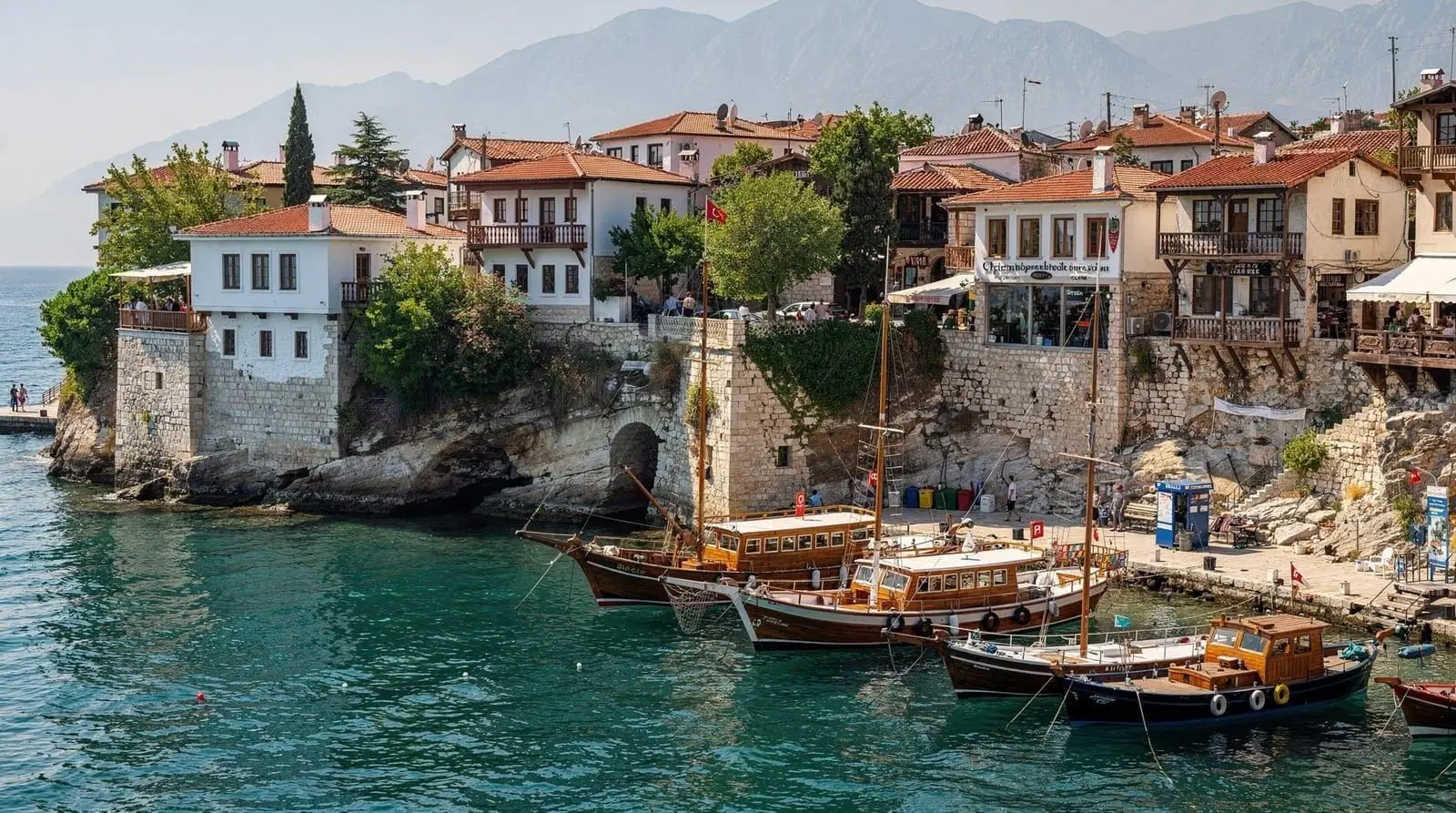
Antalya
Gateway to Turkey's Turquoise Coast — a Roman harbour old town (Kaleiçi), Duden waterfalls, and Aegean beaches, reached from Istanbul by a 1-hour flight.
Antalya: Old Town Walking Tour incl. Turkish Tea and Baklava
Quick facts
- Distance from Istanbul
- ~720 km southwest
- Getting there
- Fly IST/SAW → Antalya (AYT), ~1h flight
- Old town
- Kaleiçi — Roman harbour, Ottoman architecture
- Museum
- Antalya Archaeological Museum — one of Turkey's best
- Sea temperature
- 25–28°C in July–September
Antalya is Turkey’s Mediterranean gateway — a modern city of 2.6 million that contains a remarkably preserved Roman harbour town at its centre, set against a backdrop of the Taurus Mountains and the turquoise Aegean. The city serves as the base for the Turkish Riviera (the Turquoise Coast) and is a natural endpoint for an overland itinerary that includes Pamukkale and Ephesus.
As a standalone extension from Istanbul, Antalya is reached in a 1-hour flight to Antalya Airport (AYT). It warrants at least 2 nights — there is more here than a single day covers, and the city has a genuine pace of its own that makes it worth sitting in, not just passing through.
| Where | Turkey’s Mediterranean coast, ~720 km southwest of Istanbul |
| Cost | around 300–500 TRY museum entry, 600–1,000 TRY boat trips |
| Time needed | 2–3 nights for the old town, museum and a boat trip |
| Getting there | 1h10 flight from IST/SAW to Antalya (AYT) |
| Best time | April–May and September–October for beaches and sightseeing |
Kaleiçi: the old harbour town
The defining attraction of Antalya is Kaleiçi (literally “inside the castle”) — the old walled city built around a Roman harbour that has been in continuous use for 2,000 years. The current structure of the neighbourhood is largely Ottoman, with narrow cobblestone lanes, wooden-balconied houses, mosques, churches, and ruins layered over each other in the way that only a city this old manages.
Hadrian’s Gate (Üçkapılar): Built in 130 CE to commemorate Emperor Hadrian’s visit to the city. One of the best-preserved triumphal arches in Turkey — three arched passages with fluted columns and detailed carvings. Entry is free; you walk through it on the main road into Kaleiçi from the modern city.
The Clock Tower (Yivli Minare area): Antalya’s symbol. The fluted minaret (Yivli Minare, 13th century, Seljuk-era) stands above a mosque converted from a Byzantine church. The Clock Tower adjacent is 19th-century Ottoman. Together with the Roman harbour view below, this section of Kaleiçi concentrates the city’s historical layers in one place.
Roman Harbour: Still functioning as a marina for yachts and tourist boats. The quayside restaurants are heavily geared toward tourists and overpriced for what they serve; the view is excellent. More interesting to walk through than to eat at.
Antalya Archaeological Museum
About 2 km west of Kaleiçi along the clifftop Boulevard (Atatürk Caddesi), the Antalya Archaeological Museum is consistently ranked among Turkey’s best regional museums. The collections cover Anatolia from the Palaeolithic to the Byzantine period.
Hall of Gods: Twelve room-sized marble statues of gods from the Perge excavations — Apollo, Artemis, Hermes, Tyche, and others — in excellent preservation. These were cult statues from the Temple of the Gods at Perge, and seeing them at full scale (2–3 metres) changes the understanding of Roman religious practice.
Sarcophagus Hall: Elaborate carved marble sarcophagi from Perge and Side, with mythological battle scenes. The level of carving detail is extraordinary.
Hall of the Emperors: Portrait busts and statues of Roman emperors from the region’s excavations.
Entry approximately 300–500 TRY (≈ 8–13 USD). Allow 2 hours. Open Tuesday–Sunday.
Düden Waterfalls
The Düden River drops into the sea in two stages near Antalya. The upper Düden Falls (10 km northeast of the city centre) are a series of cascades through a forested gorge, popular with locals for picnics. The lower falls are more dramatic: the river drops 40 metres directly over a cliff into the sea, visible from both land and boat. The lower falls are best seen from a boat trip in the harbour.
City tour including falls and boat trip:
Boat trips from Antalya harbour
The Roman harbour is the departure point for several types of boat trip. The standard “pirates tour” — a day trip by wooden gulet (traditional Turkish sailing boat) along the coast with swimming stops and lunch — runs for 6–7 hours and costs around 600–1,000 TRY per person (≈ 15–25 USD). These depart daily in summer from the harbour. Quality varies significantly; look for operators with newer boats and better safety records.
Suluada Island: A protected marine area near Adrasan, about 45 minutes southwest of Antalya. The water around the small island is unusually clear — a result of the protected status limiting fishing and anchoring. Day boat trips to Suluada depart from Antalya’s harbour area.
A sample day in Kaleiçi
For visitors with only a single full day in the old town before or after a day trip, a workable sequence: start at Hadrian’s Gate around 09:00 before the cruise-ship crowds arrive, walk the lane network toward the Clock Tower and Yivli Minare, and continue to the harbour for a mid-morning coffee overlooking the yachts (skip lunch here — the quayside prices are the highest in the neighbourhood). Spend the early afternoon at the Antalya Archaeological Museum, which needs a genuine 2 hours and is air-conditioned relief from the midday heat.
Late afternoon, walk the clifftop boulevard toward Konyaaltı for the sea view, then return to Kaleiçi for dinner at Parlak or a side-street lokanta rather than the harbour restaurants. This sequence avoids the two common mistakes — overpaying at the harbour and running out of energy before the museum, which is easy to underestimate from the outside. Travellers who’d rather follow a guide than self-navigate can book an Antalya city tour covering the old town (Kaleiçi) and the Düden Waterfalls instead, which covers similar ground with transport included.
Antalya with limited mobility or children
Kaleiçi’s lanes are cobblestone and occasionally steep, which is worth knowing if travelling with a stroller or limited mobility — the harbour area and the clifftop boulevard are flatter and more manageable than the upper old-town streets. The Archaeological Museum has ramps and lifts throughout. For families, the Antalya half-day private city tour with aquarium visit (the aquarium is on the city’s outskirts, reachable by tram or taxi) is a reliable option that isn’t covered elsewhere on this page, and Konyaaltı Beach’s organised sections have showers, sunbeds and shallow entry that suit younger children better than the rockier stretches further along the coast.
Choosing among Antalya’s day trips
With limited time, the four main options pull in different directions — ruins, theatre, beach, or boat. This comparison is the fastest way to decide:
| Day trip | Distance | Best for | Time needed |
|---|---|---|---|
| Perge | 17 km east | Colonnaded Roman street, museum context | Half day |
| Aspendos | 47 km east | Best-preserved Roman theatre in the world | Half day |
| Side | 75 km east | Beach + ruins combined, sunset temple photo | Full day |
| Olimpos/Çıralı | 100 km southwest | Turkey’s best beaches, Lycian ruins, Chimaera | Full day, ideally overnight |
If you only have one day beyond the city itself, Aspendos edges out Perge for sheer visual impact, and Side edges out Olimpos if you want ruins and a swim in the same afternoon rather than a longer drive; with a full day to spare, a full-day Pamukkale and Hierapolis tour with lunch reaches the travertine terraces and the ancient spa city, at the cost of a longer drive each way.
Perge and Aspendos: day trips from Antalya
Two of Anatolia’s most significant ancient sites are within 45–60 minutes of Antalya:
Perge (17 km east): A Hellenistic-Roman city with an intact colonnaded main street, baths, agora, and stadium. The museum pieces from here are in the Antalya Archaeological Museum. Entry around 400 TRY.
Aspendos (47 km east): Home to the best-preserved Roman theatre in the world — still used for performances today, with original seating and stage facade. The view from the top row of seats over the Köprüçay River plain is one of the finest theatrical views in Turkey. Entry around 400 TRY.
Both are accessible by car (essential — public transport is poor) or on a guided excursion from Antalya.
Beaches and the Turquoise Coast
Antalya’s city beaches are not the area’s best. Konyaaltı Beach (3 km west of Kaleiçi) is a long pebble-and-concrete stretch with beach clubs, free public sections, and organised facilities — functional rather than beautiful. Lara Beach (east of the city) is sandier and associated with the large resort hotels.
The area’s most appealing beaches are further along the coast: Olimpos and Çıralı (100 km southwest) are among the best in Turkey — a protected cove backed by ruins of the ancient Lycian city, a sea-turtle nesting beach, and the eternal flame of the Chimaera (Yanartaş) accessible via a 45-minute hike at dusk.
These require a car or local bus from Antalya and at least a night’s accommodation to experience properly.
Getting from Istanbul to Antalya
By flight: Turkish Airlines, Pegasus, and AnadoluJet operate frequent daily flights from Istanbul Airport (IST) and Sabiha Gökçen (SAW) to Antalya (AYT). Flight time approximately 1 hour 10 minutes. Prices vary from 800–3,500 TRY one-way (≈ 20–90 USD) depending on lead time. AYT is about 12 km east of the city centre; tram, bus, and taxis connect it.
In a Turkey circuit: Antalya sits logically at the end of an Aegean extension — Istanbul → fly to Izmir → Ephesus → drive to Pamukkale → drive to Antalya → fly home from AYT. This covers the western Turkey highlights in about 6 nights.
Practical notes
Neighbourhood: Kaleiçi is small (about 500 metres across) and walkable. Hotel options within the walls are in converted Ottoman mansions; romantic but sometimes noisy from the bars along the harbour. The clifftop boulevard outside the walls has modern hotels with sea views.
Weather: Summer (June–September) is hot (35–40°C daytime) and dry. The Mediterranean sea moderates temperatures slightly vs. inland Cappadocia. The sea is swimmable from May through October. Winter is mild (10–15°C) by Turkish standards — one of Turkey’s warmest cities in winter.
Eating: The waterfront restaurants in Kaleiçi are overpriced tourist venues. Better value is in the streets behind: Parlak Restaurant near the clock tower is a long-standing lokanta serving lunchtime menus at reasonable prices (350–500 TRY per person). The market area (pazaar) northwest of Kaleiçi has fresh produce and street food.
The Turquoise Coast and what it means in practice
“Turkish Riviera” and “Turquoise Coast” are marketing terms for the same stretch of Mediterranean coastline between Antalya and Fethiye. The coast is genuinely turquoise — the combination of clear water, limestone seabed, and good light gives it a colour that photographs as almost artificially blue.
The coast divides into distinct zones:
East of Antalya (Antalya to Alanya): Resort concentration, large hotels, developed beaches. Side, Aspendos, and Manavgat are the main cultural stops. The coast road (D400) runs the length of this section.
West of Antalya (Antalya to Fethiye — the Lycian Way): The more interesting section for independent travellers. The Teke Peninsula has Olimpos and Çıralı (sea turtle beaches, Lycian ruins, the Chimaera eternal flame), Kaş (a diver’s and yachting town), Patara (longest beach in Turkey, Lycian city ruins), and Ölüdeniz (the famous lagoon). The Lycian Way long-distance walking route covers much of this coast.
For a visit based in Antalya with a rental car, the west coast (toward Olimpos and Çıralı) is the stronger day-trip direction. The east coast (toward Side and Alanya) is more developed and more generic.
The Ottoman old town in detail
Kaleiçi’s lane plan has barely changed since the Byzantine period — the organic network of narrow streets followed the ancient property boundaries. The modern experience of walking through it involves:
Ottoman-era wooden houses (konaklar): Several dozen survive in varying condition. The characteristic overhanging upper floors supported on carved wooden brackets are a regional style that reached its height in the 18th–19th centuries. Some have been converted to boutique hotels; others are occupied by families who have lived here for generations; others are crumbling despite legal protection.
Old harbour church (now the Kesik Minare Mosque): A 5th-century Roman temple converted to a Byzantine church, then an Ottoman mosque in the 15th century, damaged by fire in 1851. The stub of a minaret survives (hence the name “truncated minaret”). The shell of the building incorporates Roman columns and Byzantine capitals in its walls — a literal accumulation of the city’s different periods.
The harbour wall and sea gate: A section of the ancient city wall survives along the harbour edge, with a gate leading to the Marina. The view from the wall toward the Taurus Mountains is one of the best in the city.
Hadrian’s Gate (Üçkapılar) at night: Worth revisiting after dark when it is lit from below. Especially effective in winter when the streets are quiet.
Antalya in context with Istanbul
Antalya has a very different character from Istanbul. It is a Mediterranean city — broader skies, less vertical density, a pace that slows down rather than accelerates in the evening. The old town is intimate where Istanbul’s historical core is monumental. The sea is near and swimmable; in Istanbul, the Bosphorus is present but not a swimming body of water for most of the city.
The archaeological material in Antalya (particularly the museum) and its surroundings represents the Hellenistic and Roman world of the south Anatolian coast — a different strand of history from the Byzantine and Ottoman focus of Istanbul. Visiting both gives a more complete picture of what modern Turkey’s territory has been through.
For itinerary planning: Antalya fits naturally as the southwestern end of a Turkey loop that begins in Istanbul, moves through Cappadocia, descends to the coast, and flies home from AYT.
Side: the most rewarding day trip from Antalya
Of all the day trip options from Antalya, Side (75 km east on the D400) offers the best combination of beach and archaeology in a single location. The old town of Side occupies a small peninsula — a Roman city with a still-visible street plan, two agoras, temples, baths, and a theatre — with a sandy beach on each side of the peninsula.
Side Theatre: Built into an earth embankment rather than a hillside (the flat coastal terrain required this engineering solution), it seated 15,000 and is well-preserved. The stage building (scaenae frons) has two storeys of columns still standing.
Temple of Apollo: The most photogenic structure — five standing Corinthian columns from a 2nd-century CE temple to Apollo, positioned on the shoreline. At sunset, the columns against the sea is one of Turkey’s most reproduced images.
Side Museum: Housed in a Roman bath building, with quality statuary from the excavations. Entry around 200–300 TRY.
The beach on the west side of the peninsula (the “new Side” beach) is a long sandy stretch, windy in summer but excellent for swimming. Sun loungers and umbrellas available.
The old town is heavily touristic in summer — hundreds of restaurants and souvenir shops. Better restaurants are in the side streets away from the main tourist drag. Allow a full day from Antalya (1.5 hours each way by bus or car, or a guided day tour).
Aspendos Theatre: the unmissable excursion
Aspendos (47 km east) has the best-preserved Roman theatre in the world — not one of the best, but definitively the best, with its original stage building rising four storeys and the original roof timbers replaced by a Seljuk restoration in the 13th century. Seating for 15,000 in the marble cavea remains almost entirely intact.
The theatre was built in 155 CE by the architect Zeno, funded by the merchant brothers Curtius Crispinus and Curtius Auspicatus as a gift to the gods and the city. The quality of construction reflects serious wealth — Aspendos was an important trading city on the Eurymedon River.
Performances are still held here — the Aspendos International Opera and Ballet Festival occurs every June. The theatre’s acoustics are extraordinary; a whisper from the stage is audible at the top row.
Entry: around 400–500 TRY. There is no shade at the theatre; bring water. The visit takes 45–60 minutes. Combine with Side in a full-day east coast excursion.
Practical Antalya logistics
Airport transport: Antalya Airport (AYT) is 12 km east of the city. Tram line T2 connects the airport to the city centre (Müze tram stop near the Archaeological Museum, and onward to Kaleiçi area) for around 20–30 TRY. Journey time about 25 minutes. Taxis cost 200–350 TRY (confirm the meter is running). Many hotels offer transfers for a fixed fee.
Getting around Antalya: The clifftop boulevard (Atatürk Caddesi / Cumhuriyet Caddesi) runs from Kaleiçi westward to the Museum. Tram line T2 runs along this route — useful for the Museum, too far to walk comfortably. Kaleiçi itself is walkable once you park.
Within Kaleiçi: No through-traffic. Navigating by phone maps helps; the streets are confusing and look similar. The clock tower square (Kale Kapısı) is the central orientation point.
Day trips by car: Renting a car from the airport or city centre (from 1,200–2,500 TRY per day in mid-range) unlocks the coast and archaeological sites that are inaccessible by public transport. Most visitors staying 3+ nights in Antalya benefit from a car for at least one day.
Planning Antalya around the rest of your trip
Antalya works best when it is a deliberate chapter rather than an afterthought. If you have not yet settled the shape of your trip, the Istanbul trip planning guide and the how many days in Istanbul guide help you decide how much time the city deserves before you fly south. Travellers weighing a coastal break against inland highlights should also read Cappadocia from Istanbul and the day trip reality check, which explains honestly which excursions are genuine day trips and which need a night away.
For the flight itself, the choice of departure airport matters. The Istanbul airports guide and the IST vs SAW comparison explain how the two airports differ, and the Sabiha Gökçen to city centre guide covers the ground leg if you are leaving from the Asian side.
If you want to string several regions together, the Istanbul, Cappadocia, Ephesus and Pamukkale in 7 days itinerary shows how the western highlights connect, and the Turkey highlights in 10 days itinerary leaves room to finish on the Mediterranean coast. Antalya then becomes the relaxed final stop, a place to swim and unwind after the sightseeing.
Before you leave Istanbul
A few practical pages are worth a look before departure. The Turkey e-visa guide covers entry rules, the Istanbul packing list helps you pack for a trip that mixes city and beach, and the Istanbul travel budget page gives a sense of how costs are structured across a trip. Since the Mediterranean is much warmer than the city for much of the year, the best time to visit Istanbul guide is a useful companion when deciding which month to travel.
If you are combining coast and Aegean ruins
Visitors who plan to see ancient sites on the way to or from Antalya will find the Ephesus visiting guide, the Pamukkale visiting guide and the Ephesus and Pamukkale together guide helpful, along with the Hierapolis guide for the ancient spa city above the terraces. The Istanbul destination page remains the best starting point if you are building the whole route from scratch.
Frequently asked questions about Antalya
Is Antalya worth visiting from Istanbul?
For most visitors, yes — particularly those interested in the combination of Roman archaeology, boat trips, and Mediterranean beach access. The Antalya Archaeological Museum alone justifies the trip for archaeology enthusiasts. The Kaleiçi old town is genuinely attractive. As a quick 2-night extension from Istanbul, it adds a coastal dimension that Istanbul itself cannot provide.
How far is Antalya from Istanbul by flight?
Approximately 1 hour 10 minutes from Istanbul Airport (IST) or Sabiha Gökçen (SAW) to Antalya Airport (AYT). Flights run multiple times daily on Turkish Airlines, Pegasus, and AnadoluJet. Check both Istanbul airports — SAW-based low-cost options can be significantly cheaper.
What is Kaleiçi?
The Roman harbour old town at the heart of Antalya. Walled, with narrow cobblestone lanes, Ottoman mansions, mosques, the Roman Hadrian’s Gate, and the fluted Seljuk minaret (Yivli Minare). Largely pedestrianised. Entry is free; it functions as a normal neighbourhood with restaurants, hotels, and small shops.
What are the best day trips from Antalya?
Aspendos (47 km east) — best-preserved Roman theatre in the world, essential for archaeology. Perge (17 km east) — extensive Roman city with the originals of the Antalya Museum statues. Olimpos and Çıralı (100 km southwest) — best beaches in the region with Lycian ruins and the Chimaera eternal flame. Side (75 km east) — another Roman town with temples and a museum. All require a car or day tour.
What is the Antalya Archaeological Museum?
One of Turkey’s top regional museums, 2 km west of Kaleiçi. The Hall of Gods contains 12 room-sized marble statues from Perge; the Sarcophagus Hall has elaborate carved Roman sarcophagi; the Emperor portraits provide context for the Roman province of Lycia. Allow 2 hours. Entry around 300–500 TRY. Worth prioritising over a second boat trip.
Is Antalya a good base for exploring the Turkish Riviera?
Yes, but a car is essential for making the most of it. Antalya Airport is well-connected internationally, making it a practical entry and exit point for a western Turkey circuit. The coast between Antalya and Fethiye (the “Turquoise Coast” / Lycian Way) requires either a rental car or a series of buses.
Top experiences
Bookable activities with verified prices and instant confirmation on GetYourGuide.

