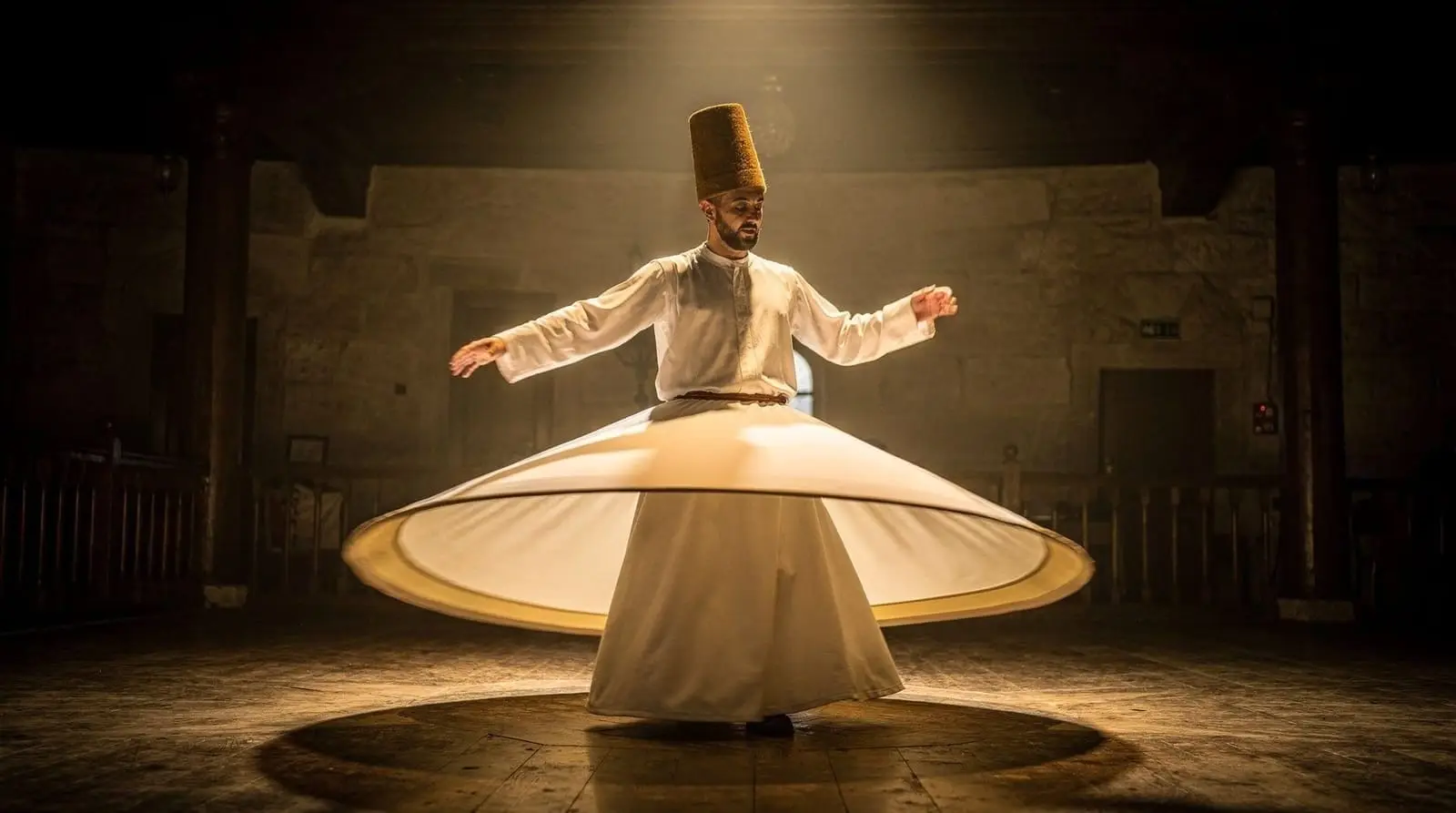
Whirling dervishes in Istanbul: what to know before you go
The whirling dervish ceremony (sema) is a Sufi meditation practice associated with the Mevlevi Order, founded in Konya in the 13th century by the followers of the poet and mystic Rumi (Mevlana Celaleddin-i Rumi). In Istanbul, it can be seen in both genuine ceremonial settings and theatrical tourist-oriented performances. Understanding the difference helps you decide which experience you are seeking — and, having sat through both kinds, I think most visitors default to the wrong one without realising there was a choice.
| Where | Hodjapasha Culture Centre (Eminönü) or Galata Mevlevihanesi (Beyoğlu) |
| Cost | Around 550–700 TRY for the tourist-facing show |
| Time needed | 1 hour (tourist show); 1.5–2 hours (full ceremonial sema) |
| Getting there | Hodjapasha is a short walk from Hagia Sophia; Galata Mevlevihanesi is in Beyoğlu |
| Best time | Book 3–5 days ahead April–October |
What the ceremony is
The sema is a meditative ritual in which the dervishes (semazen) enter a turning state to achieve spiritual communion with the divine. The white robe (tennure) and tall felt hat (sikke) are ceremonial dress with specific symbolic meaning. The semazen begins by crossing arms over the chest, then opens them during the turning — one hand raised toward heaven, one pointed toward earth, acting as a channel between the divine and the physical world.
The ceremony opens with a recitation of the Kuran (nat-ı şerif) and the ney flute solo that is central to Mevlevi music. The sema itself proceeds through four salams (movements). The ceremony concludes with further prayer and a slow return.
A genuine sema in a traditional lodge is not entertainment. It is a religious practice being observed by visitors. The atmosphere is meditative; audience participation is not expected or appropriate.
If you are still shaping your trip, the sema fits naturally into an evening after a full day of sightseeing. Our Istanbul itinerary for 3 days and the first-timer plan both leave room for a cultural show, and the top things to do in Istanbul puts it in context alongside the big monuments.
Where to see the ceremony in Istanbul
Hodjapasha Culture Centre (in a converted 15th-century hammam in Eminönü, adjacent to Hagia Sophia): The most accessible and best-produced tourist-facing dervish show in Istanbul. The 1-hour performance is professional, the setting is beautiful (the former bath building has excellent acoustics and atmosphere), and the performers are skilled. This is explicitly a theatrical performance rather than a religious ceremony, but it is done with quality and genuine Mevlevi technique. Tickets approximately 550–700 TRY (mid-2025 — verify current price). It pairs naturally with a day around the Hagia Sophia visiting guide sights, since Hodjapasha sits a short walk from Sultanahmet.
Hodjapasha whirling dervishes show — the standard recommended tourist experience.
Galata Mevlevihanesi (Mevlevi Lodgehouse, Beyoğlu): The most historically significant dervish venue in Istanbul — the active Mevlevi tekke (lodge) in Galata, now also functioning as a museum. Sema ceremonies are held on specific dates (typically weekly or fortnightly; check current schedule). This is the closest to a genuine ceremonial context rather than a performance. Audience is typically mixed between Muslim worshippers attending for religious reasons and interested visitors. It sits inside the Beyoğlu neighbourhood, an easy pairing with the Galata Tower earlier the same afternoon.
Sirkeci Station area ceremonies: Several smaller venues in the Sultanahmet and Eminönü areas hold weekly or twice-weekly ceremonies. These vary in quality and authenticity — research specific venues before booking.
The tourist performance vs the ceremonial experience
The honest distinction:
Tourist performance (Hodjapasha style): Staged, polished, performed by skilled practitioners for an audience that may not share the faith context. The technique is genuine; the setting is produced for visitors. Appropriate for anyone interested in the aesthetics and structure of the sema without the religious context. Children can attend.
Ceremonial sema (Galata Mevlevihanesi): A religious observation that happens to be open to respectful non-participant observers. Audience should be quiet, dressed appropriately (covered), and aware that this is not primarily a performance.
Both have legitimate reasons to attend; they serve different needs.
| Tourist performance | Ceremonial sema | |
|---|---|---|
| Venue | Hodjapasha Culture Centre | Galata Mevlevihanesi |
| Length | 1 hour | 1.5–2 hours |
| Photography | Usually permitted | Usually restricted |
| Atmosphere | Produced, accessible | Devotional, quiet |
| Best for | First-timers, families | Those wanting genuine religious context |
I went to Hodjapasha first, expecting a slightly hollow “tourist show,” and came away genuinely moved — the technique is real Mevlevi practice even if the setting is produced for an audience. It was only on a later trip, sitting quietly at Galata Mevlevihanesi among a mostly local, respectfully silent crowd, that I understood the difference the honest distinction above is trying to make: one is a beautifully executed performance, the other is closer to witnessing an actual act of worship. Neither is “the fake one” — they are simply different experiences of the same practice. For background on the wider guide to both formats and how to book each respectfully, see the whirling dervishes guide.
Because a genuine sema is a religious setting, the same courtesy you would show in a mosque applies. Our mosque etiquette guide and the broader Turkish customs and etiquette page explain what respectful dress and behaviour look like, and they carry over almost unchanged to a Mevlevi lodge.
Practical details for the tourist performance
- Duration: 1 hour (Hodjapasha), occasionally 45–55 minutes at other venues
- Dress: Smart casual minimum. No active dress code, but the ceremony’s context warrants respectful attire
- Photography: Permitted at tourist performances; restricted or prohibited at genuine ceremonies. Check with specific venue
- Children: Appropriate for most ages at tourist performances; the ceremony is quiet and meditative, which challenges young children’s patience
- Booking: Hodjapasha and other major venues sell out in peak season. Book 3–5 days in advance in April–October. Same-day tickets are sometimes available outside summer.
Mevlevi sema ceremony — a more ceremonial format than the theatrical shows.
Konya vs Istanbul for dervish ceremonies
Konya, where Rumi is buried and where the Mevlevi Order originated, is considered the spiritual home of the sema. The annual Rumi Commemoration Week (Şeb-i Arûs) in December 17 is the most significant ceremony of the year in Konya and attracts visitors from across the Islamic world. Istanbul’s dervish experiences are more accessible and more tourist-oriented; Konya’s are more spiritually significant for those seeking a genuine religious context.
If you are combining Istanbul with a trip further into Turkey, Konya is a full day’s detour but worth it for those specifically interested in Sufi history. Most visitors who head inland choose Cappadocia instead, and our Istanbul and Cappadocia itinerary shows how that trip is usually put together. For the wider picture of how the city’s religious and imperial past fits together, the Ottoman Istanbul guide is a good companion read before you watch your first sema.
The music: ney and ud
The music accompanying the sema is distinctive and deeply beautiful. The ney (an ancient end-blown reed flute) is the central Mevlevi instrument — Rumi used it as a metaphor for the soul’s separation from the divine. The ud (short-necked lute), kudüm (small kettle drums), and rebab (bowed string instrument) complete the ensemble. The opening ney taksim (improvised solo) at the start of a ceremony is something that stays with most listeners long after the event.
Planning the rest of your evening
A sema pairs well with a relaxed dinner before or after, since the performance itself is quiet and unhurried. Our where to eat in Istanbul guide and the meze and rakı guide help you pick a place near your venue. If you are choosing a base so evenings like this are easy, see where to stay in Istanbul, and for moving around after dark, the getting around Istanbul guide covers the practical options. You can also read the companion post on mosque etiquette for visitors for the dress and behaviour expectations in more depth.
Frequently asked questions about dervish ceremonies in Istanbul
Is the whirling dervish ceremony religious or cultural?
Both. It is a Sufi Islamic devotional practice that has been recognised by UNESCO as an Intangible Cultural Heritage of Humanity. Tourist performances strip it to the aesthetic and cultural content; ceremonial semas in active tekkes are religious observances.
Is it respectful for non-Muslims to attend?
Yes, if attended with appropriate respect. Silence, modest dress, and non-intrusive behaviour are the expectations. Laughing, talking during the ceremony, or treating it as entertainment are not appropriate at genuine ceremonies. Tourist performances explicitly welcome all audiences.
How long does the ceremony last?
The complete Mevlevi sema runs approximately 1.5–2 hours including all sections. Tourist performance versions are condensed to 1 hour. The Hodjapasha performance is 1 hour.
Do the dervishes get dizzy?
They train extensively in the spinning technique and reach a meditative state that manages the physical sensation. Children and beginners who try spinning report immediate dizziness; trained semazen reach a different physiological state through practice. Performances ending without stumbling or stopping mid-sema are the norm with experienced practitioners.
Should I book Hodjapasha or try to find a genuine ceremony instead?
Depends on what you actually want. If this is your only cultural show of the trip and you want a reliable, well-produced introduction, Hodjapasha is the right call and the easiest to book. If you specifically want the more meditative, less staged version and don’t mind an unpredictable schedule, look up Galata Mevlevihanesi’s current ceremony dates before your trip — it requires more planning but is the more genuine encounter of the two.