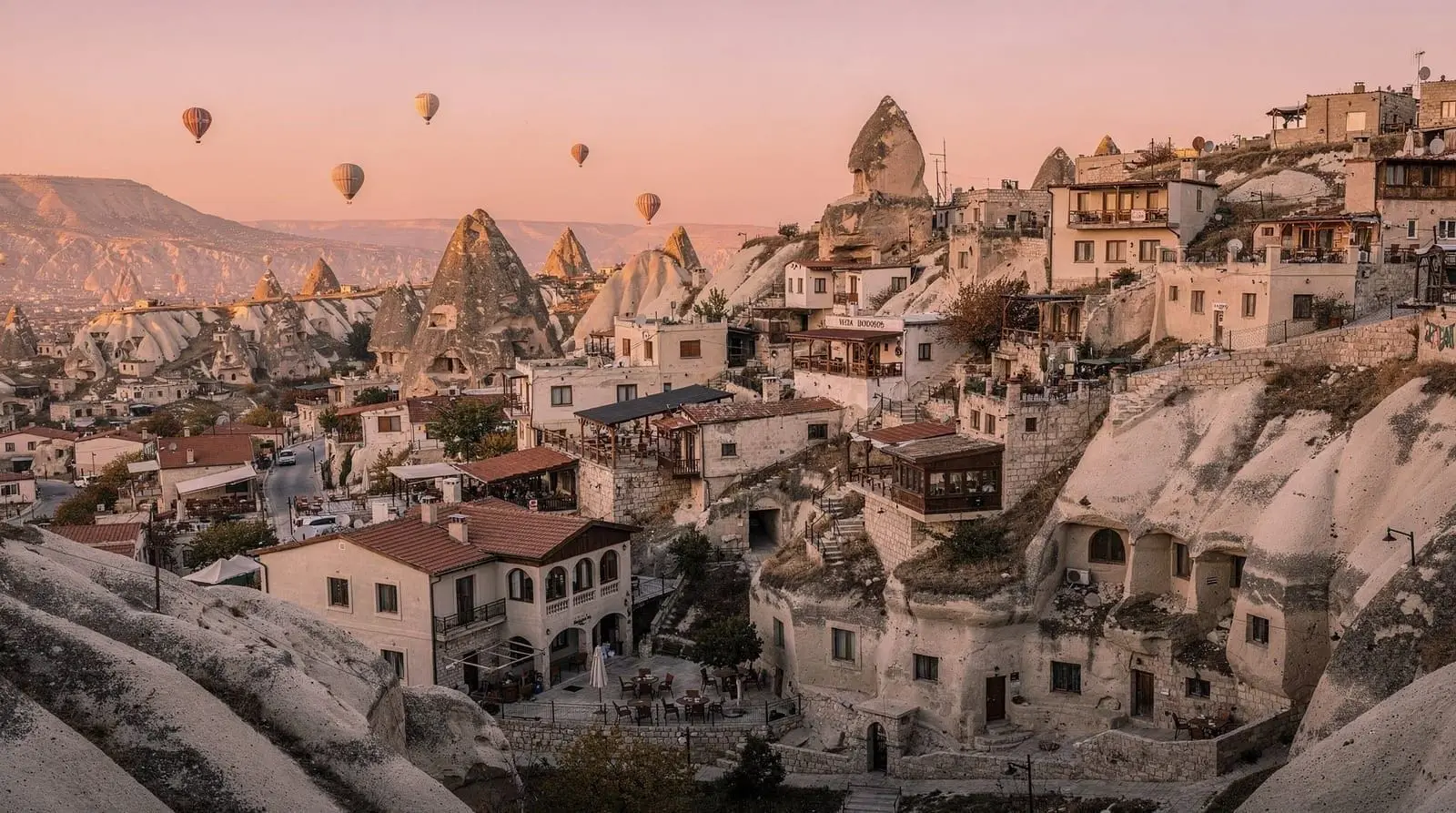
Göreme
Cappadocia's main base town — the Open Air Museum, valley hikes, cave hotels, and the best access point for sunrise balloon flights over the fairy
Cappadocia: Goreme Open-Air Museum Tour
Quick facts
- Location
- Centre of Cappadocia region, Nevşehir province
- Airport
- Nevşehir (NAV) ~40 min by shuttle; Kayseri (ASR) ~75 min
- UNESCO listing
- Göreme National Park, listed 1985
- Open Air Museum entry
- ~900–1,100 TRY (≈ 23–28 USD); Dark Church extra
- Altitude
- ~1,100 m above sea level
| Where | Central Cappadocia, Nevşehir province |
| Cost | Open Air Museum ~900–1,100 TRY; cave hotels from ~40 EUR/night |
| Time needed | 2–3 nights as a Cappadocia base |
| Getting there | Fly to Nevşehir (NAV, ~40 min shuttle) or Kayseri (ASR, ~75 min) |
| Best time | April–May / September–October for balloon season and mild heat |
See the Cappadocia from Istanbul guide for full routing details before you book flights.
Göreme is the village at the centre of Cappadocia that has become the default base for most visitors to the region. It sits in a natural amphitheatre of fairy chimneys, surrounded by the valleys that give Cappadocia its character — Rose Valley, Pigeon Valley, Love Valley, and the Göreme Open Air Museum are all within walking distance or a short taxi ride. The village itself has expanded significantly from its pre-tourism origins but retains an organic, unplanned quality, with cave hotels built into cliff faces and restaurants perched on terraced outcrops.
For context on why Cappadocia requires a flight from Istanbul and at least one overnight, see the Cappadocia destination page.
The Göreme Open Air Museum
The Open Air Museum is the single most important archaeological site in Göreme and one of the highlights of the entire Cappadocia region. It is a UNESCO-listed complex of cave churches, monasteries, and refectories carved into the cliffs during the 10th–13th centuries, when Byzantine Christian monastic communities used the soft tuff landscape to create both hermitages and communal worship spaces.
The site is about 1 km from Göreme town centre, walkable in 15 minutes along the main road. Entry costs approximately 900–1,100 TRY (≈ 23–28 USD) in 2026.
What to see inside the Open Air Museum:
Karanlık Kilise (Dark Church): Requires a separate additional ticket (around 300–350 TRY / ≈ 8–9 USD) but is the most visually impressive church on the site. The name refers to its minimal windows, which protected the interior frescoes from light damage. The result: frescoes depicting the Nativity, Baptism, Entry into Jerusalem, and Crucifixion in vivid blues, greens, and ochres that are far better preserved than any other church in the complex.
Elmalı Kilise (Apple Church): Named for an apple tree that once stood nearby (or possibly for a dome that resembles an apple). Four carved columns support a dome with frescoes from the 11th century. Reasonably well preserved and easier to enter than the Dark Church.
Aziz Barbara Kilisesi (St Barbara’s Chapel): Unusual geometric and cross decorations rather than figurative painting — possibly intended as protective symbols. A good example of non-narrative Byzantine cave art.
Yılanlı Kilise (Serpentine Church): Named for a fresco of St George and the dragon on the south wall. Long and narrow, with a single nave.
Tokalı Kilise (Buckle Church): Located just outside the main ticketed complex, about 50 metres back toward Göreme town. Often overlooked, it is one of the largest and most elaborate churches in the region — a barrel-vaulted nave with extensive fresco cycles from the 10th century, in relatively good condition. Entry included in the main Open Air Museum ticket.
Practical notes: Arrive when the museum opens (08:00) to get ahead of tour groups, which dominate from 10:00 to 14:00. Photography is permitted in most churches but not in the Dark Church. The site path is largely unpaved and uneven — wear comfortable shoes. The churches are genuine religious heritage sites; treat them with appropriate quiet.
Valley hikes from Göreme
Göreme’s other great advantage is immediate access to hiking valleys — all reachable from the town without transport.
Rose Valley (Güllüdere Vadisi): The most popular sunset walk. Start at the Çavuşin end and walk toward Göreme, or do the full round-trip from Göreme (about 6 km, 2–2.5 hours). The tuff formations glow pink and amber at sunset. Several small cave churches line the route — some still have faded frescoes, uncatalogued and unmarked.
Pigeon Valley (Güvercinlik Vadisi): The valley between Göreme and Uçhisar fortress. Named for the thousands of carved niches historically used to collect pigeon guano (an important fertiliser). A well-marked path of about 3 km from Göreme’s edge to Uçhisar takes about 60–80 minutes one-way. Continue up to Uçhisar’s castle (entry around 100 TRY) for panoramic views.
Love Valley: The valley with the most photogenic fairy chimneys — tall, mushroom-shaped formations that require no architectural metaphor from me. A 30-minute walk north of Göreme’s centre, viewpoints accessible from the road. The valley floor can be explored on foot.
Red Valley (Kızıldere Vadisi): Less visited than Rose Valley but connects to it; the tuff here has a deeper orange-red tone. Best in the last two hours before sunset.
Cave hotels: the definitive Göreme experience
Staying in a genuine cave hotel — rooms carved into the volcanic tuff, with thick rock walls maintaining temperature stability — is part of what distinguishes a Cappadocia visit from everywhere else. Göreme has the highest concentration at every price level.
Budget end (40–80 EUR per night): Kelebek Cave Camp, Shoestring Cave Pension. Basic cave rooms with private or shared bathrooms, rooftop terraces with valley views. Breakfast included.
Mid-range (100–200 EUR per night): Kelebek Special Cave Hotel, Doors of Cappadocia, Göreme House. Better-finished cave rooms with private terraces or Jacuzzis, full breakfast, Turkish nights.
Luxury (200–500 EUR+ per night): Kayakapi Premium Caves (technically in Ürgüp), Sultan Cave Suites, MDC Cave Hotel. Designer interiors within genuine cave architecture, heated pools, premium restaurant options.
Book well in advance for April–May and September–October. Even mid-range properties fill months ahead during balloon season.
Practical orientation in Göreme
Getting around Cappadocia from Göreme: The main Red Tour and Green Tour sites are too spread out to walk. Options are organised tours (most practical), scooter or ATV rental (150–350 TRY per hour), hired taxi for the day (1,500–2,500 TRY depending on itinerary), or rented car. Buses to Ürgüp and Avanos run regularly from the main bus terminal (otogar) near the centre.
Eating in Göreme: The restaurant concentration near the main square offers everything from tourist kebap menus to more ambitious Anatolian cuisine. For a sit-down meal, Topdeck Cave Restaurant and Mozaik Bahçe have reliable reviews. Expect 300–600 TRY per person (≈ 8–15 USD) for a full meal. The local wine from Cappadocia’s volcanic soil vineyards is worth trying — the region produces distinctive whites and reds.
Balloon launch mornings: Hotels arrange 04:30 pick-up for balloon flights. Operators meet you at your hotel, drive to the launch site, and return you after landing (approximately 08:00–09:00). You will not need to be at the site yourself until 04:45–05:00.
Weather and altitude: Göreme sits at about 1,100 metres. Summer days reach 30–35°C; evenings cool quickly, especially in spring and autumn. Pack a layer even in summer for early morning balloon flights.
Getting to Göreme from the airport
From Nevşehir airport (NAV): Shuttle buses meet arrivals; journey about 40 minutes to Göreme, cost around 200–300 TRY (≈ 5–8 USD). Taxis available for around 600–900 TRY. Most hotels can arrange pick-up for a fixed price.
From Kayseri airport (ASR): Shuttle buses run to Göreme in about 75 minutes; cost around 300–400 TRY. Taxis are around 1,000–1,500 TRY. The drive is through open Anatolian plateau landscape before the Cappadocia formations begin.
History of Göreme village
Göreme’s history stretches back to early Christianity. The natural landscape — soft volcanic tuff easily carved with simple tools — attracted ascetic monks who cut cells into the cliffs from the 4th century onward. By the 10th century, the valley contained a significant monastic community with dozens of churches. The frescoes in the Open Air Museum date primarily from the 10th–13th centuries, when the community was at its height under Byzantine patronage.
The village name “Göreme” came into official use relatively recently. For centuries the settlement was known as Matiana, then Avcılar (Hunters). It was renamed Göreme in 1954. The modern village grew up alongside the cave dwellings and became an international tourist destination in the 1980s after the landscape’s World Heritage listing. Its population remains small — around 2,000 permanent residents — with a tourism industry that dwarfs the permanent community in summer.
The geology explained
Cappadocia’s distinctive landscape results from a geological sequence that happened over millions of years. Around 60 million years ago, volcanic eruptions from nearby volcanoes (Erciyes, Hasan, and Güllü Dağ) deposited thick layers of ash and lava. This material solidified into a soft rock called tuff. Over millions of years, wind and rain eroded the tuff, but where the soft tuff was capped by harder lava or basalt, the cap protected the softer rock beneath, producing the characteristic cone shapes — fairy chimneys.
The caps on fairy chimneys are darker and harder than the white-grey shafts below them. When the cap eventually erodes away, the chimney loses protection and gradually wears down. Some valleys show fairy chimneys in every stage of this erosion process simultaneously. The geological action is still ongoing — slow erosion, occasional rockfall, the occasional chimney that has lost its cap and is now just a rounded mound.
The colour variations in the tuff — white, grey, pink, red, orange — reflect different mineral contents in different eruption layers. Rose Valley is red-orange because of iron oxidation in that particular deposit.
Balloon operations: the practical reality
Cappadocia’s balloon industry is the largest in the world outside tourist-specific events. On a clear spring morning, 100–150 balloons can be in the air simultaneously — a density impossible to appreciate from ground photographs. The scale of the operations means significant infrastructure: dozens of transport vans, hundreds of staff, multiple inflation teams working in the dark from 04:00 onward.
How a balloon morning works: Your hotel picks you up between 04:30 and 05:00. You drive 10–20 minutes to the launch field (which varies by operator and wind conditions). A light breakfast is served while the balloon inflates. Launch typically happens around 05:15–05:45, approximately 30–45 minutes before official sunrise. Flight duration is 60–90 minutes. Landing is in a field; the basket does not have wheels, so you land on padded skids — brace for a slight jolt. Champagne is served on landing per tradition. You are back at your hotel by approximately 07:30–08:30.
The weather decision process: operators track wind speed and direction from the evening before. The Turkish Civil Aviation Authority sets a wind speed limit; if conditions exceed it, no flights are permitted. The call is made as late as possible — sometimes as late as 04:30. Most operators send WhatsApp or SMS notifications at 03:30 and 04:30 with final confirmation.
Horse riding in the valleys
Cappadocia is the Turkish word for “land of beautiful horses” — an ancient name reflecting the region’s history as a horse-breeding area. Today, horse riding tours through the valleys are one of the most atmospheric ways to experience the landscape.
Horseback tours typically depart from stables in Göreme or Çavuşin and ride through the Rose Valley, Red Valley, or toward Uçhisar castle. Tours range from 1-hour introductory rides (around 400–700 TRY / ≈ 10–18 USD) to full-day trips covering multiple valleys (2,000–3,500 TRY / ≈ 50–90 USD). Sunset rides along the ridges are the most requested option.
The horses are generally well-maintained (the reputable stables understand that horse welfare affects review scores), and most stables cater to all experience levels from beginner to advanced. Worth booking a day in advance.
Practical Göreme orientation
Transport within Cappadocia: Local dolmuşes run between Göreme, Ürgüp, Avanos, and Uçhisar at low cost. The main route is Göreme ↔ Ürgüp every 30 minutes. For sites like Derinkuyu or Kaymaklı (underground cities) or Ihlara Valley, you need either a tour or a taxi. Car rental is available from several agencies in Göreme from around 1,500–2,500 TRY per day (≈ 38–65 USD) — useful for 2+ day independent exploration.
ATMs: Several in Göreme’s main square, accepting international cards. They run dry on busy weekends — withdraw cash when you first arrive.
SIM cards and wifi: Most cave hotels have wifi. A Turkish SIM card (Turkcell, Vodafone TR) costs around 200–300 TRY for 20 GB — useful for maps. Buy at the airport or any phone shop.
Shopping: The main street in Göreme has ceramic shops (Avanos pottery, some locally made), onyx, and Turkish textiles. Prices are tourist-oriented. Better quality ceramics at better prices in Avanos itself (30 min by car or dolmuş). The best souvenir is a properly made evil eye (nazar boncuğu) — glass beads handmade in Göreme, not the mass-produced import versions.
The pigeon houses and the farming logic
A detail worth noticing throughout the Cappadocia valleys — and particularly in Pigeon Valley — is the thousands of small holes carved into the cliffs at various heights. These are pigeon houses (güvercinlikler), built by farmers from the medieval period onward to house pigeons whose droppings (gübre) were used as fertiliser for the vineyard and orchard soils. The volcanic tuff of Cappadocia is inherently nutrient-poor; pigeon droppings provided the nitrogen and phosphorus that crops required.
The caves were carved with small entrance holes and interior niches for nesting. Collecting the droppings involved climbing with ladders to each hole — the cliffs in Pigeon Valley have hundreds of them at different heights, creating a ladder-dependent agriculture that must have been laborious. The practice continued until chemical fertilisers became available in the mid-20th century.
The pigeon houses are still visible throughout the region but no longer maintained as functional farming infrastructure. Some have been converted to tourist viewing platforms or simply left open. They give a domestic, agricultural dimension to the cliff landscape that the church-and-cave focus of most Cappadocia tourism tends to overlook.
Sunset observation points
The classic Cappadocia sunset experience is from one of the ridgeline viewpoints above the valleys, with balloons often still visible in the mid-distance and the fairy chimneys lit in orange and gold.
Sunset Hill (Aktepe) above Göreme is the most accessible — a 15-minute walk from the town centre, free, consistently crowded at sunset in high season. Worth the walk despite the company.
Uçhisar Castle gives a 360-degree panorama from the highest point in the central Cappadocia area. Entry around 100 TRY. The view encompasses Göreme, the Rose Valley, the fairy chimneys of the main valleys, and on clear days the snow-capped cone of Erciyes volcano (3,916 m) to the east. Best in late afternoon before the castle closes.
Rose Valley viewpoint from Çavuşin side: Accessed by a short walk from the Çavuşin village area. Less visited than Sunset Hill, with better composition angles on the Rose Valley formations. Ideal for photography.
In high season (April–May, September–October), sunset viewpoints fill 30–45 minutes before actual sunset. Arrive early for position; the light changes quickly in the last 20 minutes.
Göreme vs Ürgüp vs Uçhisar: where to base yourself
| Base town | Character | Cave hotel density | Best for |
|---|---|---|---|
| Göreme | Busiest, most touristic, most walkable | Highest | First-time visitors, walking to valleys/museum |
| Ürgüp | Slightly larger, more local restaurants | High | Travellers wanting a quieter evening scene |
| Uçhisar | Quiet, elevated, panoramic views | Moderate | Photographers, those prioritising views over walkability |
For a fuller comparison including price bands and specific hotel recommendations, see the Cappadocia where to stay guide. If you also want to fit in the underground cities at Derinkuyu or Kaymaklı, the Cappadocia underground cities guide explains how they fit around a Göreme base, and the Göreme Open Air Museum guide has a room-by-room walkthrough for the museum itself.
Göreme and Cappadocia together
Göreme functions as the operational base; Cappadocia is the broader region. The Cappadocia destination page covers the logistics of getting there from Istanbul, choosing between balloon season dates, and the full scope of Red Tour and Green Tour activities. The things-to-do hub aggregates the main activities with tour options. For day-trip questions from Istanbul specifically, the day-trips hub covers the realistic logistics of a one-day flight trip versus an overnight.
Frequently asked questions about Göreme
Is Göreme the best place to stay in Cappadocia?
Göreme is the most convenient base: central to most sites, closest to the Open Air Museum, large selection of cave hotels at all price levels, and the most established infrastructure for balloon and tour bookings. Ürgüp is slightly larger with a more local character and better restaurants. Uçhisar is quieter and higher, with panoramic views but less walking-distance access to hikes. For a first visit, Göreme is the logical choice.
How far is the Open Air Museum from central Göreme?
About 1 km on foot, taking around 15 minutes along the main road toward Ürgüp. It is walkable or reachable by taxi for around 50–80 TRY. The site opens at 08:00; arrive at opening to beat tour groups.
Is the Dark Church worth the extra ticket?
Yes, clearly. The Karanlık Kilise has the best-preserved frescoes on the entire Open Air Museum site — vivid colour, clear iconography, minimal damage. The additional entry (around 300–350 TRY on top of the main ticket) is small relative to what you get. Every guidebook recommends it; the recommendation is accurate.
How do I hire a guide for the Open Air Museum?
Licensed guides meet visitors at the entrance and offer tours of 1–2 hours. Rates are negotiable but expect 400–800 TRY for a private guide (≈ 10–20 USD). Alternatively, an audio guide is available for rental at the ticket office. The context a knowledgeable guide provides for Byzantine iconography and the monastic community’s history substantially enriches the visit.
Can I walk between the main valleys from Göreme?
Yes. Rose Valley, Pigeon Valley, and Love Valley are all walkable from Göreme’s edge without a vehicle. Rose Valley’s classic route is about 6 km and takes 2–3 hours. Pigeon Valley to Uçhisar is about 3 km. Wear solid shoes (paths are rocky), carry water, and check sunset times for the Rose Valley walk — it is timed to end at dusk.
What should I eat in Göreme?
Local specialities worth seeking out: testi kebabı (meat stew cooked in a sealed clay pot that is broken at the table — theatrical and good), Cappadocia wine (volcanic tuff soil produces a distinctive mineral character), fresh pide flatbread from the traditional wood-fired ovens. Pottery from Avanos (30 minutes away) is worth buying if you want a regional souvenir.
Is the balloon flight worth the cost?
For most visitors, yes — it’s frequently cited as a trip highlight, but it is weather-dependent and not cheap. See our dedicated take in is the Cappadocia balloon worth it and the Cappadocia balloon ride guide for booking timing and what affects cancellation odds.
How many days should I spend in Cappadocia based in Göreme?
Two to three nights is the practical minimum: one day for the Open Air Museum and a valley hike, one for a Red or Green Tour covering the wider sites, and a balloon flight (weather permitting) on whichever morning works. The Cappadocia 2-day itinerary and the 5-day Istanbul and Cappadocia itinerary both lay out realistic day-by-day plans.
Top experiences
Bookable activities with verified prices and instant confirmation on GetYourGuide.


